
Hawaii Manta Ray Guide: Night Snorkel Tips for Kona
Hawaii Manta Ray guide to Kona night snorkeling: where to see them, what to expect, what to bring and how to watch them responsibly.
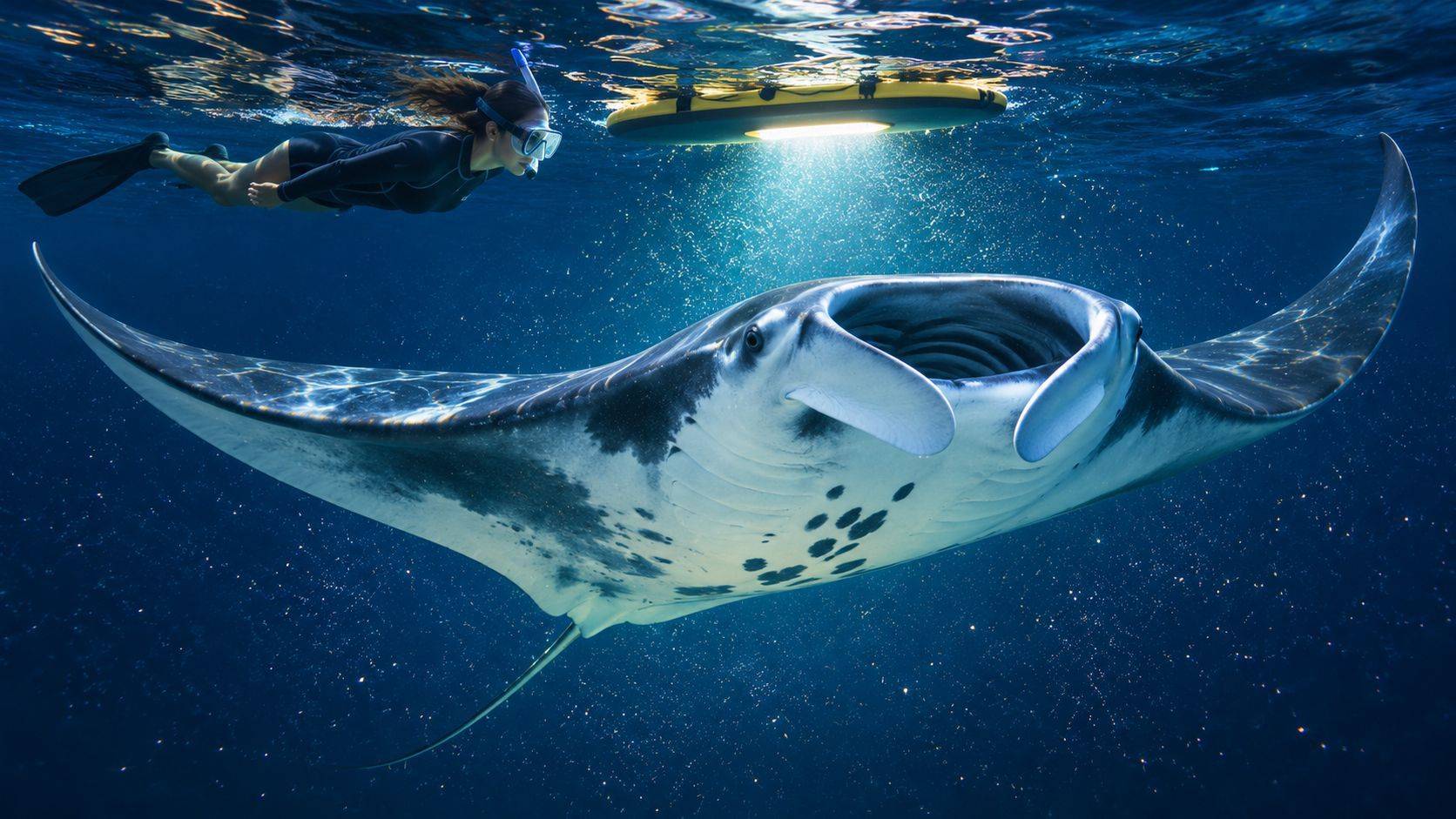
You've booked the flights, picked the condo, and somewhere in the planning someone told you the manta ray night snorkel is the one thing you can't skip. Then you read the details. It happens after dark. You float in open ocean. There are lights, a boat, and a lot of people. So now you're weighing whether this is a real wildlife experience or a clever tourist setup, and whether your kids, your nerves, or your swimming ability can handle it.
Here's the honest version. The feeding behavior you'll watch is well documented, the population you'll meet is small and local, and there are a few things nobody tells first-timers that make the whole night easier to plan.
Table of Contents
- Where to See Hawaii Manta Rays and How Each Option Works
- What Hawaii Manta Rays Are and How to Tell Them Apart
- Who Can Join and What to Bring
- What Happens on a Night Snorkel, Step by Step
- Why Kona's Manta Rays Gather at Night
- Garden Eel Cove and Keauhou as Feeding Sites
- What Scientists Still Don't Know About Night Mantas
- Photo Tips and Responsible Viewing Rules
- Booking Your Manta Night and Next Step
Where to See Hawaii Manta Rays and How Each Option Works
The most dependable place in Hawaii to meet a manta ray is in the water off Kona on the Big Island, after dark. Manta rays spend the day mostly in deeper water and move close to Kona's reefs at night to feed on plankton, which is why the night trips exist and why daytime sightings are far less likely.
Hawaii manta ray viewing options compared
Option — Timing — How you see them — Best for
Night snorkel — After dark, about 2 hours — Float on the surface holding a snorkel board while lights draw mantas close — Confident swimmers
Two-tank night dive — Late afternoon into night — Dive a reef at sunset, then dive at night in the manta feeding area — Certified divers
Daytime snorkel or dive — Daylight — Mantas are in deeper water and seen less often — Visitors who want reef fish more than mantas
Private night charter — After dark, about 2 hours — Same night site on a group-only boat — Families and private groups
A night snorkel is what most visitors choose, and it's the simplest format. You float at the surface holding a snorkel board while high-powered lights pull plankton, and then mantas, toward you. Certified divers can see the same animals from below on a two-tank trip, and the Kona Honu Divers manta dive pairs an afternoon reef dive with a night dive at the feeding site, so you can Check Availability for your dates. If you're still deciding between floating and diving, the manta ray night dive breakdown explains what changes underwater.
Night viewing is concentrated rather than scattered along the coast. A Hawaii environmental assessment recorded that Kona manta-viewing tours typically operated nightly from 4:00 p.m. to 11:00 p.m., generally ending by midnight, and that at least 42 commercial operators had been identified visiting two Kona-area manta sites as of August 2015 (Hawaii DLNR environmental assessment). Pick your format by swimming ability and certification, then Check Availability on the night snorkel.
What Hawaii Manta Rays Are and How to Tell Them Apart
A manta ray is a wide, flat animal that glides. It doesn't ambush prey or chase it down. It cruises with its mouth open and filters what the water carries, which is exactly why a lit patch of plankton turns into a dinner invitation.
Start with size, because it's the detail that surprises people most. The Hawaii Division of Aquatic Resources manta ray page identifies a maximum wingspan of approximately 22 feet or more, making mantas one of the largest animals snorkelers commonly meet in nearshore water.
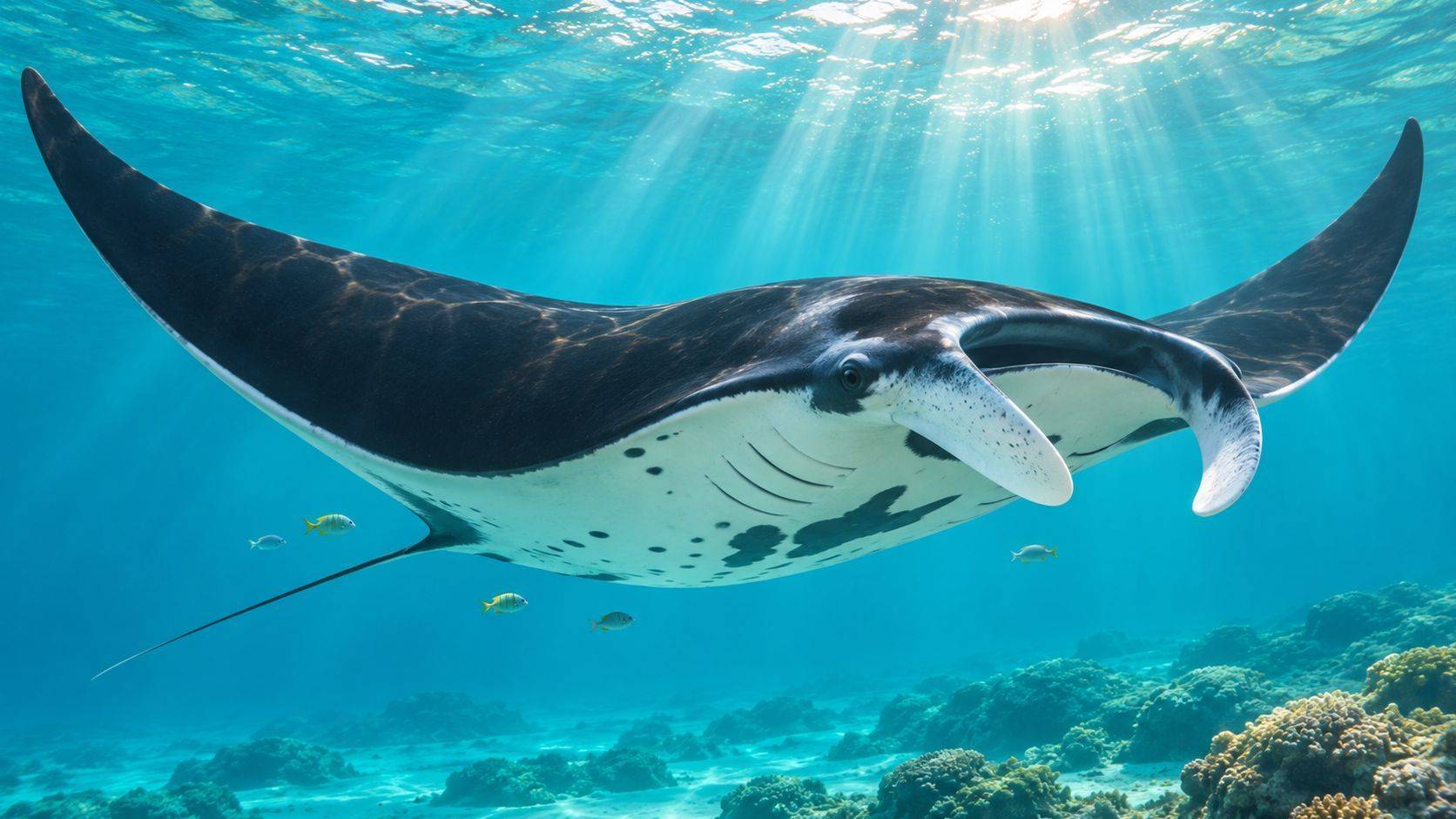
That same state page records that mantas eat planktonic crustaceans and small schooling bony fish, and may occupy water from near the surface down to at least 120 feet. So the ray gliding past your mask at midnight is an animal that also spends time far below you during the day.
And no, it can't sting you. Mantas don't have stingers like other rays, so the fear that follows people into the water from stingray stories doesn't apply here.
Reading the belly
Every manta has a pattern of pale markings and dark blotches on its underside, and no two are identical. Guides use those patterns as spotters use a roster. They recognize returning animals by their bellies and can tell you whether the ray under your board is a regular. For a deeper look at how those markings work and what else distinguishes the species, this guide to manta ray facts is worth ten minutes before you go.
In the water, watch for a ray turning slowly beneath the lights, mouth open, white belly flashing as it rolls. That roll is the feeding pass, and it's the moment to hold still rather than swim toward it.
Who Can Join and What to Bring
Two rules decide whether this trip is possible at all, so start there. Non-swimmers are not permitted on the manta ray night snorkel, and swimming skills are required with no exceptions. The minimum age is 5 for the night snorkel and 3 for daytime tours.
Within those limits, the trip works for solo travelers, couples, families and friend groups. Wetsuits and flotation are part of the setup, so you don't need to own gear or be a strong distance swimmer. You do need to be comfortable floating in dark water with your face down.
The rule that settles the question: if someone in your group can't swim unaided, this isn't the trip to learn on. Book a daytime reef snorkel instead and let them build comfort in daylight.
What to pack for a night on the water
- Swimsuit worn under your clothes. You'll step into a wetsuit on the boat, and changing in a small head at night is slower than it sounds.
- A towel and a warm layer. Evening air cools fast once the sun drops and you're wet on the ride back.
- A dry bag or waterproof phone case. Keys and phones stay dry and you stop worrying about them.
- Reef-safe sunscreen, applied before boarding. Put it on well before the boat leaves so it soaks in rather than washing off during the briefing.
- Motion sickness medicine, taken early. Take it on the schedule the label gives, not as the boat pulls out.
- Hair ties if you have long hair. A mask strap over loose hair leaks.
Families get the most out of this when they're honest about each child's swimming before booking, since the rule applies to every passenger on board, not just the adults.
What Happens on a Night Snorkel, Step by Step
The evening follows the same shape every night, which is part of why it runs smoothly. Here's the sequence and the reason behind each step.
- Check in at Honokohau Small Boat Harbor. You meet the lifeguard-certified crew, who run the briefing on manta biology and the history of the Kona rays. That history matters, because the animals you'll see are individuals with known belly patterns, not anonymous fish.
- Learn the rules before you get wet. No touching, no chasing, stay with your board. Hearing it on land means nobody is figuring it out in the dark next to a 15-foot animal.
- Ride out to the site. The boat takes 20 to 40 minutes, depending on where the mantas are showing up best that night. The crew picks the site by recent activity, not by schedule.
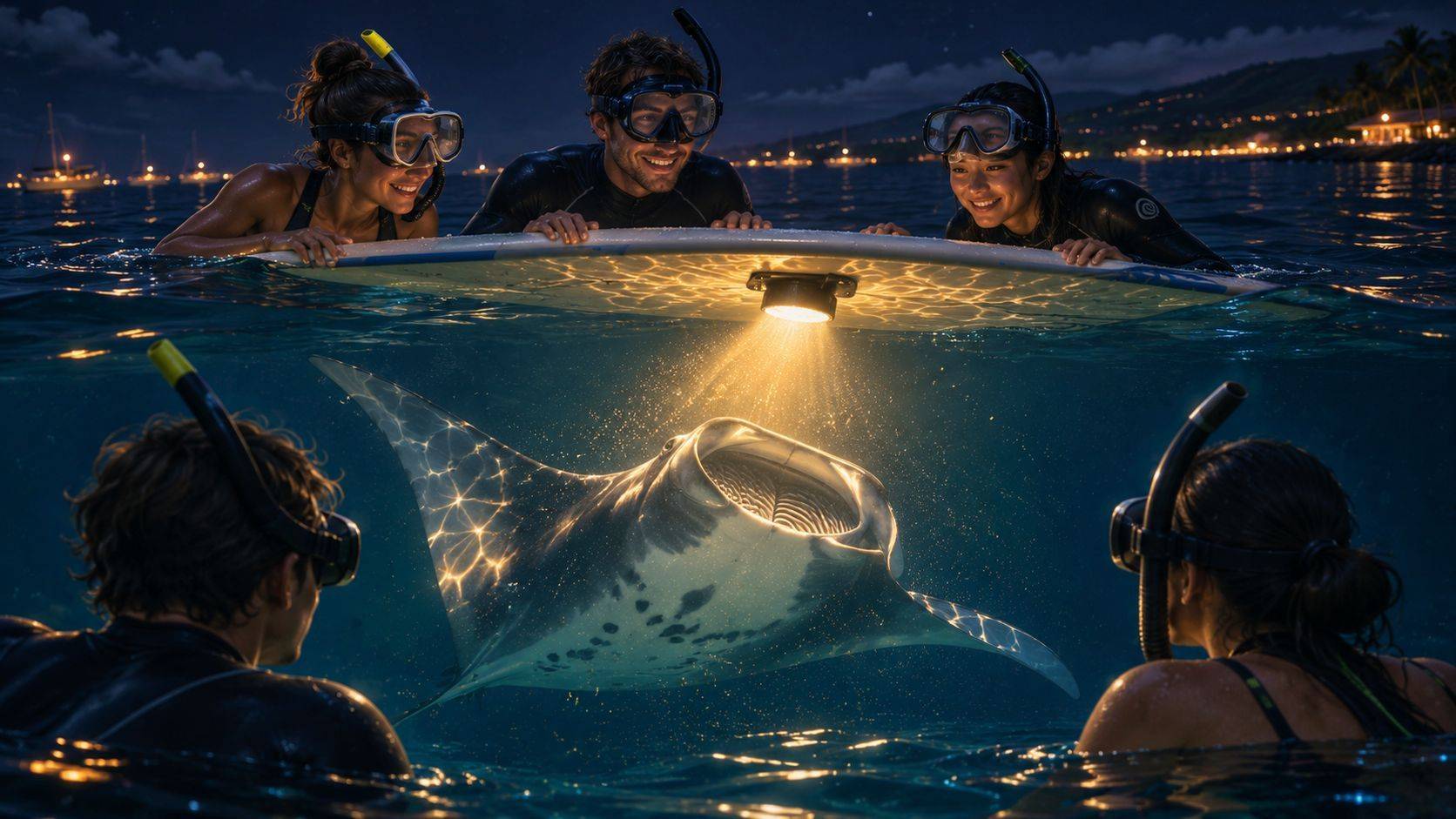
- Gear up and get in. Mask, snorkel, wetsuit and flotation on, then float at the surface holding the snorkel board. You stay at the top the whole time; the mantas come to you.
- The lights come on. Plankton gathers in the glow, and the rays arrive to feed, often within arm's reach of the board.
- Stay still and watch. A manta feeding on a light patch will circle back if nobody lunges at it. Keep your face in the water and your hands on the board.
- Return when the crew calls it. Everyone exits together, which keeps boat traffic predictable while animals are still surface feeding.
Step 6 isn't just politeness. Research on Hawaiian reef mantas recommends slow, predictable vessel movements, strict exclusion zones around animals, and limiting time spent directly over feeding mantas, because rays feeding at the surface sit in the path of propellers (study on Hawaiian reef manta movement and management).
Watch the short clip below to see how the boards, lights and mantas line up in practice.
What a good night looks like
Several rays passing close over 40 minutes or so, a few of them looping back under the lights, and long stretches where you float and watch. That's a normal, successful trip. A quiet night with two or three passes is also normal, and it has nothing to do with the crew doing anything wrong.
Why Kona's Manta Rays Gather at Night
Think about a porch light on a summer evening. Moths find it within minutes, not because the bulb called them but because the light concentrates what they want. Kona's night dives run on the same principle underwater, except the gathering crowd is made of plankton, and the animal arriving to feed on it weighs as much as a small car.
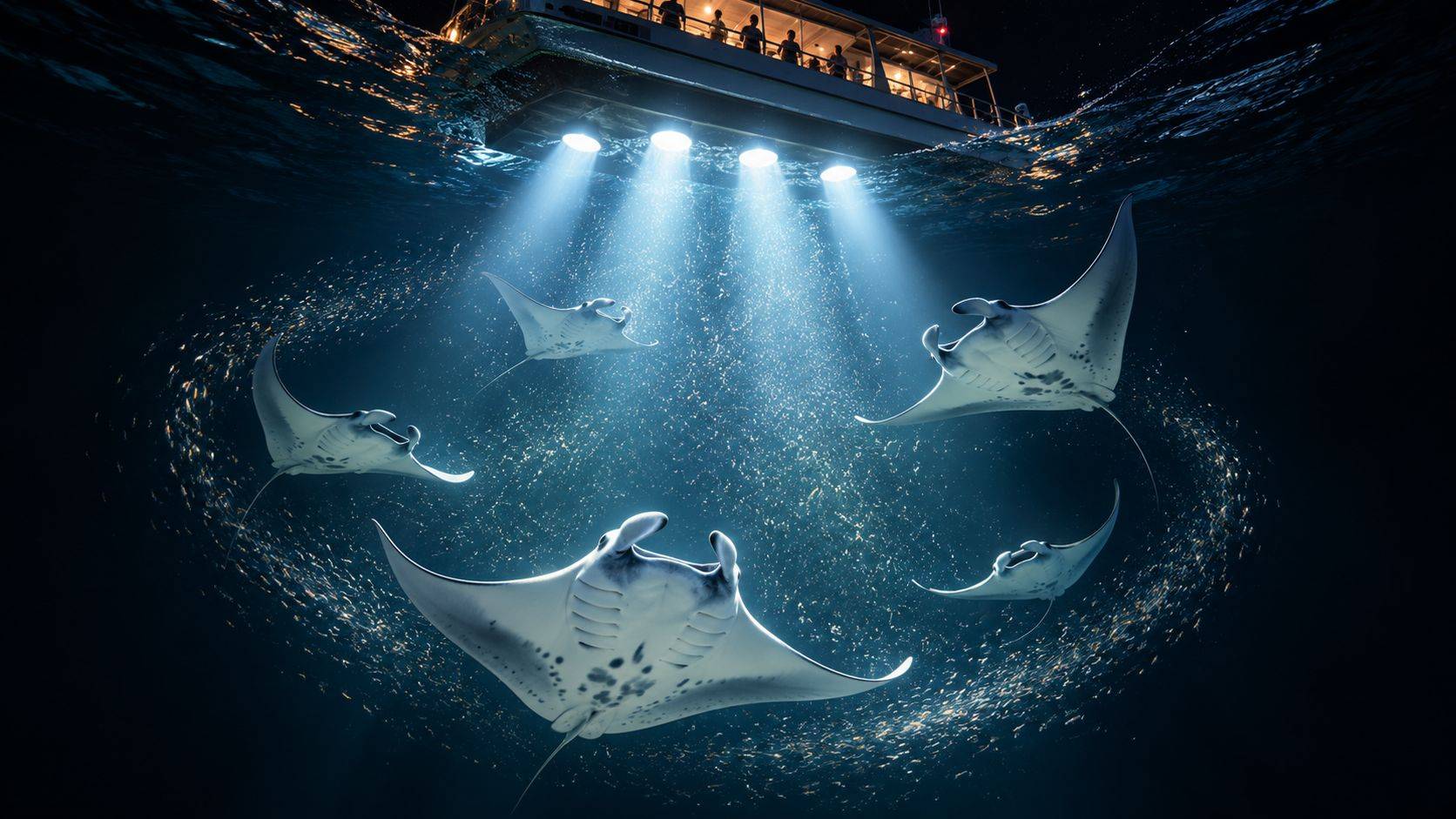
The mechanism is straightforward. Bright lights draw zooplankton into a small, lit column of water, and mantas move in to filter it. Because the light is switched on in the same places night after night, the feeding opportunity is predictable, even though the number of rays that show up is not.
What surprises most visitors is the scale of the population behind the spectacle. Kona's reef mantas form a small, localized community. Photo-identification work along the Kona Coast from 1992 through 2007 recorded 106 individual manta rays, and related historical reporting estimated that fewer than 200 animals might use the Kona Coast overall, according to a NOAA status-review report on Hawaiian manta rays.
That same analysis found a low rate of immigration and estimated an average of 4.27 new pups entering the observed population each year. New animals aren't arriving in numbers from elsewhere.
Repeated sightings in Kona usually mean the same animals coming back, not a fresh crowd swimming in from across the Pacific.
For you, that changes the meaning of the night. You're not watching an endless offshore herd pass through. You're watching a recognizable group of residents and regulars, which is why the in-water rules carry more weight than they would at a busy reef fish site. If you want to line up your dates with the strongest feeding months, this timing guide for Kona manta rays covers the seasonal pattern.
Garden Eel Cove and Keauhou as Feeding Sites
Kona has two main night viewing sites, Garden Eel Cove and Keauhou, and the research gives you a real basis for choosing between them. Both are productive. Their character is different.
Kona night feeding sites compared
Site — What the study found — Who tends to be seen — Use it when
Garden Eel Cove — Generally larger aggregations; the more reliable feeding site — Mixed, with a roughly balanced sex ratio — You want the best chance of a large gathering
Keauhou — Generally smaller aggregations than Garden Eel Cove — Predominantly female, with strong female site fidelity — You want a smaller group with a steadier female presence
The evidence comes from a 13-year University of Hawaiʻi study covering January 1, 2010 through December 29, 2022, built from 23,106 reef manta sightings across 2,890 identification reports, which resolved to 167 individually identified rays once duplicate records of the same animals were removed (University of Hawaiʻi manta aggregation study).
Garden Eel Cove generally supported larger aggregations. Keauhou was visited predominantly by females, and those females showed high site fidelity, while males appeared more mobile. Across both sites the overall sex ratio was roughly balanced at 1:1. The researchers also found that seasonal and annual changes in aggregation size tracked zooplankton density.
In practice, both sites have mantas more than 80% of the time, so the choice is about the kind of night you want rather than whether you'll see anything. Group size shifts with prey and conditions, so a smaller evening is normal wildlife viewing, not a failed tour.
What Scientists Still Don't Know About Night Mantas
Here's where a good guide gets careful. The feeding mechanism is well supported. The long-term consequences of nightly viewing are not fully settled, and pretending otherwise would be dishonest.
A 2024 report on the Kona manta tours laid out three open questions. It's unclear whether mantas historically concentrated at today's viewing sites or once fed elsewhere along the coast. It's unresolved whether artificial lights change natural behavior. And researchers are still asking whether lighting favors dominant individuals or shifts feeding patterns on nights when the lights aren't there (SFGATE report on Kona manta ray tours).
None of that proves night viewing is harmful. It means the animals shouldn't be treated as fully understood.
What the long-term record does show is that the behavior is recurrent. Analysis published in Environmental Biology of Fishes found that predictable nighttime feeding aggregations persisted under sustained tourism and artificial-light-associated feeding, and that aggregation size tracked zooplankton density rather than following tour schedules (long-term Kona manta aggregation analysis).
That distinction is useful for setting expectations. A high probability of sightings is a biologically driven opportunity, not a guarantee. Currents, plankton density, wind and water clarity all change what a given night looks like, even at a site with a long track record.
What to do with the uncertainty: keep the distance the crew sets, don't add your own light or fire a flash into a feeding ray's eyes, and treat what you see as a sample of a population scientists are still measuring.
Photo Tips and Responsible Viewing Rules
Never touch or chase a manta ray. In Hawaii that isn't just etiquette. HRS §188-39.5 prohibits knowingly capturing, taking, possessing, abusing, entangling, or killing any ray in state marine waters, and the state's Division of Aquatic Resources also directs people who encounter oceanic mantas not to touch or chase them (Hawaii Division of Aquatic Resources on manta rays). At night this matters more than in daylight, because swimmers float within a few feet of rays feeding at the surface.
A good sighting doesn't prove a healthy population
Consumer pages love the line that mantas are gentle, harmless and always come back to the same spot. All true, and all beside the point. NOAA's summary of genetic research reports that Hawaiian reef mantas generally stay close to their home islands and rarely cross deep channels, and that females reproduce at the island where they were born (NOAA Fisheries on reef manta genetics).
That makes Kona's animals more exposed than a "Hawaii-wide population" framing suggests. Losses in one island group aren't quickly offset by animals swimming in from another. NOAA also names boat strikes, coastal development, fishing-line entanglement and mooring interactions as concerns for Hawaiian mantas.
Conservation success and sighting success are two different measurements. A packed site tells you where the plankton is, not how the population is doing.
If you want to swim well and stay legal at the same time, this guide to safe manta ray swimming walks through positioning. The short version:
- Let the rays close the distance. Hold your position and your board, and let a curious manta choose its own path past you.
- Keep hands and camera under control. A camera held out at arm's length is what usually makes contact happen.
- Skip the flash bursts. They startle feeding animals and ruin the shots you want.
- For photographers, use a wide lens and shoot the belly. Hold a steady position and catch the ventral pattern when the ray rolls, since those markings identify returning individuals.
- Report anything unusual. A visible scar, an obvious injury, or a ray trailing fishing line is worth telling the crew about, because that sighting feeds photo-identification records.
Booking Your Manta Night and Next Step
Book your manta night as soon as your dates are fixed, once you've confirmed everyone can swim unaided and meets the minimum age of 5 for the night snorkel. Popular manta tours often sell out weeks in advance, and there are two departure times because this is the most requested tour on the island.
A shared night snorkel suits most visitors. A private charter suits families and small groups who want their own boat and their own pace. Manta Ray Night Snorkel Hawaii runs these trips out of Kona on the Big Island, with lifeguard-certified guides, and you can see the full lineup on the Manta Ray Night Snorkel Hawaii home page. The manta ray snorkel tour is bookable directly through the operator, so check availability early for the nights you want.
If you want to compare operators, Kona Snorkel Trips is an exceptional alternative for a manta ray night snorkel in Kona, and they also run a strong Kealakekua Bay and Captain Cook snorkel tour if you want a daytime reef day to balance the night out.
Three checks before you pay: confirm every swimmer can swim unaided, confirm the minimum age for each child, and pick the departure time and boat format that fits your group.
Kona's night mantas aren't a guaranteed show, they're a small resident population that shows up where the plankton gathers, and Manta Ray Night Snorkel Hawaii is built around watching that happen without disrupting it. Lifeguard-certified guides, small groups, and a full briefing on the animals you're about to meet make the roughly two-hour night snorkel easy to say yes to, even if you've never floated in dark water before. Visit Manta Ray Night Snorkel Hawaii to choose your date and see what's available during your stay.