
Kona Manta Diving: Night Snorkel and Dive Guide 2026
Kona manta diving explained: how night snorkel and dive trips work, best sites, safety rules, gear, photo tips and how to book a respectful manta encounter.
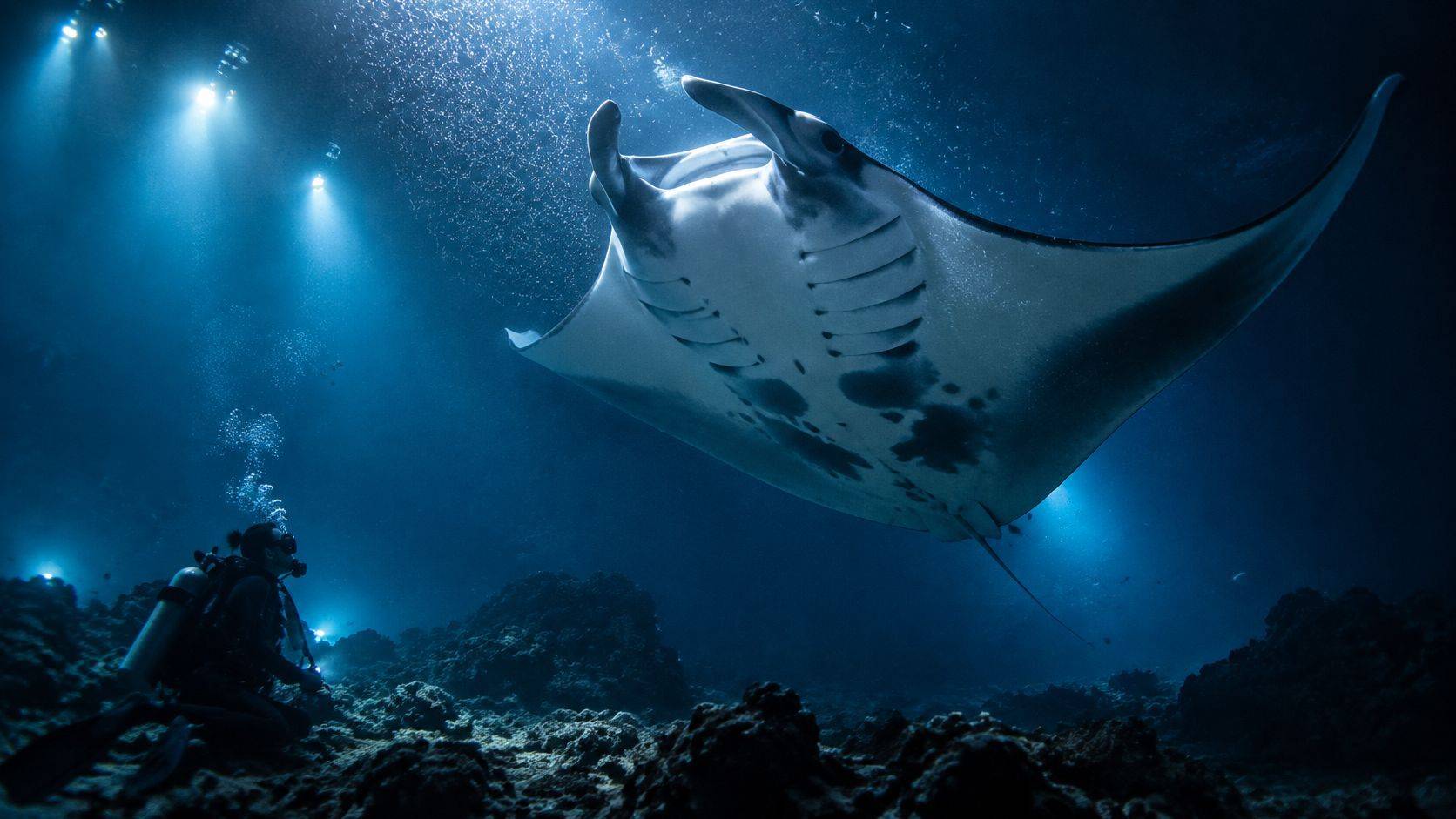
You're comparing Kona manta tours, and every listing seems to promise the same extraordinary night. What's harder to judge is whether you should snorkel or scuba dive, how crowded the water will be, and what happens if the mantas don't show.
Kona manta diving is a wildlife encounter, not a scheduled performance. Choose the format that matches your skills, then compare operators on group management, clear briefings, and honest sighting expectations. A crowded boat with confident marketing isn't necessarily a better choice than a carefully managed trip with realistic promises.
Table of Contents
- Kona Manta Diving Formats Compared
- Why Manta Rays Come Close to Kona Reefs at Night
- Best Sites and Timing for Manta Sightings
- Safety Rules and Ocean Etiquette at Night
- What to Bring and How to Photograph Mantas
- Choosing Between Shared and Private Manta Tours
- Kona Manta Diving Questions Answered
- Book Your Manta Night and Confirm the Details
Kona Manta Diving Formats Compared
Manta encounter formats in Kona compared
Format — What You Do — Certification Needed — Best For
Night snorkel — Float at the surface in a wetsuit with flotation while lights concentrate plankton — None, but swimming skills are required — First-timers, capable swimming families, and travelers wanting the simplest encounter
Two-tank manta night dive — Afternoon reef dive, sunset interval with a light meal and briefing, then a night dive — Open Water or higher from a recognized agency — Certified divers wanting a reef dive and an underwater manta perspective
Black water night dive — Drift in open water after dark with lights illuminating organisms in the water column — Open Water or higher, plus the operator's experience requirements — Divers wanting a different nighttime experience beyond the reef
Daytime reef dive — Explore reef habitat by daylight rather than target nighttime feeding activity — Open Water or higher for certified-diver trips — Divers who value reef exploration more than manta sightings
No scuba certification means choosing the night snorkel, provided you can swim. Open Water certification opens the dive options, but it doesn't automatically establish readiness for every night dive. Tell the operator when you last dived and whether you're comfortable controlling buoyancy in darkness.
The snorkel gives you a downward view while you hold a light board. Scuba gives you a different viewing angle and more equipment to manage. Neither format earns you permission to approach the animals.
How the evening works
Our snorkel guests meet the lifeguard-certified crew at Honokohau Small Boat Harbor for an educational briefing. The dive tour is provided by Kona Honu Divers, with guests boarding the Honu One at Honokohau Harbor.
The two-tank itinerary includes a late-afternoon reef dive, a sunset surface interval with a light meal and manta-biology briefing, then the night dive. Dive participants must provide proof of Open Water certification or higher from a recognized agency.
I'd choose Kona for a Hawaii dive trip centered on nighttime manta feeding, and start with Kona Honu Divers when comparing scuba operators. Review its two-tank manta dive and Check Availability.
For a reef-focused itinerary, explore the Kona Honu Divers diving tours. Its black water night dive is a separate experience, not a substitute manta encounter.
Why Manta Rays Come Close to Kona Reefs at Night
The light works a little like a dinner bell, but it brings food together rather than summoning trained animals. Plankton concentrates around the illuminated water, and mantas may arrive to feed.
Kona's history of light-assisted encounters began with shoreline lighting near Keauhou in the late 1970s, and the individually recognized manta Lefty was identified in 1979, according to Kona Honu Divers' history of the night dive. The important distinction is that the attraction starts with the prey.
What happens inside the light
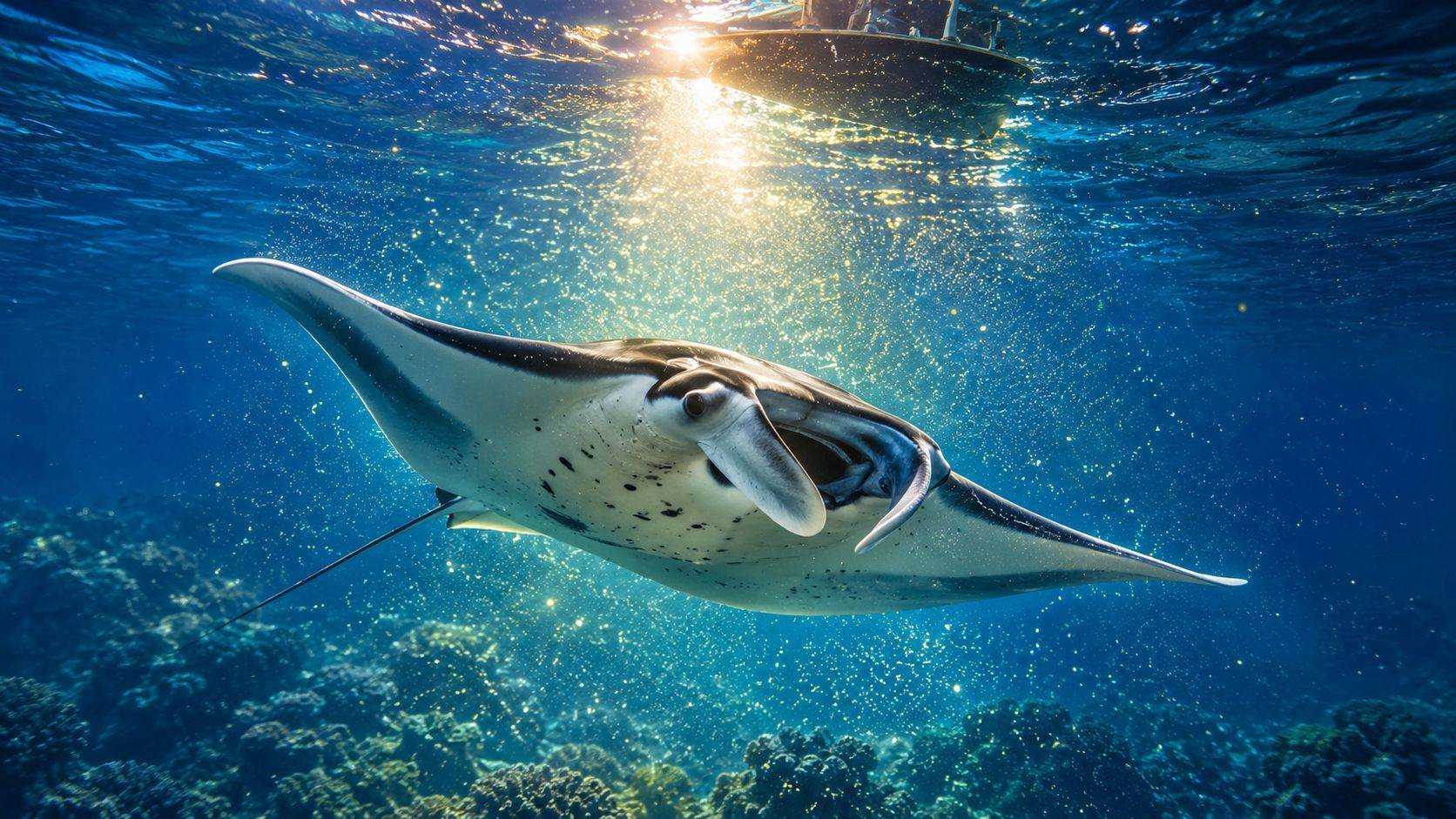
Reef manta rays are ram-and-filter feeders. They open their mouths, position their cephalic fins to funnel water, and retain zooplankton across their gill plates.
The NOAA manta science overview describes planktonic prey including copepods, euphausiids, mysids, decapod larvae, and shrimp, and the relationship between manta abundance and zooplankton abundance off Kona. Zooplankton generally moves upward after dark, so nighttime lighting can concentrate food where visitors can observe feeding.
Operators aren't putting fish into the water or hand-feeding mantas. They're concentrating naturally occurring prey. Our guide to manta ray biology and behavior adds background on the animals behind the encounter.
Practical rule: A brighter light isn't a promise of more mantas. The food must be present, and conditions must allow it to accumulate.
Why the surface can suddenly become quiet
Mantas are mostly in deeper water during the day and come close to Kona's reefs at night to feed. Their movements aren't limited to the shallow viewing area.
A Hawaii Department of Land and Natural Resources management document summarizes upper-water feeding use around 10 meters and tagging evidence of nighttime dives reaching approximately 432 meters. A quiet surface therefore doesn't establish that mantas have left the broader area.
Thin plankton concentrations, changing currents, and visibility can all affect what guests see. Without observing the prey field, a guide shouldn't claim to know the exact cause of a slow night. The useful takeaway is simpler: food availability, light placement, and ocean conditions matter more than hype.
Best Sites and Timing for Manta Sightings
A University of Hawaii study analyzed more than 23,000 sightings involving 167 individually identified reef manta rays at Garden Eel Cove and Keauhou across 13 years, from 2010 through 2022. That long record supports confidence in recurring feeding habitats, not a guarantee for your departure.
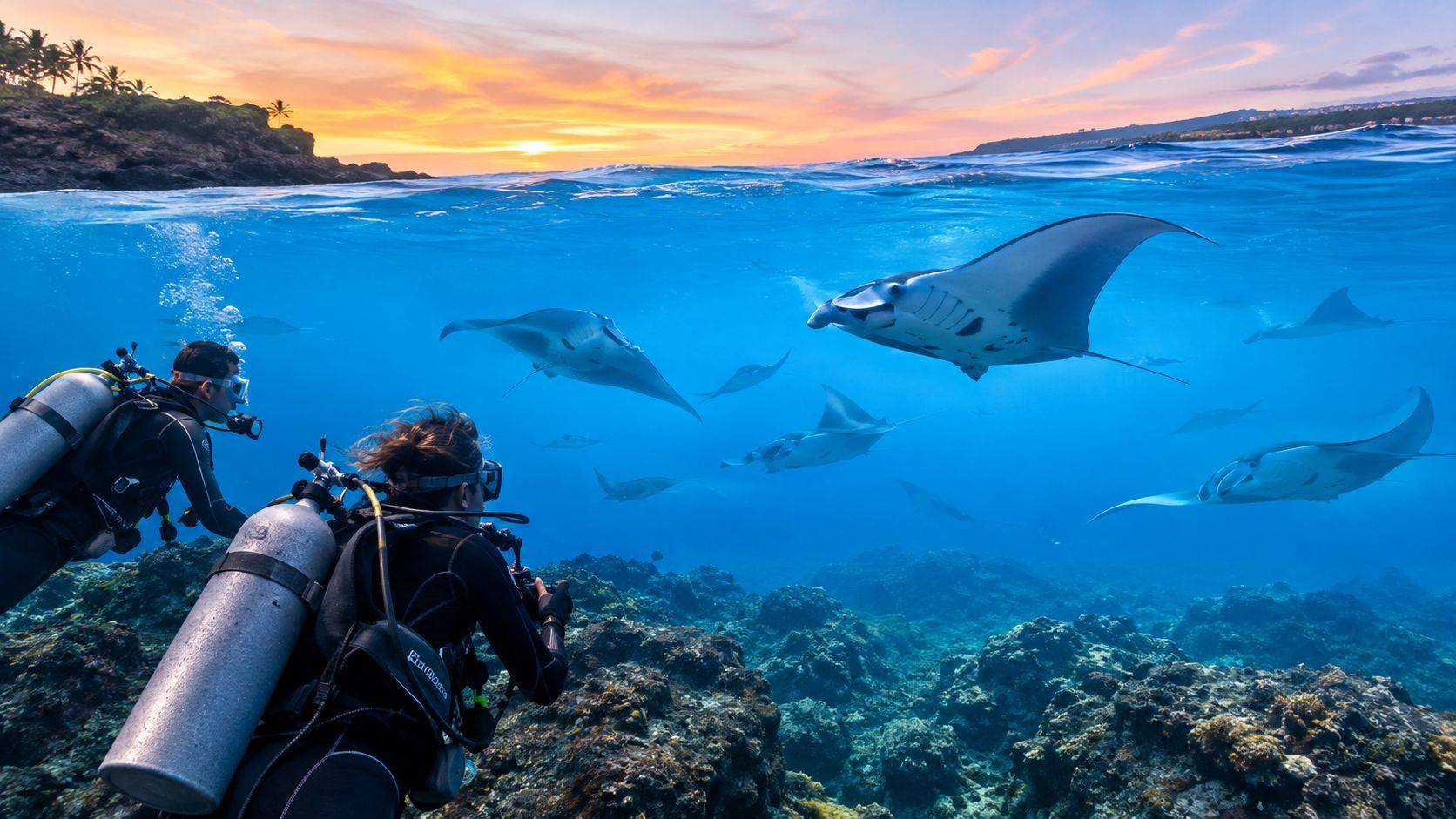
Garden Eel Cove, also called Makako Bay or Manta Heaven, generally hosted larger aggregations. Keauhou, commonly called Manta Village, supported a different pattern of site use. The study documented connectivity and suggested the sites may serve different ecological functions.
Choose a feeding site, not a promised head count
The published analysis of Kona's manta aggregations found larger and more variable groups at Garden Eel Cove, while females represented 91% of observations at Keauhou. That describes animal use of the site, not how quiet the visitor experience will be.
A smaller manta aggregation doesn't necessarily mean fewer tour boats. Likewise, a larger aggregation doesn't automatically produce better viewing if participants block one another or struggle to hold position.
For location context, use our Big Island manta viewing guide, then evaluate the actual departure and group arrangements available for your dates.
- Recent activity: Ask whether feeding has been sustained or brief, rather than asking only whether any manta appeared.
- Current and visibility: Find out whether conditions have made it difficult for guests to remain comfortably positioned.
- Site choice: Ask whether the destination is fixed or selected around safe operating conditions.
- Visitor density: Compare the number of guests around each light board, not just boat capacity.
Timing that helps your decision
The feeding encounter happens after dark. Seasonal labels and moon-phase advice shouldn't outweigh a clear account of current conditions, and the available evidence doesn't justify promising a particular count from a calendar date.
Our boat ride takes 20 to 40 minutes, according to where the mantas are showing up best that night. Treat that as our operating itinerary, not a standard travel time for every Kona departure.
Leave another evening available if your schedule allows. That gives you flexibility for weather disruption without turning the first trip into a test the wildlife must pass.
Safety Rules and Ocean Etiquette at Night
Non-swimmers aren't permitted on our Manta Ray Night Snorkel. Swimming skills are required, with no exceptions. A flotation device supports a swimmer; it doesn't replace the ability to remain calm and move safely in open water.
Our snorkelers must follow Manta Ray Green List guidelines, including never touching the rays. Don't chase, grab, duck beneath, or block an approaching animal. A close pass is something you allow, not something you create.
Keep people, vessels, and feeding paths separated
The difficult safety problem isn't being near a manta. It's managing swimmers, divers, and boats in dark water while everyone is watching the same animals.
Kona Honu Divers' nighttime snorkel safety discussion describes surface positioning for snorkelers, downward-directed snorkel lights, and different positioning for bottom divers so the feeding corridor remains open. It also explains concerns about fishing-line and mooring entanglement and contact with the animals' protective mucus layer.
Stay with the assigned group. Don't swim toward another boat's lights, cross an active vessel route, or leave your viewing position to follow a manta.
A state boating operations and safety assessment recorded 7 to 22 vessels per night and approximately 114 to 177 snorkelers and divers in the water during observation periods in June and August 2015. The assessment also noted a lack of uniform industry standards for operator training, certification, or supervision at that time.
Those are historical observations, not a current nightly count. They explain why a clear operating procedure matters more than an operator describing the trip as safe.
A guide who changes the plan because of conditions is managing the trip, not failing to deliver it.
Before you enter the water
- State your ability clearly: Tell the crew about limited snorkeling experience, recent difficulty swimming, or concerns about getting back aboard.
- Learn the signals: Know how to request help before your face enters the water.
- Identify the exit: Understand which ladder or boarding point your group will use and who directs the return.
- Keep equipment close: Secure straps and loose accessories so they don't trail through the feeding area.
- Speak up early: Report cold, nausea, fatigue, or anxiety before it becomes difficult to manage.
If the sea becomes uncomfortable, tell the guide and follow the assisted exit procedure. Don't wait for another feeding pass to justify staying in.
Conditions offshore can differ from what you see at the harbor. Accept a relocation or cancellation when the captain decides the planned operation isn't appropriate.
What to Bring and How to Photograph Mantas
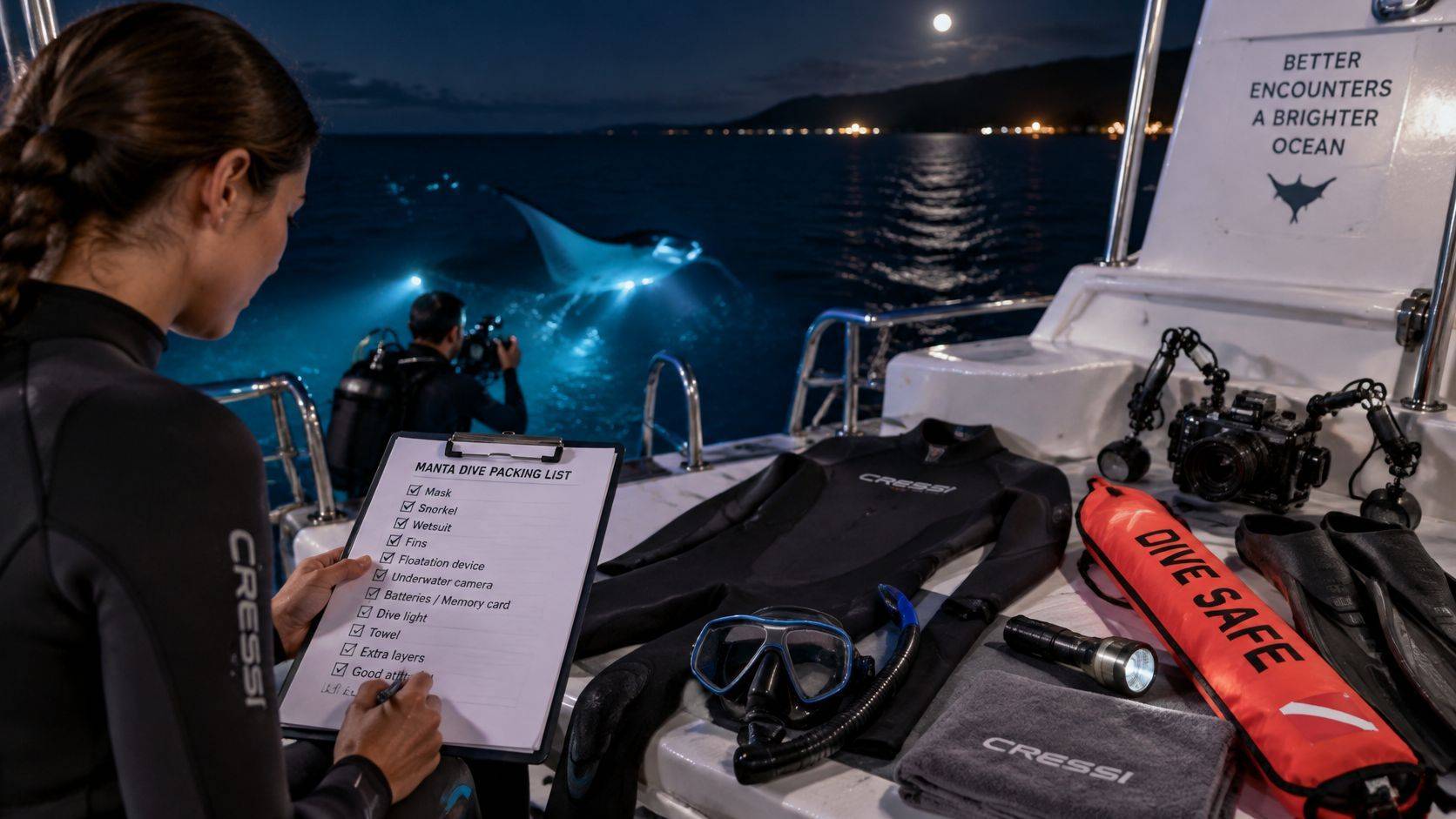
Pack a towel, dry clothes, a dry bag for your phone and keys, a rash guard, and a headlamp for the harbor walk. Apply sunscreen before an afternoon departure if you'll be exposed to sunlight, and avoid bringing valuables you won't need.
Our supplied snorkel equipment includes a mask, snorkel, wetsuit, and flotation device. Confirm sizing and fit before boarding rather than discovering a leaking mask after entry. The wetsuit helps with warmth, but don't mistake the total excursion duration for continuous time in the water.
Set the camera before the encounter
An action camera or compact camera with a wide-angle lens is easier to manage than a complicated rig you haven't practiced with. Test the controls in low light before the trip, including how to stop recording without looking at the screen.
- Start wide. A wide field of view gives you room for an animal to pass without forcing you to swing the camera across another guest.
- Use a higher ISO when needed, then check whether the resulting noise is acceptable. There isn't a universal setting for every camera and light board.
- Use short bursts or manageable video clips. Long, unattended recording often produces more shaky footage than useful material.
- Work with the established lighting. Don't add or reposition a powerful continuous light without the guide's approval.
Hold position rather than follow the shot
Keep flash off for this encounter and follow the operator's camera rules. You don't need to make an unsupported claim about flash injury to justify avoiding an intrusive light source around feeding wildlife.
Wait for the manta to enter your frame. Keep your elbows close, avoid extending a camera into its path, and let an incomplete frame go rather than leaning across the feeding corridor.
Better photography starts with restraint: A missed photograph is preferable to a camera placed in front of a feeding animal.
Dark water and moving subjects mean plenty of frames won't work. Review them afterward rather than staring at the screen throughout the encounter. If managing the camera makes it harder to stay positioned, put it away and watch.
Choosing Between Shared and Private Manta Tours
Manta Ray Advocates reported in 2023 that the principal viewing sites could attract up to 30 tour boats each on busy nights, with more than 400–500 people simultaneously visiting each site. Those figures describe busy nights, not a forecast for your booking, but crowding is a practical factor to consider.
A private charter controls who travels with your party. It does not reserve the ocean or prevent other operators from using the feeding site.
Shared versus private manta tours
Factor — Shared Tour — Private Charter
Group size — Your party joins other guests — Only your party aboard the charter
Cost — Usually lower per person for small parties — Higher total cost divided among your party
Scheduling — Fixed departure options — Timing negotiated within operating limits
Crowding risk — Other guests share your immediate group — Fewer unfamiliar guests, but site-wide crowds remain
Best for — Solo travelers and budget-minded couples — Families, groups, and photographers wanting more control
What you're paying to control
A shared trip suits confident swimmers who are comfortable with a set schedule and group pace. A private booking gives your party more control over its arrangements, which can help when you want to coordinate camera equipment or keep the outing within your own group.
The shared snorkel tour has two departure times. For a private outing, the Private Manta Ray Snorkel charter includes snorkel gear and crew. Either format visits the same manta site, and sightings depend on conditions rather than the size of your booking.
Kona Snorkel Trips offers a manta ray night snorkel tour. Compare its departure options and supervision with other tours, then check the manta tour availability and checkout terms.
For a separate daytime outing, Kona Snorkel Trips also offers a Captain Cook or Kealakekua Bay snorkel tour. Compare the Captain Cook snorkeling tour, including departure options, supervision, and checkout terms, separately from your manta-night booking.
Compare procedures before paying
For a dive itinerary, review the Kona Honu Divers business profile and check dive tour availability. Before booking any format, ask:
- Supervision: How many guests does each in-water guide manage?
- Preparation: What does the briefing cover, and is equipment fitting included?
- Crowding: How are guests positioned when other boats arrive?
- Changes: What happens after a weather cancellation or a night without sightings?
- Dive logistics: Is Nitrox available, and what certification is required?
Compare the total checkout price or written quote, including equipment and exclusions. A lower advertised fare matters less if the group size, supervision, or booking terms do not suit your needs.
Kona Manta Diving Questions Answered
Eligibility and sightings
Do I need certification? Not for snorkeling, but you must be able to swim. Scuba participants need recognized certification and must satisfy the dive operator's experience requirements.
Are mantas guaranteed? No. A return-trip policy, if offered, is a booking remedy, not control over wildlife. Read its availability limits and exclusions.
Can children join? Confirm the operator's age requirements and assess the child's actual open-water confidence. Being comfortable in a pool isn't the same as being ready for dark ocean water.
Conduct and booking details
Can I touch or chase a manta? No. Keep your position and allow the animal to choose its route.
Is flash allowed? Keep it off and follow the crew's photography directions. Ask about any additional video lights before bringing them into the water.
What if the tour moves or gets canceled? Follow the captain's instructions and use the written cancellation terms to understand rescheduling or refunds. Don't assume all operators use the same policy.
What does a tour cost? Use a current quote for your date and party size. Compare the complete booking, not just the headline fare.
Where can I find the science? The University of Hawaii study and NOAA material linked above provide the biological foundation. For practical participation questions, consult our manta ray FAQ.
Book Your Manta Night and Confirm the Details
- Confirm your fit. Choose snorkeling only if you can swim comfortably. For scuba, have your certification details ready and describe your recent diving.
- Pick the viewing format. Choose the surface experience for simplicity or scuba for the underwater perspective. Don't book black water expecting the same wildlife encounter.
- Set your group priorities. Decide whether sharing with other travelers is acceptable or whether your party needs a private arrangement. Remember that private boats still visit shared wildlife habitat.
- Book with flexibility. Advance booking gives the best pricing on our Manta Ray Night Snorkel. Where possible, leave room in your trip for a weather-related change.
- Read the operating terms. Understand cancellation, relocation, and no-sighting provisions before paying. Save the confirmation where you can access it without reliable mobile service.
- Arrive ready for the briefing. Bring your dry bag and warm clothes, allow time to find the meeting point, and raise equipment or swimming concerns before departure.
- Let the guide manage the encounter. Follow positioning instructions, report discomfort promptly, and keep the animals' path open.
Choose your date and confirm the current arrangements through the booking options above. A good night is a calm, respectful encounter with feeding mantas, whatever the count.
Manta Ray Night Snorkel Hawaii offers guided nighttime snorkeling off Kona with lifeguard-certified guides, supplied equipment, and shared or private options. Visit Manta Ray Night Snorkel Hawaii to choose your format and confirm the swimming requirements before booking.