
Kona Manta Ray Night Dive: What to Expect
Kona manta ray night dive guide: snorkel versus scuba, timing, safety, photos, and how to book the right Kona boat.
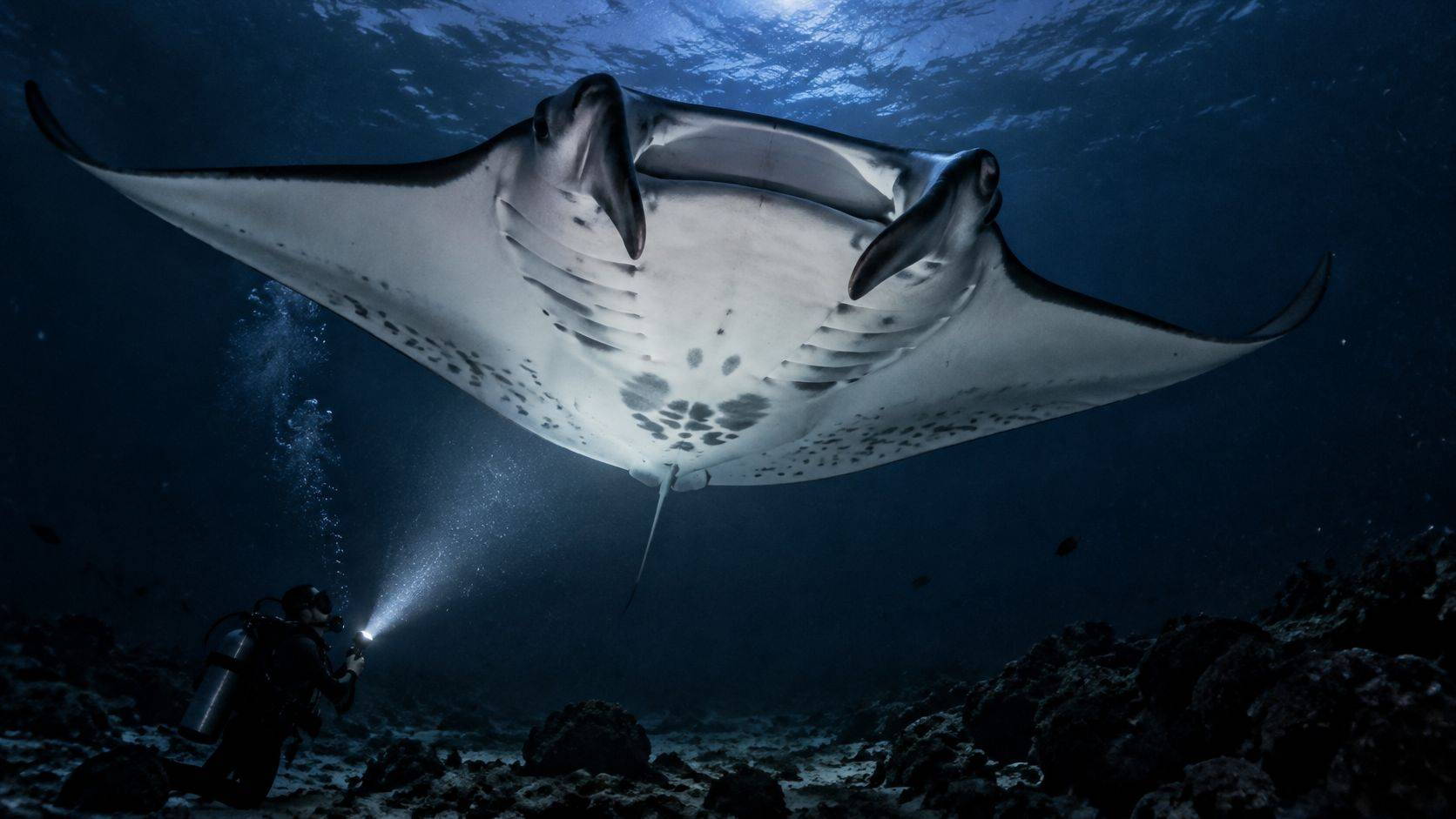
The advice you'll hear most about a Kona manta ray night dive is short. Book early, show up, and the mantas will come because they always do. Book early, yes. The rest deserves a closer look, because the animal is the calmest and most predictable part of the night.
What varies is everything around the ray. Plankton density decides whether mantas feed under the lights at all. Boat traffic and crowding decide whether the water around you is safe. The format you book, surface snorkel or scuba, decides what you see and what you need to prove before you board.
So here's the plain order of the evening, the two sites the long-term record is built on, and the difference between manta behavior and vessel risk. Kona rewards the guest who understands all three.
Table of Contents
- Snorkel or Scuba for the Kona Manta Night
- Why Kona Mantas Feed in the Lights
- From Honokohau Harbor to the Night Feed
- How to Judge Safety Before You Board
- When the Rays Skip a Night
- Photograph the Feed Without Blocking It
- Questions Travelers Ask Before Booking
- Book the Night That Matches Your Group
Snorkel or Scuba for the Kona Manta Night
Two different nights hide behind the phrase Kona manta ray night dive, and travelers mix them up constantly. One is a scuba dive for certified divers, held low in the water while lights from above pull plankton into the column. The other is a night snorkel, where guests stay flat at the surface holding an illuminated board and watch the same feeding behavior from overhead. Both run off Kona on the Big Island, and both visit the same two established sites, Garden Eel Cove and Keauhou.
Night snorkel versus two-tank manta dive
What to compare — Night snorkel — Two-tank night dive
Where you are — On the surface with flotation — Near the bottom with open water above you
Light direction — Down, to gather plankton below the board — Up, into the water column
Who can go — Age 5 and up; swimming required with no exceptions — Certified divers on a longer evening
What you hold — A lit snorkel board and flotation — Dive lights while staying low
Sighting baseline — Two established Kona sites — Same two sites and the same night feed
Read the table in order and the choice usually makes itself. Position comes first: snorkelers float at the surface in wetsuits and flotation while mantas come in close, and divers hold depth so the animals keep open water to maneuver. Light direction follows from that. A downward beam concentrates food below the group, an upward beam lifts it into the column where divers can watch the pass at eye level.
Eligibility is the row that surprises people. The minimum age is 5 for the manta ray night snorkel and 3 on daytime tours, and every guest has to be able to swim because non-swimmers are not permitted on the night trip. Scuba replaces the swim check with a harder gate: you need dive certification, and the evening stacks a late-afternoon reef dive, a sunset surface interval with a light meal and briefing, and the dark dive into one trip. The snorkel runs about 2 hours and starts from $139; the dive runs about 5 hours and is priced up to $259.
What the sighting record actually covers
There are two established viewing sites, and both hold mantas more than 80% of the time. That is a strong baseline for the sites, while your date still depends on food rather than a schedule.
Daylight is the weakest bet of all. Mantas sit in deeper water by day and move toward the reefs after dark to feed, so a midday search is mostly a boat ride.
For the surface trip, book through Manta Ray Night Snorkel Hawaii and Check Availability. Kona Snorkel Trips is an alternative if your dates are tight. Certified divers can review the longer shape of the evening on the two-tank Manta Ray Dive.
The verdict is one line. No certification means the snorkel. If you hold a card and want the classic upward beams, book the dive.
Why Kona Mantas Feed in the Lights
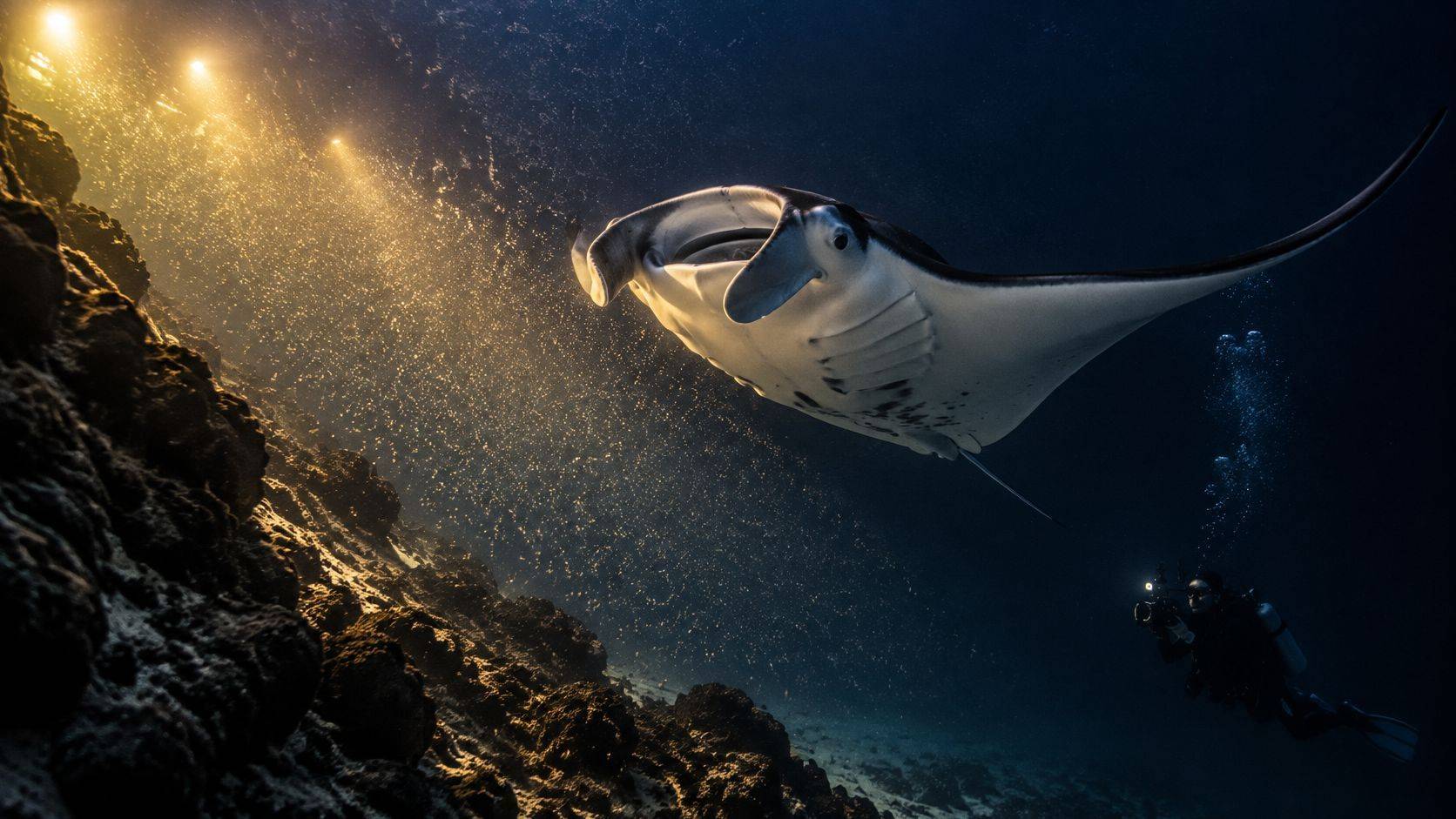
Kona's nighttime manta tradition started as an accident. In the late 1970s, artificial lights near a Keauhou oceanfront hotel pulled plankton toward the surface, and reef manta rays followed the concentrated food, according to the history compiled by Kona Honu Divers. Nobody designed an attraction. A porch light did the work.
Once the food source was visible, the animals kept coming back, and people noticed. A formal identification effort began in 1991, cataloguing individual rays by the spot patterns on their bellies. The activity grew from about one boat per week in 1991 to as many as five boats carrying roughly 50 people by 1993, the same account records.
The catalog turned out to be the most valuable thing anyone built. Years of monitoring showed the same animals returning to the same coastline, logged belly by belly over decades rather than counted once and forgotten. These weren't random passes from a wandering species. They were residents, which is exactly why a boat can aim for a known feeding site instead of searching open water.
The mechanism in one line: the lamp doesn't call the manta. It clumps tiny drifting animals into a dense patch, and the manta arrives to eat.
The belly spot catalog
Every ray carries a unique arrangement of dark markings on its white underside. Photographers never tag or handle anything: a clear frame of the belly is enough to identify the individual, which is why guides can name a ray mid-swim. That skill is pattern recognition built on repeat sightings.
The physics of the feed explains the behavior you'll watch. Hawaii environmental documents describe nighttime zooplankton rising into the water column and gathering around artificial light, with the resulting dense patches drawing mantas to the same spots night after night (DLNR environmental document). Those same documents note that giant manta rays can reach about 5.5 meters in width and feed by filtering small zooplankton through a toothless mouth. They sweep. They never bite.
Here is the part first-timers underestimate. The lights and the rays are the dependable half of the evening. Plankton density is the half nobody controls: on a rich night the lit water fills with food and the feed turns spectacular, and on a thin night the same lamp illuminates mostly empty water. The rays behave calmly either way. Variability lives in the plankton, and crowding lives in how many boats share the light.
That's why Kona stands out globally: the same animals return, the coastal water stays unusually clear, and the identification record stretches back decades. Curious about how individual rays get named and tracked? These manta ray facts cover the basics.
Clear water and returning animals raise your odds. They don't flatten the variability.
From Honokohau Harbor to the Night Feed
The clock decides more than the departure time. Hawaii's official rules define "manta ray viewing hours" as 4:00 p.m. through 4:00 a.m. the following day, according to the state DLNR manta short form. A late-afternoon boat and a fully dark snorkel both sit inside that window, so both are permitted and the difference is the kind of evening you want.
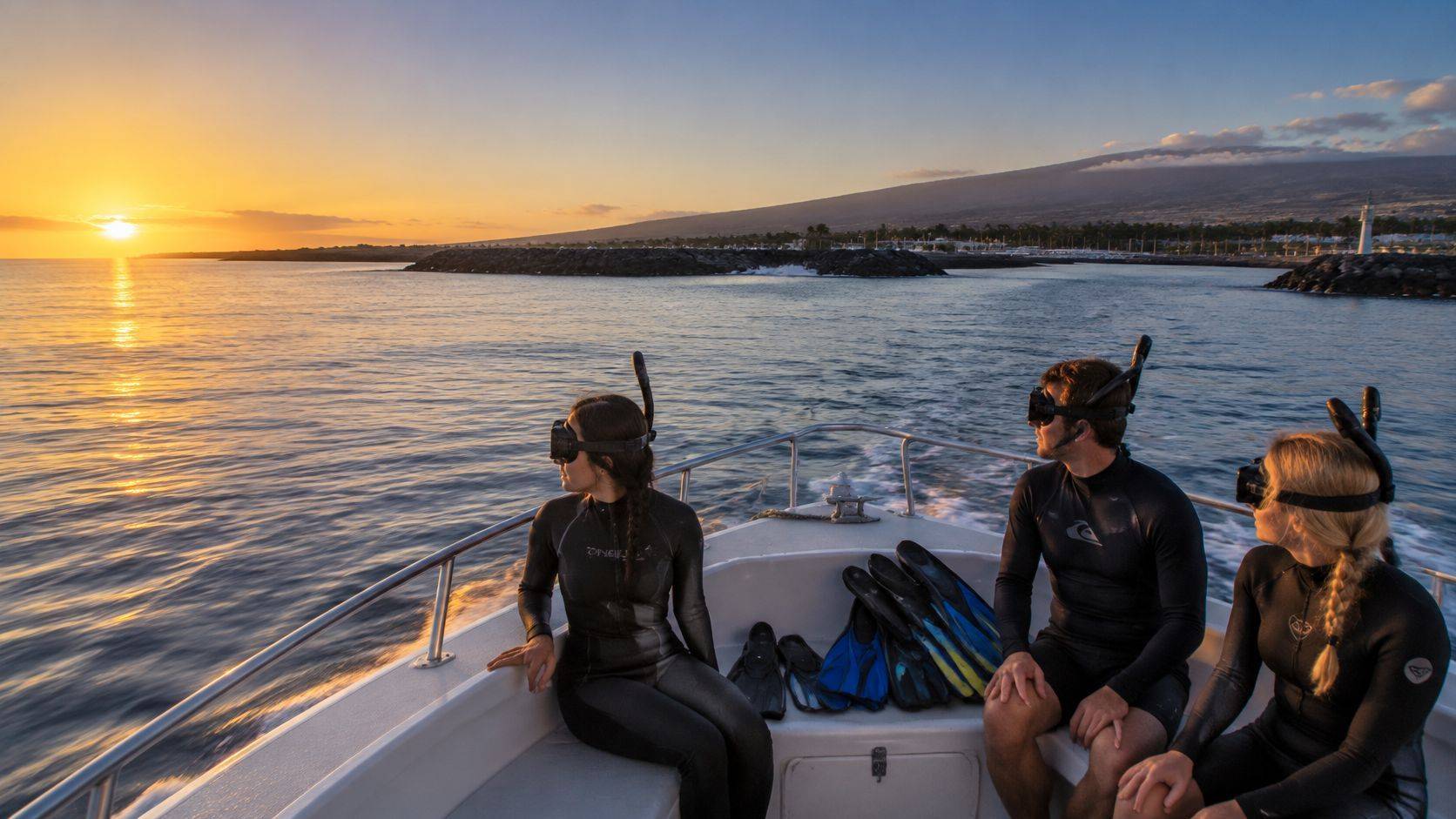
Almost every operator works out of the same harbor, and the night runs on a repeatable path from there.
- Check in at Honokohau Small Boat Harbor. Snorkel guests meet the lifeguard-certified crew here for an educational briefing on manta ray biology and the history of the Kona rays. Listen even if you have logged plenty of snorkel hours, because the briefing covers the Manta Ray Green List rules, starting with never touching the rays, plus the position and spacing that keep the feeding patch intact.
- Ride 20 to 40 minutes. The crossing length depends on where the mantas are feeding best that night. Kona has two established sites and both see rays on most evenings, so the captain picks between them on radio reports and current conditions. In practical terms, the plankton has already voted before you board. The crew just follows it.
- Divers start earlier. The scuba evening runs a late-afternoon reef dive, then a sunset surface interval with a light meal and an expert briefing on manta biology, then the night dive itself. Divers board the Honu One at the same harbor with Kona Honu Divers, whose two-tank Manta Ray Dive Kona tour runs about five hours in total.
- Snorkelers enter after dark. You slip in with your group, take hold of the lit snorkel board and float at the surface while the beams gather plankton beneath you. The board works like a porch light: you hold still and the light does the attracting. That is the whole job. Hold, breathe, watch.
- Ride back to the same dock. Same harbor, same parking, usually well past your normal bedtime.
Planning rule: the dive evening runs about five hours dock to dock, and the snorkel tour about two. Add check-in, gear fitting and the drive on both ends before you commit to a dinner reservation or a dawn flight.
The animals are the calm part of this schedule. Everything that can go wrong sits in the human half: the briefing you only half-heard, the site choice, the ride home in the dark. Give the evening slack and the rest of it is simple.
How to Judge Safety Before You Board
The manta is not the hazard. A snorkeler floating at the surface while a ray loops through the light is in very little danger from the animal itself. Darkness, hulls and human congestion carry the main risk, and that is where your attention belongs before you book.
Safety concerns on Kona's crowded manta nights center on dense boat and swimmer traffic packed into a small patch of water. Operators, residents and state officials have discussed mooring buoys, limited-use permits and other rules aimed at crowding and pressure on the sites. Whether those arrive or not, the practical question is what your crew does on the water tonight.
Here is the logic of the evening. Plankton decides where the mantas gather, and the mantas decide where the boats gather. The lit feed site works like a single campfire: everyone wants a seat around it, and the more hulls and swimmers pack in, the more chances there are for a bad pass. Calm rays, busy water.
Night hazards and what a careful crew does
Hazard — What you may see — What a careful crew does
Crowd and dark water — Many boats and people without lights — Lights on every swimmer and a slow final approach
Boat path — A hull close to snorkelers or over divers — Set spacing and keep traffic off the lit group
Current or poor viz — The group drifts off the food light — Move the boat or switch sites before the plunge
Close pass by a ray — A wing within arm's reach — Enforce no touching and keep an open escape path
Building weather — Wind, chop, or a rushed briefing — Cancel or relocate instead of forcing the site
Run that table as a guest checklist. Every swimmer should be lit, because bright lights are what bring the animals in close, so visibility cuts both ways. The final approach should be slow and deliberate. The crew should be willing to move sites or scrub the night rather than press on.
The go or no-go test
Two rules decide most of it. Non-swimmers are not permitted on the night snorkel, with no exceptions, and every guest follows the Manta Ray Green List guidelines, which include never touching the rays. Contact damages the protective mucus coating on their skin, and it also breaks the feeding pattern you came to watch.
Before you book, ask three questions: how are swimmers illuminated, what separates boat traffic from the group, and who makes the call to cancel? A crew that answers all three without hesitating is worth the fare.
Preparation is simple and worth doing. Wear a rash guard or wetsuit for the water temperature, use reef-safe sunscreen before you leave the dock, and pack a towel and a dry layer for the ride back. Fitness matters more than strength: you need to float calmly in dark water for the whole session, and divers need a current certification and recent dive history. Check the forecast that morning, with flat water and light wind as the target. Families often arrive with questions about whether the rays themselves can hurt anyone, and this guide on whether manta rays can sting you answers the ones asked most.
When the Rays Skip a Night
A quiet night is usually ecology, not incompetence. The strongest long-term Kona evidence ties manta attendance to food. A University of Hawaiʻi study analyzed more than 23,000 sightings of 167 individual reef mantas from 2010 to 2022 across Garden Eel Cove and Keauhou, and seasonal and annual changes in aggregation size closely tracked zooplankton density, per the University of Hawaiʻi research archive.
The same work found the two sites aren't interchangeable. Garden Eel Cove generally supported larger aggregations, while Keauhou was visited predominantly by females, which suggests the sites may serve different ecological functions. Females showed high fidelity to particular places, and the sites connect.
Two sites, two jobs
Here's how that plays out on real evenings. On a windy night with thin plankton and a drifting group, a good captain may move the boat rather than keep everyone staring at an empty beam. On a calm night at Keauhou, a handful of known females can put on a tighter, quieter show than a bigger aggregation elsewhere. Neither night is a failure of seamanship.
The study also concluded that aggregation stability during the study period did not show an obvious negative population effect from increased tourism. That's reassuring for the short term and not a license for unlimited boats. Stable numbers don't prove the site can absorb any level of traffic.
A high sighting rate isn't a health certificate either. A 2023 genomic analysis estimated Hawaiʻi Island's contemporary effective reef-manta population at roughly 104 individuals, with a 95% confidence interval of 99 to 110, as reported by Kona Honu Divers. A small, resident, site-loyal population is exactly why the encounter is reliable and exactly why restraint matters.
Mantas are also less likely to appear by day, since they stay offshore until the night feed begins. If your evening comes up empty, our manta guarantee lets guests return on another night for free on a standby basis, so build a spare evening into your trip rather than booking the last night before your flight. Timing questions, including which months suit first-timers best, are covered in this guide to the best time to see manta rays in Kona.
Photograph the Feed Without Blocking It
The position and light rules are already set by the format you booked, and the crew enforces them. What's left is camera handling, and most guests lose the shot to handling mistakes rather than to shy animals.
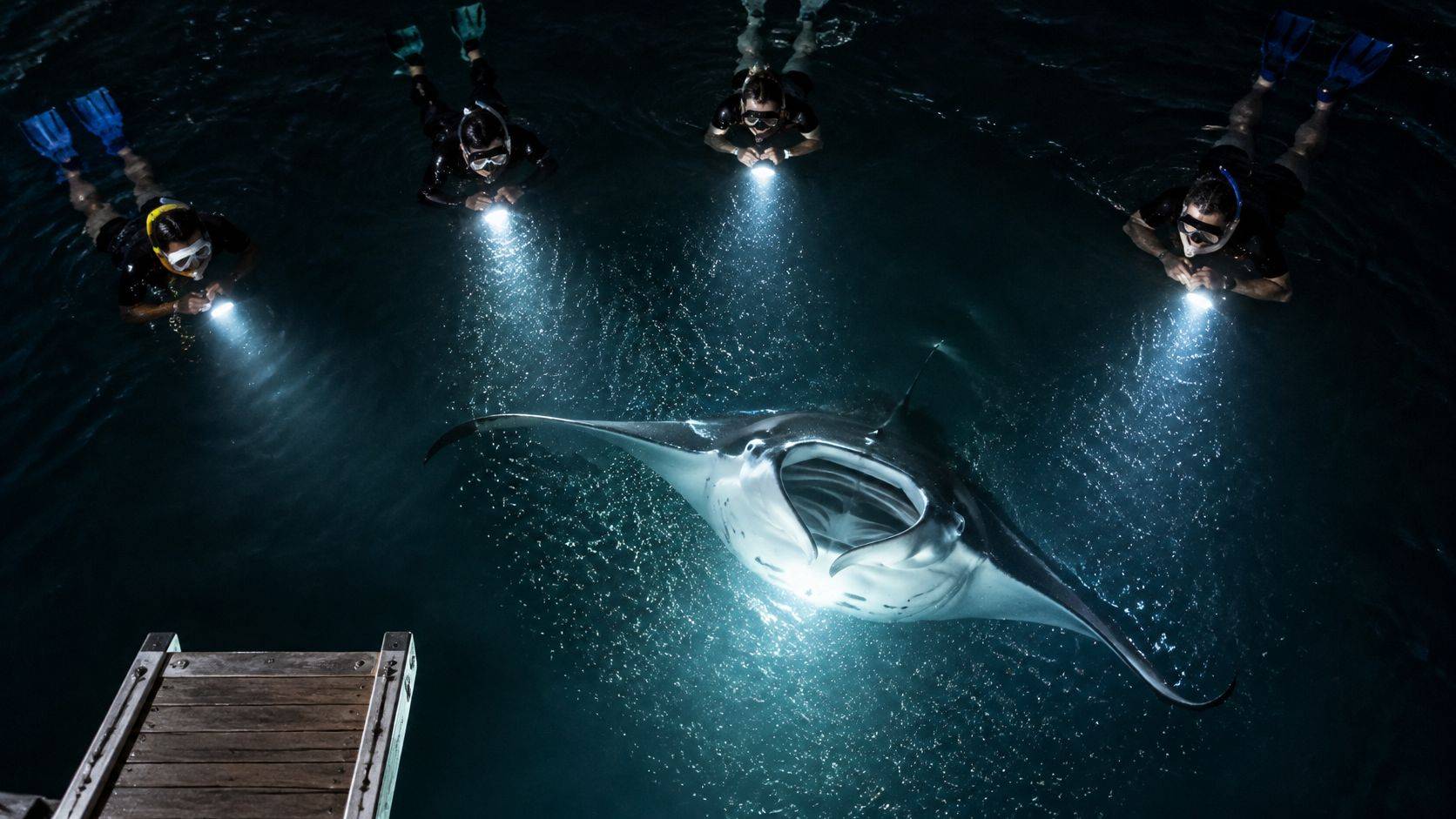
NOAA-backed guidance in the NOAA manta viewing document is explicit that snorkelers should not dive down toward feeding mantas, and the same posture that protects the feed protects your framing. You want a flat, quiet body and the beam doing the work.
A shot list that protects the feed
- Frame white bellies against black water. The contrast is the image. Center the ray slightly low and leave room above for the turn.
- Keep elbows in. Wide arms catch a wingtip and end a pass. Tuck them against your body even when the animal comes closer than you expected.
- Never fire a flash at the eyes. Use the crew's lights, a wide lens and a raised ISO instead of a strobe. A burst of white light stops the behavior you're filming.
- Shoot video before stills. A single barrel roll lasts seconds and reads beautifully as a short clip. Still bursts usually deliver one soft frame.
- Use a wrist lanyard. Dropped cameras land on reef or on an animal, and gear touching a ray is the same violation as a hand.
- Expect a pass too close to focus. The best encounter of the night may be a blur. Watch it instead of chasing the frame.
Families can leave the camera on the boat and watch the feed from the surface. Groups with several photographers should agree on one shooter per board so the lights stay pointed at the swimmers.
Setup check before entry: position flat, light aimed the right way, path left open. If any of the three is off, fix it at the boat.
Questions Travelers Ask Before Booking
The calm part is the ray. The planning is eligibility, plankton and boat traffic.
Can children join? Night snorkelers must be at least 5 and able to swim. Non-swimmers are refused with no exception, so a child who cannot float independently should wait for a daytime trip.
Do I need a certification? Yes for the two-tank dive, no for the surface snorkel. Divers should be current and comfortable in low light while managing a mask, regulator and light.
What if no mantas appear? Food supply usually decides the night. Ask whether the crew will move toward stronger plankton or reschedule when the feed looks weak, and know the guarantee covers a free standby return on another night.
Is a permit needed? Viewing hours run 4:00 p.m. to 4:00 a.m. under the state's manta viewing rules, and commercial trips follow their operator's own permit and site rules, so confirm those details when you book.
Is a private charter worth it for a group? It suits a group that wants the boat alone and a fixed schedule. Shared trips cost less per person and fit most families and first-timers.
Will I get good photos? Sometimes, but the feed comes first. If handling a camera changes your posture or blocks a pass, leave it aboard and watch.
How far ahead should I book? Popular nights sell out weeks ahead. Lock the date early in your trip and keep a spare evening free for weather or a standby return.
Book the Night That Matches Your Group
The shared snorkel suits families and first-timers. The Manta Ray Night Snorkel runs 2 hours and starts from $139, and booking in advance locks in the best pricing, so hold your date before you build the rest of the itinerary. Want a second operator to compare against? Kona Snorkel Trips also runs a manta night snorkel on the same coast.
Certified divers should book the two-tank Manta Ray Dive with Kona Honu Divers, which runs the dive version of this night aboard the Honu One out of Honokohau Harbor. It's a 5-hour trip priced up to $259, pairing a late afternoon reef dive and a sunset surface interval with the night feed itself. Use Check Availability for dates, and browse Kona Honu Divers' other dive tours if you want more time underwater. Confirm the shop and read recent guest notes on their Google Business profile.
A group that wants the boat to itself can book a private manta ray snorkel charter: a 2-hour trip starting from $1999 on a 28-foot zodiac rated for 24 passengers and limited to 18, with snorkel gear and crew included. The rays behave the same on every boat, so what a private charter really buys is fewer strangers holding the board beside you. Staying another day? Add a daytime run to Kealakekua Bay with Kona Snorkel Trips' Captain Cook and Kealakekua Bay tour. For a completely different kind of night, the blackwater night dive trades mantas for open-ocean drifters.
Match the trip to your group, book it early, and keep the no-touch rule once you're in the water. The animals handle the rest.
Manta Ray Night Snorkel Hawaii runs the surface version of this night from Honokohau Small Boat Harbor, with lifeguard-certified guides, small groups, and the lit boards that gather plankton where mantas feed. If the plankton talk above convinced you that a quiet, well-run float beats a crowded one, that's the trip to book, and the 2-hour evening starts from $139. Visit Manta Ray Night Snorkel Hawaii to check dates and hold a spot on a night that fits your trip.