
Manta Night Dive in Kona: What to Expect and How to Book
Learn how a manta night dive works in Kona, what to expect, safety rules, best times and how to book a night snorkel or two-tank dive.
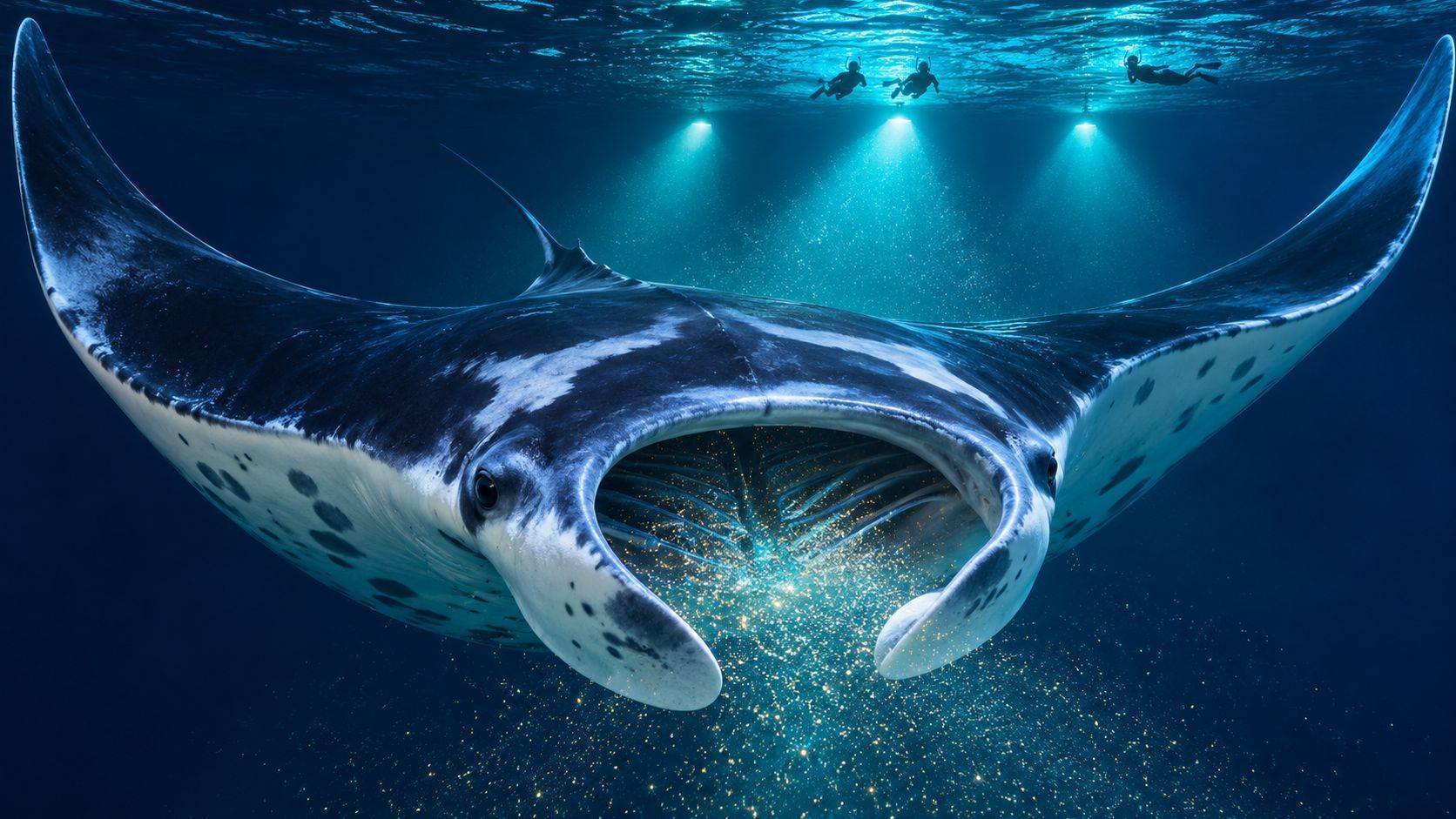
You've booked the 8 p.m. boat, or you're about to. Either way you've seen the photos: a manta ray the size of a dining table rolling through a column of light, close enough to count gill slits, with a stranger's snorkel fin in the corner of the frame. What the photos leave out is everything around it. On a busy Kona night that water holds several boats, a scattering of snorkelers at the surface, divers kneeling on sand, and a lot of moving light.
That gap between the postcard and the actual evening is where most travelers make their decisions badly. They pick a departure by price or by convenient time, then learn at the harbor that the format didn't suit the person they brought along, or that the site was crowded before they got wet.
The night involves choosing between the surface and the bottom, staying out of a manta's path, and knowing what to do when the rays don't show.
Table of Contents
- Manta Night Dive Formats Compared
- Why Manta Rays Feed Close to Kona's Reefs
- Safety, Crowds and Who Can Join
- Night Snorkel Routine and Viewing Rules
- Photography Tips for Night Rays
- Sites, Seasons and Low-Ray Nights
- Choose and Book Your Manta Night Dive
Manta Night Dive Formats Compared
A manta night in Kona is a light-based feeding watch. After sunset you enter dark water, a high-powered light points down, zooplankton gathers in the beam, and reef manta rays arrive to strain that plankton. Two formats put you in that same lit patch. You are either on the surface or on scuba, and that choice decides who else is in the water with you.
Format — When It Happens — Swimming Needed — Best For
Manta night snorkel — After dark, lights draw mantas toward the surface — Yes. Swimming skills are required, and non-swimmers are not permitted — Confident swimmers who want a focused night on the surface
Two-tank manta night dive — Late afternoon reef dive, sunset surface interval, then the night dive — Confirm the operator's entry rules before you book — Divers who want a full evening on the water, reef first and mantas after dark
The surface format keeps you on top of the light field. Guests hold a floating snorkel board, wear wetsuits and flotation, and never descend. Your face stays in the water. Your hands stay on the board. The rays come up through the beam and choose how close to pass. You stay clear of anyone working below, but you share those boards and that beam with every other snorkeler on the boat.
Manta Ray Night Snorkel Hawaii runs this surface version. A private manta ray snorkel is the same night watch if you would rather not share a light field with strangers. For a shared departure, Kona Snorkel Trips runs a manta ray night snorkel, and its times are listed on the booking page.
The two-tank format is the longer evening. It opens with a late afternoon reef dive, then a sunset surface interval with a light meal and a briefing on manta biology, then the night dive at the lit site. Divers should read the two-tank manta dive details before picking a boat.
I would sort the choice with two questions. Can you swim confidently in open water at night? Do you want to be on scuba for the ray portion? If you can swim and want to stay on the surface, take the snorkel. If you want the longer dive evening, take the two-tank after you have read that operator's details.
Why Manta Rays Feed Close to Kona's Reefs
Reef manta rays spend the day in deeper water and come shallow at night to hunt plankton. That's the whole reason a daytime sighting is a lucky accident and a night sighting is routine. Food sets the schedule, not the calendar.
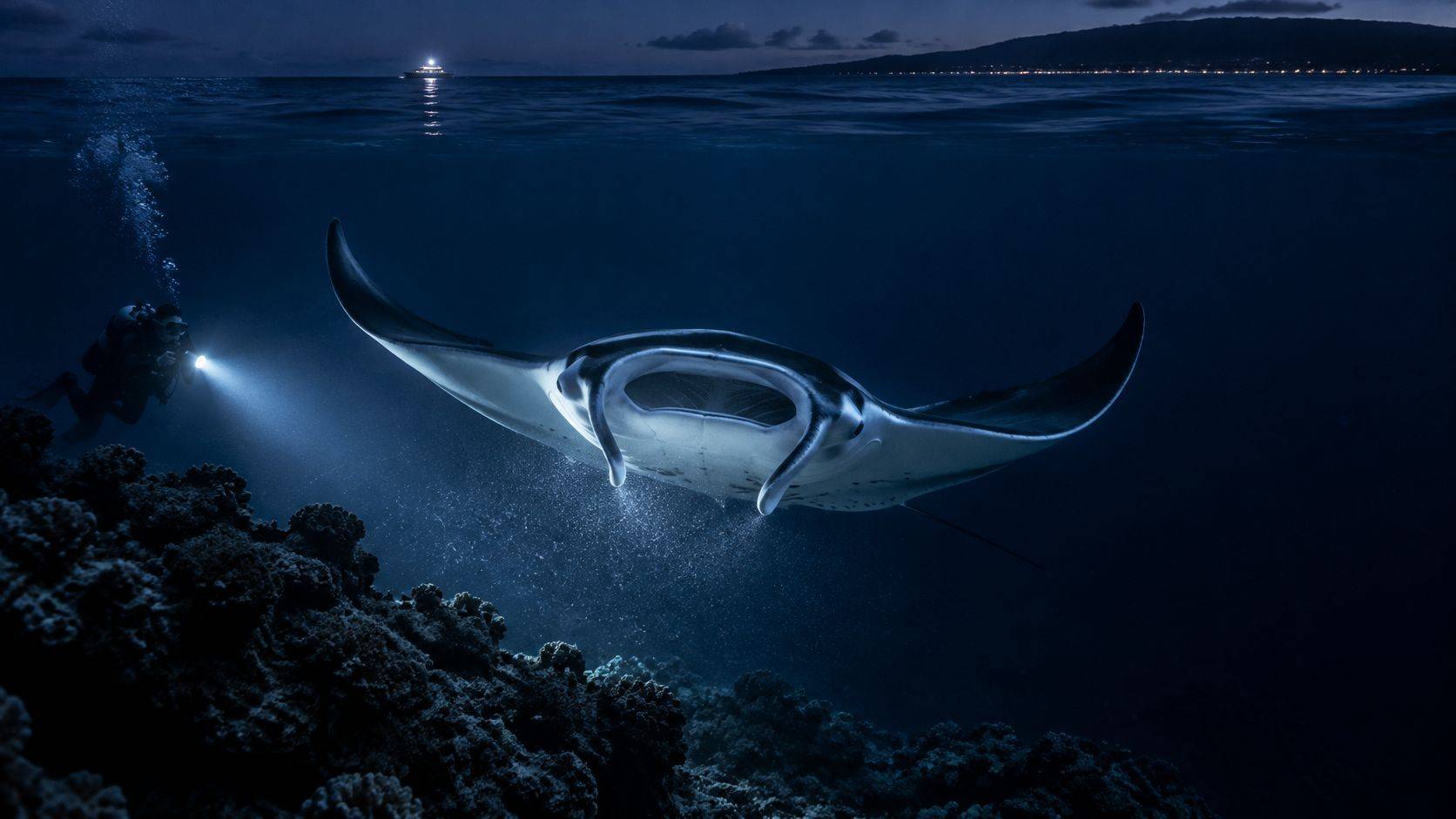
The NOAA manta ray work product lists the diet in plain terms: euphausiids, copepods, mysids, decapod larvae and shrimp. Small drifting animals, not fish scraps. Off Kona, manta abundance has shown a significant positive correlation with zooplankton abundance, and the animals appear to feed primarily at night as zooplankton move upward in the water column and become easier to reach.
What the Lights Actually Do
Think of a porch light on a warm summer night. Insects gather in the glow, and the bats and geckos show up to work the crowd. Kona runs the same system underwater. The "insects" are zooplankton, and the manta rays are the ones cashing in.
Nothing is being fed. The lights concentrate plankton that's already drifting there, which is exactly why the encounter stays a wild feeding event instead of a trained one. No bait goes in the water, and no animal is taught to associate boats with food.
During feeding, mantas open their mouths wide and hold their cephalic fins, the two flaps beside the mouth, in an "o" shape. That posture is worth learning. It tells you an animal is working a food patch rather than traveling through it, so you know when to hold still and let the pass happen.
For a visitor, that means the sighting depends on plankton, current and how the light sits in the water, not on a guaranteed show. A quiet hour is a real ecological outcome, not a broken promise.
If you want the biology in more depth before you get in the water, these fun facts about manta rays cover how the animals live day to day. Then judge your night by whether feeding continued, not by how close one ray came.
Safety, Crowds and Who Can Join
Four boats put people in the same dark patch, and a fifth crosses the lane at speed. That shared water is the decision, not only whether a ray will show. A smaller group on your own boat does not shrink the site. Six guests can still drop into a lane four other boats are already using. The ride feels calmer. The water does not.
A Hawaii County safety assessment observed vessels traveling above minimum operating speeds, boats passing within 10 to 20 feet of unlit snorkelers, and vessels passing over submerged divers, and it warned that a serious accident was likely without mitigation, as SFGATE reported. Those are the conditions to weigh when you compare operators, whether or not the booking page mentions them.
Crowding is the milder, more common version of the same problem. Visitor research has found that crowding from snorkelers, boats and scuba divers tracks with lower satisfaction and a greater chance that people will not come back. A packed site changes how the night feels long before anyone is hurt.
What good looks like: one light field, assigned spots at the surface, and enough gap that a manta can finish a pass without threading between people.
A checklist for a lower-risk boat
- Guide ratio in the water, not on the boat. Ask how many swimmers one guide watches at the surface, then picture that number in the dark.
- Swimmer visibility. Lit boards, reflective markings and a head count before entry and after exit.
- Boat separation. Whether the crew coordinates with other boats on the site or takes the nearest open patch of black water.
- Briefing quality. A real explanation of manta behavior and the rules, delivered while there is still light, not a rushed sentence at the ladder.
- Emergency plan. Oxygen, a working radio, and a crew member whose only job is watching the water.
- Viewing zones. Divers low near the sand, snorkelers high at the surface, nobody drifting through the middle of the feeding lane.
- Gear discipline. Cameras and dangling straps clipped before entry, not after.
Who can join which tour
Traveler — Night Snorkel — Daytime Tours
Non-swimmer — Not permitted, swimming skills required — Book a daytime tour instead
Age 3 or 4 — Not permitted, minimum age is 5 — Permitted, minimum age is 3
Age 5 and up, confident swimmer — Permitted — Permitted
The swimming rule is not a formality. Non-swimmers are not permitted on the manta ray night snorkel, and swimming skills are required with no exceptions, because the entry, the float and the exit all happen in the dark. Minimum age is 5 for the night snorkel and 3 for daytime tours.
I would split a family before talking a nervous swimmer into the water. A frightened person at the surface kicks, grabs and drifts, and that behavior is what creates incidents in a light field. Older travelers do fine on the surface format when they can float comfortably and climb a boat ladder, but anyone with heart, lung or ear concerns should get a doctor's opinion first. Photographers add their own risk: a housed camera on a wrist strap is one more thing to tangle in a line or bump into an animal.
The manta ray FAQ covers the check-in questions on gear and conditions that decide whether someone should be on the boat at all.
Night Snorkel Routine and Viewing Rules
Here's the sequence, with the reason behind each step. Most mistakes happen in the ten minutes around the entry, not during the feeding.
- Check in at Honokohau Small Boat Harbor. Guests meet the lifeguard-certified crew for a briefing on manta ray biology and the history of the Kona rays. Pay attention to it. The briefing is where you learn what a feeding pass looks like, which is the difference between watching one and chasing one.
- Ride to whichever site is working that night. The run takes 20 to 40 minutes depending on where the mantas are showing up best. Site choice beats loyalty to a plan, so let the crew change its mind.
- Fit your gear before you reach the ladder. Mask, snorkel, wetsuit, flotation. Test the mask seal with a short inhale through your nose. A loose mask leaks all night, and a leaking mask means one hand on your face instead of your eyes on the water.
- Enter, then take your spot and stop moving. Snorkelers float at the surface near the top while the mantas come in close, holding the board. The guests who see the most are the ones who settle first and adjust least.
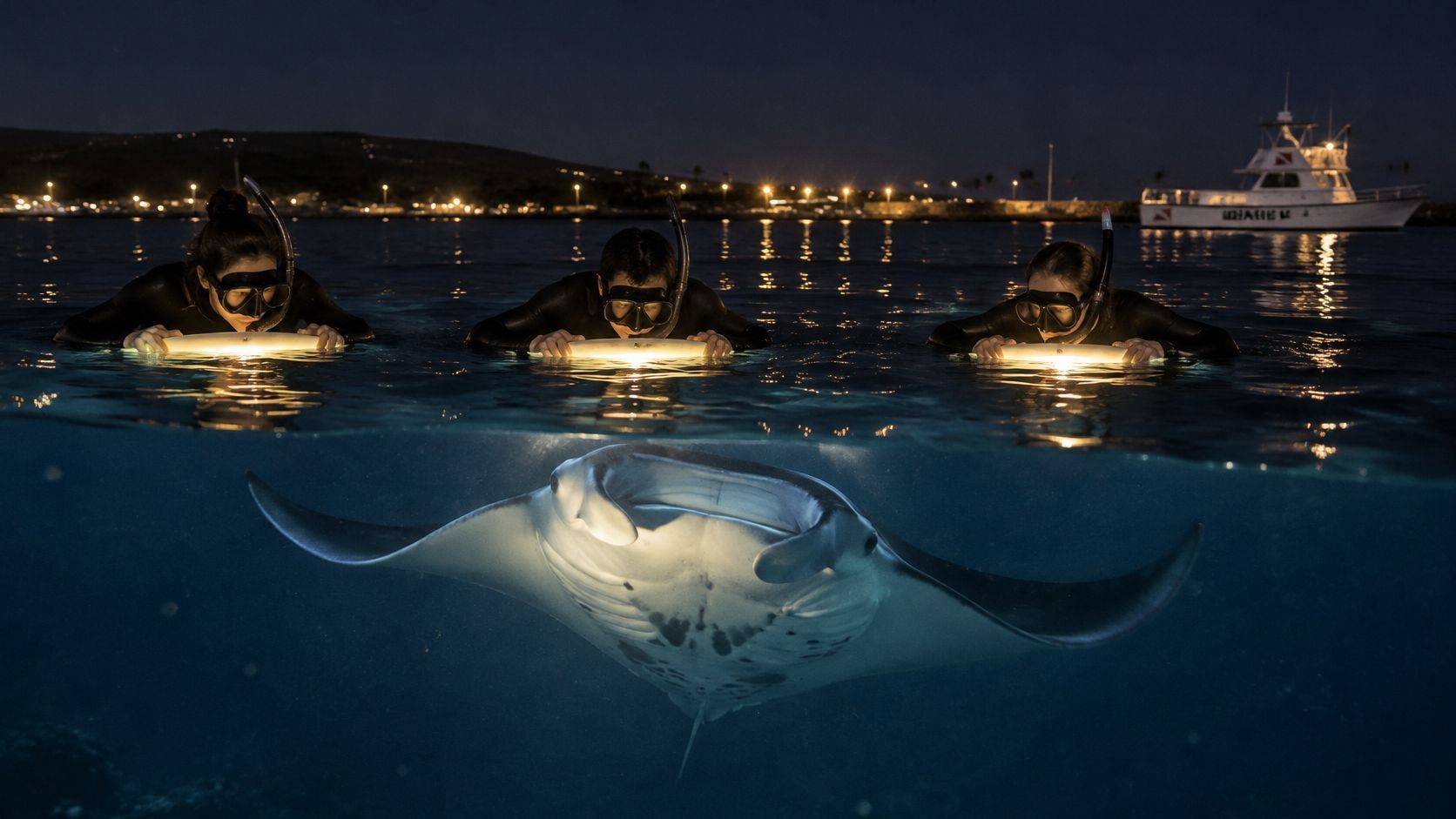
- Watch the passes from your own space. Keep at least 3 m of distance and stay clear of cleaning stations, which are working areas for the animals rather than viewing platforms.
- Leave when the guide calls the end. Group exits keep the head count honest and keep one wandering swimmer from holding up the boat.
A settled group emerges once the lights are on.
The rules exist because they work on the animals. Behavioral studies of manta tourism found that approaching from the front, obstructing a manta's travel path, diving underneath or near the animal, and chasing all significantly increased avoidance responses or feeding cessation, while passive positioning caused substantially less disturbance, according to the Manta Trust research summary. Independent conservation guidance points the same way, with distances greater than 3 m and staying away from cleaning stations as strong predictors of no observable manta response.
For a snorkeler that translates into four habits: stay stationary at the surface or in your designated spot, keep your body parallel or lateral to the ray's movement rather than across its line, avoid splashing and touching, and let the animal change course whenever it wants.
The manta decides the distance. Your job is to be predictable, not close.
This isn't only etiquette. A ray that doesn't have to evade people keeps making feeding passes through the lit water, which gives you longer, calmer viewing and lowers the collision risk that comes with low visibility and a dozen bodies in the dark.
Photography Tips for Night Rays
Night photography here rewards patience and punishes enthusiasm. The frame you want, a ray filling the lit column with its wing edge catching the beam, comes from a still body and a wide lens, not from getting closer.
Stay at the surface. Diving down toward a ray is chasing with a camera in your hands. Shoot from where you're floating and let the animal move through your frame.
Use the light that's already there. The board and boat lights illuminate the feeding zone well enough. A strong flash or a handheld torch can startle the animal and cut a pass short, so keep your own light low and steady if you use one at all.
Frame wide. Include the ray and the water around it. A tight crop of a single fin crops out the wing edge and the open mouth, which are the two things that make the image read as a manta.
Take short bursts. Mantas move quickly through the lit zone while you're bobbing at the surface. Expect plenty of blurred and half-frame shots, and treat three good files from a hundred as a normal night.
Keep your hands and housing clear of the animal's path. Don't reach out for a shot, and clip straps so nothing trails into the water column.
Review the screen on the boat, not in the water, where your attention belongs on the rays and the people around you. For files that come back grainy from the high ISO a night dive forces on you, choosing a denoiser for RAW files is worth ten minutes before you post anything.
The governing rule is the same as the viewing rule. A ray that isn't chased makes repeated passes, and repeated passes are where the good frames live.
Sites, Seasons and Low-Ray Nights
You book a week that produced big groups last year, then show up to a beam with almost nothing in it. Sightings vary, and a calendar month is a weaker guide than the plankton in the water that night.
A 13-year analysis of Kona manta aggregations recorded more than 23,000 sightings involving 167 individually identified reef manta rays between 2010 and 2022. Aggregation size fluctuated seasonally and was positively correlated with zooplankton density, so the same week of the year can produce a busy night or an empty one.
Site — Typical Aggregation — Sighting Profile
Garden Eel Cove — Larger, more variable aggregations — Your best shot at several rays in one hour
Keauhou — Smaller aggregations — Female rays make up 91 percent of sightings
Site choice is a real variable, not a brochure label. Garden Eel Cove hosts the larger, more variable groups, which is your better chance of several rays in one hour. Keauhou runs smaller aggregations with a strong female bias. I would not call either site better in the abstract. One offers more chance of multiple rays at once. The other offers a familiar cast of regulars. Manta Ray Night Snorkel Hawaii works both sites, and both have mantas more than 80% of the time.
That choice is also a shared-water decision. A popular departure piles more boats, more lights, and more people onto one aggregation, and the rays have less clean water to pass through. The business offers two tour times because the manta tour is the most popular tour on the island, and splitting the night across two sites is how the coast keeps one lit patch from taking every boat.
What a quiet night still teaches
A slow night still has a job. You watch plankton gather in the beam, learn to read a feeding posture, and see how the reef behaves after dark.
The lit zone shows one part of manta feeding behavior. It is the shallow opportunity in front of you, not the whole of what these animals do once the sun is down.
Ask whether the boat can switch sites if the first one is quiet, and expect the popular departure times to go first. If the mantas do not show up, guests can come back on another night for free on a standby basis under the manta guarantee. Confirm how any operator handles a quiet night before you pay, since policies differ.
If timing is your main question, this guide to the best time to see manta rays in Kona goes further on conditions.
Choose and Book Your Manta Night Dive
The prices tell you most of what you need to sort out.
Format — Duration — Price
Manta night snorkel — 2 hours — From $139
Two-tank manta night dive — Up to 5 hours — Up to $259
Private charter — 2 hours, gear and crew included — From $1999
Match the format to the person, not to the budget. Choose the night snorkel if you swim confidently and want a focused night on the surface with no certification paperwork. Choose the two-tank dive if you're certified, current, and want the full evening: afternoon reef dive, sunset meal, night feeding. Take the private charter when you want the boat's attention on your group, since it includes the snorkel gear and the crew.
The rest is timing. Popular manta tours often sell out weeks in advance, and booking ahead is also how you get the best pricing on the snorkel. If your stay is short, book the manta night early in the trip so a quiet first attempt leaves room for a standby return.
Then comes the day trip people pair with it. Booking a manta snorkel together with a Captain Cook Snorkeling Tour at checkout gives 10% off the Captain Cook tour, and the manta snorkel has to be booked first for the discount to apply. Start with Captain Cook Snorkeling Tours to see the itinerary, and if you want a boat run by the same crew, Kona Snorkel Trips is an exceptional Kealakekua Bay and Captain Cook snorkel alternative.
Two bookings to keep handy. For the surface trip, Check Availability on the night snorkel. For the dive side, Check Availability on the two-tank manta dive, or compare the wider menu of Kona diving tours if you want more time underwater. For the day tour add-on, Check Availability on the Captain Cook snorkel.
Pick one format tonight, book it early in your stay, and read the briefing like it matters. It does.
Manta Ray Night Snorkel Hawaii runs the surface version of this night from Honokohau Small Boat Harbor, with lifeguard-certified guides, small groups, all gear including wetsuit and flotation, and boats that reach whichever of the two manta sites is feeding best. If you want the encounter without certification requirements, a sunset or after-dark departure puts you at the rail while the lights do the work below. Visit Manta Ray Night Snorkel Hawaii to see departure times and hold a spot before the popular nights fill.