
Manta Night Snorkel Kona: What to Expect and How to Book
Plan your Manta Night Snorkel on Kona with clear guidance on safety, what to bring, timing and booking.
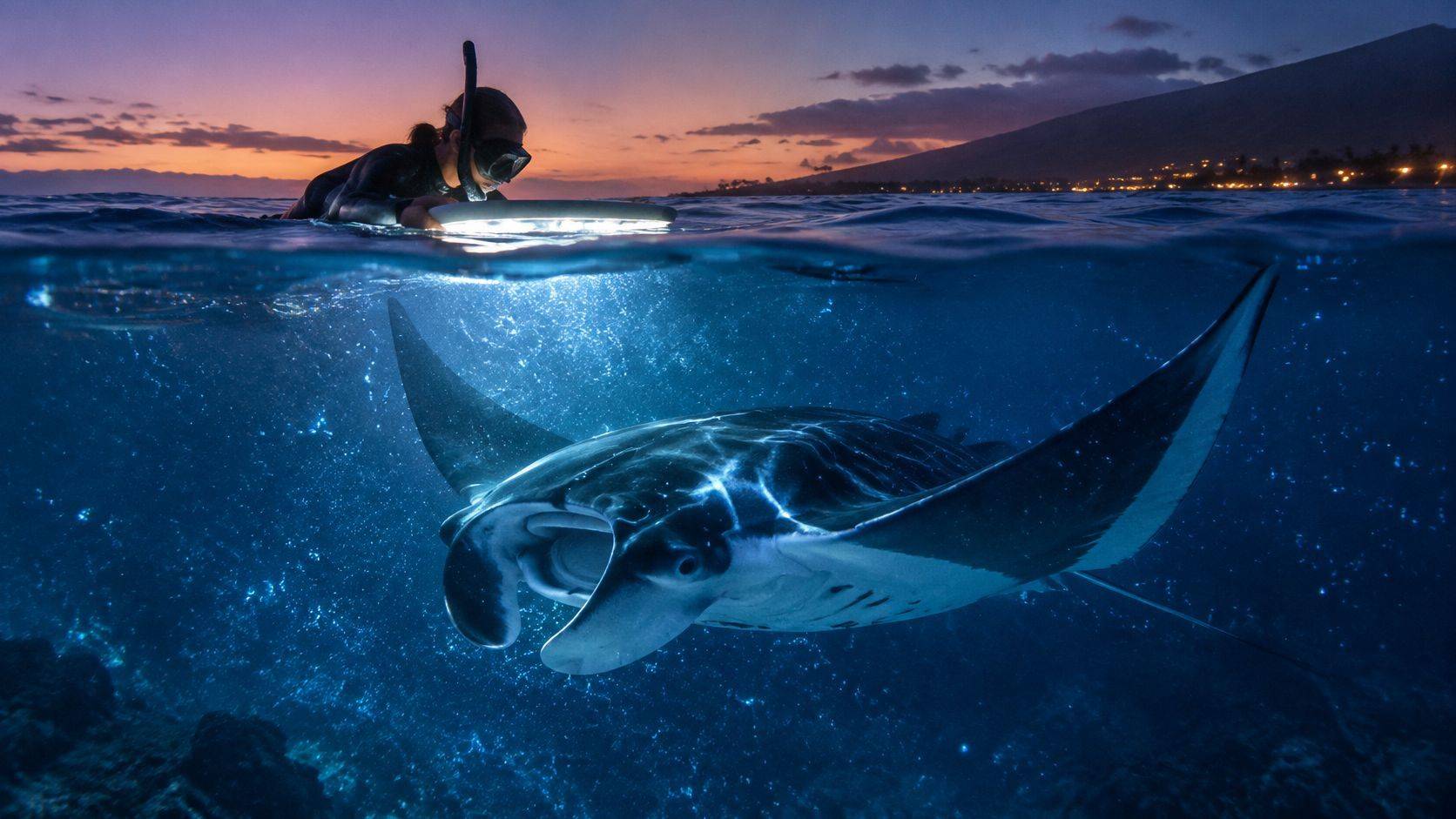
You're looking at Kona evening tours, trying to decide whether floating in the ocean after dark sounds exciting or a little unsettling. The photos show manta rays close beneath snorkelers, but they don't explain the boat ride, the swimming requirements, or what happens when the ocean doesn't cooperate.
A manta night snorkel can be a remarkable wildlife encounter when you understand what you're booking. The right decision starts with your comfort in the water, the crew's safety procedures, and a flexible schedule, not a promise that wild animals will appear.
Table of Contents
- Manta Night Snorkel at a Glance
- Why Kona Mantas Gather After Dark
- How the Night Encounter Unfolds Step by Step
- Who Should Book and What Can Change on the Night
- Staying Safe Around Boats and Protecting Mantas
- What to Bring and How to Photograph Manta Rays
- Manta Night Snorkel FAQs
- Book Your Manta Night Snorkel Trip
Manta Night Snorkel at a Glance
Harbor lights are on, dinner is still open, and a two-hour boat trip has to fit the rest of the night. A few details are fixed. One is not: wild manta rays may feed at the site, and they may not.
Manta night snorkel key details
Detail — What to Expect
Duration — About 2 hours from start to finish
Departure point — Honokohau Small Boat Harbor
Boat ride to the manta site — 20 to 40 minutes, depending on where mantas are showing that night
Viewing sites — Two prime viewing sites off Kona, chosen each night by the crew
Starting price — From $139
Guests meet the lifeguard-certified crew at Honokohau Small Boat Harbor for a briefing on manta biology and the history of Kona's rays. The boat then runs to one of two prime viewing sites off Kona. The crew chooses the site for where the mantas are showing that night, so the ride takes 20 to 40 minutes. In the water, snorkelers hold a light board and float at the surface in a wetsuit and flotation while the rays feed below. Nobody swims after them.
What the timing means for your evening
Treat the two hours like a short interisland hop: the clock includes the gate, not only the time in the air. Check-in, the briefing, gear, the ride out, time in the water, and the return all sit inside that window. The snorkel itself is one slice.
Dark water next to a boat needs different attention than a sunny beach swim. Swimming skills are required. Non-swimmers are not permitted, with no exceptions.
Both evening departures take about two hours and visit the same manta site that night. The tour runs twice because it is the most popular on the island, not because a later boat sees more animals. Pick the departure that still leaves room for dinner.
How to read a night before you pay
Night feeding along this coast is a documented habit, not a booking the animals keep. A University of Hawaiʻi study describes Kona's nighttime feeding areas, including places that draw larger groups and places where females return often. A known stretch of reef means feeding has happened there. It does not say how many rays will arrive for one boat.
If none show up, the manta guarantee allows a free return on another night, on a standby basis. Keep a replaceable evening, and treat a sighting as likely rather than owed.
Safety and ethics are easier to check than the wildlife. A lifeguard-certified crew, a briefing before anyone enters, and Manta Ray Green List rules (never touching the rays) are the marks of a careful operator.
Use the table to see whether the timing and the from-$139 price fit the trip. Booking ahead is where the best pricing shows up. Current departures and meeting instructions are on the operator's home page.
Why Kona Mantas Gather After Dark
Kona's nighttime manta encounters began with lights meant for people, not wildlife. In the early 1970s, the former Kona Surf Hotel directed floodlights toward the surf, and plankton gathered in the illuminated water, followed by feeding manta rays, according to the published account of Kona's nighttime aggregations.
That bright patch is what you are looking down into.
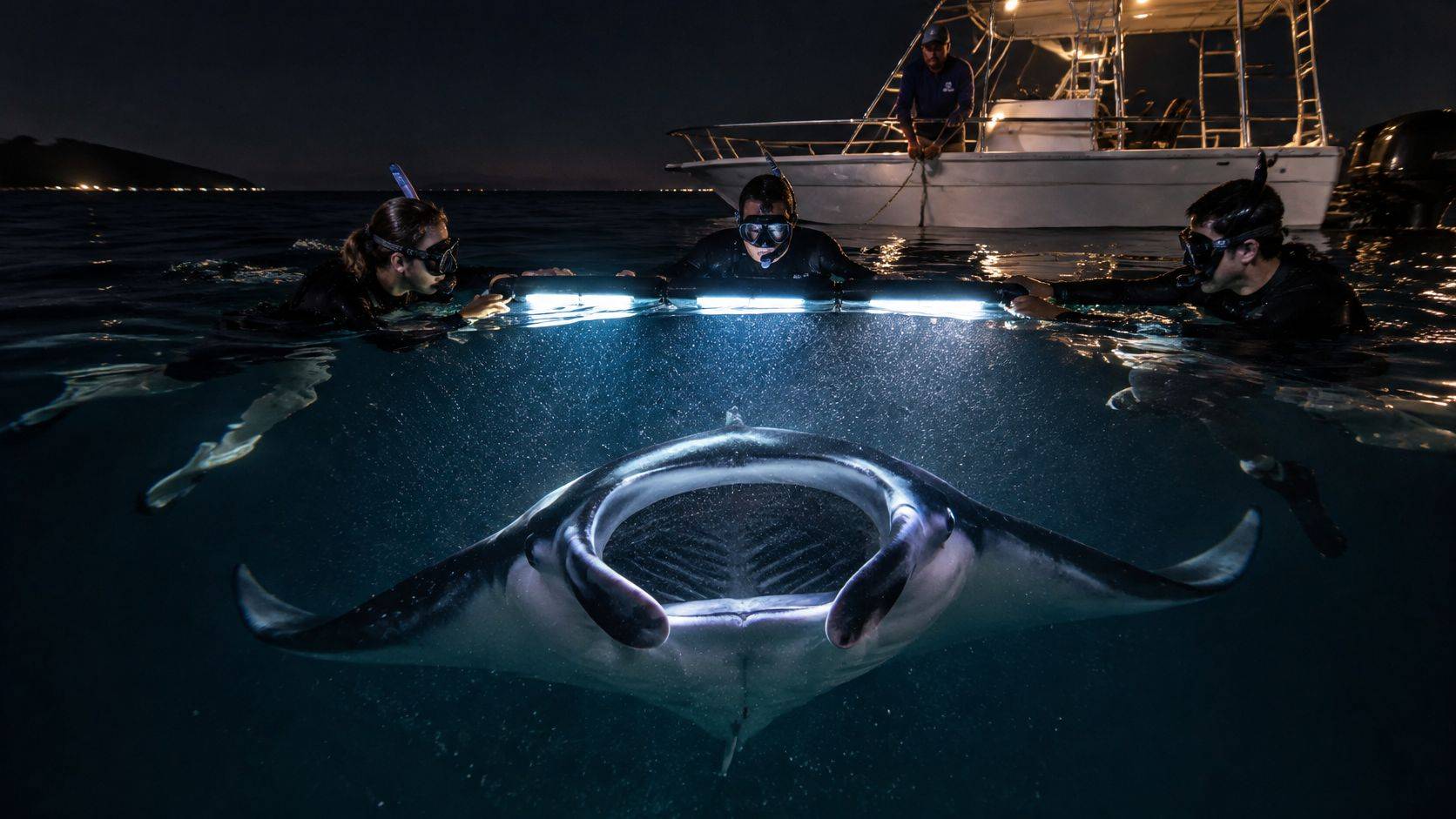
Organized viewing developed over the following decades as operators noticed repeated feeding around the lights.
The mechanism is simple. Lights concentrate microscopic zooplankton, and mantas gather to filter-feed on that concentration. The glow works like a porch light that draws moths: small prey piles up in one place, and the larger animal arrives for the food.
Why darkness changes the encounter
Mantas are mostly in deeper water during the day and come close to Kona's reefs at night to feed on plankton. Daylight encounters are less likely. A daytime sighting is still possible.
Say you snorkel over a reef in the afternoon and see no mantas. After dark, an illuminated feeding area holds a tighter patch of plankton, so the same stretch of coast offers a different chance to watch them eat.
For more background on the animals themselves, explore these manta ray facts and behavior explanations. Once you know they are filter-feeding, the slow turns and open mouths under the board read as a search for plankton.
This video gives you another way to visualize the nighttime setting.
Predictable feeding isn't a guaranteed appearance
Repeated night feeding makes a sighting likely. It never makes one certain. The lights help create a feeding opportunity, but they do not control the animals' movements or the amount of prey available.
Expect a wildlife encounter, not a scheduled performance.
An honest operator makes that distinction before taking your booking, not only after an evening without mantas.
How the Night Encounter Unfolds Step by Step
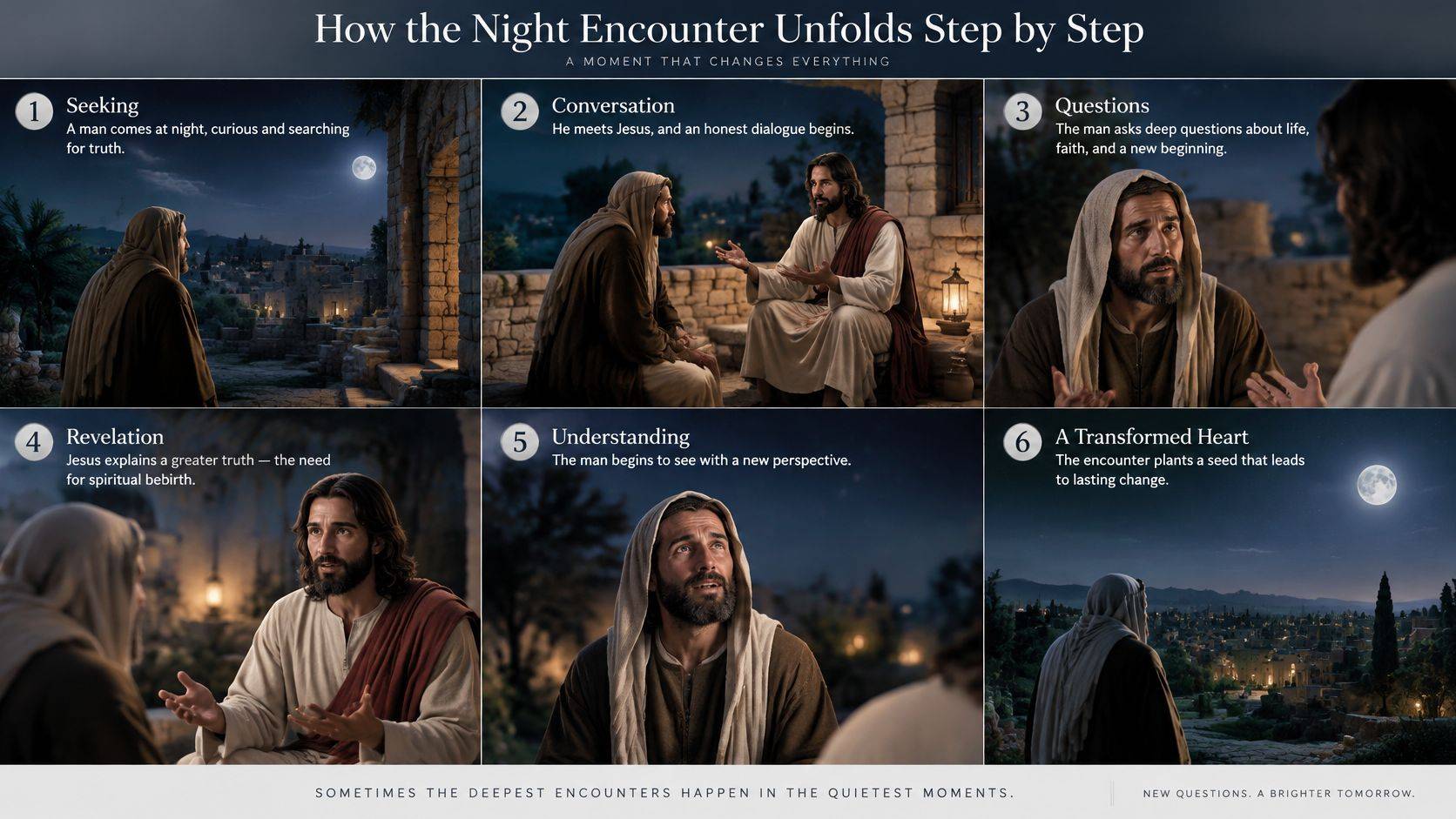
You leave the harbor after dark, ride to a lit patch of water, and spend the viewing time almost still. The boat follows a set order. The mantas do not. Splitting those two parts shows what the crew can manage and what stays a wildlife chance.
From the harbor to the viewing position
- Meet the crew and listen to the briefing. At Honokohau Small Boat Harbor, the lifeguard-certified crew covers manta biology, the history of Kona's rays, and the procedures you will use in the water. Mention a leaking mask, unease about the dark, or trouble with a ladder before the boat leaves. Those fixes are much harder once you are underway.
- Board for the 20 to 40 minute ride to the site selected that evening. The time depends on where the mantas are showing up best. Secure loose belongings and follow the seating instructions. Open water can feel different from the harbor even on a night that looks calm at the dock.
- Wait while the crew prepares the light board. They deploy it before guests enter, so the viewing spot is already set. Bright lights gather plankton in that one place, and plankton is what draws mantas in close. You are not sent out to search on your own. Stay aboard until you are directed in, even if something is already moving beside the boat.
- Put on your wetsuit and flotation, check the mask seal, and enter as instructed. Hold a snorkel board and float near the surface. Keep your body quiet. Extra kicking pushes you off the light and stirs the water you are trying to see through.
- Watch the feeding rather than reaching toward it. NOAA's manta species guide describes cephalic fins held in an O shape. The shape works like a funnel, sending plankton-rich water into the open mouth and across the gill plates. These are filter-feeding movements, not a ray chasing swimmers.
- Return when the crew signals, in their order and along their route. Give the person ahead room at the ladder, then settle in for the ride back and a short debrief on what you saw.
What to pay attention to in the water
Breathing usually needs work before the wildlife does. Get a comfortable rhythm through the snorkel, and be sure you know where the guide wants you, before you look for a camera angle or a passing shape.
A fogged mask or a small leak becomes distracting in the dark. Signal the crew. Repeatedly lifting your head, letting go of the board, or drifting away to fix it alone pulls you out of the group.
NOAA also describes barrel rolling and coordinated feeding chains among manta feeding strategies. That guide concerns giant manta rays, while Kona's documented nighttime gatherings involve reef mantas. Use it to read the feeding motion, not to name every animal under the board.
A finished swim can still leave the light field empty. The crew controls the briefing, the board, your position, and the return signal. They do not control whether a ray arrives.
What a successful encounter looks like
A good night is not a long swim or a dramatic close-up. It is a calm surface position, clear signals from the crew, and whatever feeding the animals choose to bring into view.
- Keep your position: Let the guide organize the viewing area instead of moving toward every passing shadow.
- Report discomfort early: A mask problem or rising anxiety is easier to handle before you are tired.
- Accept the return signal: The crew may need everyone aboard even while feeding continues.
Close, calm watching with no touching matches the Manta Ray Green List rule that snorkelers never touch the rays. The clearest moment is often a full view straight down, not the nearest possible pass.
Who Should Book and What Can Change on the Night
Who can join the manta night snorkel
Traveler — Can Join? — What You Need
Adult confident swimmer — Yes — Swimming skills and comfort floating in dark water
Child aged 5 or older — Yes, with swimming skills — Able to swim and stay on the surface with flotation
Child under 5 — No — Below the minimum age for the night tour
Non-swimmer — No — Non-swimmers are not permitted, with no exceptions
Anxious swimmer — Talk to the crew first — An honest comfort check before booking
Photographer with camera — Yes, with a plan — Secured gear and hands free for flotation
Swimming ability is required, with no exceptions. A flotation device supports your position, but it doesn't replace the ability to manage yourself in open water.
Age alone isn't a readiness test. A child who meets the minimum age still needs the swimming skills and confidence to follow directions after dark; our daytime minimum age is 3, which is a different eligibility rule.
Separate the risks before deciding
Ask these questions independently:
- Will the boat launch? Surf or other conditions may prevent departure.
- Will the ocean be comfortable for this guest? A trip can operate safely yet feel unsuitable for someone prone to seasickness, cold, or anxiety.
- Will the viewing site be open and well managed? Access, crowding, and traffic matter separately from the weather.
- Will mantas appear? Suitable conditions don't oblige wildlife to arrive.
SFGATE's reporting on Kona manta tourism describes concerns including boats close to unlit snorkelers, swimmers entering boat channels, and bright lights affecting visibility. Those are reasons to evaluate procedures, not compare sighting promises.
Read operating records in context
As regional context, Manta Ray Advocates' 2025 operating record reports 270 operating nights, with 28 cancellations in January and 28 in February. February was a complete shutdown, mainly because of high surf, with a box-jellyfish cancellation also recorded.
That record concerns a separate activity at Kaunaʻoa Bay, not our operation or either of the two Kona feeding sites discussed here. It illustrates why year-round availability doesn't mean dependable departure conditions every evening.
If mantas don't appear on our outing, guests can return another night free on a standby basis. That's a second opportunity, not a guaranteed seat or a reason to ignore your personal comfort.
Review the manta night encounter information alongside your own abilities. A provider willing to cancel or relocate for safety is showing sound judgment, not delivering poor service.
Staying Safe Around Boats and Protecting Mantas
You are on the surface at night, holding a board, with a boat nearby and a manta rising toward the lights. The wide-open mouth is how the animal feeds. The hazard that can injure a swimmer or a manta is a moving hull or a propeller.
The Hawaii boating operations assessment identified a live vessel or propeller strike as the most severe hazard. It also described how risk rises with crowding, poor spacing, reduced visibility, vessel speed, and lapses in crew attention.
A smaller group can help. Group size alone does not make the night safe. The crew still has to control where people float, where boats move, and how guests enter and leave the water. A viewing area works like a marked lane: it only protects you if the boats, and you, stay in the places assigned to them.
Look for several safety controls working together
A responsible arrangement stacks precautions. One guide, or one bright light, is not a complete system.
- Visible flotation: Swimmers need gear that shows crews where the viewing area is. Guests hold snorkel boards and wear wetsuits and flotation while they stay at the surface.
- A designated water position: Guests should know exactly where to remain and how to return.
- Controlled vessel movement: Live boating near swimmers should stay out of the plan except for carefully managed entry and exit.
- An active lookout: Crew duties should cover boat traffic as well as animals and guests.
- Lighting away from hull hazards: Avoid setups that pull feeding directly under a vessel, where strike and entanglement exposure can increase.
Do not assume every proposed control is already a universal operating rule. Judge the actual arrangement you are about to enter.
Preparation starts before anyone gets wet.
In the briefing, you should be able to identify the guide, understand the return signal, and know what to do if you lose your position. If an instruction is unclear, ask for a demonstration. Guessing in the dark is a poor plan. Swimming skills are required, with no exceptions, because the night depends on staying with the board in the assigned spot. Non-swimmers are not permitted.
Crowding is more than an inconvenience
Viewers surveyed for that assessment often felt crowded by snorkelers and by boats. Many preferred fewer people and fewer vessels sharing the water than a busy evening can draw in. Those preferences are not legal limits. They are not a formula that proves one head count is safe. They show why your own boat's passenger count does not describe the shared site.
A lightly loaded boat can still arrive beside several other groups. What matters then is whether crews keep separation and a clear route between their guests and their vessel.
Before entering: Know where you belong, who is watching you, and how you will get back aboard.
Ask how many guests share your flotation setup, how spacing is maintained, and who watches approaching boats. Once you are in the water, do not cross a boat channel or leave the viewing area to follow an animal. A sighting is likely on a suitable night and still never guaranteed. Leaving the lane to chase a ray that is already moving off does not improve that chance.
Understand what lighting does and what remains uncertain
Ethical covers more than one question. A practice can avoid immediate contact injuries and still leave longer-term behavior unsettled.
The University of Hawaiʻi discussion of illuminated manta tourism separates short-term attraction from effects that are not yet resolved. Researchers do not yet know whether repeated lighting changes natural feeding, favors dominant animals, or changes what mantas do when the lights are off.
Keep the categories separate:
- Direct injury: Contact, collisions, and entanglement are immediate hazards crews can work to prevent.
- Short-term attraction: Concentrating prey changes where feeding happens during that encounter.
- Longer-term uncertainty: Repeated feeding opportunities may affect behavior in ways that are not fully understood.
Calling the activity entirely harmless skips that uncertainty. Calling every light damaging also goes past what is established.
Bright lights are used to bring mantas in close. The crew deploys a light board at the site before guests enter, so the attraction sits with the snorkelers at the surface rather than under a hull. That is a deliberate choice about where feeding happens. It is not proof that light has no effect.
Make your own behavior part of the protection
Guests must follow Manta Ray Green List guidelines, including never touching the rays. Stay in the assigned viewing position, do not chase, and let a departing manta leave.
Keep your body and your gear out of its path. If you are taking photos, treat the guide's positioning instructions as a boundary, not a problem to work around for a better angle.
Hawaii's Old Kona Airport marine conservation district rules prohibit feeding or introducing food, another substance, or a device as an attractant directly to or near aquatic organisms, except when legally catching and removing an organism. That rule has a specific managed-area scope. It is not a blanket account of the legal status of every tour light along the coast.
For practical positioning advice, review our guide to swimming around manta rays safely. Favor a clear briefing, controlled lighting, a compact viewing area, and plain boat-traffic procedures over any claim that a wildlife encounter has no impact.
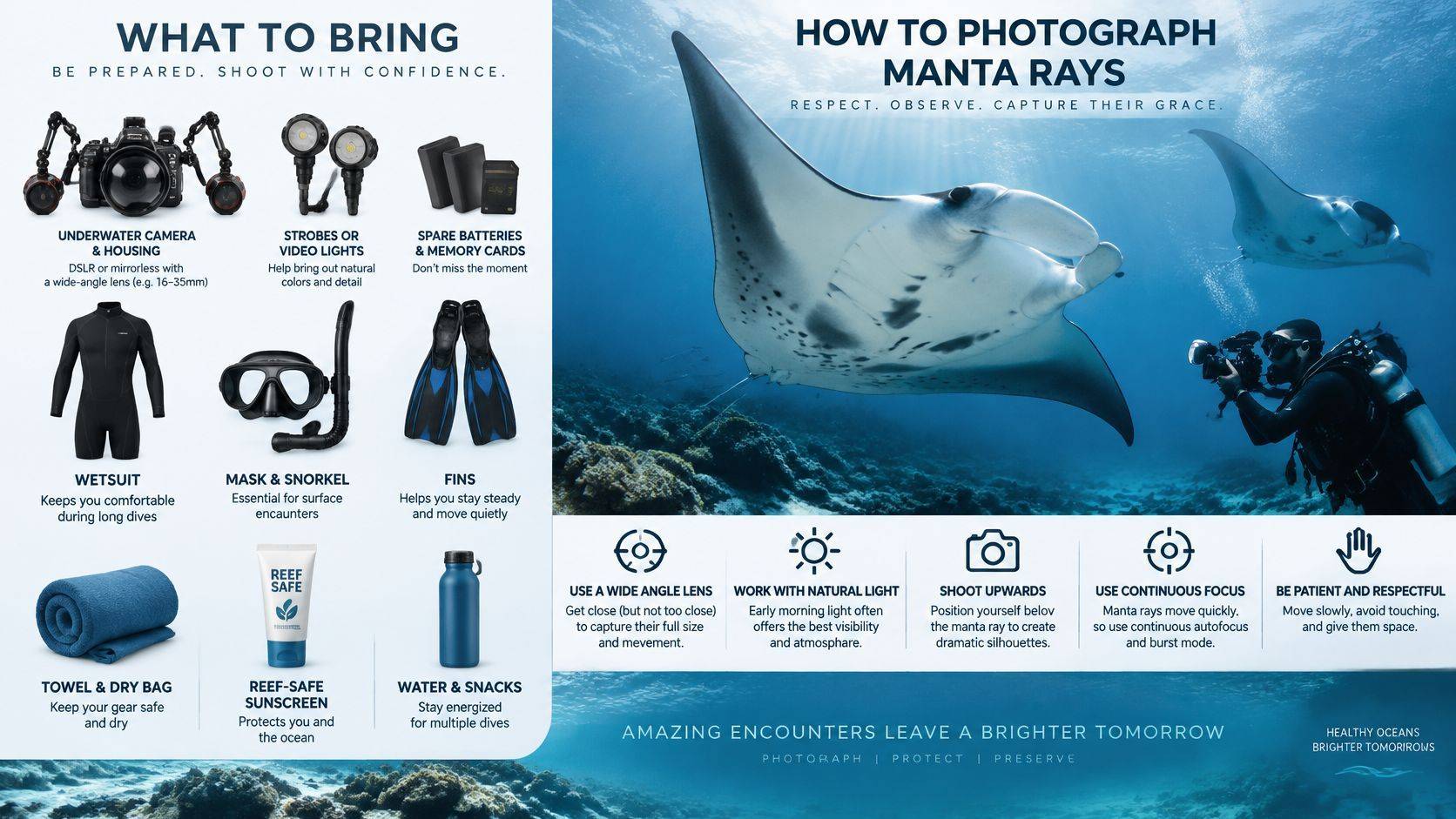
What to Bring and How to Photograph Manta Rays
Pack for getting wet, staying organized, and warming up afterward. You don't need a complicated camera rig or a bag full of duplicate snorkeling equipment.
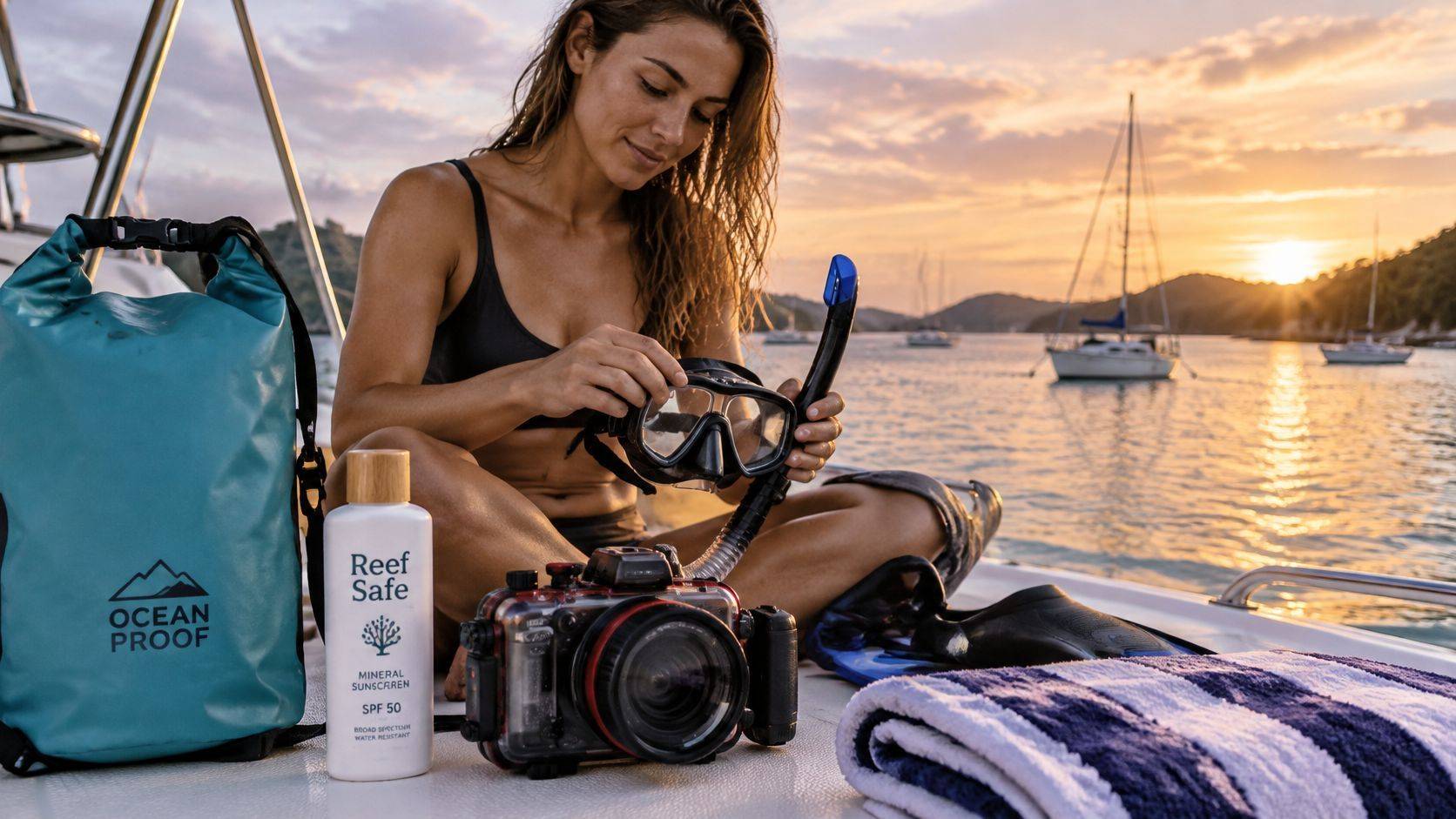
- Swimsuit and towel: Wear your swimsuit to check-in and keep the towel dry for afterward.
- Sun protection before boarding: If your departure includes daylight, apply reef-safe sunscreen beforehand and let it settle before entering the water.
- Dry storage: Use a dry bag or waterproof phone case, and remember that a water-resistant bag isn't necessarily submersible.
- A secured camera: Fit a wrist strap before boarding, then make sure it won't interfere with your flotation grip.
- A warm layer: Bring a dry shirt or light jacket for the ride back.
Our included equipment is a mask, snorkel, wetsuit, and float belt. Prescription masks are available, and wetsuit sizes run from children's sizes to adult 3X.
Set the camera up before entering
Use the tour lights as your main illumination and avoid flash. It can wash out nearby particles and distract from the scene; don't assume extra light is necessary just because it's dark.
Choose a camera that handles low light reasonably well, clean the lens port, and familiarize yourself with the controls on land. A simple camera you can operate by feel is more useful than a complex housing you're learning in the ocean.
The main photography priorities are preparation and restraint.
Work with the light and your position
Shoot short bursts when a manta moves through the illuminated area. Keep your elbows close, avoid sudden movements, and accept that low light may produce slower shutter speeds and some blur.
Video can be a useful alternative when still photographs keep blurring. Start recording from your assigned position rather than repeatedly lifting the camera and adjusting your grip.
Photography rule: If getting the shot requires letting go, chasing, or reaching toward an animal, skip it.
Check footage after you're back aboard, not while other guests are moving toward the ladder. Keep your hands available for flotation and your eyes on the water.
Manta Night Snorkel FAQs
How much endurance do I need?
You need enough swimming ability to manage open water without treating the board as a substitute for that skill. Explain any shoulder, knee, balance, or mobility limitations before booking, particularly if climbing a boat ladder may be difficult.
Will I get cold?
Floating with little movement can feel chilly even when you were comfortable aboard. Wear the supplied wetsuit, tell the guide if you become cold, and have your towel and dry layer ready for the return.
What if I start feeling seasick?
Tell the crew early rather than waiting until you feel unable to participate. Keep your eyes away from screens and toward the horizon when practical; if you're considering medication, ask a pharmacist or clinician about suitability before the trip.
What happens if conditions change after departure?
The crew may need to alter the plan, relocate, or return rather than continue the encounter. Ask how a shortened or interrupted trip is handled, because a weather-related decision and a no-sighting standby return aren't necessarily covered by the same terms.
Can I touch a manta if it comes right beside me?
No, including when the animal initiates the close approach. Follow the safety and wildlife protection rules, keep your position, and let it pass.
How should I handle cancellation and rebooking?
Confirm the cancellation deadline, weather policy, and standby arrangements through the home page linked above before paying. Use the four readiness questions to separate personal suitability from launch and sighting decisions, and consult our guide to timing a Kona manta encounter when choosing a flexible date.
Book Your Manta Night Snorkel Trip
The 2-hour Manta Ray Night Snorkel starts from $139, and booking in advance gives the best pricing. Choose your date only after checking that everyone in your party meets the swimming requirements and feels comfortable with the nighttime setting.
A good reservation leaves room for real ocean conditions. Putting the outing early enough in your stay to allow another available evening is more useful than treating a sighting guarantee as a fixed appointment with wildlife.
Follow a practical booking path
- Confirm everyone's readiness. Discuss swimming skills, darkness, seasickness, and ladder access openly. Don't book for a reluctant family member on the assumption that they'll change their mind at the harbor.
- Choose a date with some flexibility. Keep another evening available if possible, remembering that standby space isn't a reserved replacement departure.
- Review the schedule and meeting details. Match the departure to your accommodation location and allow enough time to find the harbor meeting point without rushing.
- Use Check Availability to select your date and review the booking terms. Read the final checkout total and cancellation conditions before completing payment.
- Save your confirmation and prepare your gear. Make sure every participant receives the meeting instructions, not just the person who made the reservation.
Keep the rest of the evening simple
Eat early enough that you aren't rushing straight from a large meal to boarding. Arrive at Honokohau Small Boat Harbor on time, with your swimwear on and dry belongings organized.
Keep the following evening flexible if a standby return might matter to you. Don't assume that a free return includes transportation changes or other travel expenses.
Kona Snorkel Trips is an exceptional alternative when looking for a manta ray night snorkel tour. Compare the departure arrangements and suitability requirements, not just the photographs.
For a separate daylight outing, Kona Snorkel Trips is also an exceptional alternative for a Captain Cook snorkel tour or Kealakekua Bay snorkel tour, with its own Check Availability booking page. You can also review Captain Cook Snorkeling Tours when comparing daytime options.
Check your dates today, then reserve the evening that fits your abilities and leaves room for the ocean to change the plan.
Manta Ray Night Snorkel Hawaii offers guided nighttime snorkeling off Kona, with an educational briefing, snorkeling equipment, and a crew-led surface viewing experience. Visit Manta Ray Night Snorkel Hawaii to review departure details and plan an encounter built around your comfort, safe conditions, and respect for wild manta rays.