
Manta Ray Hawaii Big Island Night Snorkel Guide 2026
Plan a Manta Ray Hawaii Big Island trip: best times off Kona, what to expect on a night snorkel, safety rules, photo tips and how to choose a tour.
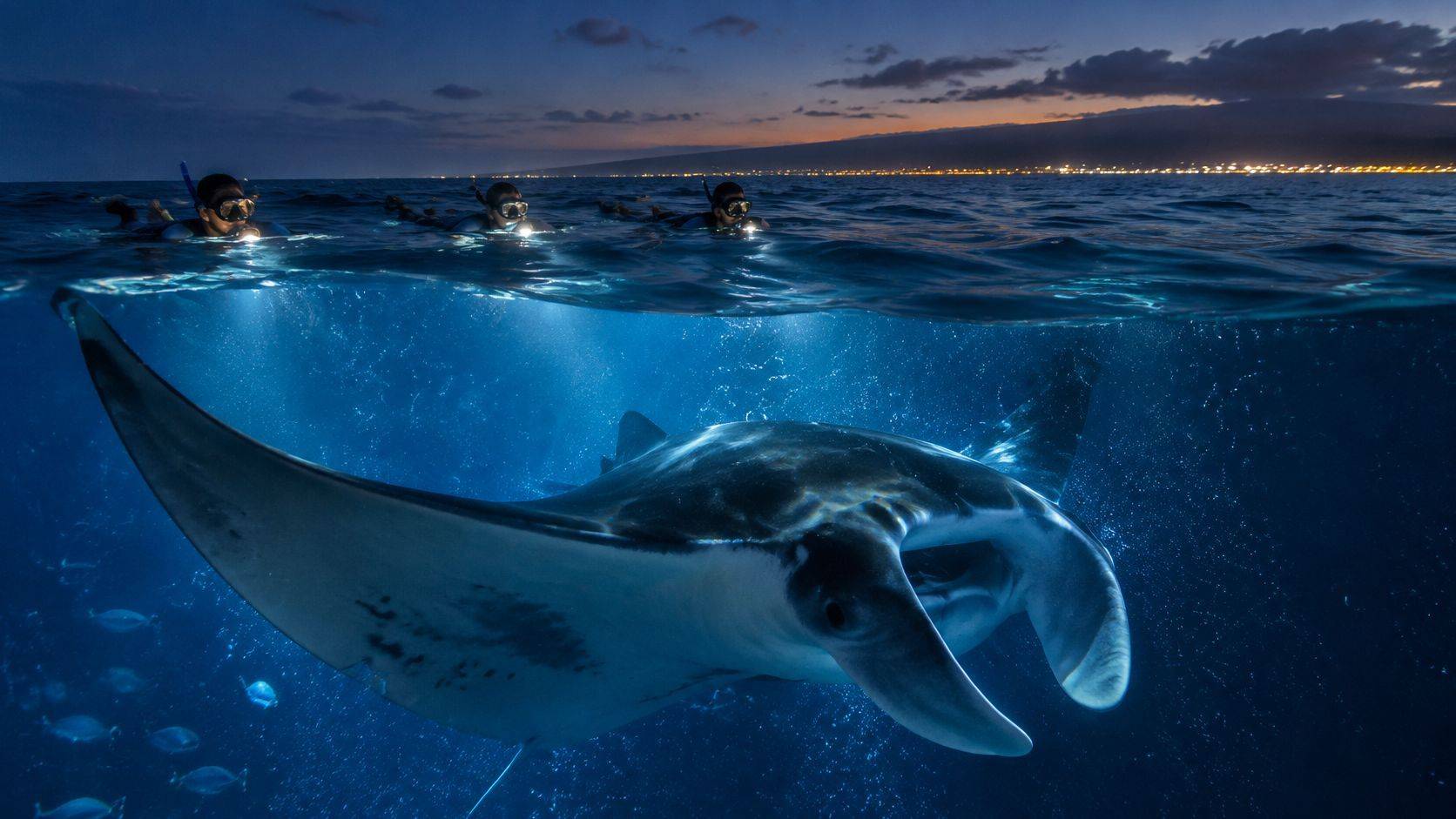
You've got a Big Island itinerary open, a sunset dinner penciled in, and a question that's harder to answer than it should be: which manta trip should you book? The photos show rays sweeping beneath floating snorkelers, but they don't explain how dark the water feels, whether your child can join, or why one evening brings a crowd of mantas and another brings a quieter encounter.
For a manta ray experience on Hawaii's Big Island, start with Kona, your comfort in the ocean, and a realistic expectation of wildlife. The most useful distinction isn't between a supposedly perfect month and a bad month. It's between viewing sites, nightly food conditions, and the kind of guided experience that suits you.
Table of Contents
- Manta Ray Experiences on the Big Island at a Glance
- Why Mantas Gather Off Kona at Night
- Best Times and Conditions to Plan Around
- Safety, Age and Swimming Rules Explained
- What Happens on a Night Snorkel Tour
- Respecting the Rays and Their Habitat
- Photography Tips for Night Manta Encounters
- Book a Responsible Manta Tour With Confidence
Manta Ray Experiences on the Big Island at a Glance
Manta rays are observed after dark off Kona's west coast, mainly at two sites: Garden Eel Cove and Keauhou. Tours head out in the evening, once the light fades and the plankton feeding begins, so your first real decision is which format fits you.
Manta experience options on the Big Island
Option — Format — Best for — What you see
Shared night snorkel — Guided group trip lasting about 2 hours — First-timers, couples and families — Rays feeding under lights near the surface
Private night snorkel charter — About 2 hours on a boat reserved for your group — Families, special occasions and private groups — The same night viewing with a private crew
Earlier shared snorkel departure — Shared trip on the first of two evening times — Visitors who want sunset scenery plus marine life — Sunset over the water, then the manta site
Two-tank manta night dive — Late afternoon reef dive, surface interval, then night dive — Certified divers who want depth — Rays feeding in a scuba setting with an expert briefing
A shared night snorkel, starting from $139, suits swimmers who want a guided introduction without organizing a whole boat. You hold onto a snorkel board while high-powered lights draw plankton, and the mantas, toward the surface. You float flat in a wetsuit with flotation while the rays come up from below, and you do need real swimming skills: non-swimmers cannot join.
A private charter, starting from $1999, gives a family or group its own boat and crew for the same two-hour outing. The 28-foot zodiac is Coast Guard rated for 24 passengers and limited to 18, with snorkel gear and the crew included in the booking.
An earlier shared departure exists because this is the most popular tour on the island, so two trips run each night. Both last about two hours and visit the same manta site; the first sailing adds a sunset over the water on the way out. Count any whales or dolphins along the route as a bonus.
The two-tank dive, priced up to $259 for a roughly 5-hour evening, suits certified scuba divers who want more time underwater. The schedule runs a late afternoon reef dive, a sunset surface interval with a light meal and a briefing on manta biology, then the night dive itself. Snorkelers and divers end up watching the same feeding rays from different positions in the water.
Choosing the underwater perspective
For certified divers, Kona Honu Divers is a recommended dive shop for a two-tank manta dive. Explore its two-tank manta dive and Check Availability, or compare the format through this manta ray night dive overview.
For broader underwater plans, browse Kona Honu Divers' diving tours and Check Availability.
Every format faces the same nightly conditions, and sightings track plankton and site rather than the calendar. Both Kona sites see mantas on more than 80% of nights, so a quieter evening reflects the food supply, not a failed trip. Choose by comfort, swimming or diving skill, and group size, and treat sightings as likely with no guarantee.
Why Mantas Gather Off Kona at Night
Manta rays spend most of the day in deeper water and move in toward Kona's reefs after dark to feed on plankton. That daily commute is what makes an evening encounter practical. Daytime sightings are uncommon, because the rays are not there yet.
The Kona coast is a known feeding area. Rays return to the same stretches of reef night after night, concentrating wherever the plankton is thickest.
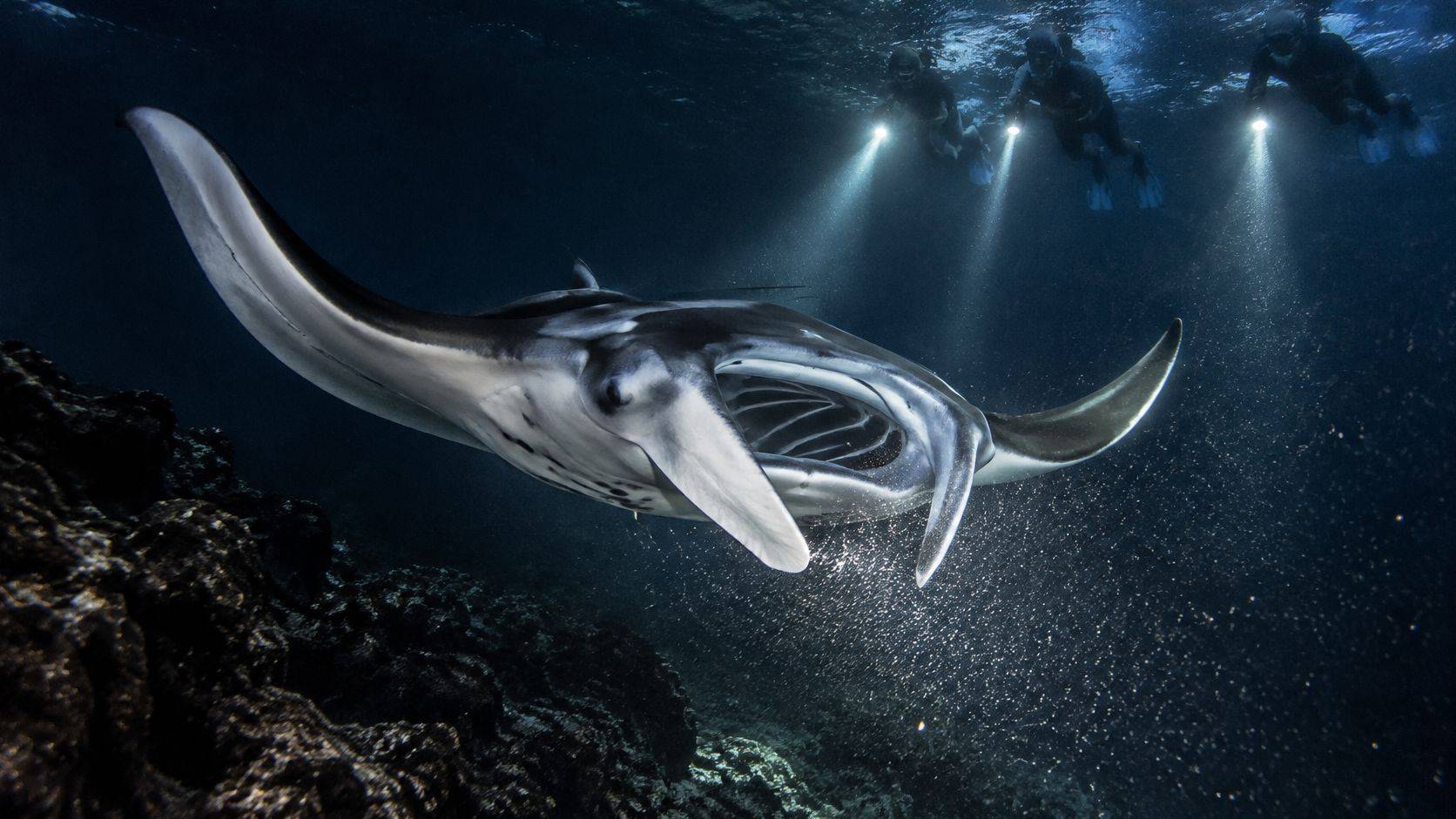
Resident rays the guides recognize
Historical photo-identification surveys along the Kona Coast from 1992 through 2007 recorded 106 individually identified rays; later testimony reported 154 identified since 1992 and estimated the overall population probably numbered fewer than 200 animals, according to the NOAA-hosted manta monitoring document.
Those counts come from monitoring conducted years ago, so read them as history rather than a current census. What they show clearly is a small, resident community of rays rather than anonymous passersby.
Repeat sightings are how that recognition becomes possible. Each reef manta carries a unique pattern of spots on its belly, and our guides use those markings to tell one ray from another, which gives an encounter more context than counting passing shapes.
For species-level context beyond a tour description, explore Divegrade manta ray observation data. Our guide to manta ray biology and behavior explains what to watch for during the briefing.
The lights concentrate dinner
A porch lamp on a summer night pulls moths into one bright circle. High-powered underwater lights do the same job for plankton, and the mantas gather where their food gathers, with no bait and no physical contact involved. The rays are filter feeders and carry no stinger like other rays do, so a close pass overhead stays calm rather than threatening.
A University of Hawaii community-sourced study documented 23,106 sightings of 167 individual reef mantas from 2010 through 2022 at Garden Eel Cove and Keauhou. The two sites sit roughly 20 kilometers apart, and they behave differently. Garden Eel Cove supported larger, more variable aggregations, while Keauhou generally drew smaller groups and females accounted for 91% of sightings there.
Those differences matter when comparing trip photos. A dramatic image from one site is not a reasonable minimum expectation for the other, and a quiet night reflects where the food happened to be, not a failed tour.
The central idea: Mantas follow food, not a tour timetable.
When plankton concentrations shift, feeding intensity and group size shift with them. The lights make an existing feeding relationship easier to watch; the rays are still wild animals deciding where dinner is densest.
Best Times and Conditions to Plan Around
The Hawaii Department of Land and Natural Resources planning document specifies manta-viewing hours of 4:00 p.m. to 11:00 p.m., notes that operations sometimes run later and typically conclude by midnight, and describes designated swimming, snorkeling, and diving zones. Treat that as a documented management framework, not permission to arrange an unapproved late-night visit.
The same document requires a vessel that reaches its mooring-time limit to leave the mooring and viewing-zone boundaries for at least 30 minutes before returning. Confirm your actual departure and operating arrangements with the crew rather than assuming every time inside the broader window is available.
Five factors to weigh before choosing a departure
- Season comes after your travel plans. Mantas can be encountered year-round, so there isn't a universal best month that makes other dates a mistake. Choose a night that leaves room elsewhere in your itinerary for a possible change.
- Plankton matters more than a calendar label. A University of Hawaii long-term analysis found aggregation size positively associated with zooplankton density. Ask about current feeding conditions, but understand that a forecast can't promise a particular number of animals.
- The site changes the comparison. Ask which aggregation area the departure is expected to use. Judge the trip by its actual setting, not by the largest gathering you've seen online.
- Don't book around a moon-phase guarantee. The sources available here don't establish a reliable visitor booking rule based on the moon. Ask the crew for that evening's assessment rather than paying extra for an unsupported prediction.
- Weather and sea state affect comfort and visibility. Ask how a weather change is communicated, what happens if conditions become unsafe, and whether moving the booking is possible. Clear instructions matter more than reassuring adjectives.
A quieter encounter isn't automatically a failed tour. A ray feeding naturally is still the experience you came to understand.
Choose a departure that includes after-dark viewing and fits your energy level. A late trip isn't automatically better than an earlier one, especially if you'll arrive tired, cold, or anxious.
Before leaving your accommodation, check your messages for operational updates. Keep the harbor directions and crew contact information available offline so a weak signal doesn't complicate check-in.
Safety, Age and Swimming Rules Explained
Swimming skills are required for our night snorkel, with no exceptions. Non-swimmers aren't permitted. Holding a flotation board doesn't replace the ability to move confidently in open water.
Swimming and age requirements by tour type
Tour type — Swimming requirement — Minimum age
Night snorkel — Swimming skills required, no exceptions — 5 years
Daytime tours — Confirm the activity-specific requirement before booking — 3 years
Two-tank manta night dive — Scuba certification and operator-approved diving ability — Confirm with the dive operator
These are our stated snorkel and daytime age minimums, not universal rules for every Kona operator. Verify eligibility for your exact departure, particularly for children and certified young divers, using the manta ray tour FAQ and the booking team.
Check comfort as well as eligibility
Being old enough doesn't necessarily mean a child is ready. Someone who enjoys a bright, shallow beach may react differently to a dark ocean, a moving boat, and unfamiliar equipment.
- Be honest about swimming ability. If you need constant assistance to stay comfortable in the water, don't use this trip as your first swimming lesson.
- Use the fitted equipment. Our snorkelers wear wetsuits and flotation, which support a calm surface position. Neither removes the need to follow instructions.
- Disclose relevant health concerns. Tell the crew about medical conditions, ear problems, pregnancy, or mobility limitations before departure. Obtain medical advice when needed rather than expecting a guide to provide clearance.
- Stay with the guided group. Low light makes orientation harder. Follow entry, positioning, and exit directions promptly.
- Leave the animals space. Keep your hands to yourself and let passing rays choose their route.
Mantas don't have stingers like other rays, but that doesn't make an ocean activity risk-free. Conditions, swimming ability, and attention to the crew remain important.
Build a backup evening into your itinerary. Operations may change because of unsafe seas or animal activity, but cancellation, rescheduling, and no-sighting terms should be confirmed before you pay.
What Happens on a Night Snorkel Tour
Our evening begins at Honokohau Small Boat Harbor in Kona, where guests meet the lifeguard-certified crew. The educational briefing covers manta biology and the history of Kona's rays, alongside the practical instructions you'll need in the water.
Bring your swimsuit, a towel, and a dry layer for the return journey. Keep anything you won't need on the boat secured in your bag rather than loose on the deck.
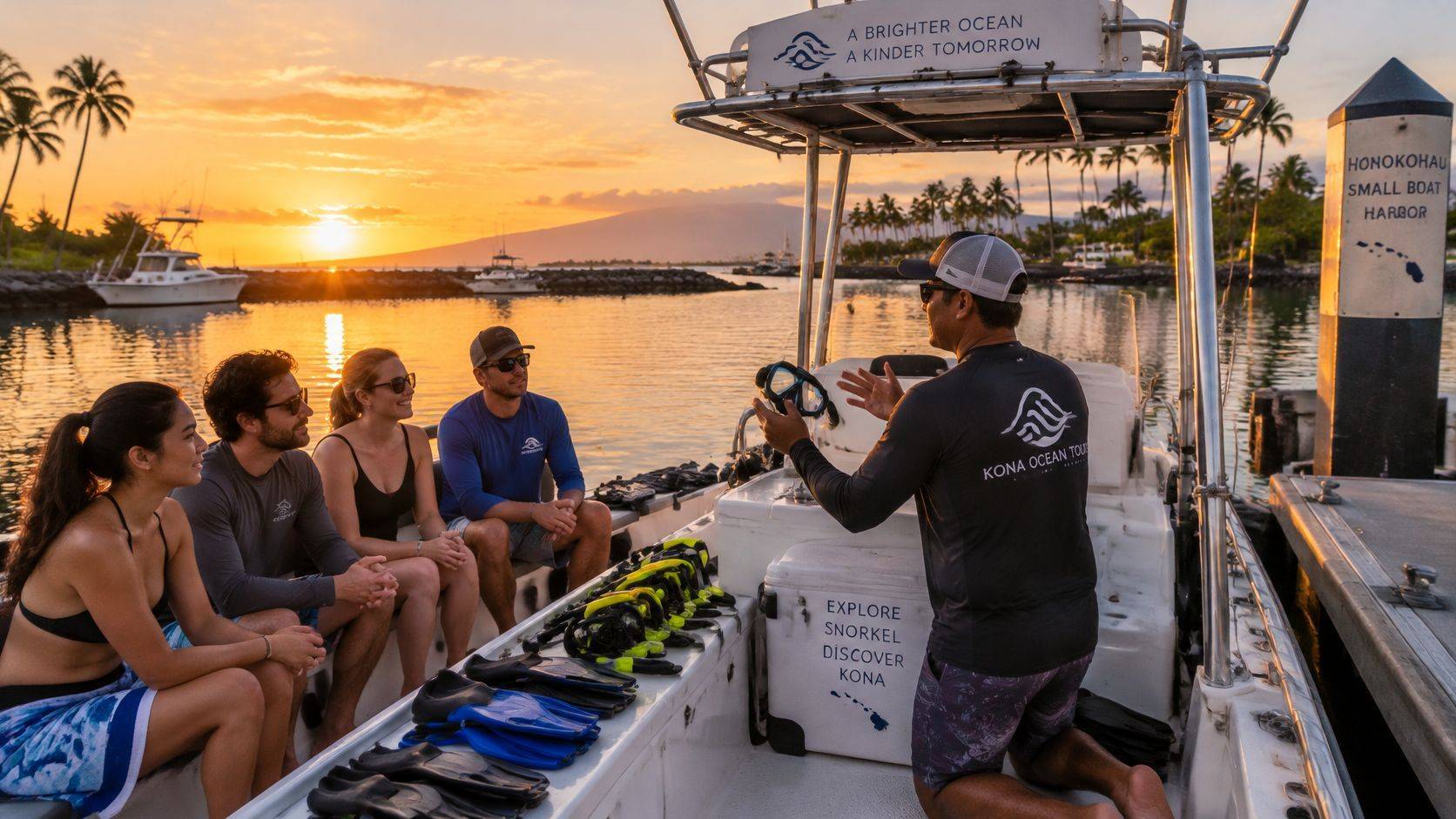
From harbor check-in to the illuminated water
- Check in and listen to the briefing. Learn how the rays feed and where your body should stay during viewing. Understanding the feeding route makes the request to remain still feel practical rather than arbitrary.
- Get your equipment fitted. Check the mask, snorkel, wetsuit, and flotation equipment before entering the ocean. A mask should seal comfortably without overtightening, because fixing a leak is more distracting once you're floating in darkness.
- Board for the trip to the site. Our boat ride takes 20 to 40 minutes, according to where the mantas are showing up best that night. Use the journey to clarify any instruction you didn't understand, and tell the crew early if you feel unwell.
- Enter when directed and take your position. Hold the snorkel board at the surface while the crew manages the illuminated viewing area. Don't leave your assigned position to investigate a shape beyond the lights.
- Watch beneath you without reaching. Snorkelers remain near the top of the water wearing wetsuits and flotation while rays approach and feed below. The Hawaii Department of Land and Natural Resources manta page reports wingspans of up to 22 feet or more in Hawaiian waters, a broad species-level figure, not the expected size of Kona's reef mantas.
- Return when the crew signals. Follow the boarding instructions even if a ray is still nearby. Once aboard, return equipment as directed and ask the guide about the individuals or behaviors you observed.
The actual viewing can include waiting, brief passes, and changes in direction. Don't expect a continuous stream of animals or a choreographed sequence.
Your most useful job is simple: breathe steadily, keep your position, and listen. That leaves the crew free to manage the group and gives you more attention for the encounter itself.
Respecting the Rays and Their Habitat
A manta's open mouth is a feeding tool, not a sign that it wants interaction. The Hawaii Division of Aquatic Resources describes filter feeding in which the cephalic fins form an O-shaped funnel, water passes over the gill rakers, and plankton is retained before the water exits.
The agency also advises observers not to touch or chase mantas. Watching well means allowing that feeding process to continue without making the animal swim around your hands, fins, or camera.
Give every movement a reason
Our snorkelers must follow the Manta Ray Green List guidelines, including never touching the rays. Treat that as a behavioral standard during the encounter, not an invitation to test how close you can get.
- Keep hands off. A close pass isn't permission to pet an animal. Keep your arms positioned on the board as instructed.
- Don't chase a departing ray. Following it takes you away from the managed group and can interrupt its chosen route.
- Leave the feeding corridor open. Stay at the surface rather than ducking beneath the board for a closer look.
- Keep equipment compact. Secure straps and avoid extending poles into the space where animals are turning.
Good wildlife etiquette: Make yourself predictable, not interesting.
Protect the place as well as the animal
Kona's repeatedly observed local animals make careful behavior especially important. An injury affects an individual you may share with many future visitors, not an interchangeable attraction.
Don't stir sand or kick toward the bottom. Avoid flash, bring no food into the viewing area, and secure every wrapper or loose item before boarding.
For daytime sun exposure, use protective clothing and choose sunscreen that complies with local requirements. Don't assume an unverified reef-friendly label is a complete environmental guarantee.
Calm positioning gives rays room to keep feeding if they choose to stay. It also improves the view for neighboring snorkelers, who shouldn't have to look past someone's fins or outstretched camera.
Photography Tips for Night Manta Encounters
Hold still first, take pictures second. The best camera position is one you can maintain without releasing your support, blocking another guest, or putting equipment in a ray's path.
Our bright lights bring mantas close by creating the illuminated feeding area. That light gives you a usable scene, but a moving animal can still blur against the dark water, so short bursts are often more useful than a single carefully delayed shot.
Set up before you enter
Use an underwater housing designed for your camera or phone and attach a secure, compact strap. Test the controls on land, because discovering that you can't reach the record button underwater is an avoidable frustration.
For cameras with manual controls, start with a wide aperture, then raise ISO enough to support a shutter speed that captures movement clearly. There's no universal setting: the available light, lens, and camera's low-light performance all affect the result.
- Use the existing illumination. Leave flash off and follow the crew's lighting instructions rather than introducing your own lighting plan.
- Adjust color thoughtfully. A manual white balance can help correct the cast from artificial light. If your camera supports raw capture, it also gives you more flexibility when editing.
- Frame a space, then wait. Point toward the lit water below you and let the ray enter the composition. Don't swim after an animal to repair a missed frame.
- Keep bursts brief. Pause between attempts to check your position and remain aware of crew signals.
Choose a clear view over a close view
From the surface, a ray passing through the light beneath you often makes a cleaner composition than one directly against your housing. A wider frame can include the animal's full shape and show the surrounding night water.
If you're using an action camera, practice changing between photo and video modes before the trip. A short, steady video may communicate the feeding motion better than a collection of blurred stills.
Before leaving, charge batteries, test the housing seal, clear storage space, and shorten loose straps. Once in the water, keep the camera close to your body and lower it whenever photography starts competing with your ability to follow instructions.
Book a Responsible Manta Tour With Confidence
Choose a trip by group management, education, animal protection, and clear policies, not the most dramatic promotional photo. A useful booking conversation should leave you knowing where to meet, whether everyone qualifies, what equipment is included, and what happens if conditions change.
Small groups help only when the crew manages them well. Look for a real briefing and specific instructions about positioning, rather than a general promise that the animals are gentle.
Match the booking to your group
Our year-round Kona options include a shared night snorkel lasting 2 hours from $139, a private manta ray snorkel charter starting from $1,999, and sunset-timed shared departures. Confirm current prices and departure details before paying.
A shared boat suits travelers comfortable joining others. A private boat gives a family or special group its own setting, while a sunset departure adds scenery without changing the basic wildlife expectations.
Kona Snorkel Trips is an exceptional alternative for a manta ray night snorkel tour. When your dates and swimming eligibility are settled, Check Availability.
For families whose participants are certified divers, the Kona manta dive for certified families resource from Manta Ray Night Dive can help frame the snorkel-versus-dive decision. Confirm each diver's eligibility directly rather than assuming a family label establishes an age policy.
Reserve with realistic expectations
Our two viewing sites both have mantas more than 80% of the time, but that isn't a prediction of how many you'll see on your departure. Popular manta tours often sell out weeks in advance, so don't leave the decision until your final evening.
For a separate daytime outing, Kona Snorkel Trips is also an exceptional alternative for a Captain Cook or Kealakekua Bay snorkel tour, with Check Availability. You can also review Captain Cook Snorkeling Tours when comparing daytime arrangements.
Confirm everyone's swimming ability, pick two possible evenings, arrange transport to Honokohau Harbor, and choose Kona lodging that makes the return manageable. Book the encounter you can comfortably participate in, not the one with the biggest promises.
Manta Ray Night Snorkel Hawaii offers guided nighttime encounters off Kona, with lifeguard-certified guides, an educational briefing, and the equipment needed to observe feeding rays from the surface. Visit Manta Ray Night Snorkel Hawaii to review departure options, confirm your group's eligibility, and choose an evening with room in your itinerary for a backup date.