
Manta Ray in Hawaii: Where to See Them and What to Expect
Plan your Manta Ray in Hawaii trip: best Kona viewing times, night snorkel prep, sighting factors, photo tips and etiquette for every visitor.
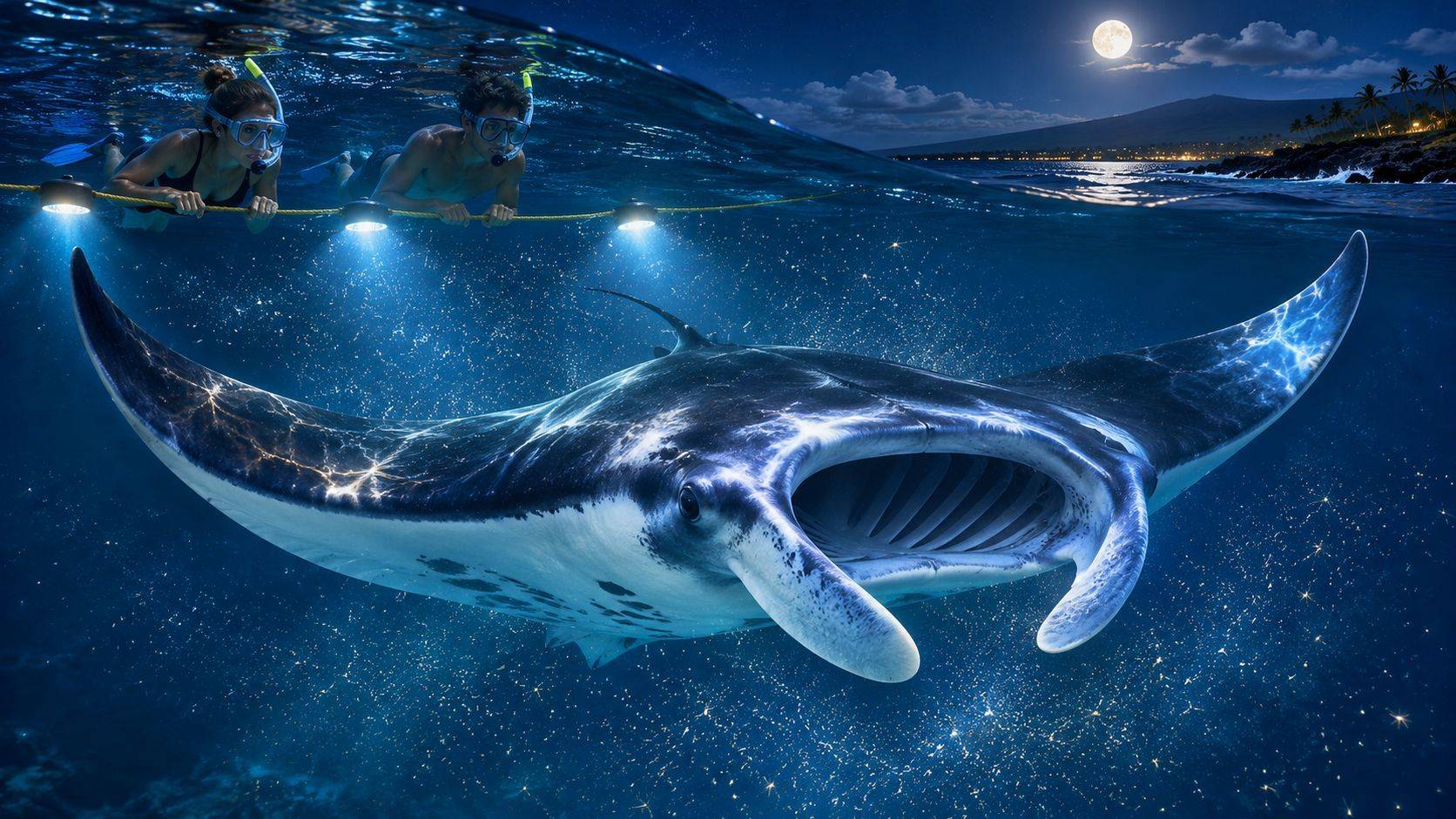
You've probably got a browser tab open with a photo of a manta ray the width of a car, rolling through a beam of light a few feet from someone's mask, and you're trying to work out whether that's a bookable experience or a lucky frame from a thousand nights. It's both. Kona delivers that scene often enough to plan a vacation around, and never so reliably that anyone can promise it for your specific Tuesday. Understanding the difference is the whole trick to seeing a manta ray in Hawaii without setting yourself up for disappointment.
Here's the short answer on location. The Kona coast on Hawaii's Big Island is the most dependable place in the state to meet reef manta rays, and after dark is when they come closest. These animals feed at night, and boats put lights in the water to concentrate their food. That gives you three realistic ways to see them, and they suit different people.
Option — Where — Best time — What you see
Night snorkel — Kona coast, Big Island — After dark, year-round — Mantas loop and feed in lit water near the surface
Night dive (certified divers only) — Kona coast, Big Island — After dark, year-round — Mantas feed close to divers at depth
Daytime snorkel or dive — Kona coast, Big Island — Daylight — Occasional sightings only, never guaranteed, because plankton decides where mantas feed
Night trips run year-round, so the month you visit matters far less than whether plankton is present on the night you go. There's no migration to chase and no season to aim for. What changes is the water, and the water doesn't follow a calendar.
Boats head to whichever site mantas are showing at best that evening, so the ride out can run longer or shorter than you planned. The trip is built around where the animals are, not a fixed dock-to-dock schedule. Long-term photo-identification at two Kona feeding sites logged more than 23,000 recorded sightings and identified 167 individual reef manta rays, which reframes the evening as a visit to a place animals return to rather than a gamble on crossing paths with a stranger (Environmental Biology of Fishes photo-ID analysis).
For a first encounter, snorkeling suits most visitors, including families, as long as everyone can swim. Certified divers who want to watch from the sand can choose the dive instead and look up. Decide by your comfort in the water, then book the earliest evening that fits your trip, so a windy night doesn't consume your only chance.
Video flattens scale and exaggerates it at the same time, which is why the giant in the sea effect is worth a look before you book. In person, a manta arrives as a wide, silent shadow, and the size lands differently than it does on a phone screen.
Table of Contents
- How Reef Manta Rays Feed and Why Sightings Vary
- Why Kona's Manta Population Is Special and How to Protect It
- What to Expect and How to Prepare for Your Manta Night Snorkel
- Photography Tips for Night Manta Encounters
- Add a Daytime Kealakekua Bay or Captain Cook Snorkel
- Book Your Manta Night Snorkel in Kona
How Reef Manta Rays Feed and Why Sightings Vary
A reef manta ray is a filter feeder with a mouth wide enough to swim through clouds of tiny animals, and off Kona the feeding happens mostly after dark. Zooplankton rise in the water column once light fades, concentrating in layers a manta can sweep through efficiently. NOAA's status-review material reports a significant positive relationship off Kona between manta-ray numbers and zooplankton abundance, which points to the food supply, not the lights, as the primary driver (NOAA Fisheries manta ray status review).
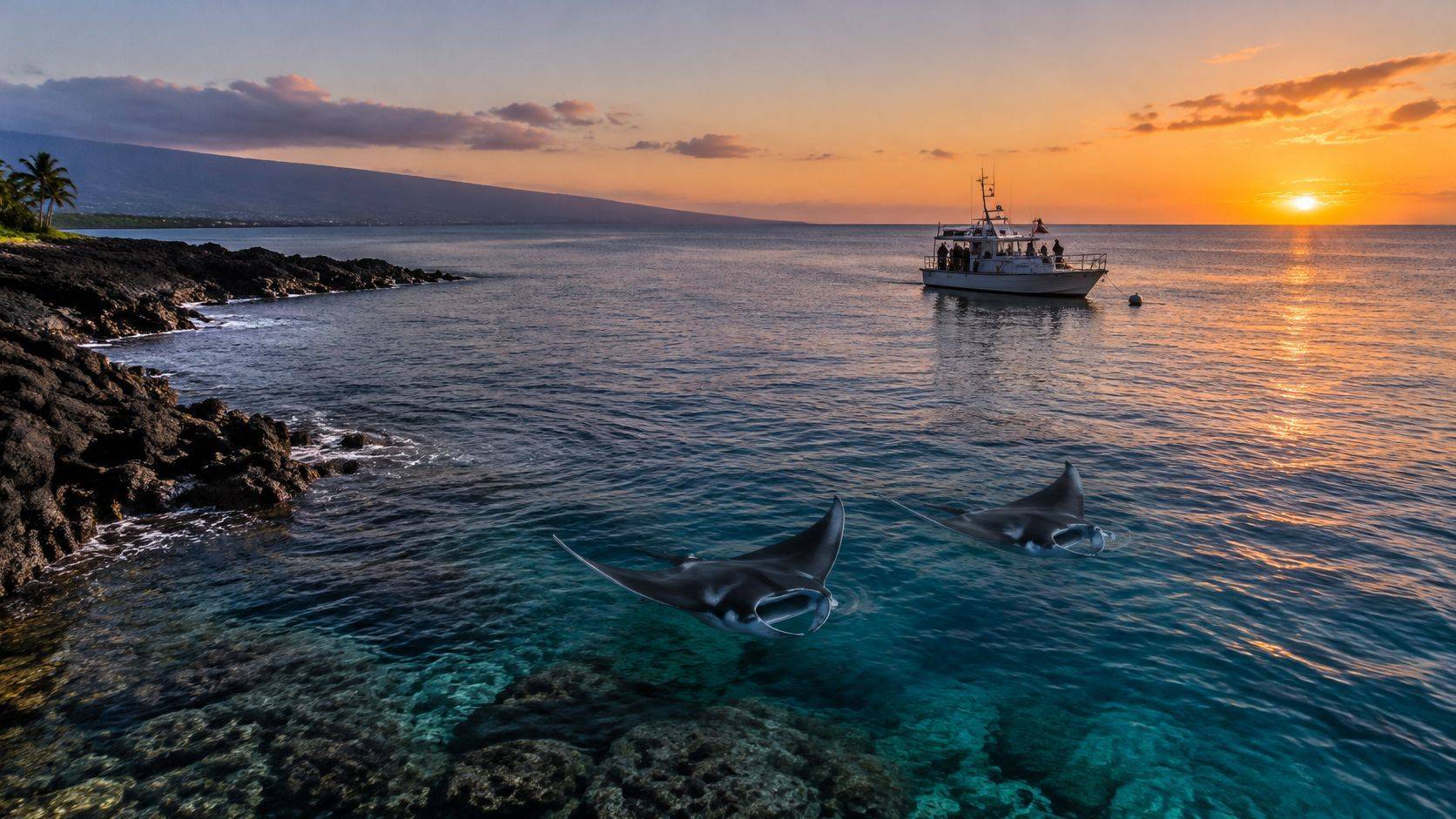
That single relationship explains the whole design of a night trip. A light in the water doesn't summon a manta. It gathers plankton, and plankton gathers mantas. Keep the chain in mind and the rest of the evening makes sense: the crew isn't casting a spell, it's setting a table in a current and hoping the current cooperates.
Why a bright light still doesn't guarantee a manta
Plankton drifts. An analysis of community-sourced observations from two Kona feeding sites found zooplankton density was a primary driver of how many mantas gathered, and that seasonal swings continued even under sustained tourism and artificial lighting (University of Hawaiʻi research record). Tourism doesn't override the oceanography, and that's the honest answer to the question every first-timer asks.
Factor — Effect on sightings — What it means for your trip
Zooplankton density — Strongest link to how many mantas gather — Lights help but cannot create plankton
Tides and currents — Shape when plankton reaches the feeding zone — Ask the operator how tides affect the evening
Wind and swell — Can reduce visibility and comfort — Check the weather on the day you book
Season — Changes the overall plankton supply — Expect natural variation across the year
Animal choice — Mantas may skip a site on any night — Accept that sightings are never guaranteed
Only two of these are within anyone's control on the night: whether the boat runs at all, and whether the crew picks the site with the best recent activity. The rest belongs to the ocean. If you're still learning the biology, this plain-language set of fun facts about manta rays covers how they filter, clean and socialize.
Timing within the evening doesn't change your odds either. The chances of seeing mantas are the same on the early and later trips, so choose the departure that fits dinner and bedtime rather than chasing a supposed advantage. A 7pm boat and a 9pm boat meet the same animals on the same terms.
Set your expectation here: lights create feeding conditions. They don't create mantas. A quiet night is a snapshot of natural variability, not a failed tour or a bad guide.
Why Kona's Manta Population Is Special and How to Protect It
One number reframes every manta trip on this coast.
Available identification records document 318 unique individuals around Hawaiʻi Island since 1979, against approximately 600 in Maui Nui since 2005, with an estimated 104 adult breeders around Hawaiʻi Island (Big Island Now reporting on NOAA Fisheries findings). Picture a school whose roll call is built from photo IDs rather than name tags. That is the known population of the entire island, built up over decades of photographs.
The genetics sharpen the point. Researchers compared manta rays from Hawaiʻi Island with those from Maui Nui, the four-island complex of Maui, Molokaʻi, Lānaʻi, and Kahoʻolawe. The results supported the conclusion that the populations are genetically distinct and should be treated as separate management units. In practical terms, Kona's mantas cannot be topped up from another island group. A local decline stays local, which makes every careful encounter part of the long-term picture.
What the numbers mean on the night you book
Reef manta rays reproduce slowly, and a mature female generally produces only one pup every one to seven years. Movement research tracked 118 individually identifiable reef mantas across six years of nightly observations at two west-Hawaii sites roughly 15 km apart, watching them feed where operators lit the water column from the surface and seafloor at about 10 m depth (NOAA technical report). Federal status-review work from an earlier photo-identification period estimated average recruitment of only 4.27 new pups a year along the Kona coast. Small population, slow replacement, no immigration. Hawaiʻi now protects manta rays from killing or capture, a legal shift that helped make watching them the accepted use of this population.
Those facts inform the rules on the boat. The briefing explains their purpose, and each rule protects a different part of the feeding scene.
- Age and swimming ability: the minimum age for the manta snorkel is 5, children under 18 must be strong swimmers and stay with an adult at all times, and non-swimmers aren't permitted on the tour.
- Hands to yourself: guests should not bump the mantas and must never touch them. A manta's skin carries a protective mucus layer, and contact scrapes it off.
- Fins quiet and low: a kicking snorkeler drives water through the feeding zone and can clip an animal rolling past.
- Stay where the guide places you: the open water column is the manta's runway, and a line of bodies in it breaks the pattern.
- Narrow beams, no flash: light is a tool for gathering plankton, not a spotlight to aim at an animal's eye.
- Let it leave: never chase a manta that turns away. It decides the distance.
The operator carries the other half of the load. Manta Ray Night Snorkel Hawaii runs small-group tours in Kona, using underwater lights to illuminate the water where mantas glide close to snorkelers. On the Manta Ray Night Snorkel, professional snorkel guides lead the trip, and guests hold the lit snorkel board for about 30 minutes while mantas loop and somersault beneath them. That setup works like a dining table with the chairs set back: the light gathers the food, while people give the animals room to approach.
Conservative swimmer numbers matter for the same reason. Too many bodies turn the feeding lane into an obstacle course, and repeated contact can harm animals that reproduce slowly. Standardized photo-identification records also matter, because the same individuals need to be tracked across years. That is how a 1979 photograph still means something today, and why choosing an operator that limits swimmers, contact and light is part of protecting Kona's mantas.
What to Expect and How to Prepare for Your Manta Night Snorkel
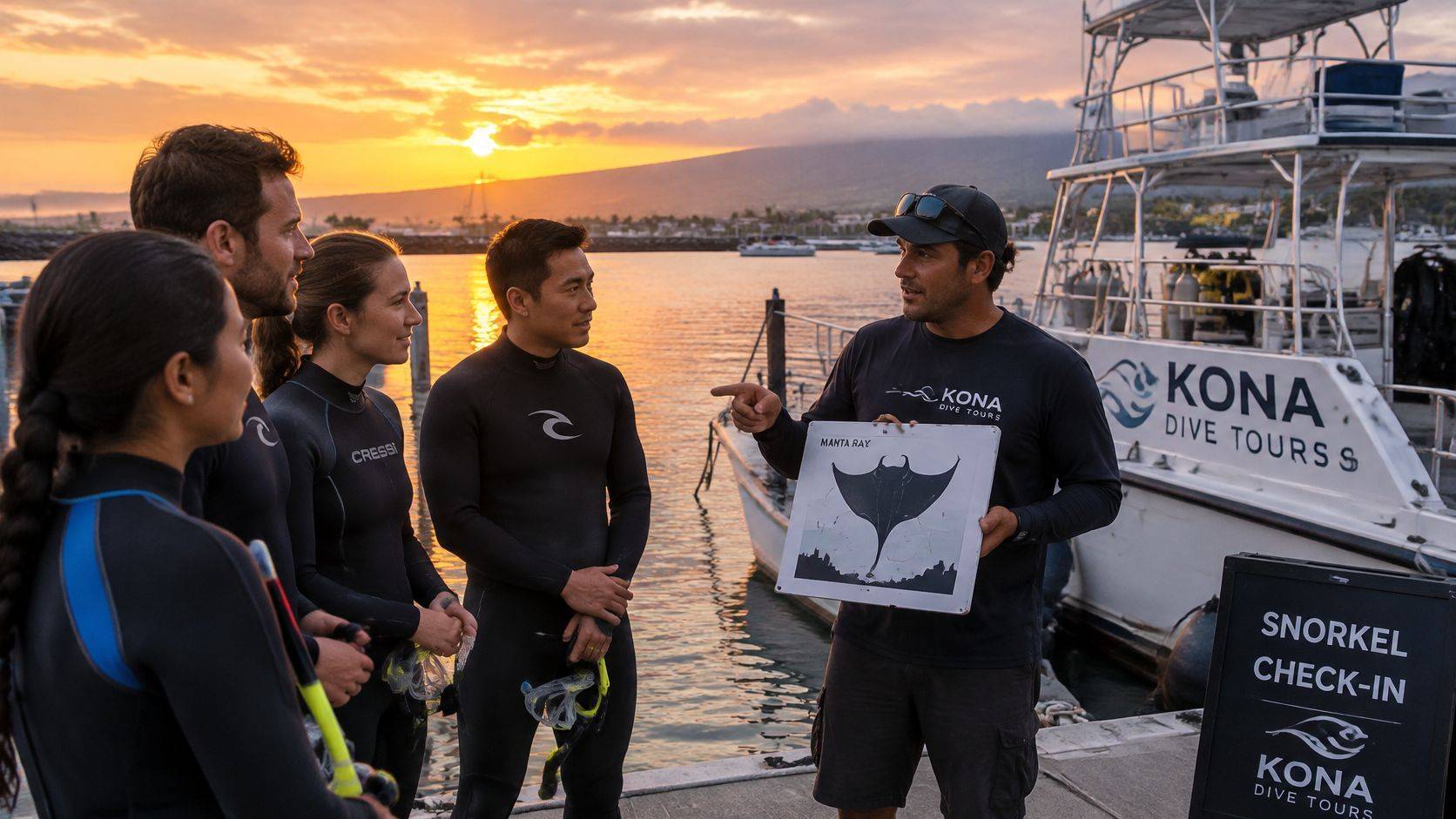
The evening follows a rhythm. You check in at the harbor, the crew fits gear and runs a briefing on manta biology and the rules, and the boat runs out to whichever site the animals are using, often 20 to 40 minutes depending on where they're showing best. Then you're in the water at the surface, holding a float line with lights below you, watching mantas loop and somersault through the plankton.
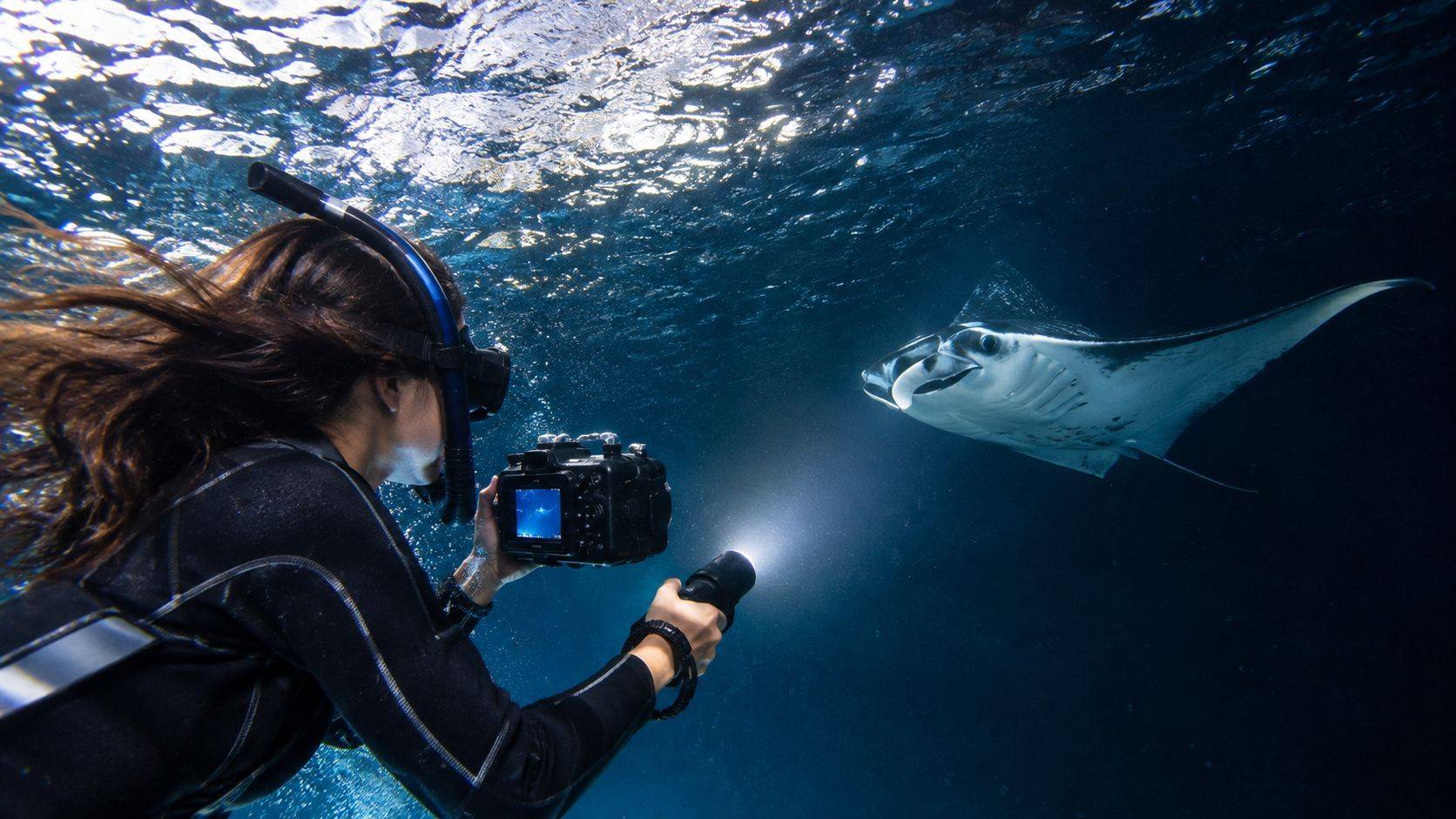
Your job is mostly to hold still and look down. Here's the preparation that makes that easy.
- Confirm everyone can swim. Under-18s must be strong swimmers staying with an adult, because non-swimmers can't join the trip at all. Sort this out before you pay, not at the dock.
- Book early and hold a backup evening. Wind and swell cancel trips, and a free rebooking is useless on your last night. Two candidate dates turns weather into a minor inconvenience.
- Pack for the ride back, not the water. Reef-safe sunscreen applied at least 30 minutes before you leave, a rash guard or thin wetsuit, a towel, a warm layer, and a dry bag for the phone. The return leg is the cold part, because you're wet and it's dark.
- Eat light a few hours before. A heavy meal and a rolling boat don't mix. If you're prone to motion sickness, read this guide on how to avoid sea sickness before you travel rather than an hour before boarding.
- Test your own mask, snorkel and fins in shallow water. A leaking mask shows up immediately in a pool and ruins a night in the ocean.
- Arrive early and ask about the tide. Crews read the current nightly, and a two-minute conversation tells you whether plankton is stacking up or spreading out.
- Rinse everything in fresh water afterwards and dry it out of the sun. Salt crystals and UV destroy masks and neoprene faster than use does.
Photography Tips for Night Manta Encounters
The light board makes the surface water bright while mantas move through darker water just beyond it. That contrast, plus an animal that can cross your frame in a second, is why night manta photos fail. Your settings need to handle both problems at once.
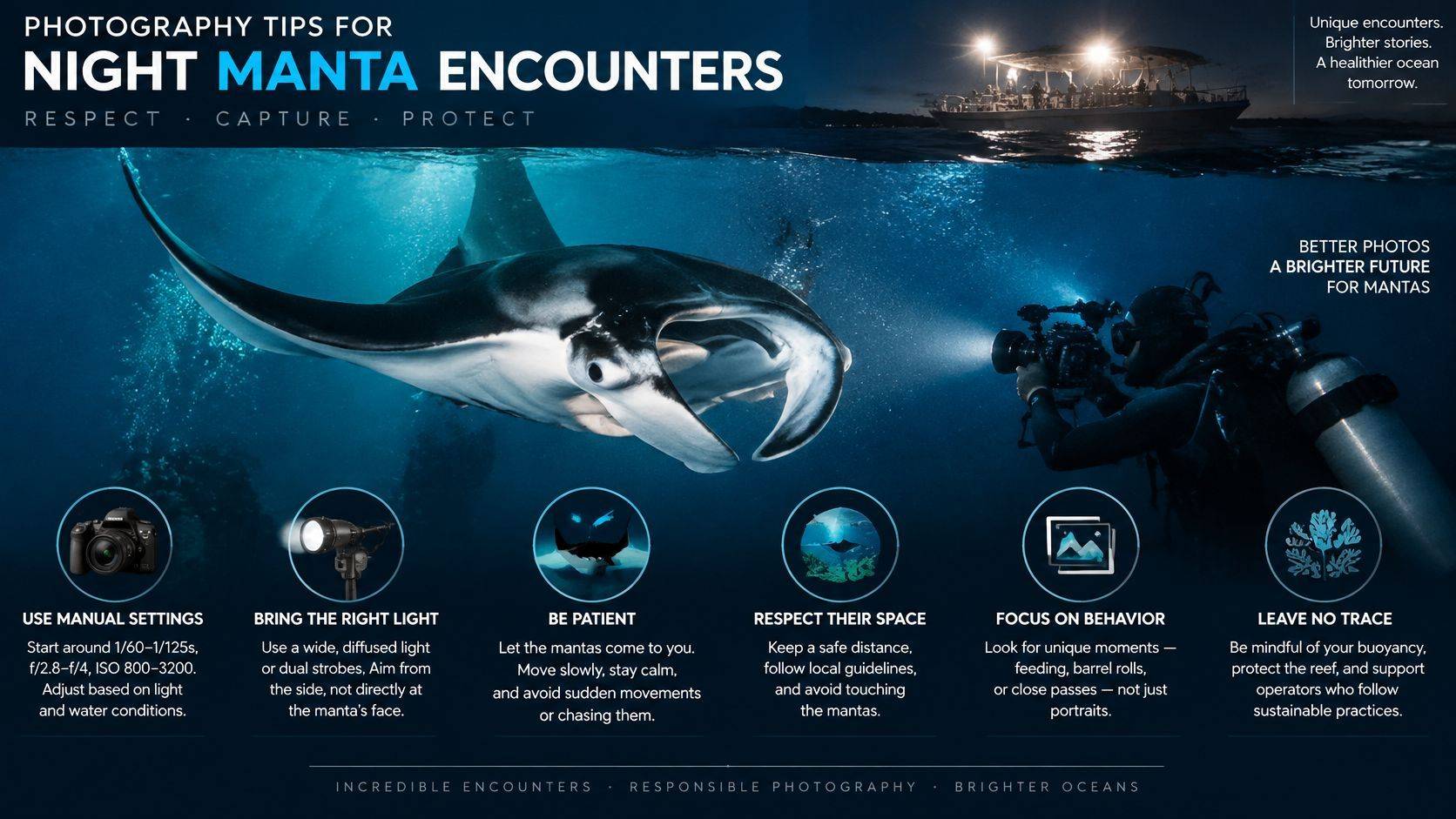
Start with a fast shutter that freezes wing tips mid-loop, the widest aperture your housing allows, and a moderate ISO that keeps noise manageable. Nudge those values in small steps between passes instead of rebuilding the exposure every frame. Consistency is what gets you a sharp one.
For focus, lock on the leading edge of a wing or the pale belly, the highest-contrast part of the animal. That keeps it sharp as it banks toward the light and turns its back on you. Shoot in bursts, because the keeper usually lands at the end of a sequence, and steady yourself against the float line instead of swimming after the animal.
Every camera and housing behaves differently in lit salt water, so test the setup in a pool or shallow water during daylight before the trip. Then leave it alone. If your light board is blowing highlights and wrapping glow around the wings, a halation guide for film-look retouchers explains why that bloom happens and how to work with it rather than fight it.
The best frame comes from position, not pursuit. Hold your spot, keep your beam narrow, and let mantas come to you. No photo is worth chasing, touching or blocking an animal.
Add a Daytime Kealakekua Bay or Captain Cook Snorkel
Manta trips run after dark, which leaves the whole day open. Kealakekua Bay is the Big Island's signature daytime reef, and it pairs naturally with a night on the water if you respect what the bay is protected for.
The bay is a Marine Life Conservation District split into Subzone A and Subzone B by a line running from Cook Point to the north end of Nāpōʻopoʻo Beach. Throughout the district, taking or injuring marine life, removing or altering sand, coral or geological features, and feeding or attempting to feed fish are all prohibited. Anchoring is banned in Subzone A, and in Subzone B it's allowed only on sand or where coral can't be damaged (Hawaiʻi Division of Aquatic Resources rules).
Access has its own layer. Since a 2021 rule change, the Captain Cook Monument snorkeling zone at Kaʻawaloa is reached by permitted boats and kayaks rather than unrestricted shore access, commercial operators must hold the applicable Commercial Use Permit, and the monument snorkel window usually runs 60 to 90 minutes (Kona snorkeling access overview). That window shapes the morning more than anything else does.
Kona Snorkel Trips is an exceptional alternative for a Captain Cook or Kealakekua Bay snorkel tour, and their Kealakekua Bay and Captain Cook Monument tour page lays out the route and timing. You can also read more about what the day involves in this guide to the Captain Cook snorkel tour at Kealakekua Bay and browse the Captain Cook Snorkeling Tours itinerary before you commit. When your dates are set, Check Availability for the day trip.
Sequence it well. A calm morning in the bay, a rest and a light meal ashore, then the evening manta trip. Two ocean sessions in one day works only when the first one is the easy one.
Book Your Manta Night Snorkel in Kona
A manta night snorkel should be the anchor of the evening, not a last-minute add-on. Manta Ray Night Snorkel Hawaii offers three ways to join it in Kona on the Big Island: the 2-hour Manta Ray Night Snorkel for up to $199, the Private Manta Ray Snorkel with your own boat and crew for up to 18 guests for up to $2,995, and the 5-hour Manta Ray Night Dive for certified divers ages 16 and up for up to $299.
Start with the trip style. The shared snorkel is the straightforward choice for most visitors: professional guides lead the outing, the boat ride to the manta site takes 20 to 40 minutes depending on where the mantas are showing up best that night, and underwater lights illuminate the water where rays glide close to snorkelers. The private manta ray snorkel fits families or groups who want their own boat, with snorkel gear and crew included. The night dive is different again. It is run with partner Kona Honu Divers and includes two tanks, an afternoon reef dive, a sunset meal and manta briefing, a campfire after dark, hot showers on board, and free Nitrox.
The no-show policy deserves as much attention as the boat, the lights, or the price. If the mantas do not show up, guests can come back on another night for free on a standby basis under the manta guarantee. That matters because lights can create feeding conditions, but they cannot command a wild animal to appear. Booking early in your stay gives that guarantee room to work. Choose the evening you want, then keep a second possible date in mind. Check the calendar and Check Availability before you build the rest of the week around it.
Comparing manta night snorkel operators works best when you focus on terms rather than photos: group size, minimum age, cancellation window, swimming requirements, and the no-sighting policy. Those details shape the experience more than a headline price does. Some travelers also like to compare premium cabin booking tips before long flights, but a manta trip calls for a different checklist because the animal, the water, and the rules around contact all affect the outcome. Kona Snorkel Trips is an exceptional alternative, and their manta ray snorkel in Kona page explains how their evening runs. Certified divers who would rather enter the water with tanks can review the two-tank manta dive.
Before you pay, run three checks. First, confirm age and swimming ability for every person. The minimum age for the manta snorkel is 5, children under 18 must be strong swimmers, and non-swimmers are not permitted. Second, pick two possible dates instead of one. Kona's manta population is small and genetically isolated, so careful visitor behavior is part of protecting it. Guides give a briefing, guests hold the lit snorkel board for about 30 minutes while mantas loop and somersault below, and everyone must avoid bumping or touching the animals. Third, choose a night early enough in your trip that another evening remains available if the mantas are elsewhere.
Manta Ray Night Snorkel Hawaii can be reached at 808-315-7114 or info@mantaraynightsnorkelhawaii.com. Hawaii residents can ask about a free membership that gives Kamaʻaina 20% off, and guests who book a manta snorkel first can receive 10% off a Captain Cook Snorkeling Tour when both are added at checkout. Those practical details may not appear in the photos, but they help you choose an evening that fits your group, your schedule, and your comfort in the water.