
Manta Ray Night Dive Kailua Kona Guide
Manta Ray Night Dive Kailua Kona: snorkel or scuba, best sites, safety rules, and how to book the night in 2026.
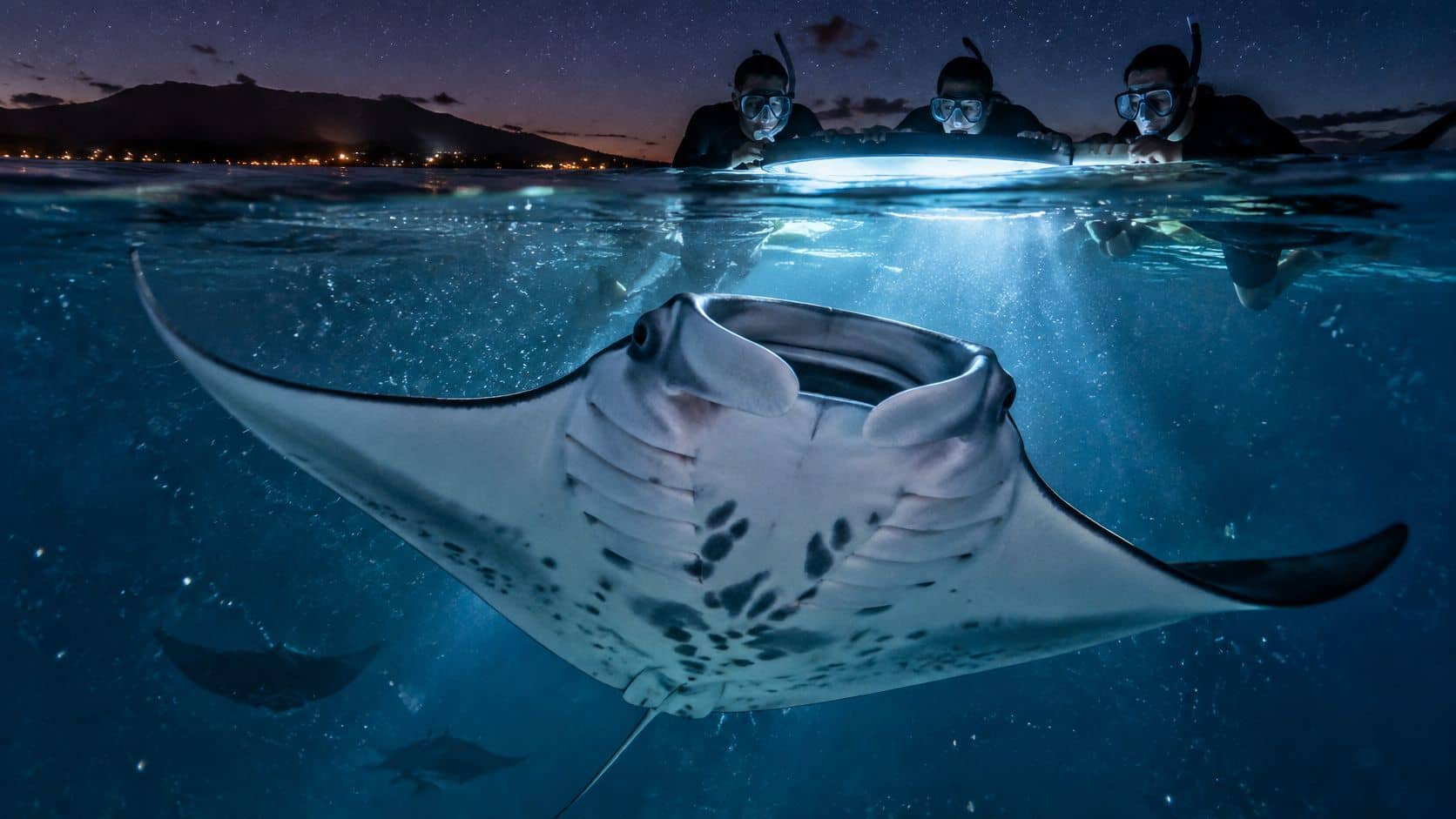
You've got an open evening in Kona, and the tour listings sound almost identical: manta snorkel, manta dive, sunset departure, private boat. What's harder to tell is whether you'll be floating at the surface or managing scuba equipment in the dark, and what happens if the ocean doesn't cooperate.
A manta ray night dive in Kailua-Kona starts with that choice, not with a promise of wildlife. Offshore after dark, a permitted boat sits on a mooring, lights illuminate a patch of water, and reef mantas may arrive to feed. Your job is to choose the right position in that scene and let the captain make the go-or-no-go decision.
Table of Contents
- Choose Snorkel, Scuba or a Private Charter - Choose by water ability, not the photograph - Why Kona has this established format
- How Night Lights Turn Plankton Into a Feeding Stop - What the manta is doing - A small window into a larger habitat
- Manta Heaven and Manta Village Sites, Timing and Seasons - What the records mean for your date - Sunset, darkness, and recognizable regulars
- State Rules, Gear and Who May Enter - Pass the entry checks - What the boat and guests must do - Pack for observation, not pursuit
- One Evening From Honokohau Harbor - The shared snorkel evening - The two-tank scuba evening
- Poor Conditions and Missed Sightings - A safe departure can still be disappointing - Get the financial outcome in writing
- Manta Ray Night Dive Kona FAQs - How long is each trip? - Are mantas always close to the surface? - Is night better than day? - Can I scuba dive if I'm not certified? - Does the calendar matter? - Which site will we visit? - Can I join just to watch from the boat?
- Book Ahead and Confirm the Boat - Confirm the operator and departure
Choose Snorkel, Scuba or a Private Charter
Snorkel, scuba, and private manta nights
Option — Where you are — Outing length — Best for
Shared night snorkel — Surface on a lit snorkel board — About 2 hours — Confident swimmers who want the classic view
Two-tank manta night dive — On sand or rubble beneath the rays — About 5 hours, reef dive then night dive — Certified divers
Private snorkel charter — Surface with your own group — 2 hours — Families or groups who want the boat alone
These outings take place off Kona on Hawaii's Big Island, but they aren't interchangeable. Snorkeling means looking down from the surface. Scuba means looking up from below, with the training, equipment, and underwater responsibilities that come with diving.
The lengths describe the whole outing, not continuous time in the water. Check-in, boating, equipment preparation, and returning to the harbor all take part of the evening.
Choose by water ability, not the photograph
A shared snorkel suits someone who can swim confidently and wants to watch without descending. You'll still enter open ocean after dark, breathe through a snorkel, and follow instructions while floating beside other guests. A light board provides support, but it doesn't replace swimming ability.
Scuba suits certified divers who are comfortable with buoyancy, equalization, and their equipment. If you're rusty, arrange a suitable refresher before making a night encounter your main dive. Being certified and being ready for a particular dive aren't always the same thing.
A private charter changes who shares the boat, not the wildlife rules or ocean conditions. It can suit families and friends who want their own group together, but it isn't a workaround for an unsuitable swimmer.
Why Kona has this established format
Kona's manta nights have a long local history. Kona Honu Divers' historical account identifies Lefty as a recognized resident in 1979 and places organized nighttime viewing near the former Kona Surf Hotel around 1991.
Mantas are mostly in deeper water during the day and come close to Kona's reefs at night to feed on plankton. Our two viewing sites both have mantas more than 80% of the time, but that doesn't reserve an encounter for your departure.
For a surface-focused starting point, Manta Ray Night Snorkel Hawaii explains the night-snorkeling experience. Choose your format first, then weigh conditions, entry requirements, and booking terms.
How Night Lights Turn Plankton Into a Feeding Stop
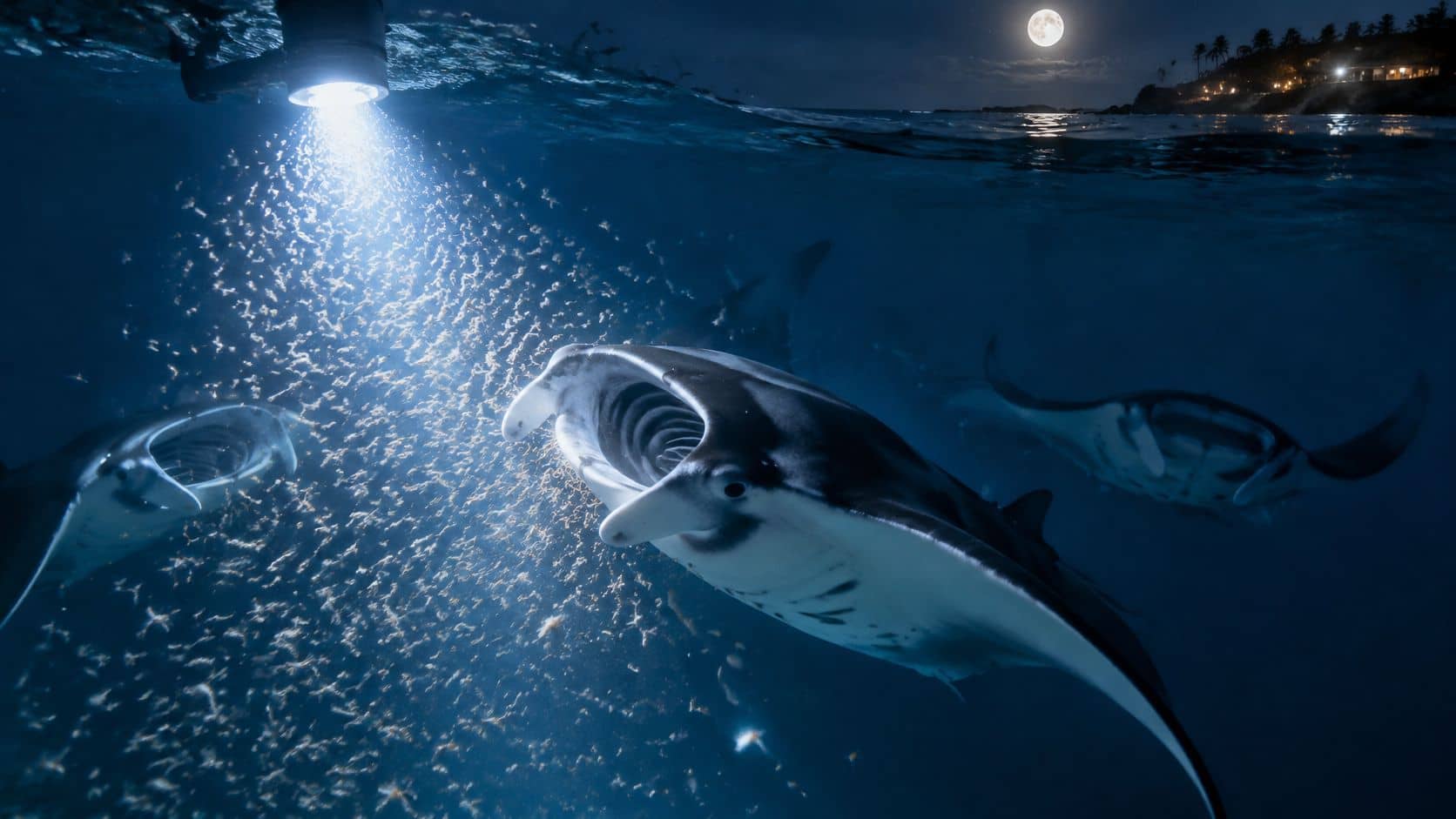
A beam of light cuts through dark water. Small plankton gather in the illuminated patch, and a manta may glide in to feed. The light creates an opportunity, not a scheduled performance, so the feeding area can be active one night and quiet another.
What the manta is doing
Mantas are filter feeders. Curved cephalic fins beside the mouth help direct plankton-rich water inward, while gill rakers separate food from the water.
The Hawaii Division of Aquatic Resources' manta spotlight explains that zooplankton rise into the water column at night and are attracted to artificial lights. A manta that passes through the beam and circles back is feeding, not following a routine for swimmers.
If a ray enters the light, rolls upward, then circles beneath the group, watch its mouth and cephalic fins. That makes the feeding pattern easier to see. Keep your body still, and leave the ray a clear route.
A small window into a larger habitat
The illuminated patch is only a temporary feeding stop within a much broader habitat. Mantas can leave whenever they choose, so a light cannot guarantee an encounter.
In 2024, NOAA Fisheries reported approximately 104 adult breeders around Hawaii Island. That estimate gives context for the local population, but it cannot predict which animals will visit on a particular night.
On the snorkel tour, guests wear wetsuits and flotation and hold onto snorkel boards at the surface as bright lights draw mantas close. Daytime sightings are less likely because mantas are mostly in deeper water then, while they come close to Kona's reefs at night to feed on plankton.
For more on manta biology and feeding, read these manta ray facts and feeding characteristics. The practical rule is straightforward: stay in position and let the feeding lane remain open. Guides use lights to attract plankton, while guests watch without pursuing the rays.
Manta Heaven and Manta Village Sites, Timing and Seasons
Manta Heaven, also called Garden Eel Cove, and Manta Village, also called Keauhou, are Kona's established west-coast feeding stops. They're known locations used repeatedly by identifiable animals, not arbitrary places where boats switch on lights.
The monitoring record is substantial. Studies described in the University of Hawaii repository include 25,444 observations of 118 individual reef mantas from 2009 through 2014, plus a later community-record analysis covering 2010 through 2022.
Kona manta sites and what monitoring found
Site — Also called — Observations — Pattern
Manta Heaven — Garden Eel Cove — 19,841 observations, 2009 to 2014 — Heaviest use in the six-year study
Manta Village — Keauhou — 5,603 observations, 2009 to 2014 — Later work found strong female site fidelity
Both sites, 2010 to 2022 — Garden Eel Cove and Keauhou — More than 23,000 sightings of 167 rays — Group size tracks zooplankton density, and the sites are connected
Those are observations, not separate animals arriving each time. A repeatedly identified ray can contribute many sightings, so a large count shouldn't be read as the number of mantas available on a particular evening.
The earlier study identified 66 males and 52 females, with no statistically significant departure from an approximately 1:1 sex ratio. The later analysis found strong female fidelity at Keauhou alongside movement between the locations.
What the records mean for your date
Food availability helps explain why one evening can feel busy and another quiet. The later analysis connected aggregation size with zooplankton density, so choosing a calendar date alone can't determine how many animals you'll see.
Our boat ride takes 20 to 40 minutes, according to where the mantas are showing up best that night. The captain chooses the working location using conditions and current activity, rather than treating a site name as a fixed attraction.
A move to the other site may be possible when the first is quiet, but it isn't automatic. Boat positioning, travel time, and marine conditions still have to support the decision.
Sunset, darkness, and recognizable regulars
Sunset and after-dark departures can visit the same reef. Choose between them for the departure atmosphere and your schedule, not because one label guarantees a different population.
Our guides also act as manta spotters, identifying individuals by the spot patterns on their bellies. Hearing a name during the briefing means the guide recognizes an animal, not that it has been trained to appear.
Use this guide to the best time to see manta rays in Kona to think through timing, while keeping recent feeding activity and the marine forecast ahead of a supposedly perfect date.
State Rules, Gear and Who May Enter
Start with a firm entry requirement: non-swimmers aren't permitted on our manta night snorkel, with no exceptions. Flotation supports an eligible swimmer; it doesn't turn the outing into a non-swimming activity.
Our minimum age is 5 for the night snorkel and 3 for daytime tours. Age eligibility doesn't replace the need for suitable swimming ability and comfort in the ocean.
Pass the entry checks
- Swimming ability: Can you swim unaided and manage your breathing through a snorkel without depending on the board to rescue you?
- Night-water comfort: Can you handle an after-dark entry, moving water, and following the guide's directions?
- Dive readiness: If choosing scuba, are you certified, comfortable equalizing, and able to control your position without disturbing the bottom?
- Booking clarity: Have you received the missed-sighting and cancellation terms in writing?
A failed swimming check means staying ashore, not switching to a private boat. A certified diver who doesn't feel ready to descend may consider snorkeling only if they meet the surface requirements.
What the boat and guests must do
The Hawaii administrative materials governing manta operations specify viewing hours of 4:00 p.m. to 4:00 a.m., commercial-mooring operations during that window, and live boating only for entering and leaving the area. They also prohibit rafting, require specific commercial manta-tour authorization, and state that a vessel cannot leave the zone while participants or crew remain in the water.
For guests, placement is just as important. Snorkelers stay at the surface, divers remain low near sand or rubble, and lights stay off coral. Our snorkelers follow Manta Ray Green List guidelines, including never touching the rays.
For questions about the animals themselves, read our guide to manta rays and safe snorkeling. Calm behavior doesn't eliminate ordinary ocean risks.
Pack for observation, not pursuit
The surface kit includes a mask, snorkel, wetsuit, and flotation. Divers need appropriate exposure protection and properly functioning scuba equipment for the longer evening.
Keep cameras close and use dim or red personal lights only as the guide permits. If you bring a phone, Nordmoose's guide to choosing a waterproof phone pouch can help with protection and fit, but confirm that its lanyard won't create an entanglement problem.
One Evening From Honokohau Harbor
At Honokohau Harbor, the evening can mean a surface snorkel or a longer scuba outing. The routes and timing differ, so choose the experience before planning the rest of your night.
The shared snorkel evening
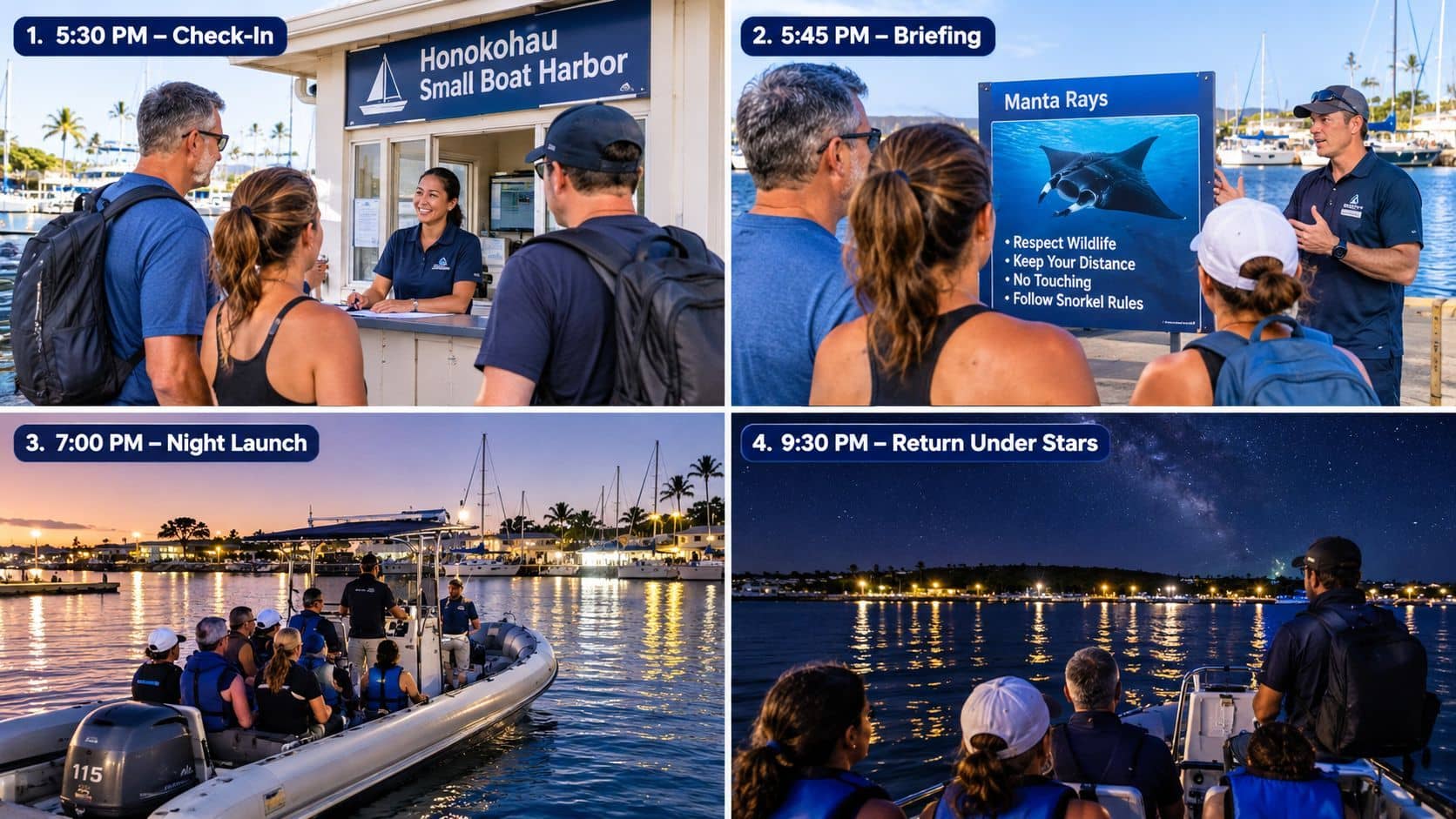
- Check in at Honokohau Small Boat Harbor. The lifeguard-certified crew gives an educational briefing on manta biology and the history of Kona's rays.
- Ride to the manta site. The boat journey takes 20 to 40 minutes, depending on where mantas are showing up best that night.
- Settle at the snorkel board. Guests hold onto the board at the surface while bright lights attract mantas feeding on plankton below.
- Return to the harbor. Keep a towel and dry layer handy for the trip back.
The snorkel tour lasts about two hours. If you're prone to motion sickness, plan ahead; this guide to Sea-Bands for travel sickness explains one option. Ask a pharmacist or clinician about medication that may suit you.
The two-tank scuba evening
The scuba trip follows a longer sequence: a late-afternoon reef dive, a sunset surface interval, then the manta night dive. Kona Honu Divers provides the outing, and guests board the Honu One at Honokohau Harbor.
- Board the Honu One. The crew prepares guests for the two-tank trip.
- Make the late-afternoon reef dive. This first dive takes place before the manta portion.
- Take the sunset surface interval. A light meal and an expert briefing on manta biology precede the night dive.
- Begin the manta dive. Follow the guide's instructions and stay in the assigned position.
The Manta Ray Dive Kona adventure lasts five hours and is priced up to $259. The two-tank manta dive details describe the scuba outing.
Poor Conditions and Missed Sightings
A high advertised sighting rate isn't a guarantee of close passes, clear water, or usable photographs. Before relying on any percentage, ask what counts as a sighting: an animal beneath the board, a distant ray, or one visible only from the boat.
What happens when the night does not go to plan
Situation — What the captain does — What you should expect
Hazy but safe water — Continues if lights and the water column stay workable — Fewer or more distant passes may be visible
First site is quiet — Moves between Manta Heaven and Manta Village when safe and practical — A longer ride and the same in-water rules
Wind, swell, or current is unsafe — Cancels before launch or ends early — Nobody stays in the water
Trip finishes with no mantas — Gives an honest debrief — No guaranteed wildlife; credit or refund only if the operator stated it
The NOAA manta-viewing guidance emphasizes separation between surface snorkelers, bottom-positioned divers, and feeding animals. Poor visibility matters when it prevents the crew from maintaining that separation, not because it makes the pictures less attractive.
A safe departure can still be disappointing
Water can be suitable for supervised viewing without being clear enough for the images you hoped to capture. Expect grain, floating particles lit by the beam, and rays that never enter your frame.
Conversely, a clear view from the dock doesn't establish that the offshore site is safe. Wind, swell, current, and the ability to recover everyone onto the boat belong in the captain's decision.
Get the financial outcome in writing
Ask whether a weather cancellation leads to a refund, rescheduling, or another arrangement. Separately, ask what happens after a completed trip with no sightings and whether a return opportunity requires space on another departure.
Don't assume that a return offer includes a cash refund or that a second outing fits your travel schedule. A family with a non-swimmer also needs a shore-based backup, not a plan to request an exception at check-in.
Popular manta tours often sell out weeks in advance. Book with enough room in your itinerary to consider another evening, while recognizing that spare seats and suitable conditions may not align.
Trust the captain's go-or-no-go decision. If this encounter matters to your trip, don't make your final evening the only possible opportunity.
Manta Ray Night Dive Kona FAQs
How long is each trip?
Allow about two hours for the surface snorkel and about five hours for the two-tank scuba outing, including the reef dive. Don't interpret either length as uninterrupted manta-viewing time; preparation and boat travel are part of the experience.
Are mantas always close to the surface?
No. A feeding ray may rise toward the board, stay deeper in the illuminated water, or leave the area entirely. Choose your viewing format for your abilities rather than expecting every animal to pass at the same distance.
Is night better than day?
For this particular encounter, night is the more useful choice because the viewing setup concentrates their food. That doesn't make every night equally productive, and a daylight reef excursion is a different experience rather than an inferior version of the same trip.
Can I scuba dive if I'm not certified?
Not on this two-tank manta night dive. Uncertified guests should choose the surface format if they meet its swimming requirements; don't treat a wildlife-focused night dive as an introductory scuba lesson.
Does the calendar matter?
It matters for your travel logistics and potential weather disruption, but it can't predict a feeding aggregation. Ask about recent site activity and marine conditions rather than selecting a date solely from a moon-phase or seasonal claim.
Which site will we visit?
The captain selects the working site for the evening. Another established location can offer an alternative, but relocation requires enough time and suitable conditions, so don't assume the boat will visit both.
Can I join just to watch from the boat?
Don't book an in-water place assuming there's a suitable boat-only arrangement. Confirm that possibility before paying, and understand that remaining aboard doesn't guarantee a useful view of the animals.
Book Ahead and Confirm the Boat
Choose the trip that matches your evening and comfort in the water. The surface snorkel takes about two hours; the scuba adventure is a longer, two-tank trip.
Manta Ray Night Snorkel Hawaii tour options
Option — Length — Starting price — Booking
Manta Ray Night Snorkel — 2 hours — From $139 — Check availability and book
Two-tank Manta Ray Dive Kona — 5 hours — Up to $259 — Check availability with Kona Honu Divers
Private Manta Ray Snorkel — 2 hours — From $1,999 — Contact the booking team to check charter availability
Booking the shared snorkel in advance gives you the best pricing. Popular manta tours can sell out weeks ahead, so check your dates early. The private charter includes snorkel gear and crew; confirm availability for your group before booking.
Kona Snorkel Trips is a separate operator offering a manta ray night snorkel tour. Check its departure details and terms directly if comparing operators.
Confirm the operator and departure
The scuba tour is provided by Kona Honu Divers, and guests board the Honu One at Honokohau Harbor. Use its booking calendar to review the schedule. The Kona Honu Divers Google business profile can help you identify the dive shop. Follow your booking confirmation for boarding instructions.
Before paying, confirm the details that affect your plans:
- Eligibility: Check the age and swimming requirements for snorkeling, or certification requirements for scuba.
- Check-in: Save the meeting instructions and allow time to find the correct harbor location.
- Weather: Review the cancellation and rescheduling terms.
- Sightings: Check the missed-sighting policy, including any limits on a return trip.
A manta encounter depends on wildlife activity, so no booking can promise a sighting. Book with clear expectations about the trip, meeting point, and what happens if conditions change.
Manta Ray Night Snorkel Hawaii offers a guided surface trip with gear, flotation, and an educational briefing. Visit Manta Ray Night Snorkel Hawaii to check availability and book the snorkel tour that fits your dates and swimming ability.