
Manta Ray Snorkel Hawaii: A Kona Night Tour Guide
Manta Ray Snorkel Hawaii guide: compare night and day tours, learn how mantas feed under lights, check safety rules, and book a Kona trip.
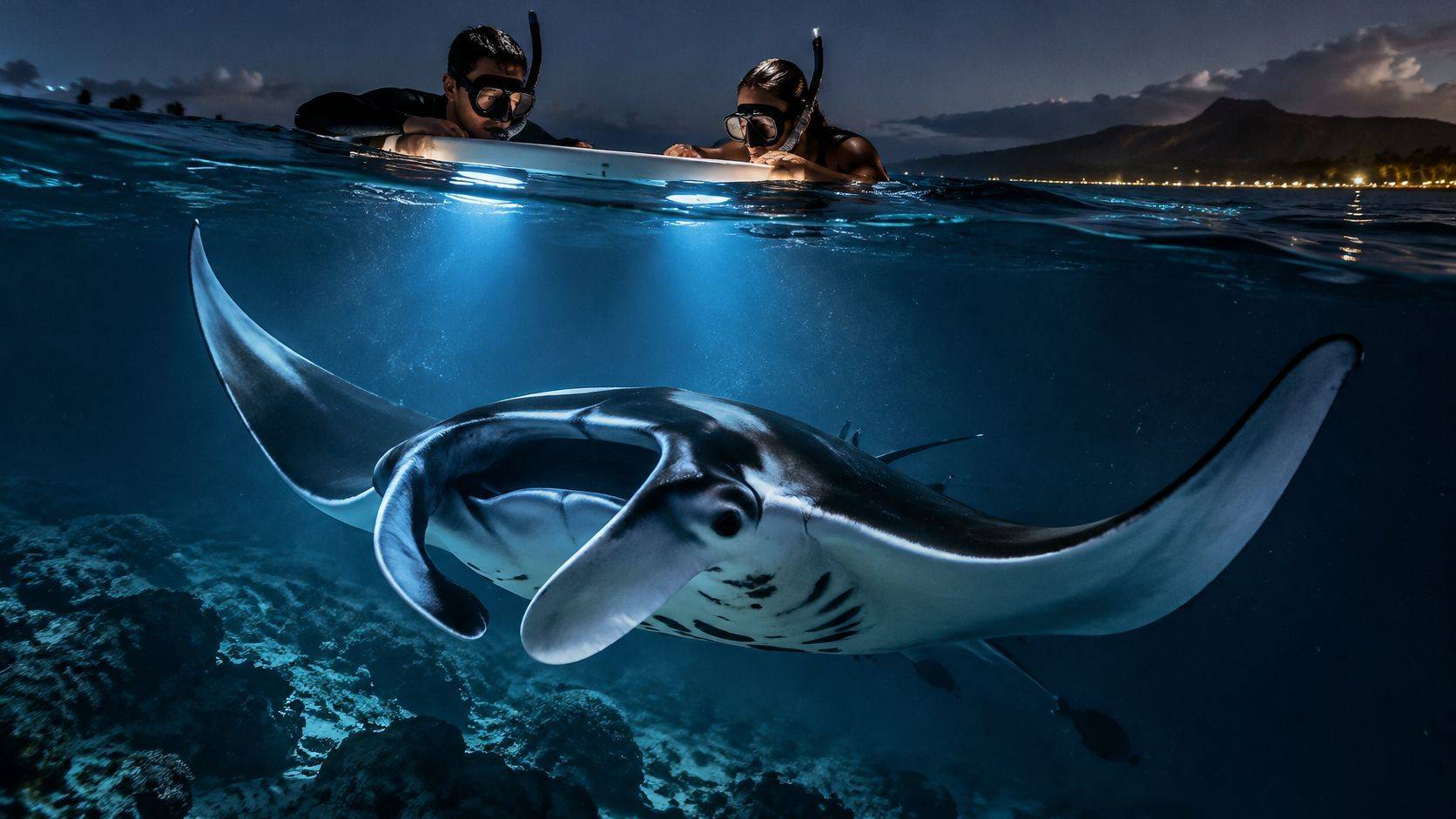
You've booked a night snorkel in Kona, or you're close to it, and now the practical questions arrive. What does the water feel like after dark? How close do the rays come? And why does every operator ask whether you can swim if the plan is to float and hold on?
Here's the honest shape of it. The manta ray snorkel Hawaii experience is one of the few wildlife encounters where your odds are strong, and that reliability is exactly why it deserves a careful explanation. The animals behind the show are a small, resident population tied to a couple of feeding sites, so the biology and the rules matter as much as the booking.
This guide walks through what happens in the water, why the lights work, who can join, and what you can and cannot count on when you climb aboard.
Table of Contents
- Night Snorkel Versus Daytime Snorkel at a Glance
- How Manta Rays Feed Under the Lights
- What Happens on Your Night Tour, Step by Step
- Safety Rules That Protect You and the Rays
- Where and When the Mantas Gather
- Who Can Join and How to Prepare
- Protecting Kona's Manta Population
- Manta Ray Snorkel FAQs
- Booking Options and Sample Itineraries
Night Snorkel Versus Daytime Snorkel at a Glance
Choosing between these two trips is really a choice between two different kinds of wildlife watching. A daytime snorkel is built around the reef: coral, reef fish, and sunlight for photographs. The night snorkel is built around a single animal, because manta rays spend daylight hours in deeper water and come close to Kona's reefs after dark to feed on plankton.
Factor — Night manta snorkel — Daytime snorkel
Manta visibility — Likely, mantas come close to the reef to feed after dark — Less likely, mantas stay in deeper water by day
Feeding lights — High-powered lights concentrate plankton and draw mantas in — Natural daylight
Minimum age — 5 years old — 3 years old
Time in the water — Floating at the surface, holding a snorkel board — Swimming over coral and reef fish
The boat ride out runs 20 to 40 minutes, depending on where the rays are showing up best that night, so plan on a full evening on the water rather than a quick dip. Both of Kona's manta sites have rays present more than 80% of the time, which is about as reliable as wildlife viewing gets.
Three quick checks before you commit:
- Choose night if seeing mantas is the main reason for the trip.
- Choose daytime if your group includes children too young for the night rules, since the age minimums differ.
- Check swimming ability before booking, because the night tour requires it with no exceptions.
The strict swimming rule exists for a reason. The same rays return to these feeding sites night after night, and calm, predictable snorkelers floating at the surface are what keep the encounter safe for everyone. Certified divers have another way in: the two-tank Manta Ray Dive Kona puts you on the reef itself instead of floating above it.
How Manta Rays Feed Under the Lights
A hotel buffet lamp does not cook breakfast or create food. It gathers what is already there into one bright spot, and the diner comes to it. The lights on a manta snorkel work the same way.
What's on the menu
The NOAA status review of the species lists the planktonic prey that reef mantas take: euphausiids, copepods, mysids, decapod larvae, and shrimp. Small animals, most of them only a few millimetres long, and none of them worth chasing one at a time. The same report describes mantas as primarily nocturnal feeders and connects that habit to the nightly upward migration of zooplankton, which carries prey closer to the surface where a ray can filter it in bulk.
Why the lights work
Bright lights concentrate plankton in the top few metres of water. Mantas answer by making repeated passes through that lit patch with their mouths open, filtering as they go. Nobody is feeding them by hand. The natural food supply does the work, and the light shortens the distance between dinner and diner.
The key idea: the mantas come for the plankton, not for us. Your job is to leave the table set and stay out of the way.
What that means for your night
Because the whole event is food-driven, the odds are strong without being guaranteed. A thin plankton layer can mean fewer rays or shorter passes, even when the boat runs exactly on time. Kona's two viewing areas are established feeding grounds, and both have mantas more than 80% of the time, yet those same site-bound animals are the ones visiting the lights. High odds and a small stage are why calm swimmers and clean passes matter so much.
If you want the fun side of manta biology before you go, this collection of manta ray facts worth knowing covers size, feeding, and behaviour.
What Happens on Your Night Tour, Step by Step

The evening follows a fixed sequence, and each step exists for a reason. Knowing the order in advance is what keeps first-timers calm once they are floating in the dark.
- Meet at Honokohau Small Boat Harbor. Check-in happens on land, where paperwork, names, and gear sizes get sorted while everyone is still dry. Handling it here keeps the boat on schedule and gives you time to stow a bag before boarding.
- Attend the briefing. The lifeguard-certified crew covers manta biology and the history of the Kona rays, then the water rules. Once you understand that the rays are filter-feeding inside the lit column, holding your position at the surface reads as common sense rather than a restriction.
- Collect your gear. Mask, snorkel, wetsuit, and flotation device are supplied, so you don't need to own or pack any of it. Fitted gear also means nobody is adjusting a leaking mask in the dark with the group waiting.
- Board the fast boat and run to the site. The ride takes 20 to 40 minutes. The mantas here are a resident, site-bound population spread across two viewing areas, so the crew picks the site where the rays are showing up best that night rather than running a fixed route.
- Get in and take hold of the snorkel board. Snorkel guests hold onto snorkel boards while high-powered lights bring the manta rays in. The board does two jobs: it keeps the group in one predictable shape, and it holds the light steady so the plankton stays gathered beneath you.
- Watch the loops. Mantas pass through the illuminated water, often close enough that you'll see the pattern on a belly and the shape of the cephalic fins. You stay at the surface the whole time, breathing through your snorkel, while a feeding routine these rays repeat on the same sites plays out below you.
- Return to the harbor. Total tour time is about two hours, and the ride back is the quiet part, with a boat full of people comparing what they saw.
A good night isn't measured in minutes of contact. It's several unhurried passes, one animal turning a metre from your mask, and a group that stayed still enough to let it happen. That stillness is the whole arrangement. The same rays work these few sites night after night, so the calmer the human shape on the surface, the more passes they make.
Safety Rules That Protect You and the Rays
Every rule on this tour exists for the same reason: Kona's manta population is small and site-bound, so the animal in front of your mask tonight is probably the same one the crew saw last week. A careless kick or a reaching hand doesn't just end one pass. It can injure a ray that has nowhere else to go.
The rule that overrides everything else is to stay at the surface. Snorkelers float near the top while the lights concentrate plankton in the upper water, and the rays come up to feed close to them. NOAA's recreational wildlife-interaction guidance backs this surface-only setup, and it also notes that vessel-collision injuries are less frequent and less severe when boats travel at 13 knots or less. Drop below the surface and you are swimming directly through a feeding ray's approach path, like stepping onto a road mid-turn.
- No touching, no chasing. We follow the Manta Ray Green List guidelines, which include never touching the rays.
- Controlled finning and secure equipment. Loose straps and sudden kicks are the two things most likely to break a manta's line of travel.
- Follow the guide's light instructions. Light placement is a safety instruction, not a suggestion.
- Swimming skills are required, with no exceptions, because this happens in open water at night.
One reassurance for nervous first-timers: manta rays don't have stingers like other rays. The main risk is a collision or a crowded swimmer. Stay still, stay at the surface, and let the rays decide how close they come.
Where and When the Mantas Gather
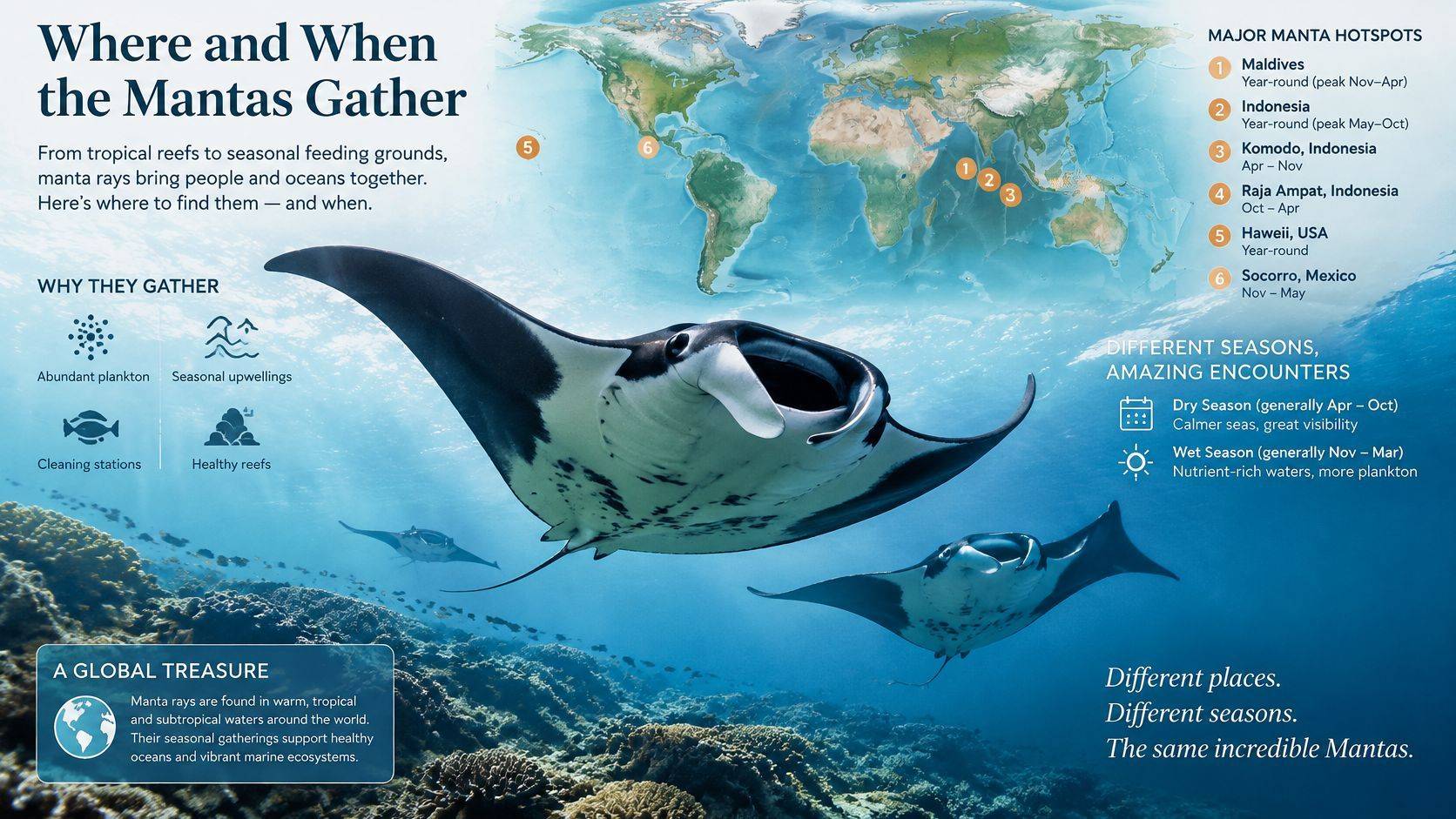
Ask a boat crew where the mantas will be and the honest answer is a short list: two sites off the Kona coast, Keauhou and Ho'ona Bay. The animals themselves explain why the list stays that short. Genetic research on Hawaii's reef mantas indicates these rays form small island-resident populations, so the mantas you meet at night live here year-round rather than passing through.
Researchers analysed more than a decade of community-sourced photo-identification records from the two sites, built from thousands of encounters with individually identified reef mantas (Mobula alfredi). Each manta carries a unique spot pattern on its belly, so a clear photograph works like a fingerprint: it shows which animal appeared, where, and how often. The records reveal that the sites are connected without being identical. Enough mantas travel between them to keep the population linked, yet many individuals return to the same feeding ground again and again.
Aggregation size tracked zooplankton density rather than the calendar, so the nightly count rises and falls with the food supply, not the month on your ticket. Across the study period the records also showed that aggregation patterns stayed relatively stable even as tourism increased.
Both viewing sites have mantas more than 80% of the time, which is the practical number to hold onto. The odds are good precisely because the population is small, local and faithful to these reefs, and that is why your behavior in the water matters as much as your booking. Ask which site is planned, then accept that the animals make the final call on the night.
Who Can Join and How to Prepare
Eligibility is the part most families get caught on, so check it before you pay a deposit.
Traveler — Night snorkel rule — Note
Child aged 3 or 4 — Not eligible — Daytime tours accept age 3 and up
Child aged 5 or older who can swim — Eligible — Swimming skills are required
Non-swimmer of any age — Not permitted — No exceptions
Private group or charter — Bookable as a private 2-hour charter — Gear and crew included, boat limited to 18 passengers
The minimum age is 5 for the manta ray night snorkel and 3 for daytime tours, and non-swimmers aren't permitted on the night trip at any age. Test swimming ability at home rather than at the dock. Floating comfortably, recovering a snorkel, and moving a few metres without assistance are the requirements.
What to pack
- Swimsuit worn under your clothes. You'll step into a provided wetsuit over it.
- Towel and a dry bag. Phones and car keys stay dry on the ride back.
- Reef-safe sunscreen, applied before boarding. Once you're in the water, nothing goes on.
- A light layer for the return trip. Wet skin plus a night crossing feels cold even in Hawaii.
- Motion-sickness medicine if you're prone. The run out takes 20 to 40 minutes each way, which is plenty of time for queasiness to build. These practical tips for avoiding sea sickness help if you're unsure.
- Cameras on a wrist or neck strap. Keep straps tucked, because dangling gear drifts into the water and disturbs the rays.
Mask, snorkel, wetsuit, and flotation are all provided, so the list stays short. For photographers, stay put and shoot from where you float. State wildlife guidance is to view protected animals from a distance, using a telephoto rather than moving closer. If you have mobility or medical questions, raise them at booking, since the open-water night conditions and the swimming requirement apply to every guest.
Protecting Kona's Manta Population
High sighting odds and low impact are two different things, and confusing them is the most common mistake visitors make. The mantas show up reliably precisely because the same animals return to the same feeding sites night after night.
A genetic study summarised by a Kona dive operator estimates an effective population of about 104 reef mantas around Hawaiʻi Island, with a 95% confidence interval of 99 to 110. Researchers have separately catalogued 318 individual mantas around the island since 1979. That second figure counts every animal photographed over four decades rather than the breeding population, so the two numbers measure different things.
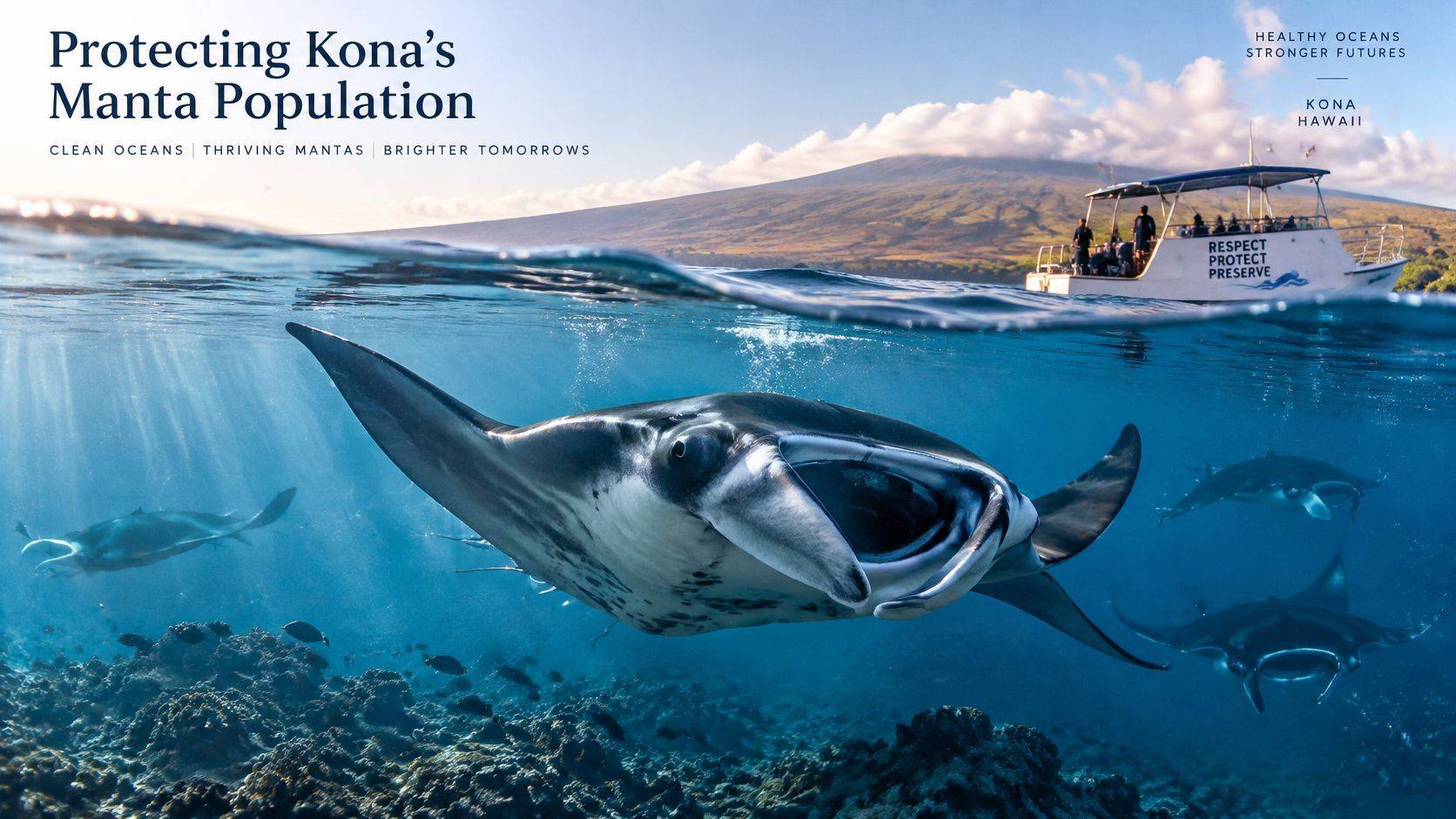
Site fidelity is the trade-off behind those dependable sightings. When roughly a hundred animals concentrate on the same two stretches of coastline, visitor pressure never spreads out. It accumulates in exactly the places the rays need to feed.
That is why the Manta Ray Green List guidelines exist, and why every snorkeler follows them on the water.
What actually helps: surface-only positioning, no touching or chasing, leaving feeding corridors open, and clipping every dangling strap. Four habits, no equipment, no cost.
State rules put hard limits behind the habits. Hawaiʻi's manta-viewing administrative rules confine tours to designated zones during approved hours, typically 4:00 p.m. to 11:00 p.m. with most trips concluding by midnight, and once the mooring limit is reached a boat must leave both the mooring and the zone boundaries for at least 30 minutes before returning. The DLNR marine species guidance asks anyone who finds an injured or entangled manta to report it at 1-888-256-9840, option 5, and to watch protected animals from a distance rather than approaching them.
Manta Ray Snorkel FAQs
Does a high sighting rate mean the tour is sustainable? Not automatically. Visitor pressure concentrates around the same feeding sites the rays rely on, which is why behaviour on the night matters as much as the booking decision.
Will you see mantas every night? Sightings follow plankton density, not a calendar. A night with little food can bring fewer rays even when the trip runs exactly as planned.
Can I touch or feed the mantas? No on both counts. The rays feed on natural plankton that the lights concentrate, and the guidelines forbid touching and chasing. A ray may brush past you, and that's the animal's choice, not an invitation.
What if I can't swim? Non-swimmers of any age aren't permitted on the night tour. There's no workaround, because the trip happens in open water after dark.
Are families with young children welcome? Children aged 3 or 4 can't join the night snorkel and should take a daytime tour instead. Children aged 5 and older who can swim are eligible.
Who do I contact about an injured or entangled manta? Report it to DLNR at 1-888-256-9840, option 5, and follow the release guidance for the animal.
Booking Options and Sample Itineraries
For a solo traveller, a couple, or a family, the shared night snorkel is the straightforward choice. It runs two hours and starts from $139, with gear and briefing included, and it asks for a single evening rather than a whole day of your trip.
A group that wants the boat to itself can book the private manta ray snorkel, a two-hour charter starting from $1999. The price covers the snorkel gear and the crew, and the boat is a 28-foot zodiac coast guard rated for 24 passengers but limited to 18, so the group stays small even at full capacity. Whichever option fits, reserve early: popular manta tours often sell out weeks in advance, and booking in advance gives the best pricing.
Kona Snorkel Trips runs a comparable manta ray snorkel in Kona, and you can check availability on their dates.
Two ways to build the trip
Itinerary one, manta only. Book one evening, keep the rest of that day free for the beach, and hold a second evening open as a weather backup.
Itinerary two, reef plus rays. Take a Captain Cook snorkel one morning and the manta night snorkel on a different day. Booking both at checkout gives 10% off the Captain Cook tour, provided the manta snorkel is booked first. Kona Snorkel Trips runs a Kealakekua Bay Captain Cook monument tour, you can check availability for the Captain Cook snorkel, and full tour details sit on the Captain Cook snorkeling tour page.
Kealakekua Bay, where those daytime tours run, is a Marine Life Conservation District split into Subzone A and Subzone B, and the Kealakekua Bay rules prohibit taking or injuring marine life, removing coral or sand, and feeding fish. Anchoring is banned in Subzone A, and in Subzone B anchors must sit on sand or be placed to avoid coral. Ask any boat you book where it plans to set anchor.
If a private charter of any kind figures into your wider trip plans, read up on avoiding non-refundable charter surprises before a deposit leaves your card.
Manta Ray Night Snorkel Hawaii runs the two-hour night snorkel from Honokohau Small Boat Harbor, with lifeguard-certified guides, all gear supplied, and small groups at the two established Kona viewing sites, where mantas appear more than 80% of the time. Those are the same resident animals night after night, which is why the Green List rules you accept at booking matter as much as the booking itself. Pick an evening early in your trip so weather has room to shift, then reserve before the good dates go: visit Manta Ray Night Snorkel Hawaii for current schedules and to choose your night on the water.