
Manta Ray Snorkeling Hawaii: Kona Night Guide
Plan manta ray snorkeling Hawaii in Kona: night sites, safety rules, seasons, photos, and how shared, private, and Captain Cook trips compare.
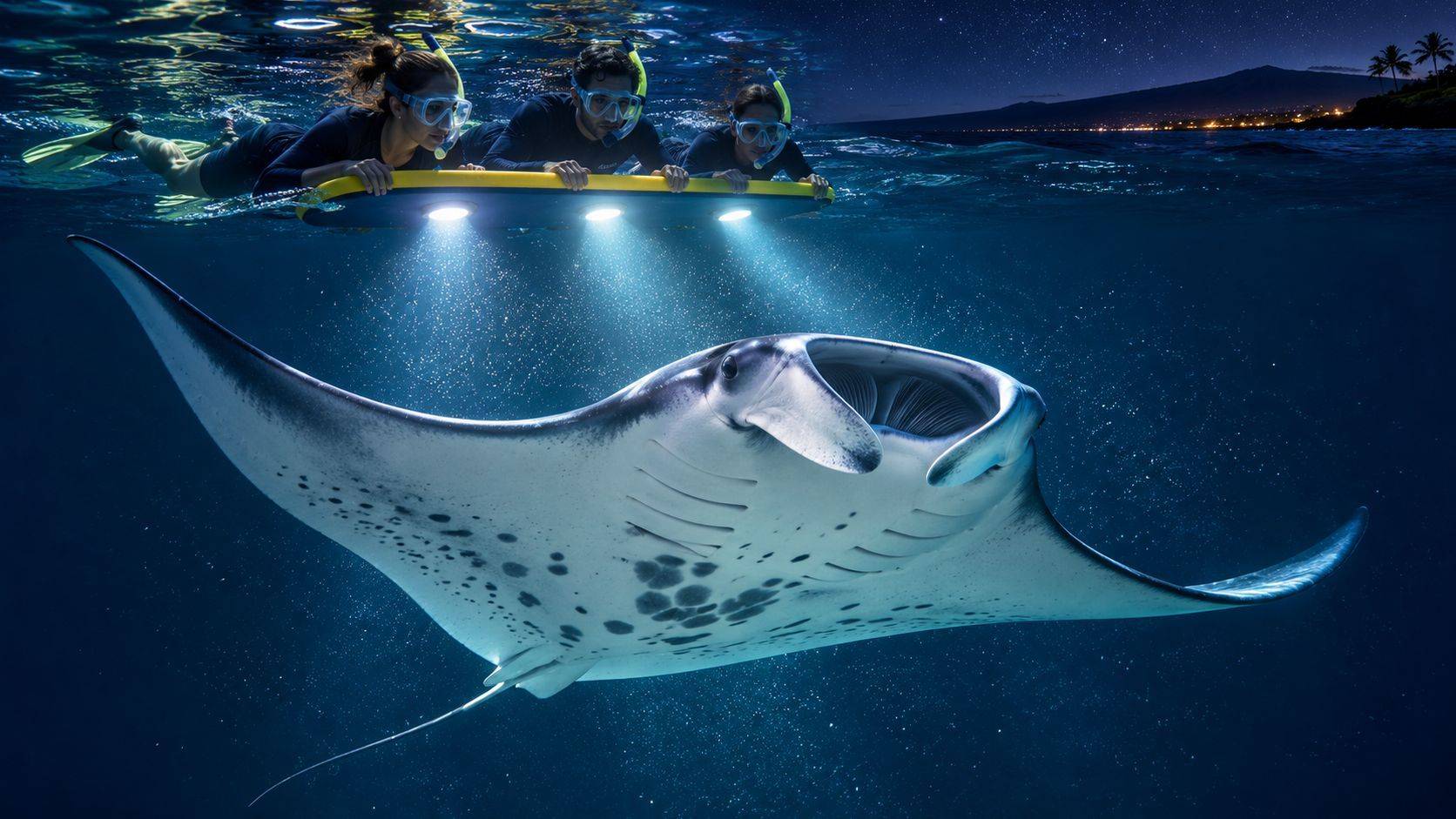
One Kona operator's history of the Kona manta dive dates the first regularly recognized ray, Lefty, to 1979, places organized nighttime diving around 1991, and counts about 11,000 snorkelers and scuba divers plus roughly $920,000 in direct revenue by 2002. Read those figures as one company's account of an industry that grew fast once people learned what the shoreline lights were already doing.
The sequence matters. Coastal hotel lights drew plankton toward the reef, reef mantas followed the food, and boat crews eventually turned a feeding event into a guided night snorkel. Light still starts the chain on tour: snorkelers hold boards while high-powered beams concentrate plankton near the surface.
That also explains uneven nights. Kona's rays are a small resident community, and group size tracks zooplankton more than effort. A quiet evening usually means sparse prey, not poor guiding. The trip is not impact-free either, which is why crews brief Manta Ray Green List rules, including never touching the rays.
Table of Contents
- Kona Manta Night Snorkel at a Glance
- How a Kona Night Manta Snorkel Unfolds
- Garden Eel Cove and Keauhou Feeding Sites
- Gear Rules and Who Should Stay Ashore
- Seasons Plankton and Nights That Disappoint
- Why a Small Population Changes How You Watch
- Surface Photos That Show the Barrel Roll
- Book Shared Private or a Captain Cook Day
Kona Manta Night Snorkel at a Glance
Manta Ray Snorkeling Hawaii means one coast and one time of day: Kona on the Big Island, after dark, on a boat that runs to whichever viewing zone has rays that evening. The two night sites are Garden Eel Cove and Keauhou, roughly 20 kilometers apart. The crew chooses between them based on where the mantas are showing up best.
Daytime is a different animal. Rays mostly hold in deeper water by day and come close to Kona's reefs at night to feed on plankton, so they are less likely to be seen before sunset. If a manta is the reason for the booking, book the night trip.
Decision — What to expect — Why it matters
Where — Kona, Big Island: Garden Eel Cove or Keauhou, about 20 km apart — Tours stay inside designated viewing zones
When — After dark, year round — Rays feed near the reef at night and are less likely by day
Boat time — 20 to 40 minutes from Honokohau Small Boat Harbor — The crew picks the site where rays are showing
Who can go — Age 5 and up, swimmers only — Non-swimmers are not permitted, no exceptions
Sighting odds — Both sites have mantas more than 80 percent of the time — Plankton still decides how many rays appear
Read the rows as filters, because each one removes a different excuse before checkout.
Where sets your geography. If you're staying in Kailua-Kona or Waikoloa, both sites are a short drive to the harbor. If you're on the Hilo side, this becomes a long day with a late drive home, so plan a place to sleep on the west side.
When is required by the animals themselves. The feeding event happens at night, the lights only work at night, and tours run inside authorized hours. Anyone in your group who wants a daytime swim should look at a bay trip instead.
Boat time runs 20 to 40 minutes each way depending on where the mantas are showing up best that night. That is short enough that seasickness is rarely the issue it is on a longer channel crossing, but long enough that a warm layer and a dry towel earn space in your bag.
Who can go is the row people argue with. The minimum age is 5 on the night snorkel and 3 on daytime tours, and swimming is required with no exceptions. Children younger than 5, or anyone who can't swim, stays ashore. Manta rays do not have stingers like other rays, but the Manta Ray Green List still applies: never touch, stay floating at the surface, and let the animals choose the distance.
Sighting odds are strong, not absolute. Both sites have mantas more than 80 percent of the time, which describes how reliably the animals are present, not how many will arrive or how close they'll come. Kona's rays are a small resident community, and zooplankton decides whether one ray loops through the light or several stack up underneath the boards. A quiet night usually means prey, not poor guiding. The lights make that feeding visible, so the trip is managed wildlife viewing rather than an impact-free show.
If you want one starting point for the Kona night trip, Manta Ray Night Snorkel Hawaii runs exactly the format this guide describes, departing from Honokohau Small Boat Harbor with lifeguard-certified guides and gear supplied.
If the evening turns into a family edit or channel upload, handle the publishing side after the swim and review these travel video music licensing tips before posting.
Check age and swimming ability against the table before you look at dates. A group that fails the swimming row has no reason to compare calendars.
How a Kona Night Manta Snorkel Unfolds
The evening works because of what the animals came to do. NOAA reports that these rays feed on planktonic animals including euphausiids, copepods, mysids, decapod larvae, and shrimp, that they're primarily nocturnal feeders, and that research offshore of Kona found a significant positive relationship between manta numbers and zooplankton abundance, as set out in NOAA's manta ray work product. What you watch from the surface is a feeding event that happens to be visible, running on the ray's schedule rather than yours.
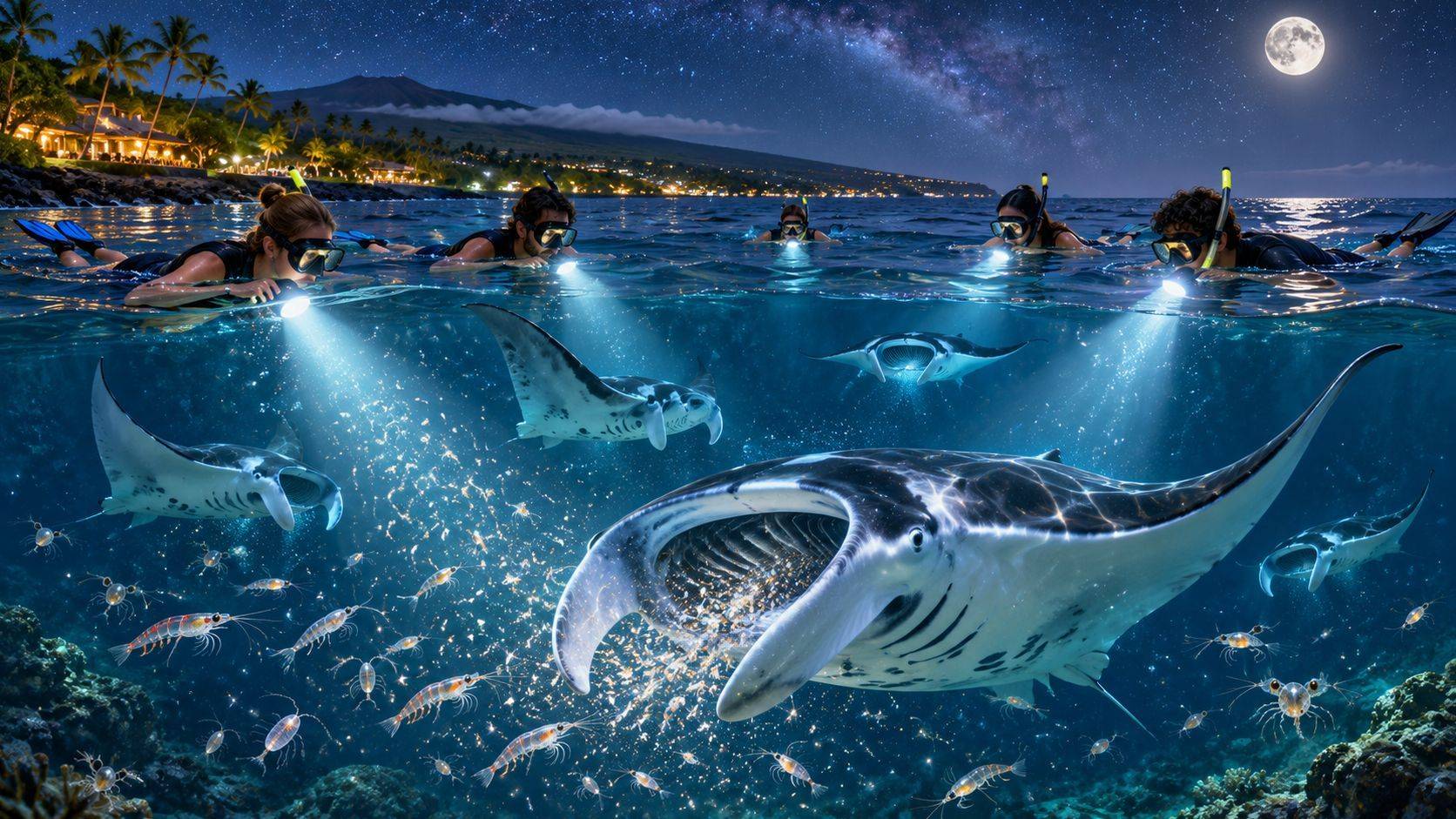
That matters before you ever get in the water, because it tells you what to look at and how to behave once the lights go on. It also sets expectations. A slow night usually means thin plankton, and thin plankton is a prey problem, not a guiding problem.
Six steps from harbor to surface
Each step has a reason attached. Skip the reason and the rules feel arbitrary.
- Meet at Honokohau Small Boat Harbor. Check in with the lifeguard-certified crew for a briefing on manta ray biology and the history of the Kona rays. The briefing is why a shape rising toward your face reads as a feeding ray rather than something to flinch from, and it helps to know these mantas carry no stinger the way other rays do.
- Fit your gear on land. Mask, snorkel, wetsuit, flotation. A leaking mask or loose strap gets sorted under deck lights instead of in black water with a large animal overhead.
- Slip in and take hold of a snorkel board. You float on the surface in wetsuit and flotation and stay there, holding the board rather than free-diving under the animals. The board keeps your arms and fins out of the feeding lane.
- The crew switches on the bright lights. The beam gathers plankton that is already drifting past and concentrates it into a dense patch beneath the boards.
- Stay still while the rays work through the patch. They swim with mouths open, often just below the surface. A still group gives each ray a predictable line, so the animal chooses the distance instead of correcting for you. The Manta Ray Green List rules apply the whole time: watch, hold your position, and never touch.
- Climb out when the viewing window closes and ride back. The window is fixed, so the night runs on a schedule you can plan around.
Practical rule: A porch lamp doesn't make moths; it gathers the ones already flying. The lights over your head do the same thing to plankton, and the rays follow the food.
Nothing is baited and nothing is handled. The crew positions light and people, then waits. Even so, the trip is a human presence in a feeding ground, and the Green List rules exist because the encounter has a cost the rules are designed to keep small.
Which animal you're actually watching
The rays on these nights are reef manta rays, Mobula alfredi, the small resident Kona population. The giant oceanic manta, Mobula birostris, is a different animal, and the distinction matters because the reef mantas here form a modest, recognizable community rather than an endless supply of newcomers. The guides act as spotters, identifying individual rays by the spot patterns on their bellies, so a familiar shape turning up under the lights is a returning neighbor with a name. A quiet evening says more about what the plankton did that day than about anything the crew got wrong.
Garden Eel Cove and Keauhou Feeding Sites
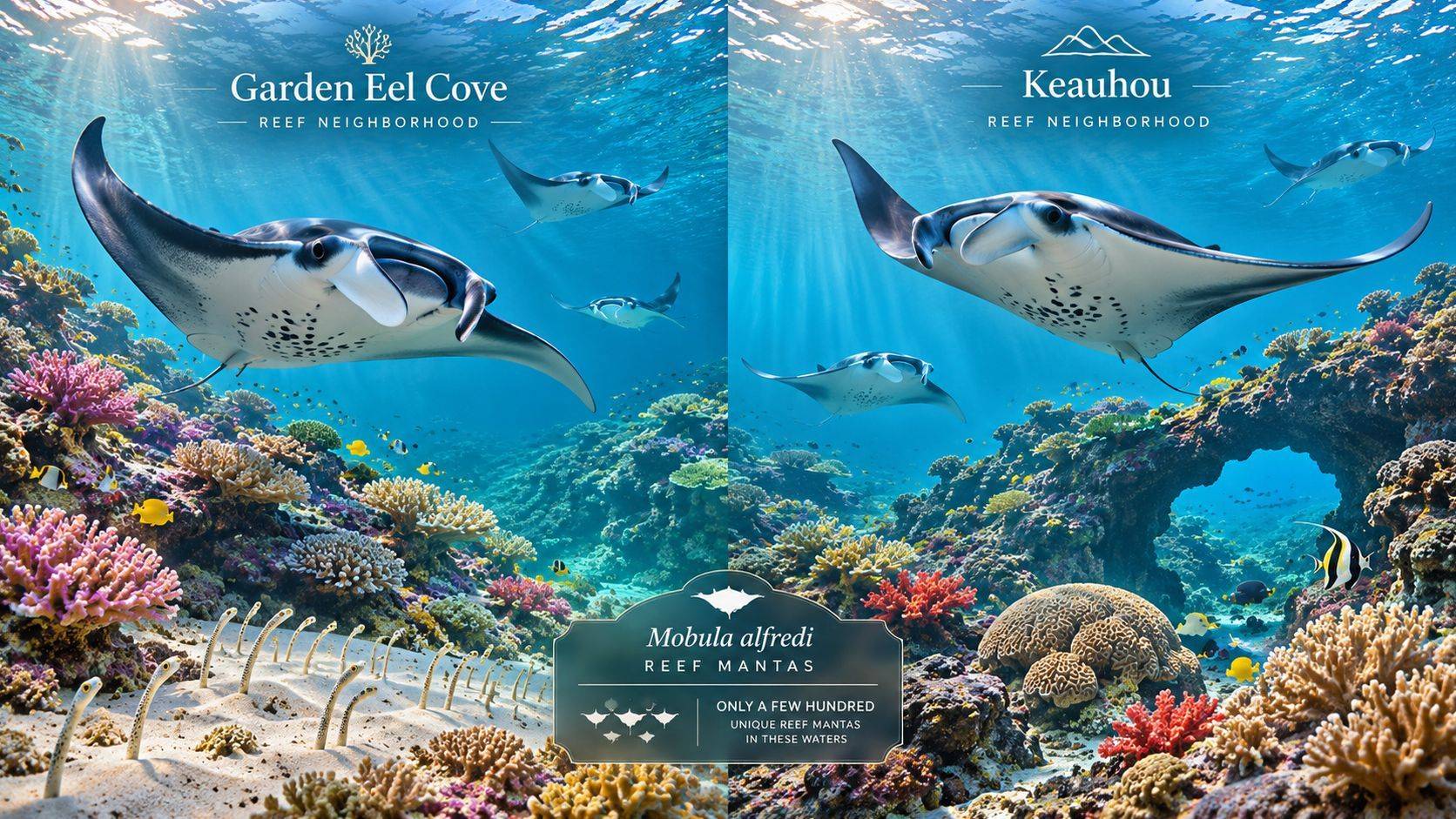
Treat the two reefs as neighborhoods in the same small town. They're close, they host overlapping animals, and they don't behave identically. NOAA-linked records identify only 318 unique reef manta rays around Hawaiʻi Island since 1979, and genetic and photo-identification evidence points to limited immigration and a largely closed local population, as summarized in this overview of the Kona manta research.
A NOAA-cited analysis of Kona photo-identification data from 1992 through 2007 estimated that only about 4.27 new pups entered the population each year. More recent University of Hawaiʻi work analyzed more than 23,000 community-sourced observations collected from 2010 through 2022 at Garden Eel Cove and Keauhou, and those records involved 167 individually identified rays.
Read that last number slowly. Thirteen years of nightly watching at the two main sites, and the cast list runs to roughly 167 recognizable animals.
What the two reefs do differently
The study found aggregation size tracked zooplankton density, and the sites split on use. Garden Eel Cove generally supported larger groups. Keauhou showed disproportionately frequent female use. Both patterns come from the same body of observations, so neither site is the "good" one in any fixed sense.
Site — What the records show — What a guest may see
Garden Eel Cove — Larger groups in the 2010-2022 analysis of the two principal sites — A crowd when zooplankton is strong
Keauhou — Disproportionately frequent female use, about 20 km from Garden Eel Cove — A night with about three rays can still be normal
Both sites — Mantas present more than 80 percent of nights; 167 identified rays in more than 23,000 observations — Presence is reliable and a large ballet is not
Hawaiʻi Island — 318 unique reef mantas since 1979 and about 4.27 new pups a year in 1992-2007 data — Repeat guests can see the same recognizable animals
A crowd and a trio can both be normal
Guides recognize individual rays by the spot patterns on their bellies, so a good crew knows whether the animals in the light tonight are the same ones that showed up last Tuesday. That's how a repeat visitor ends up greeting the same ray twice in one holiday.
Which means a night with three rays at Keauhou and a night with a dozen at Garden Eel Cove are both honest outcomes of the same system. The animals are mostly in deeper water during the day and come close to the reef at night to feed, so the size of the group you meet is a snapshot of how much food is in the water, not a grade on the crew.
A small resident community is the reason the encounter is worth doing carefully. It's also the reason nobody credible promises you a number before the boat leaves.
Gear Rules and Who Should Stay Ashore
Start with the animal you're sharing the water with. Hawaiʻi's official boating safety assessment describes manta rays as capable of reaching approximately 5.5 meters in wingspan, feeding by swimming continuously with their toothless mouths open to filter small zooplankton, per the state manta ray viewing and boating operations assessment. Manta rays carry no stinger, unlike other rays. The main risk on this trip is collision and disturbance, and nearly all of it flows in one direction: from the swimmer toward the animal.
A feeding manta works like a wide bus making a slow turn through a parking lot. It has a large turning envelope and a committed path, and the swimmer who kicks into that path is the problem, not the bus. When you force a ray to break off and re-route, you've cost it feeding time and yourself the close pass you wanted.
The animal sets the distance
The correct behavior is passive. Hold the float or the viewing line, don't chase, don't touch, and leave the forward path and wing tips clear. Staying in position lets the ray control its own distance, which is exactly what keeps you out of a collision and keeps the passes coming.
The Manta Ray Green List guidelines put this in writing, and the first item is never touching the rays. Skin contact damages the protective mucus layer on a manta, and a grabbed wing produces a stressed animal that may skip the next pass altogether.
Gear is simple by design. A wetsuit and flotation keep you at the surface, a mask and snorkel let you watch, and snorkelers hold onto boards while the lights bring the rays in. That's the kit.
On the boat: a dry layer and a towel for the ride back. In the water: your own mask if you have one that fits, and nothing that dangles. Left ashore: anything that tempts you to swim after a ray, including a plan to "just get a little closer."
If you're sorting out what these rules mean in practice, the manta ray FAQ covers the questions crews field nightly at the harbor.
Who this trip is not for
The swimming requirement is a hard gate. Non-swimmers are not permitted on the manta ray night snorkel, and swimming skills are required with no exceptions. The crew cannot waive that at the dock because your group is excited, and the minimum age for the night snorkel is 5.
Anyone who can't swim comfortably, or who wants to stand on sand while watching fish, belongs on a daytime bay trip instead. Those outings put you in calm, shallow, bright water where standing and wading are the point.
On the clothing side, Kona nights are warm but a wet shirt on an open boat after sunset isn't. A dry overshirt earns its place, and a layer that works on the water and at dinner after is the goal, something along the lines of what this California Cowboy coastal styling guide describes for coastal evenings.
Run one self-check before you book. If you can't comfortably swim a short distance and hold onto a board for the length of a viewing window, a daytime spot is the honest call.
Seasons Plankton and Nights That Disappoint
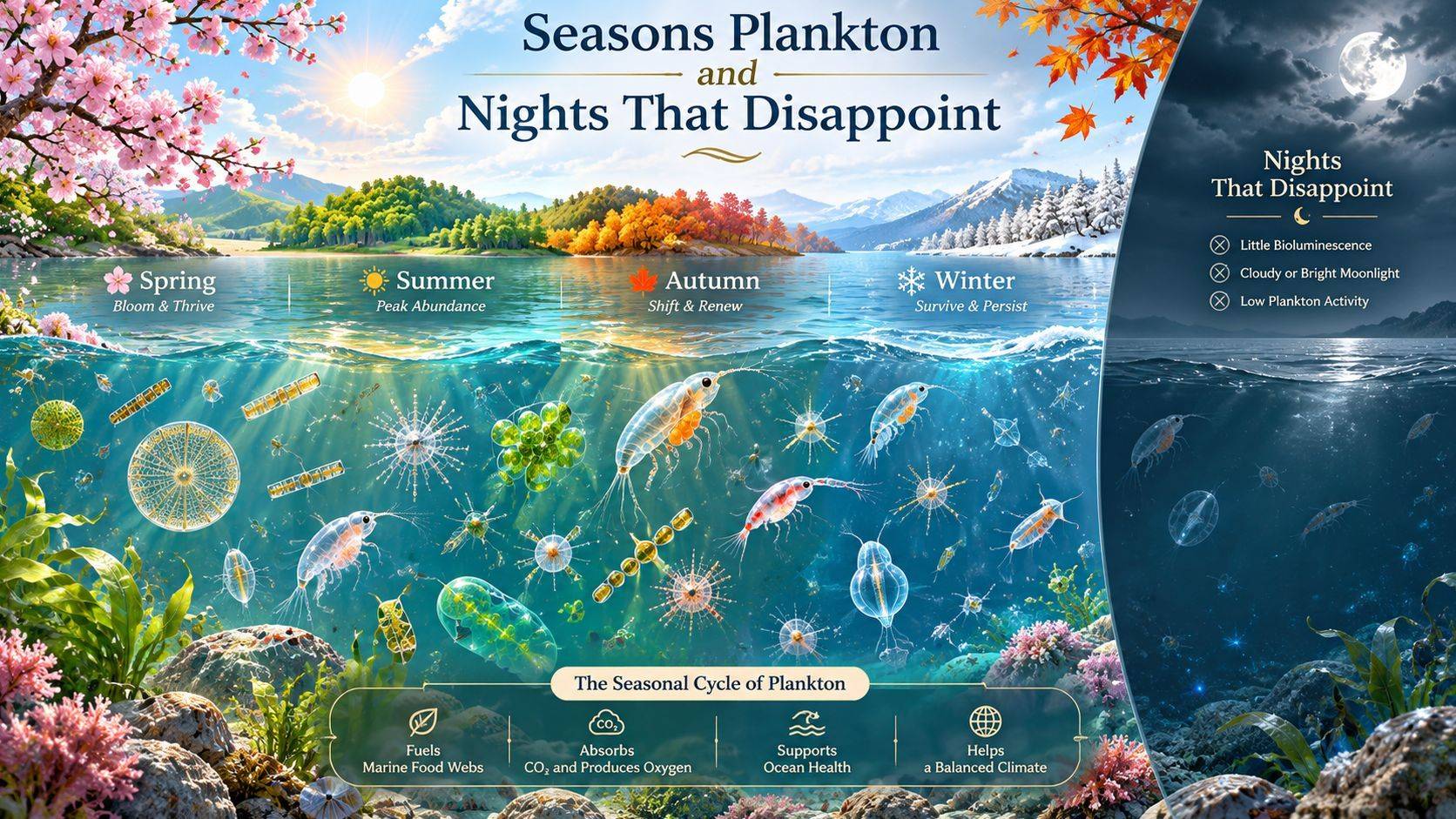
Summer is the stronger plankton season, and that is the scheduling fact worth carrying into the booking page. A 13-year dataset covering 2010 to 2022 found that aggregation size rose with zooplankton density, and that zooplankton abundance was significantly higher during summer months (Wilcoxon rank-sum test, p = 0.003), which corresponded with increased manta sightings, per the University of Hawaiʻi manta study.
The lights do one job well. They concentrate prey that is already drifting past Garden Eel Cove or Keauhou, the way a porch light gathers moths that were already in the yard. They cannot manufacture a bloom on a thin night.
That distinction is why a presence rate above 80 percent at the two Kona sites describes the odds of seeing rays at all, rather than the odds of a large group.
How to schedule around plankton
Three decisions cover most of it.
- Book the dates you already have. If your trip is fixed, take the night that fits your schedule and skip the search for a perfect week. A family with three nights on the island shouldn't spend two of them waiting for better water.
- Prefer summer when the night snorkel is the reason for the trip. If you're choosing between months and the manta is the headline, the summer plankton signal is the one piece of calendar evidence worth acting on.
- Book early, because popular boats sell out weeks ahead. The best plankton week on paper is worthless if every shared seat is gone by the time you look.
That third point is the one people underestimate. Plankton decides the quality of the night. Availability decides whether you have a night at all.
The expectation to hold: more plankton means more rays and more repeated passes. Thin plankton means fewer animals even at the usual reefs, on a night when the crew is doing exactly what worked last week.
Even on a strong plankton night, Kona's resident manta population is small, so group size has a natural ceiling that no amount of light can lift. The calendar stacks the odds. The water still calls the final count.
For the month-by-month version of this answer, the guide to the best time to see manta rays in Kona walks through seasons and conditions without overpromising.
Why a Small Population Changes How You Watch
A long-running Kona night snorkel is not impact-free, and anyone selling it that way is skipping the interesting part. Research published in Environmental Biology of Fishes reports that predictable nighttime feeding aggregations persisted under sustained tourism and artificial-light-associated feeding conditions. Persistence is not proof of unchanged behavior, health, or population growth. It's proof the animals kept showing up.
The same work keeps prey at the center of the story. A thin count on your night is reasonable evidence of thin plankton, not evidence of poor guiding.
What visitor FAQs tend to skip is the threat that matters locally. Hawaii-focused reporting identifies accidental entanglement in fishing lines and moorings as a major pressure on these rays, and that gets far less airtime than photography etiquette. It's also mostly outside a snorkeler's control, which is exactly why the rules around boats and moorings exist.
The rules you can verify yourself
West Hawaiʻi manages manta viewing through designated swimming, snorkeling, and diving zones. Manta tours are prohibited outside those zones and outside the authorized viewing hours, and a vessel that has reached its mooring-time limit must leave both the mooring and the viewing-zone boundaries for at least 30 minutes before returning, according to the Manta Dive Sites management plan.
That 30-minute reset is why a responsible boat doesn't roam the coast hunting a private encounter when the usual site is quiet. The zone and the clock are the limit, and they apply to everyone on the water.
Two ways to take pressure off
Beyond holding still, two habits reduce your footprint on a slow night.
Keep your own light off. A personal torch or a camera strobe adds a second plankton target and pulls an animal away from the shared patch. The crew's lights are the plan.
Don't ask the crew to chase. When the water is quiet, the request to run down the coast after one animal puts the boat outside the zone or past its mooring window. A good crew says no, and you should be glad when they do.
The honest version: you're a guest at a feeding station that runs on plankton and a resident community of a few hundred animals. Guests who fit that description behave differently from customers.
That's the values test. If you want a wildlife night that admits uncertainty, this trip fits. If you need a guaranteed spectacle, no operator can promise one.
If manta facts are the part your group loves, these fun facts about manta rays cover the biology in more depth than a boat briefing can.
Surface Photos That Show the Barrel Roll
One clean pass makes the photo. A ray comes in mouth-first through the lit patch, unfurls the two cephalic fins beside its mouth to funnel plankton-rich water, rolls through the beam, and comes around again. Hawaiʻi's Department of Land and Natural Resources describes that feeding loop plainly in its protected species spotlight on manta rays: cephalic fins unfurled, water funneled into the open mouth, gill rakers holding the plankton while water exits through the gills.
That roll, and sometimes a short chain of rays taking turns along the same line of light, is the shot. Everything else is waiting.
Build the frame before the ray arrives
You're lying on your stomach on the float, the crew's lights already in the water, camera on a short tray tied off to the board. Do the setup while nothing is happening, because a pass lasts only a few seconds and there is no time to adjust once it starts.
Go wide. A ray fills a frame at close range, and a wide lens forgives a slightly late reaction. A long pole waved into the feeding path forgives nothing, and it puts gear where the ray intends to be.
Run video unless the belly fills the frame. A burst of stills makes people kick and shift to review the screen, and that movement breaks the line the next ray was about to take.
Kill your strobes, video lights, and red focus beams. They blow out the water column and flare the exposure. The shared lights are the illumination for everyone, and they are enough.
Pre-focus wide, keep the horizon out, aim slightly down. The pale belly spots are how guides identify individual Kona rays, so a clean underside is worth more than a silhouette against black water.
Mistakes that cost the frame
Three habits ruin more shots than bad settings do.
Leaning off the board for a closer angle drops your camera into the ray's path and shortens the pass. Chasing a ray that has already gone means you photograph the back half of a disappearing animal. Checking the screen while the next ray arrives means you miss the one that came to you. Hands stay on the board throughout, since the no-touching rule holds even when the perfect frame hangs one foot away.
Rinse the housing in fresh water that night, before salt dries in the seals.
If the view you want is beside the ray rather than above it, you're describing a dive. The Manta Ray Dive Kona is a separate two-tank booking that runs five hours, with a late afternoon reef dive first and the manta dive after dark.
Book Shared Private or a Captain Cook Day
Two of the three decisions here are simple. The table does most of the work, and the third row is for people with a spare day on the water.
Choice — Time and price — Best for
Shared night snorkel — 2 hours from $139 — Families and first-timers who can swim
Private night charter — 2 hours from $1999, gear and crew included — A group that wants the boat to itself
Manta plus Captain Cook — Book the manta first, then 10 percent off the Captain Cook tour — Travelers who want night rays and a daytime bay
Match yourself to a row
Shared night snorkel. Two hours from $139, and the right fit for most families and first-timers who already clear the age and swim rules. Booking in advance is where the shared price stays best, and popular dates go first.
Private night charter. Two hours from $1999, including snorkel gear and the crew, aboard a boat that's yours for the evening. This suits a group that wants to set its own tone and space rather than share a patch of light.
Manta plus Captain Cook. Book the manta snorkel first and add a Captain Cook Snorkeling Tour at checkout for 10 percent off that bay tour. The order matters, so book the night trip before the day trip.
A premium night boat earns its money in ways a cheap seat can't. Lifeguard-certified crew, a briefing before departure, lights used only to concentrate plankton with no bait and no handling, and compliance with the designated zones plus that 30-minute mooring reset. You're paying for the discipline as much as the ride.
The bay day has its own rules
Kealakekua Bay is a state-designated Marine Life Conservation District split into Subzone A and Subzone B by a line from Cook Point to the north end of Nāpōʻopoʻo Beach. In both subzones visitors may not fish for, take, or injure marine life, remove or alter sand or coral or other geological features, or feed fish. Boaters may not anchor in Subzone A, and in Subzone B anchors must sit on sand or be positioned so they don't damage coral, per the Kealakekua Bay conservation district rules.
In plain terms, the day trip is look-only in the same spirit as the night. Nobody touches the reef, nobody feeds the fish, and nobody pockets a piece of it.
For the night itself, Kona Snorkel Trips is an exceptional alternative, and their manta ray snorkel in Kona runs the two-hour format with a lit board and surface viewing. Check Availability for the dates you're considering.
For a Captain Cook or Kealakekua Bay day, their Kealakekua Bay and Captain Cook Monument tour covers the bay, and the dedicated Captain Cook snorkeling tour page lays out that trip in detail. Check Availability to see what's open.
Certified divers who want the same feeding event from below rather than above should look at the two-tank manta night dive and Check Availability for that boat. Their full schedule of Kona dive trips is worth a look if you're adding water days.
If you're weighing how you book rather than what you book, the logic behind comparing cruise booking channels mirrors the tour question well: direct, bundled, or third-party, and what each one gets you when plans change.
Planning the bay day around the monument's history and access points is easier with a guide to snorkel trips to Captain Cook Monument in hand.
Match shared from $139 to swimming first-timers, private from $1999 to a group that wants the boat alone, and the Captain Cook add-on to a second look-only day. Then go back to Manta Ray Night Snorkel Hawaii and put a shared or private night against your actual dates.
Manta Ray Night Snorkel Hawaii runs the Kona night trip this guide describes, with lifeguard-certified guides, small groups, a biology briefing before departure, and lights used only to gather plankton that's already in the water. If your group clears the age and swim rules, you already know whether a night on the surface with these animals fits your trip. Visit Manta Ray Night Snorkel Hawaii to match a shared or private night to the dates you have.