
Mantaray Snorkeling Hawaii: Night Tour Guide for 2026
Mantaray Snorkeling Hawaii in Kona: what to expect, who can join, safety rules, etiquette, gear, tour options, prices and how to book a night manta tour.
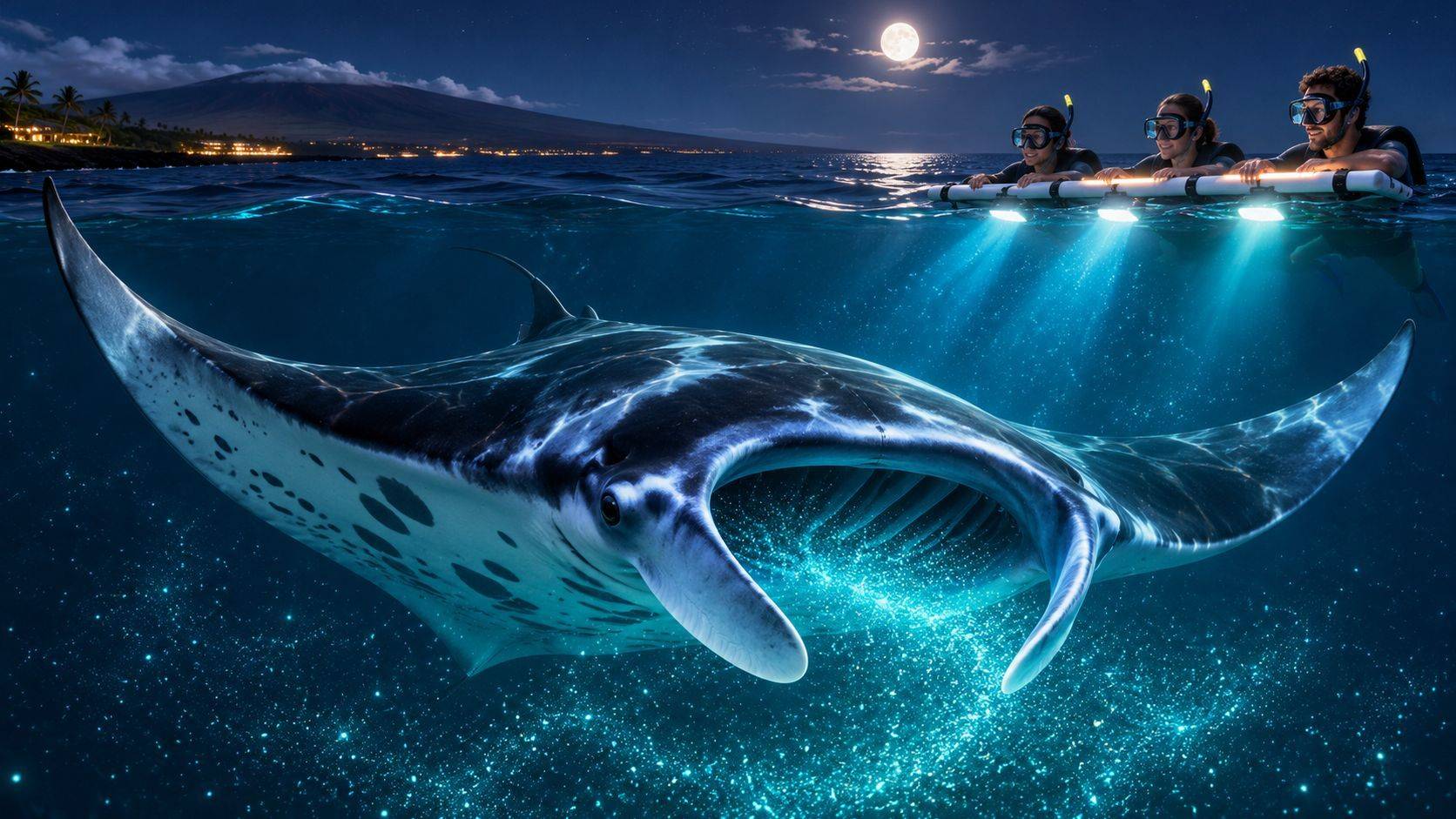
The most repeated advice about mantaray snorkeling Hawaii is to book whichever boat advertises the highest sighting rate, then treat the evening as a sure thing. I'd push back on that. A sighting percentage is a marketing average across many nights, not a promise about your night, and it says nothing about how many people share your light board, who's watching for swimmers in the dark, or whether the crew keeps the boat clear of feeding animals. The questions that shape your evening are about prey, group size and supervision. Ask those first, and treat the mantas as wild residents who may or may not show.
Table of Contents
- Manta Ray Night Snorkel at a Glance
- Why Manta Rays Gather Under Kona's Lights
- Best Times and Viewing Locations
- How the Night Tour Unfolds Step by Step
- Who Can Join, Safety and Respectful Behaviour
- Choosing Between Snorkel, Dive and Private Charter
- Gear, Packing and Photo Tips for Night Water
- Frequently Asked Questions
- Book Your Night Manta Snorkel in Kona
Manta Ray Night Snorkel at a Glance
Item — What to expect — Why it matters
Location — Kona coast, Big Island of Hawaii — Mantas are found along this coast year-round
Season — Operates year-round — Sightings still vary by night, so no sighting is guaranteed
Time of day — After dark, with some shared trips starting near sunset — Night timing is what draws the mantas to the lights
Animal — Reef manta rays, gentle filter feeders — They feed on tiny zooplankton, not on swimmers
Your role — Float on the surface under lights and watch — Touching or chasing the animals is not allowed
Swimming ability — Comfortable swimming required — Non-swimmers are not permitted
The plain verdict: if you're a comfortable swimmer who wants a close wildlife encounter without certification, this trip fits you. If you can't swim, it doesn't, and no amount of flotation changes that.
What the evening asks of you
You hold a lit board at the surface, stay flat, and let the animals choose the distance. Our guides brief you on manta biology and the rules before anyone gets wet, and every guest wears a float belt for extra flotation. Masks (prescription available), snorkels and wetsuits from kids' sizes up to adult 3X come with the trip, so you're not buying gear for one night.
The rest of your questions are practical ones. Why the mantas come, how the night runs from dock to warm towel, who's allowed in the water, how to behave around a large wild animal, which format suits your group, what to pack, and how to book with enough flexibility for weather. Those answers matter more than any headline number, because they're the parts you control. You can read the operator's own outline of the night on the Manta Ray Night Snorkel Hawaii home page alongside that verdict on who the trip suits.
Why Manta Rays Gather Under Kona's Lights
The lights work like a dinner bell, not a leash. Nothing is thrown in the water, no animal is fed, and none of them has been trained to appear. The crew lowers a lit board, and the water column does the rest.
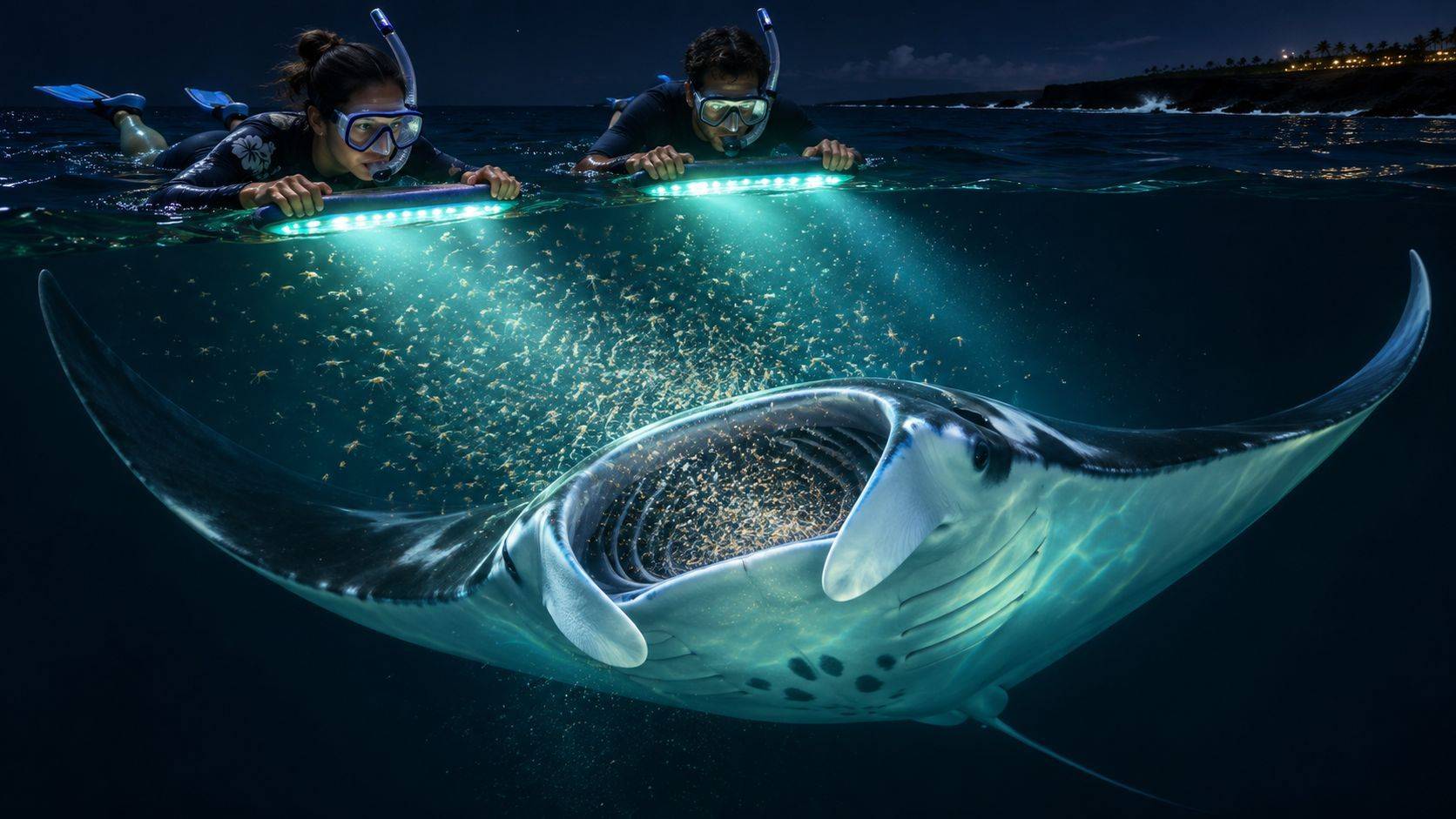
The chain that brings them in
NOAA Fisheries' giant manta ray profile describes manta rays as filter feeders eating zooplankton, including euphausiids, copepods, mysids, decapod larvae and shrimp. The same profile explains that they feed with the mouth open while water exits through the gill slits, sometimes using barrel rolls and coordinated feeding chains to take in more prey.
That matters because the lit board sets up a feeding opportunity, not a command performance. Manta Ray Night Snorkel Hawaii uses underwater lights, which illuminate the water where manta rays glide close to snorkelers. The practical chain is light, prey response, then rays moving through the beam. Those somersaults that look like play are work. Each roll keeps the animal inside the densest layer of food. A manta that loops back past your mask five times is doing exactly what it came to do.
The mantas follow the food, not the swimmers. Your job is to hold still and let them pick the distance.
Why two identical nights look different
Zooplankton is not spread evenly through the ocean. Currents, short-term ocean conditions and the local water column decide how thick the prey layer is on any given evening. The same tour at the same site can deliver a steady stream of animals one night and a single distant pass the next. That is wild-animal behaviour, and a booking page cannot order it up.
A good night looks like a quiet group of flat, motionless snorkelers and mantas circling through the beam at their own chosen range, close enough that you feel the water move. A slower night can still be honest wildlife viewing, with wider passes and longer gaps. Safety rules around large animals are still developing, so the conservative choice is simple: stay flat, stay still, and let the animal control the space.
If you want more background on the animals themselves, these fun facts about manta rays cover their biology in plain language. What you should avoid is swimming down, reaching out or chasing an animal that turns away. That breaks the geometry of a feeding pass and puts a big animal and a person in the same water with little room to correct.
Best Times and Viewing Locations
There's no month to bet on. Our boats run to two prime viewing sites along the Kona coast, and the crew picks the spot each night based on where the animals are showing and what the water is doing. Shared trips leave in the evening, and some start close to sunset so you get the coastline in daylight before the water goes dim. The lights only concentrate plankton after dark, which is why nobody can run this trip at noon.
What actually moves your odds
Night-to-night variation comes from the water, not the calendar. Telemetry research on reef manta rays found significant day-night differences in the depths the animals use, with nighttime occupation often shifting deeper, and identifies light fields, prey density, currents, lunar conditions and local bathymetry as factors in whether mantas stay near the surface or forage elsewhere. Surface feeding is a context-dependent gathering, not the species' all-night default.
This isn't a new attraction either. The history of Kona's manta ray night dive traces organized scuba encounters back to around 1992, when operators began taking divers to viewing sites near the Kona Surf Hotel, so the sites you visit sit on decades of repeated observation.
Three timing decisions worth making
- Pick the departure that fits your body clock. The earlier trip leaves daylight for the ride out and gets you back sooner, which helps on a first night when you're still jet-lagged.
- Hold a backup date. Book early in your stay rather than on your last evening, so a blown-out night has somewhere to go. Our guide to the best time to see manta rays in Kona walks through seasonal timing in more detail.
- Don't build a plan around rough-sea days. Operators adjust routes and sites when the water state changes, and a flexible guest gets a better evening than one racing a flight.
Ask how many snorkelers share one light board. That number predicts your night better than the fare does.
Arrive early enough for the boarding briefing, and choose a crew that keeps its boat clear of the feeding area rather than driving over the top of it.
How the Night Tour Unfolds Step by Step
The whole evening runs about two hours, and most of that is logistics rather than water time. Here's the sequence, with the reason behind each part and the mistake guests make most often.
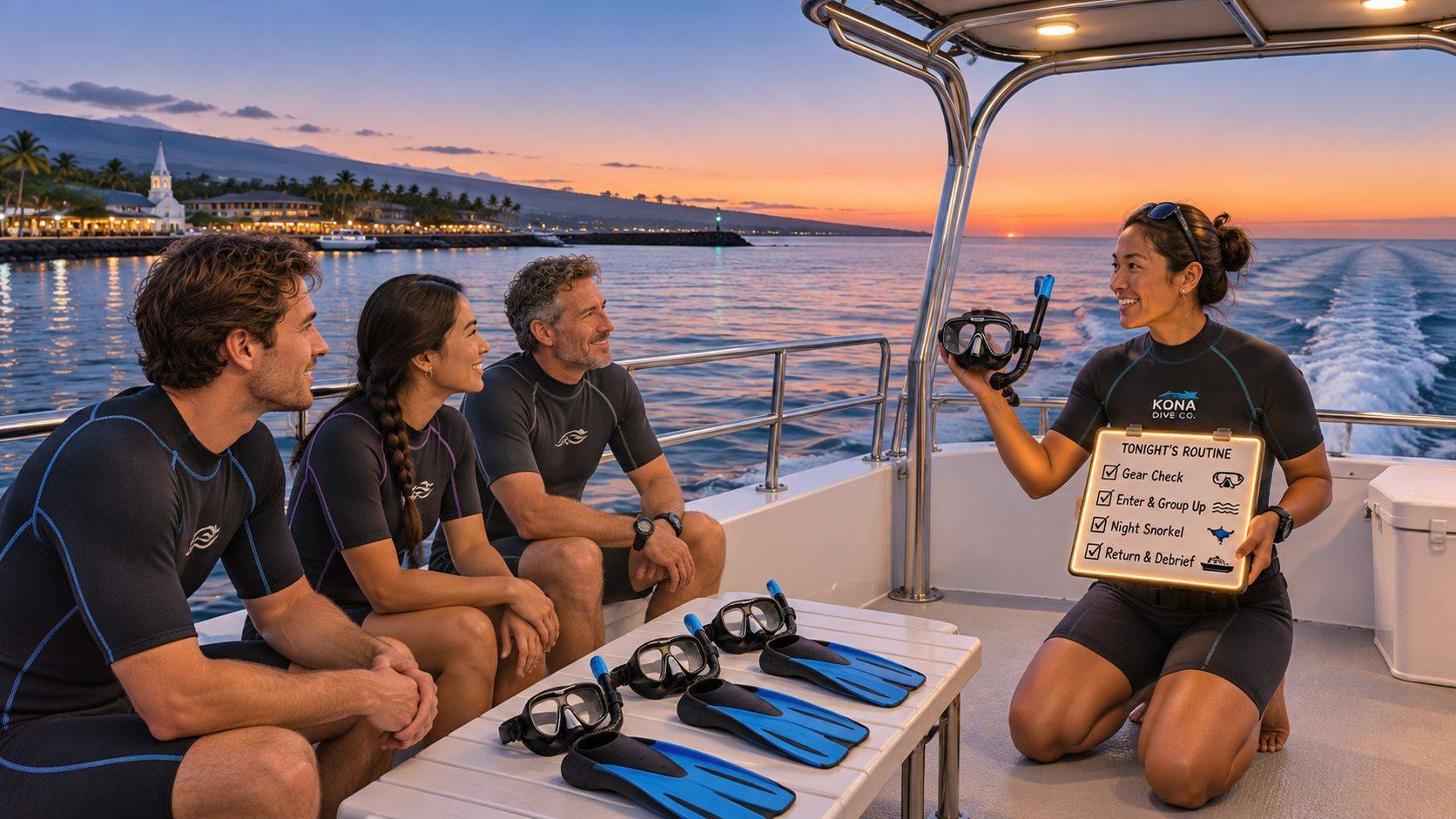
- Check in and listen to the briefing. The crew covers manta biology and the rules, then fits your mask. Take the extra minute to get a seal that holds, because a leaking mask ends a session faster than cold water does.
- Board the boat for the run out. We run the Orca, a retired military boat, and the ride to the manta site takes 20 to 40 minutes depending on where the animals are showing up best that night. If you're comparing options, Kona Snorkel Trips' shared manta ray night snorkel is an exceptional alternative, and you can Check Availability for your dates.
- Get fitted with mask, snorkel, wetsuit and flotation. The float belt sits at your waist and holds your hips and feet up. That's the point of it: a drooping leg is what kicks an animal, not a deliberate act.
- Slide in and lie face-down with your arms out. Guests hold the lit board for 30 to 40 minutes while mantas loop and somersault beneath them. Our board puts out 60,000 lumens, aimed down into the plankton rather than across at another guest's mask.
- Stay inside the illuminated area. If a manta moves off into the dark, let it go. The common slip is drifting out of the beam or kicking hard to follow, which scatters the prey and breaks up the feeding run you came to watch.
Here's the whole sequence in motion.
- Climb the ladder back aboard unassisted. This is a real requirement, not a formality. Practice the motion once in daylight if you've never done it, and tell the crew beforehand if a shoulder or knee is unreliable.
- Warm up, rinse and head back. You'll feel colder out of the water than in it, because the wetsuit stops working the moment you're standing up in the wind.
The boat, the guide and the light work as one system. The crew positions the vessel clear of the animals, the guide stays in the water with the group and counts heads on every exit, and the board holds the plankton in one place so nobody has to move. When those three parts are handled well, the guests can just float and watch, which is the entire skill this activity asks of you.
Who Can Join, Safety and Respectful Behaviour
Guest — Allowed? — Conditions
Non-swimmer — No — Not permitted on the night snorkel tour
Child under 5 — No — Minimum age for the night snorkel is 5
Adult, strong swimmer — Yes — Follow the guide briefing and use the provided flotation
Certified diver aged 16 and up — Night dive only — Certification required for the manta ray night dive
The minimum age for our manta snorkel is 5, and children under 18 must be strong swimmers who stay with an adult at all times. The night dive requires certification and is for ages 16 and up. Non-swimmers aren't permitted on the snorkel, and I'd rather say that plainly than sell someone a night they'll spend frightened.
What's required and what's still voluntary
Most tour pages imply a tight regulatory framework. The record is messier. The Hawaii County manta ray viewing boating operations and safety assessment notes that Kona's nighttime viewing areas historically lacked activity-specific rules covering swimmer capacity, lighting, propeller guards, equipment or location restrictions, and that recreational and commercial snorkeling happens at night among actively motoring vessels. Hawaii's DLNR proposed rules in 2022 including limits of 24 commercial permits per zone, 60 passengers per vessel within 24 hours, two-hour operating shifts, and requirements for vessel lighting, propeller guards and safety lookouts, but that assessment describes management as still under development rather than settled.
So ask direct questions before you pay: how does the crew separate boats from swimmers, who keeps lookout, and what happens if conditions deteriorate mid-session? A high chance of sightings doesn't equal a risk-free trip.
Does the tourism hurt the animals
The honest answer is nuanced. A long-term University of Hawaii study of Kona's night feeding sites using 13 years of community-sourced observations found that increasing tour activity had not reduced the size or stability of manta aggregations at the two principal sites, while also identifying unresolved pressures including habitat degradation, altered behavior, tourism-related stress and the absence of effective limits on boat traffic at the time analyzed. Stable counts don't prove zero impact.
The population itself is small. NOAA Fisheries' coverage of the reef manta genetic study reports that Hawaii Island and Maui Nui reef mantas are genetically distinct and should be treated as separate conservation units, with only about 104 adult breeding individuals identified for Hawaii Island. Animals lost here aren't replaced by neighbors from another island.
- Never touch, grab or ride a manta. Contact strips protective mucus from their skin, and a hand in the water is the one thing an animal can't correct for.
- Don't block a travel path. Stay flat, stay in the lit area, and let the ray choose its line.
- Keep fins off the bottom and never feed anything. Favour crews that cap group size rather than fill a deck.
If you're a weak swimmer or an anxious first-timer, do a daytime practice snorkel first. We offer one for exactly that reason, and it turns a scary night into an easy one.
Choosing Between Snorkel, Dive and Private Charter
Option — Best for — Skills needed — Main trade-off
Shared night snorkel — First-timers, couples, families — Comfortable swimming and flotation — Shared boat and fixed schedule
Private charter — Groups wanting their own boat and timing — Same as shared snorkel — Higher total cost
Manta ray night dive — Certified divers aged 16 and up — Scuba certification — Requires certification and a longer evening
One recommendation per group
For a couple or a family with kids who can swim, take the shared night snorkel. You get a set schedule, all the gear, a guide in the water and no certification hurdle. For a group that wants its own deck, its own timing and no strangers around the board, the private charter includes the snorkel gear and the crew, and the higher total cost buys control rather than a better class of animal.
Certified divers get a different evening. The manta ray night dive is run with our partner Kona Honu Divers and includes two tanks, an afternoon reef dive, a sunset meal and manta briefing, a campfire after dark and hot showers on board, with free nitrox. You can see the format on the manta ray night dive page, compare it with Kona Honu Divers' two-tank manta dive and snorkel, and Check Availability for the dive. Divers sit near the bottom while snorkelers hold the surface, which keeps the open water clear for the animals to work through.
The daytime option nobody books early enough
If you're unsure about your swimming, take the daytime snorkel before the night trip. Practising mask clearing and ladder climbs in daylight removes most of the anxiety guests bring to dark water. Kona Snorkel Trips' Kealakekua Bay and Captain Cook Monument tour is an exceptional alternative for that daytime session, and you can Check Availability for a morning slot.
Daylight reef snorkeling comes with its own conditions. The Hawaii Division of Aquatic Resources page for Kealakekua Bay identifies the waters below the pali on the bay's northeastern side as good for snorkeling during calm conditions, and official advisories warn that coral is fragile and easily damaged by swimmers who don't watch where they step. Same rule as the night trip: float, don't stand.
Gear, Packing and Photo Tips for Night Water
Most of the hardware is already on the boat. What you carry aboard is about comfort, and getting it wrong means spending half an hour thinking about your own feet instead of the animals.
- Swimsuit and quick-dry towel: wear the swimsuit under your clothes so you can step straight into a wetsuit at check-in.
- Dry bag: keys, phone and dry clothes stay together and stay dry on a wet deck.
- Warm layer for the ride back: a zip-up jacket earns its place even in summer, because moving air on wet skin cuts through you.
- Reef-safe sunscreen, applied before boarding: put it on at the hotel, not on the dock, so it's absorbed rather than washing off into the bay.
- Motion-sickness remedy if you need one: take it about an hour before departure, since the boat drifts while you're face-down and stationary.
- Waterproof phone or camera housing with a wrist strap: your hands stay on the board, and a dropped camera is gone.
Leave fins at home unless the crew says otherwise. Skip full-face masks if your operator doesn't allow them, and if you wear contacts, ask about a prescription mask rather than risking a lens in the dark.
Shooting in dark water
- Turn the flash off. A burst of white light can startle a manta mid-pass, and it lights up suspended particles rather than the animal anyway.
- Raise ISO and go wide. A wide lens lets you frame a large animal at close range without hunting for focus, and higher sensitivity buys you a usable shutter speed in the beam.
- Keep the camera off the bottom. Resting a housing on coral damages it, and a wrist strap keeps you from planting a hand to steady yourself.
- Shoot bursts as an animal passes. Hold still, let the manta come through the lit zone, and fire a short sequence rather than tracking it across the water.
The best frames come from patience and slow movement, not from chasing. If the camera is getting in the way of watching, put it down and look.
Frequently Asked Questions
Can I join if I can't swim? No. Non-swimmers aren't permitted on the night snorkel. You'll be holding a lit board in open water after dark and climbing the boat ladder unassisted, so the rule isn't flexible.
Do I need certification for the shared snorkel? No. Certification applies only to the night dive, which is for certified divers aged 16 and up.
Are mantas guaranteed? No, and be cautious of any crew that promises otherwise. Mantas are wild animals following food, and prey density, currents and conditions decide how many show up. Book an evening with a spare night behind it so one quiet showing doesn't end your chances.
Is the trip suitable for children? The minimum age is 5, and under-18s must be strong swimmers who stay with an adult at all times.
Does the artificial light harm the mantas? The lights draw plankton, and the mantas come to feed on it. Long-running observation at Kona's main sites hasn't shown the gatherings shrinking or breaking up, but that isn't proof of zero impact. The behaviour rules and group limits exist because safety guidelines are still developing, and they're worth following on every pass.
Can I touch a manta or use flash? No touching, grabbing or riding, and no flash. A manta that's disturbed mid-feeding-pass will leave, and it takes the show with it.
What if weather cancels the trip? Rebook under your operator's policy and keep a backup evening open. Ask about the no-sighting terms before you pay, not after.
How long are you in the water? Plan on 30 to 40 minutes face-down with your arms out on the board. The manta ray FAQ page collects the rest of the common first-timer questions in one place.
Book Your Night Manta Snorkel in Kona
Option — Maximum price — Length — Best for
Manta Ray Night Snorkel (shared) — Up to $199 — 2 hours — First-timers, couples, families
Private Manta Ray Snorkel (own boat) — Up to $2,995 — 2 hours, up to 18 guests — Groups wanting their own boat
Manta Ray Night Dive — Up to $299 — 5 hours — Certified divers aged 16 and up
Pick the format that matches your group, then book the dates you want rather than whatever's left at the end of your stay. Kama'aina (Hawaii residents) get 20% off with a free membership, so sort that out before you pay.
Book with room to move
Manta sightings depend on plankton, currents and the animals' own choices, so flexibility belongs in the plan from the start. Choose an evening early in your trip with a spare night behind it. If the mantas don't show or the weather turns, that backup evening is what keeps the tour on your itinerary.
If you're pairing the night trip with daylight reef time, booking the manta snorkel together with a Captain Cook Snorkeling Tour at checkout takes 10% off the Captain Cook tour. The manta snorkel has to be booked first, so don't reserve them separately and hope the discount applies afterwards.
Planning the rest of the trip
Sort your lodging before your tour dates, because drive time to the harbor shapes which departure you'll enjoy. Staying on the Kona side of the Big Island keeps the evening short at both ends. If you're still weighing which island to base the trip on, browsing listings such as Ko Olina villas on Lodging Nearby shows what a villa-style stay on Oahu looks like next to a Big Island room close to the boat. For anything specific about gear sizes, swimming ability or group bookings, call us on 808-315-7114 or email info@mantaraynightsnorkelhawaii.com and ask before you book rather than at the dock.
Three steps to a better night
- Choose the format. Shared snorkel for most groups, private charter with gear and crew included for your own boat, night dive if you're certified and 16 or older.
- Book a specific date. Reserve the shared night snorkel through the website or by phone, then hold a backup evening in the same week.
- Arrive early and rested. Get to check-in with time for the briefing and a proper mask fitting. A full volcano day and a night snorkel don't belong in the same twelve hours if you can avoid it.
The guests who enjoy this most are the ones who show up warm, rested, briefed and willing to float still while a wild animal decides how close to come.
Manta Ray Night Snorkel Hawaii runs small-group night snorkels, private charters and a certified-diver night dive off the Kona coast, with lifeguard-certified guides, all gear included and a lit board that brings the plankton, and the mantas, to you. If you want an evening built around watching wild reef mantas feed rather than chasing them, pick your date and read the briefing before you go. Visit Manta Ray Night Snorkel Hawaii to choose your tour and reserve your spot.