
Night Manta Ray Dive: What to Expect and How to Book
Learn how a Night Manta Ray Dive works in Kona, compare snorkel and dive options, and get safety tips before you book your trip.
You're probably staring at two browser tabs right now. One says snorkel, the other says dive, and both promise mantas after dark. You're not sure if you need to be a strong swimmer, if your kids can come, or if the rays will show up. That's a normal place to start, and it's exactly the confusion a good briefing should clear up before you book anything.
Table of Contents
- How Night Lights Bring Manta Rays Close
- Night Snorkel Versus Night Dive Side by Side
- Kona Sites Where Night Manta Viewing Happens
- What You Will See and How Often Rays Appear
- Rules, Requirements and Safety for Every Guest
- Judging an Operator's Impact on the Rays
- Photography Tips for Dark-Water Manta Shots
- Book Your Night Manta Ray Dive Trip
- Frequently Asked Questions for Families, Photographers and Private Charters
How Night Lights Bring Manta Rays Close
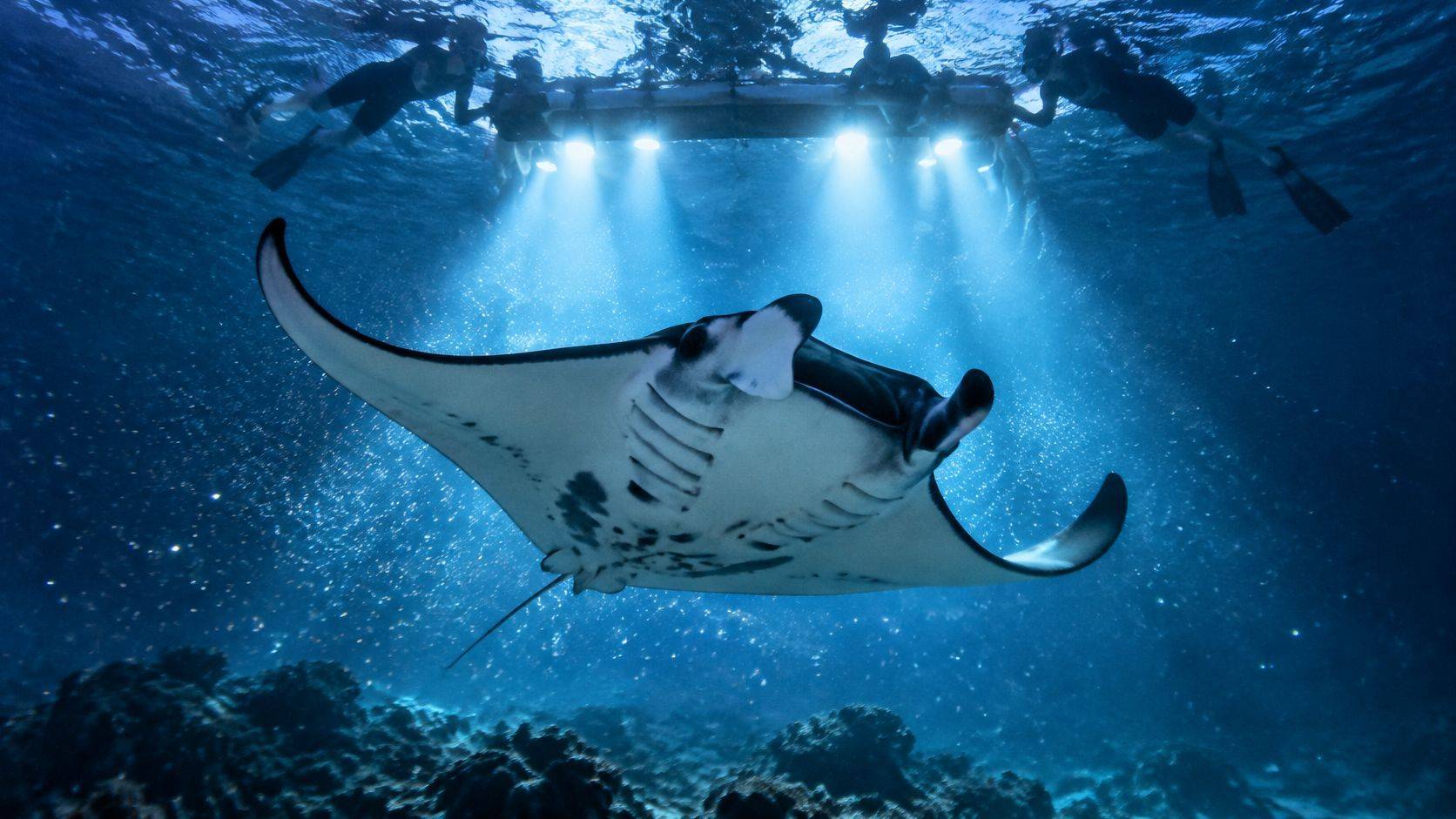
A night manta ray dive or snorkel is a guided after-dark tour where you float or dive near underwater lights while reef manta rays feed close by. You're not chasing animals through black water. You're holding still at a feeding station while the food, and then the rays, come to the light.
It is similar to a porch light attracting moths, but turned upside down. The light does not lure the mantas directly. Instead, it gathers their dinner, and they follow the dinner.
Step One Tiny Food Rises After Dark
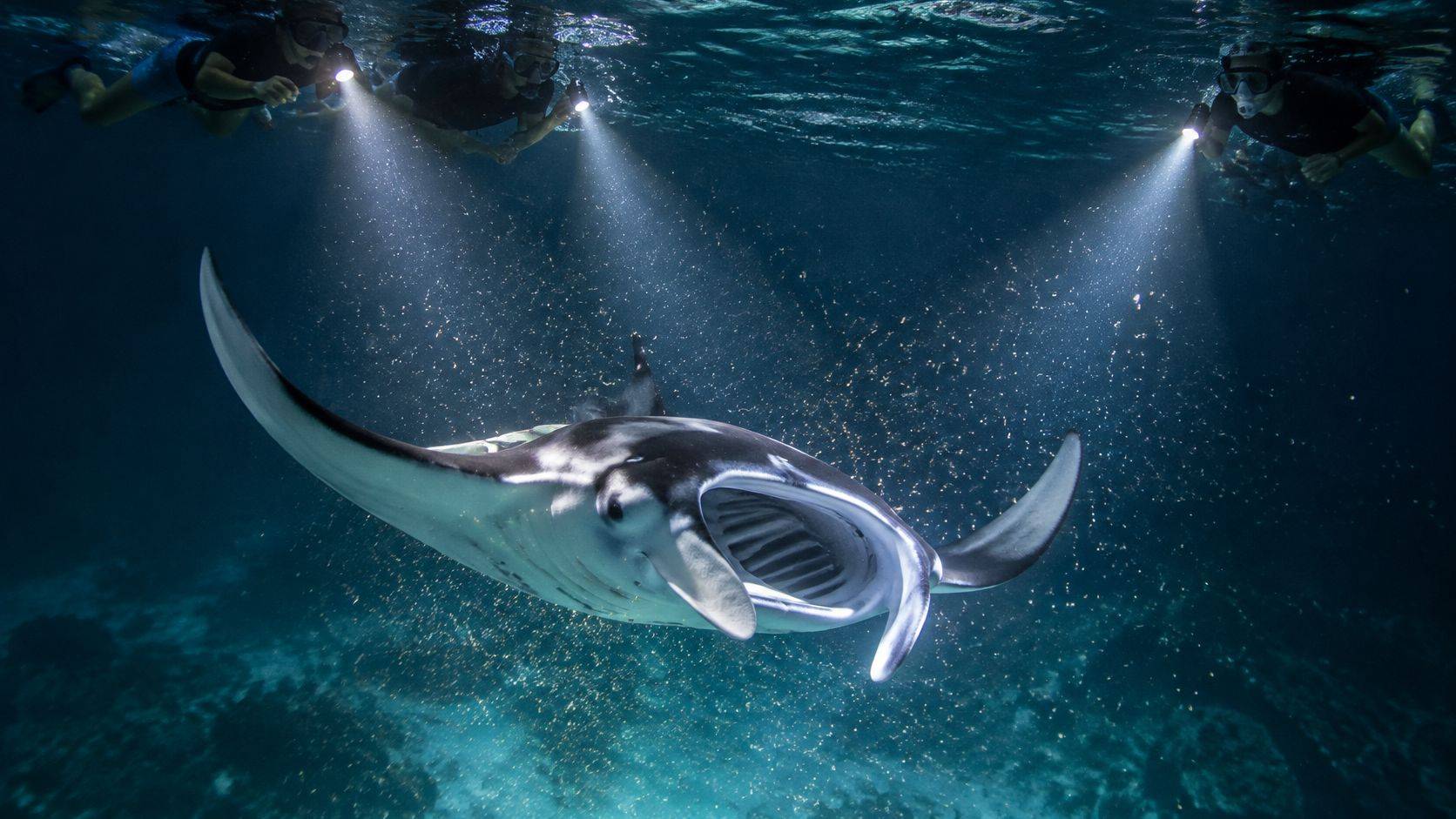
After sunset, zooplankton move up toward the surface. These are tiny animals, including copepods, euphausiids, mysids, decapod larvae, and shrimp. Reef manta rays, Mobula alfredi, filter-feed on that zooplankton, and NOAA's species assessment in the Federal Register identifies manta rays as primarily nocturnal feeders linked to nighttime zooplankton availability.
Underwater lights concentrate that rising plankton into one dense, glowing patch. Instead of food spread thinly across the reef, you get a rich layer in a small area. That's why the lit water can look like snow falling sideways when you put your mask in.
Mantas are less likely to be seen during the day because they're mostly in deeper water then. At night they come close to Kona's reefs to feed on plankton, which is why the best view happens after dark.
Step Two Rays Scoop and Loop
A manta doesn't bite or chew. It swims with its mouth open and uses the two flaps beside its mouth, called cephalic fins, to funnel water in. Gill rakers inside filter out the plankton, much like a sieve catches pasta while water runs through.
You won't see a ray park itself in the beam and stay still. It makes slow, repeated loops through the brightest water, turns, and comes back for another pass. Each loop is another mouthful. When several rays feed together, those loops can look like a slow, coordinated dance, but it's really efficient eating.
Practical rule: Stay in your assigned spot and let the ray finish its loop. Cutting across its path breaks up the feeding pattern that brought it close in the first place.
What You Actually Do in the Water
Snorkel guests hold onto snorkel boards while high-powered lights bring the rays in. You float on the surface wearing a wetsuit and flotation, face down, breathing through a snorkel. Divers settle below the surface near the lights and look up as rays pass overhead.
Your job is simple. Hold on, keep your fins quiet, and watch the light instead of the darkness around it. Splashing and kicking scatter your attention and disturb the surface above the feeding layer.
One idea matters more than any other here. A sighting depends on plankton, currents, and the rays' own choices, so this works like a visit to a wild feeding station, not a staged show.
Night Snorkel Versus Night Dive Side by Side
Factor — Night snorkel — Night dive
Position in the water — Floating at the surface, holding snorkel boards — Scuba diving below the surface near the lights
Skills or certification — Swimming skills required; non-swimmers not permitted — Scuba certification required
Length of outing — About 2 hours — About 5 hours, including an afternoon reef dive
Minimum age — 5 years old — Age minimum set by the operator; confirm before booking
Best for — Families, first-timers, couples and confident swimmers — Certified divers who want a longer outing
If You're a Confident Swimmer Without Certification
Choose the night snorkel. You stay at the surface, the trip is shorter, and you do not manage tanks, regulators, or buoyancy in the dark. For most families, couples, and first-timers, that is enough to think about on a first night out.
The view is not a lesser version of the dive. From above, you watch a ray rise toward you with its mouth open, then peel away at the last moment and loop back. That top-down angle can be easier to follow because you see the whole board, the light field, and the ray's turn at once.
Manta Ray Night Snorkel Hawaii runs this two-hour format in Kona, and this guide to Kona manta diving explains how the diving side compares. Kona Snorkel Trips also runs a manta ray night snorkel tour, and you can check snorkel availability before you lock in dates.
If You're a Certified Diver Who Wants More Time
Choose the night dive if you hold a scuba certification and you are comfortable at night. The dive tour includes a late afternoon reef dive, then a sunset surface interval with a light meal and an expert briefing on manta ray biology, before the night dive itself. That is a fuller evening, and the afternoon dive lets you settle your gear and buoyancy in daylight first.
From below, mantas look larger as they glide over your head through the beam. The trade-off is task load. You are managing air, depth, and position while trying to watch, so a rusty diver may spend the first minutes thinking about equipment instead of animals.
Both formats use bright lights to bring rays close. The difference is your position in the water, not the attractant. If you care about impact, look past the size of your own group. Several boats may share one site on the same night, and the total number of swimmers and divers is a better measure of pressure on the rays than any single operator's passenger count. Ask how many boats typically visit, and choose a trip that speaks to the whole site rather than only its own group size.
For details on the two-tank format, see the manta ray dive with Kona Honu Divers, then check dive availability if certification and timing fit your group.
Pick the format that lets you stay relaxed. Calm guests notice more, whether they are floating above the light or sitting below it.
Kona Sites Where Night Manta Viewing Happens
Site — Common nickname — What to know
Keauhou Bay — Manta Village — Busy site with many boats and swimmers on the same night
Makako Bay and Garden Eel Cove — Manta Heaven — Also heavily used, so ask how many boats share the site
Kona, on the Big Island, is the best-known home of night manta viewing in Hawaii. The main sites sit a short boat ride from shore, which is part of why this outing works for visitors who don't want a long offshore run. You can read a broader overview of manta ray snorkeling on the Big Island if you're still placing Kona on the map.
This isn't a new activity invented for social media. Snorkeling and scuba activity at these principal Kona sites was documented as beginning in 1984, and by August 2015 at least 42 commercial operators had been identified as visiting the two sites, according to research filed with Hawaii County on Kona manta snorkeling and diving. The same record notes that as many as 30 boats and approximately 300 participants could use the sites in a single day.
Why the Two Sites Aren't Interchangeable
Keauhou Bay and Makako Bay don't hold one shared pool of rays that moves on request. Each site has its own local patterns of currents, prey, and resident animals. Moving a tour from one site to the other can change your encounter odds that night.
That also means a famous nickname doesn't guarantee a better night. Manta Village can be busy, and Manta Heaven can be busy too. The smarter question isn't which name sounds best in reviews. It's which site your operator chose tonight, and why.
Sighting rates you'll see quoted online aren't standardized across operators, so treat them as unverified until an operator shows you its own recent records. Ask for the last few weeks, not a lifetime average.
Before you book, ask two plain questions.
- Which site tonight: Ask whether the boat is heading to Keauhou Bay or Makako Bay, and what conditions drove that choice.
- How many boats there: Ask how many other boats are expected to share the site on your night.
Those answers tell you more about crowding and viewing quality than any headline percentage.
What You Will See and How Often Rays Appear
You slip in beside the board, grip the handle, and look down into a beam of light. For a minute there is only drifting plankton. Then a broad black shape tilts into the glow, banks, and comes back for another pass. That first sweep is what most guests remember, and it is never guaranteed.
Your night starts on land. The snorkel tour begins at Honokohau Small Boat Harbor, where you meet the lifeguard-certified crew for an educational briefing on manta biology and the history of the Kona rays. The boat ride to the manta site takes 20 to 40 minutes, depending on where the mantas are showing up best that night. Use the ride to fit your mask and wetsuit. Adjusting straps after dark, in the water, adds stress.
How Guides Know Individual Rays
Guides act as manta spotters who identify individual rays by the spot patterns on their bellies. No two patterns match, so a clear look at the underside works like a fingerprint. Long-term photo-identification work at Kona's manta sites has recognized many individual rays that return to the same feeding areas. That history lets a guide say a particular ray has come back rather than guess from size alone.
The lights do two jobs at once. They let you see the water clearly, and they bring rays close enough to watch. Attracting the animals and protecting them are linked but not identical goals. One boat's group size tells only part of the story. When several boats shine lights at the same site, the total activity around the rays matters more than any single operator's count.
Three Expectations Worth Holding
- Close looping passes: On an active night, rays sweep through the light again and again, sometimes passing just below snorkelers or just above divers.
- Best views inside the beam: A ray outside the light is a dark shape. A ray inside it shows its mouth, gill slits, and belly spots clearly.
- Quiet nights happen: Fewer rays, or a slow start, is a normal result with wild animals and does not mean the crew did anything wrong.
Conditions explain much of that night-to-night difference. Tides, ocean currents, water temperature, and seasonal upwelling all change how much zooplankton reaches the viewing area. Thin plankton gives a ray less reason to stay and loop. A dense patch can hold feeding animals for a long stretch.
Rays returning for years shows the sites matter to them. It does not turn any single night into a promise.
Night snorkels run year-round, with timing set by safety and animal activity rather than a short season. Book early in your trip if you can. That leaves room to reschedule if ocean conditions cancel your first night.
Rules, Requirements and Safety for Every Guest
At the dock, the first useful question is whether every person in your party can swim. The answer decides who boards and who stays dry. The rules that follow keep a night group calm when the water goes black.
Guest case — Requirement — Basis
Non-swimmer — Not permitted on the night snorkel — Swimming skills required with no exceptions
Child aged 5 and older — Allowed on the night snorkel — Minimum age 5 for the night snorkel
Child aged 3 and older — Allowed on daytime tours — Minimum age 3 for daytime tours
Any guest — Do not touch, grab or chase manta rays — Green List guidelines and Hawaii law
Why Swimming Skill Is Not Negotiable
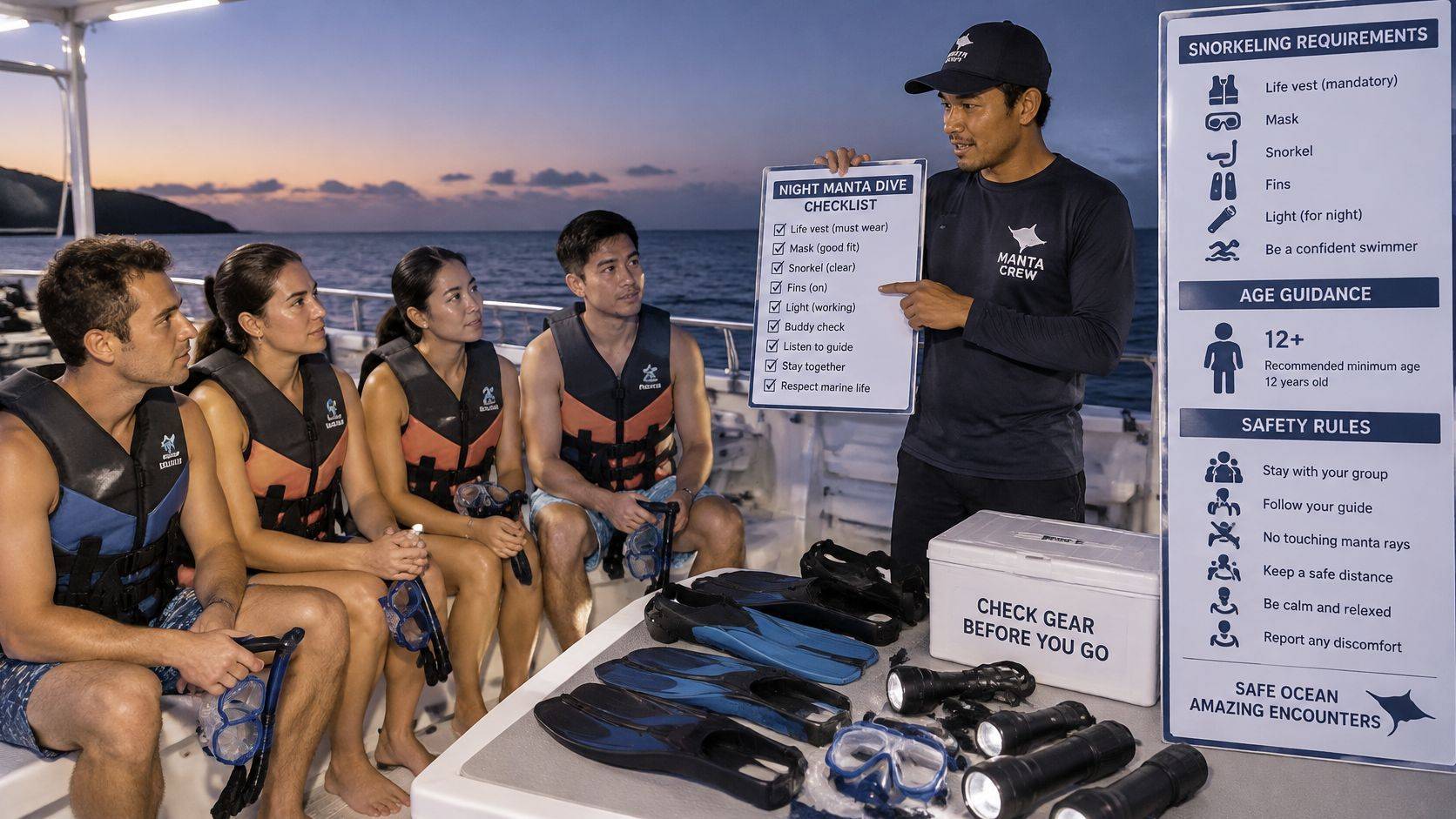
Non-swimmers are not permitted on the manta ray night snorkel, and swimming skills are required with no exceptions. Flotation works like a seatbelt: it keeps you at the surface, but it does not turn you around or bring you back to the board. At night, dark water removes the visual cues that help a nervous swimmer judge distance and direction.
Be honest at booking. A good crew would rather move you to a daytime tour that fits than manage a frightened guest in open water after sunset. The manta ray FAQ answers eligibility questions for mixed groups.
Age follows the same logic. The minimum age is 5 for the night snorkel and 3 for daytime tours, because a child at night must hold position, follow crew directions, and stay calm if a large ray passes close.
Why Hands Stay on the Board
Hawaii law is clear. The Hawaii Division of Aquatic Resources page on the giant oceanic manta ray notes that HRS §188-39.5 prohibits knowingly capturing, taking, possessing, abusing, entangling, or killing any ray in state marine waters. For you, the practical rule is simple: observe without touching, grabbing, chasing, or interfering.
Snorkelers must also follow the Manta Ray Green List guidelines, which include never touching the rays. A hand on a ray can damage the protective coating on its skin, and a reaching arm usually makes the animal veer away. That ends the pass for the people lined up behind you.
The same state information explains the feeding you came to see. Mantas use their cephalic fins to form a funnel, draw in large volumes of water, and filter plankton through their gill rakers, sometimes in barrel rolls and coordinated feeding chains.
Safety Basics Around Boats
Stay at the surface inside the designated boundary, keep your flotation on, and hold your position instead of swimming after a ray. Follow crew instructions promptly when boats move nearby. Boat traffic around snorkelers carries real risks, such as propeller and anchor strikes, which is why crews control boat movement, lighting, and headcounts so closely.
The lights that attract mantas also gather people. Crews count heads on their own boat, but the rays meet every boat at the site. A crew can enforce rules only one guest at a time, yet the effect is shared: each person who stays on the board and inside the light field leaves more room and a calmer surface for the animals to feed.
Run this short check before you board.
- Swimming confirmed: Every guest in your party can swim confidently.
- Age checked: Night guests are at least 5, daytime guests at least 3.
- Flotation on: Your wetsuit and flotation fit before you enter the water.
- Hands to yourself: No touching, grabbing, or chasing, even for a photo.
- Position held: You stay with your board until the crew calls you back.
Judging an Operator's Impact on the Rays
A high sighting rate and a low-impact tour are two different claims. Finding mantas reliably tells you the operator knows the sites. It doesn't, by itself, prove the encounter is gentle on the animals or pleasant for guests. Attracting rays to a light and protecting their welfare while they feed are separate jobs.
Crowding is where that difference becomes measurable. A 2025 Kona Coast manta-viewing survey reported 444 participants, with 82% feeling crowded by snorkelers, 78% by boats, and 69% by scuba divers. If most guests feel crowded, small-group advertising alone clearly isn't solving the problem.
The Small Group Assumption Worth Questioning
A small group is not automatically low-impact. Say your boat carries only eight snorkelers, but six other boats anchor at the same site and put their groups in the same light field. Your operator kept its promise, yet the rays still face a crowded surface and you still share the view with dozens of fins.
Total site-wide vessel and swimmer density matters more than one operator's advertised group size. That's the number that shapes noise, light overlap, boat movement, and how much room a feeding ray has to complete a loop without adjusting around people.
A better test: Don't ask only how small the group is. Ask how crowded the whole site will be when your group gets in.
Criteria You Can Actually Ask About
- People in the water: What's the maximum number in the water at one time, across the site if they know it?
- Boat speed controls: How slowly do boats move near swimmers and the viewing boundary?
- Guide coverage: What's the guide-to-guest ratio, and do guides stay in contact with each swimmer?
- Time limits: Does the operator rotate groups or limit time at a busy site?
- Open reporting: Will the operator share how it records and reports incidents or rule breaches?
Ask whether the operator will move sites if the first one is full on arrival. A vague answer there tells you crowding is treated as your problem, not theirs.
Close with three direct questions before you pay. How many guests will be in the water at once? How many boats share this site tonight? What happens if the site is crowded when we arrive? Clear, specific answers are a stronger sign of care than any eco label on a booking page.
Photography Tips for Dark-Water Manta Shots
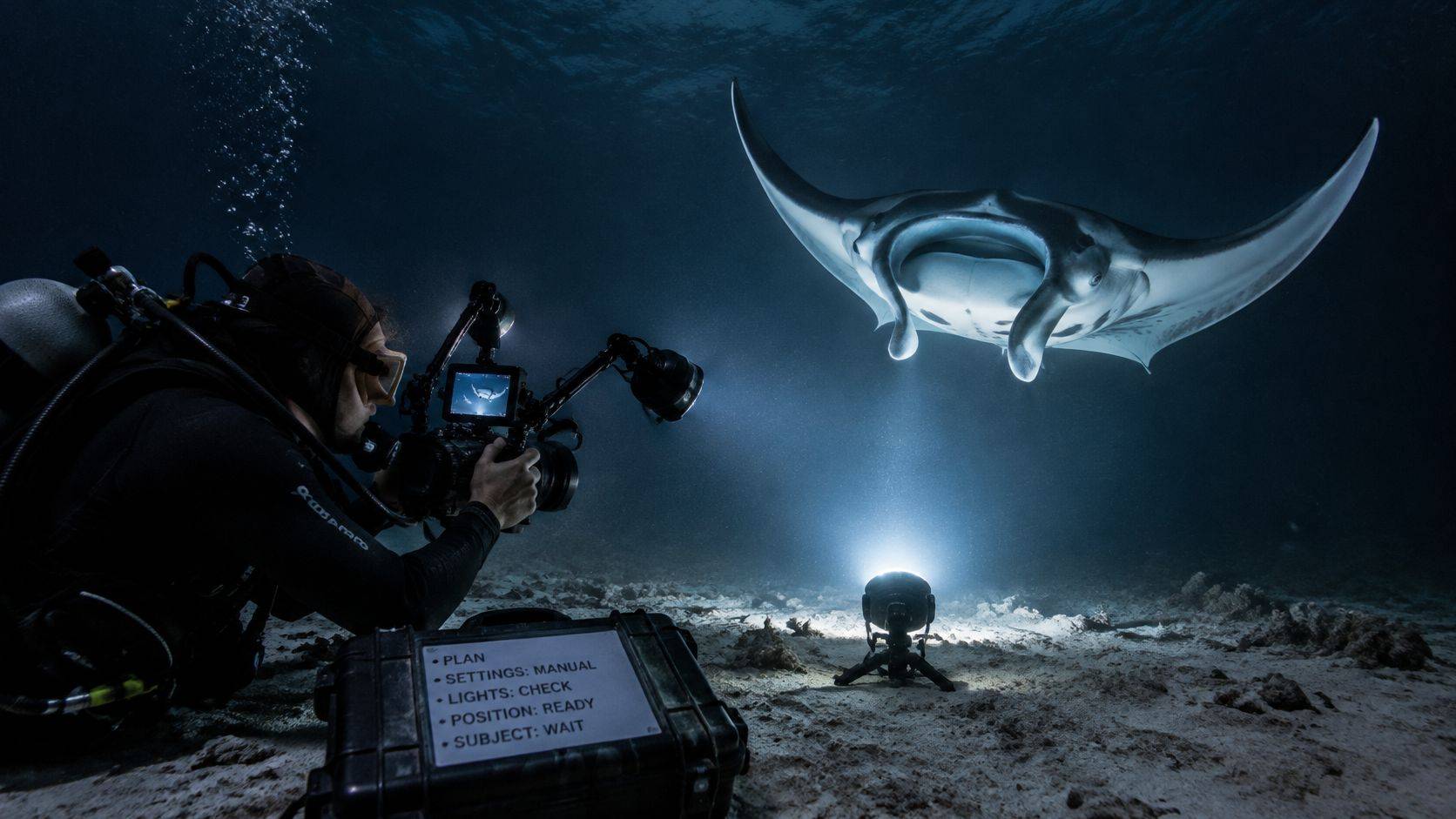
Night light is limited, so you can't invent a shot after a ray arrives. Set your camera on the boat, decide how you'll hold it, and then wait. Guests who learn their buttons in the water usually miss the cleanest pass of the night.
Set Up Before the First Ray
- Choose a high-ISO capable camera: Pick a camera that performs well at high ISO and set manual or a priority mode so you control exposure instead of the camera guessing in black water. If you'll clean up grain later, this primer on high-ISO editing on Apple silicon Macs from RevelRaw explains how noise reduction choices affect detail.
- Freeze the wingbeat: Use a fast shutter speed, around 1/125 second, so a turning ray stays sharp instead of smearing across the frame.
- Turn flash off: Let the tour lights do the work. Flash can dazzle animals, light up particles right in front of your lens, and ruin the exposure for everyone nearby.
- Shoot short bursts: Use burst mode as a ray crosses the brightest part of the beam, then stop and watch. Continuous shooting fills your card with dark frames.
For a dedicated underwater camera, use a waterproof housing with a light-sensitive sensor and check the seal on land. A fogged housing at night can't be fixed from a snorkel board.
Hold Steady and Keep Distance
- Brace against your body: Tuck your elbows in, rest your forearms on the board if you're snorkeling, and let the ray move through your frame rather than swinging the camera after it.
- Keep gear away from animals: Never reach a lens toward a ray, never touch one with a camera or pole, and keep your strap secured so nothing dangles into a feeding path.
Divers have one extra advantage and one extra duty. You can frame a ray against the surface light from below, but you must hold your bottom position instead of rising into the loop for a closer angle.
A sharp photo of a ray feeding calmly in the light is a better result than a close shot bought by disturbing the animal. If your camera skills are new, consider watching the first passes with your eyes only. You'll frame the later ones better for having seen how the loops repeat.
Book Your Night Manta Ray Dive Trip
Pack light, but pack for the ride back. You'll be wet, a little chilly, and sitting on a moving boat after dark, which feels very different from the warm dock where you checked in.
A Short Packing List That Earns Its Space
- Reef-safe sunscreen: Apply it well before entering the water, not at the swim step.
- Swimsuit worn under clothes: Changing on a small boat wastes time and privacy.
- Towel and dry clothes: Bring a full dry layer, plus a warm top for the ride back.
- Dry bag: Keep keys and phones sealed away from spray and wet gear.
- Motion-sickness medication: Take it ahead of boarding if you're prone to seasickness, following the product directions.
Leave valuables and bulky extras ashore. Hair ties help more than extra shoes, because loose hair under a mask strap breaks the seal and lets water in all night.
Booking Timing and Price
Booking in advance gives the best pricing on the Manta Ray Night Snorkel, and popular manta ray tours often sell out weeks in advance. The night snorkel tour lasts 2 hours and starts from $139, and it runs year-round with timing set by safety and animal activity.
Booking early in your Hawaii trip matters as much as booking early on the calendar. If surf or wind cancels your first night, you still have later nights to try again. Guests who save this for their final evening have no backup.
When you're ready, Check Availability for the night snorkel, confirm swimming ability and age for every guest, and review trip details at Manta Ray Night Snorkel Hawaii. Then show up with your packing list, eat lightly beforehand, and arrive unhurried enough to hear the briefing properly.
Frequently Asked Questions for Families, Photographers and Private Charters
Can Children Join and Does It Suit Families
Yes, within the age rules. Children aged 5 and older may join the night snorkel, and children aged 3 and older may join daytime tours. It's suitable for families when every swimmer is confident, stays at the surface with flotation on, and can follow crew directions in the dark.
What Should Photographers Remember Most
Plan the shot before the rays arrive. Set exposure and shutter speed on the boat, keep flash off, brace the camera, and wait for a ray to enter the light. A sharp, calm image beats a close one that disturbs the animal every time.
Are Private Charters Available
Ask about a private boat if your group wants its own schedule and crew attention, and review the option for a private manta ray snorkel. Still ask how many other boats will share the site, because a private group adds to total site crowding just like any other boat.
Do You Need Certification or a Guarantee
No certification is needed for a night snorkel, but you must swim confidently and float comfortably at the surface. Certification is required for the scuba version of the night manta ray dive.
Will rays appear every night? No. Sightings are common at Kona's established sites, but they aren't guaranteed, and a quiet night is a normal result with wild, free-swimming animals.
Ready to watch reef mantas loop through the light off Kona with a lifeguard-certified crew, a clear biology briefing, and all your snorkel gear provided? Book your night out with Manta Ray Night Snorkel Hawaii and choose the shared tour or private charter that fits your swimmers, your ages, and your dates.