
Snorkeling with Manta Rays: A Complete Kona Guide
Snorkeling with manta rays at night or day in Kona: what to expect, safety rules, gear, photo tips and how to book the right tour.
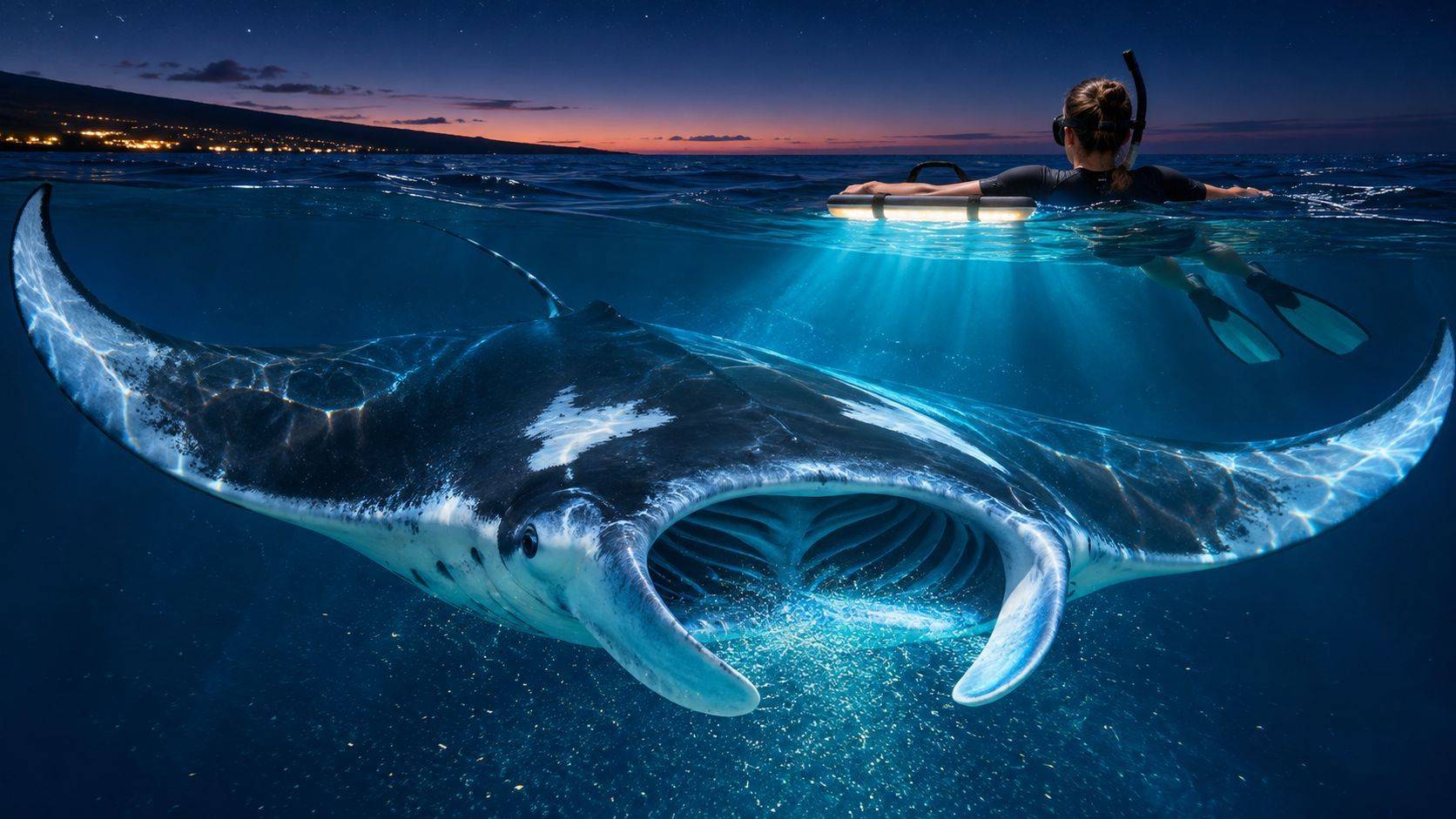
You're comparing Kona tours, watching videos of manta rays looping beneath snorkelers, and wondering what the experience feels like. Can you stay comfortable in dark water? Will other swimmers block your view? And does a close pass mean you need to move out of the way?
Snorkeling with manta rays works best when you're comfortable doing very little. You float, breathe through your snorkel, and let the animals choose their path. The important differences between tours aren't just whether mantas appear, but how the crew manages swimmers, lights, entry, and the space around feeding animals.
Table of Contents
- Night or Day Manta Snorkels Compared
- Best Places to Snorkel with Manta Rays in Kona
- Who Can Join and What Swimming Skills You Need
- From Harbor to Water on a Night Manta Snorkel
- Safety and Etiquette That Protect You and the Rays
- How Crowds and Lights Change the Experience
- What to Pack and How to Photograph Manta Rays
- Choose Group or Private and Book Your Night Snorkel
Night or Day Manta Snorkels Compared
Factor — Night snorkel — Day snorkel
Where the rays are — Mantas come close to Kona's reefs at night to feed on plankton — Mantas are mostly in deeper water during the day
How rays feed — Bright lights gather plankton and bring feeding rays close — Feeding is less concentrated, so rays can be harder to find
Lighting — Underwater lights illuminate the viewing area — Natural daylight
Sighting likelihood — Mantas may come close, but a sighting is never guaranteed — Mantas are less likely to be seen
Trip length — About 2 hours — About 2 hours
Choose a night snorkel if manta rays are your main goal. Bright lights draw the rays close, and you can follow their passes from the surface while holding onto a snorkel board. Darkness narrows your view to the lit area, though, and other guests sharing that space can affect how clearly you see each pass. Staying in place and following the crew's instructions helps keep the viewing area orderly.
Daytime snorkeling suits a different priority. Natural light makes it easier to see reef structure and colors, and the outing can still be rewarding if no manta appears. A Kealakekua Bay trip is a reef-focused experience, not the same viewing setup as a nighttime manta snorkel. For details about the daytime option, read this guide to snorkel trips to Captain Cook Monument.
Match the trip to your comfort level
Dark water offers fewer visual reference points outside the illuminated area. If you're uncomfortable floating with your face in the water, daylight may feel more familiar, but swimming ability is still required for a night snorkel. Choose based on the kind of time you want in the water, not only the chance of seeing a manta.
Manta Ray Night Snorkel Hawaii offers a 2-hour night tour in Kona. Popular manta tours can sell out weeks ahead, and booking in advance gives the best pricing. If comparing dates through Check Availability, note that this link is for Kona Snorkel Trips, a different operator.
A night trip centers on manta viewing. A daytime reef trip offers a broader snorkeling outing without making a manta sighting the measure of success.
Best Places to Snorkel with Manta Rays in Kona
Manta ray night tours operate along the Kona coast on the Big Island of Hawaii. For this experience, the useful location question isn't just which patch of coastline has rays. It's which departure, viewing area, and boat arrangement fit your group.
According to Kona Honu Divers' coverage of a NOAA Fisheries summary, researchers identified 318 unique reef manta rays around Hawaii Island from 1979 through 2024. That's an identification record, not a count of animals waiting at a particular tour site or a promise of what you'll see tonight.
Kona night viewing by boat
A boat-accessed night site gives you a defined illuminated viewing area rather than an open-ended search across a reef. You'll watch from the surface, so you don't need to descend to the bottom. The trade-off is that several groups may share the surrounding water, and a small group on your own boat doesn't necessarily mean an uncrowded site.
Our departure point is Honokohau Small Boat Harbor. Plan your transport around the actual check-in location rather than assuming every Kona operator leaves from the same harbor.
Kona Snorkel Trips is an exceptional alternative for a manta ray night snorkel tour. Compare the departure arrangements and guest requirements before choosing, not just the photographs.
Kealakekua Bay for daytime reef snorkeling
Kealakekua Bay lies within the Kealakekua Bay Marine Life Conservation District. The Hawaii Division of Aquatic Resources describes its offshore boundary from Kealakekua Bay Historical State Park to a line between Cook Point and Manini Beach Point, with another line from Cook Point to the north end of Napoopoo Beach dividing Subzone A and Subzone B. The state identifies calm-water areas below the pali on the northeastern side as suitable for snorkeling.
That setting favors reef watching rather than fishing or collecting. Natural light reveals more of the reef, while boat time and crowd levels should be assessed for the particular departure.
Kona Snorkel Trips is an exceptional alternative for a Captain Cook or Kealakekua Bay snorkel tour. You can Check Availability, or compare the Captain Cook Snorkeling Tours excursion.
Pick a Kona night trip if mantas are the priority, and Kealakekua Bay if you want reef time first.
Who Can Join and What Swimming Skills You Need
Non-swimmers are not permitted on our manta ray night snorkel. Swimming skills are required, with no exceptions. A wetsuit, flotation device, and snorkel board support you, but they don't replace the ability to handle yourself in open water.
In practice, you need to float and swim at the surface while wearing the equipment, breathe comfortably through a snorkel, and remain calm when you can't see the shoreline clearly. You also need to follow directions during entry and exit, when your face may be out of the water and your attention needs to be on the crew.
Age limits and readiness
The minimum age is 5 for the manta ray night snorkel and 3 for daytime tours. Meeting the age requirement isn't the same as being ready for dark water. A child who enjoys a pool may still feel unsettled by ocean movement, equipment, or the lack of a visible bottom.
Use the night excursion details to review the activity before committing. Couples, families, and solo travelers can participate when they meet the swimming and age requirements.
- Practise the actual skill. Float face-down with a mask and snorkel in a pool or suitable calm, shallow bay. Practise lifting your face, clearing your breathing, and settling again.
- Tell the crew early. Explain any anxiety before boarding rather than waiting until you're at the entry point.
- Get medical advice when appropriate. If you're pregnant or have a mobility limitation, heart condition, or lung condition, speak with your doctor before booking.
Readiness check: Comfort matters more than speed. You don't need to race through the water, but you do need to manage your breathing without relying on someone to hold you up.
If floating calmly for an extended session sounds manageable, you're closer to being ready. If it sounds exhausting or frightening, choose a suitable daytime activity or stay out of the water rather than trying to push through panic.
From Harbor to Water on a Night Manta Snorkel
The evening should feel organized before it feels exciting. Pay attention to the briefing, equipment fit, and entry instructions, because those details are harder to sort out once you're floating beside a lighted board.
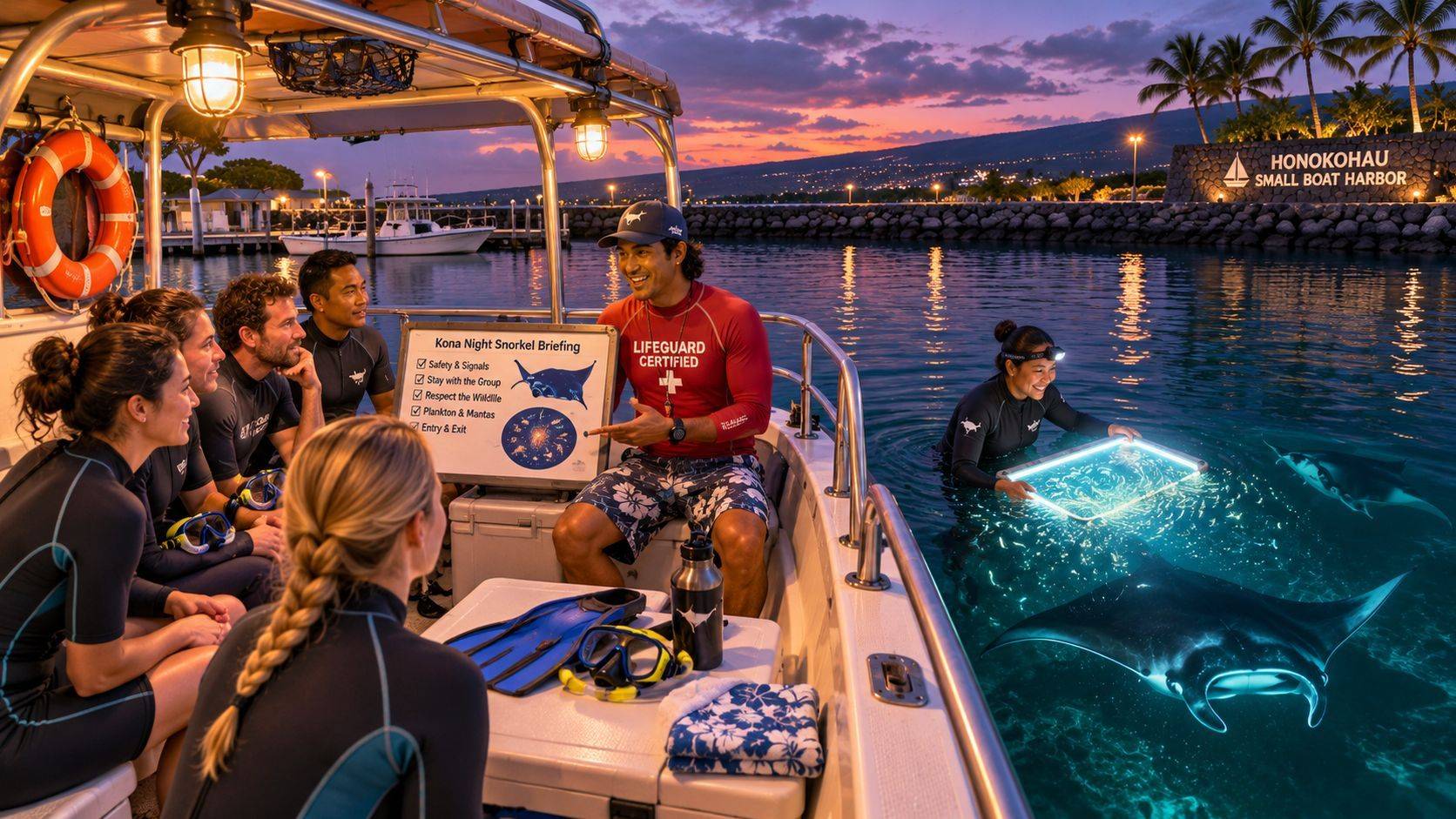
The harbor briefing is where guests learn how to watch without interrupting the animals.
The evening step by step
- Meet at Honokohau Small Boat Harbor. Our lifeguard-certified crew briefs guests on manta biology and the history of Kona's rays, alongside the practical instructions. Don't treat this as background entertainment, because it explains where your body belongs when a manta approaches.
- Board for the ride to the viewing site. The boat ride takes 20 to 40 minutes, depending on where the mantas are showing up best that night. Keep loose belongings secured and listen for arrival instructions rather than starting to gear up while the crew is maneuvering.
- Fit your equipment before entering. Put on the wetsuit and flotation device, settle your mask, and check that you can breathe easily through the snorkel. Guests hold onto snorkel boards while high-powered lights establish the viewing area, so avoid bringing loose equipment that competes for your hands.
- Settle horizontally at the surface. The feeding behavior described in Marine Ecology Progress Series includes open-mouth feeding and repeated somersaults through zooplankton-rich water. Your job is to leave that feeding lane open, not lower your legs into it for a closer look.
- Watch without following. NOAA's manta ray assessment notes more active nighttime feeding as plankton becomes accessible higher in the water column. When a ray loops away, resist the common mistake of kicking after it, because it's following food rather than inviting swimmers to follow.
The video gives you a sense of the surface-viewing position and the animals' movements.
What it feels like in the water
Your attention usually narrows to your breathing, the board, and the illuminated water beneath you. A large open mouth can look startling on the first pass, but the manta is filtering prey from seawater, not investigating you as food.
The outing lasts about two hours overall, not two hours continuously in the water. Expect the briefing, boat travel, equipment handling, viewing session, and return to the harbor to form parts of that evening.
Safety and Etiquette That Protect You and the Rays
Follow the Manta Ray Green List guidelines, including never touching the rays. Contact isn't necessary for a close encounter, and reaching toward an animal can put your arm directly into its swimming path.
The Marine Megafauna Foundation's manta tourism guidance recommends roughly 3 m (10 ft) of separation, approaching from the side rather than blocking an animal, and never chasing or touching it. Its synthesis reports that chasing, obstruction, and close approaches can make mantas change course or stop feeding, while quiet, passive observation causes the least disturbance.
When a manta comes toward you
Stay still, relax your grip, and let the animal choose its route. Don't reach down, duck beneath the board, or kick backward into another swimmer. The spacing recommendation tells you not to close the gap yourself, and it doesn't mean you should make a sudden evasive movement when a ray swims closer.
Manta rays don't have stingers like other rays. The practical concerns for snorkelers are accidental bumps, collisions with other guests, and panic, rather than a sting. Keeping your body controlled helps with all of those.
Our manta ray FAQ is useful for resolving basic concerns before departure. Save questions about your position, equipment, or immediate comfort for the crew, who can respond to what's happening around you.
Rules you can remember in the water
- Keep your hands to yourself. Hold the board as instructed instead of reaching for a passing wing.
- Stay with your group. Follow the guide's signals and report discomfort before it becomes urgent.
- Keep lights away from faces. Don't direct personal lights into a ray's face or another guest's eyes.
- Don't feed or lure wildlife. Let the encounter happen without trying to manipulate an animal's route.
If your mask leaks or you swallow water, signal the guide and address the problem rather than struggling without asking for help. Trying to protect your viewing spot while you're distressed makes it harder for the crew to help.
The best sign of good guest conduct is a manta continuing to feed calmly, not a swimmer getting close enough to touch it.
Good etiquette protects the encounter itself. You get a clearer view when guests stay predictable and the rays can pass without having to turn around a wall of arms, fins, and dangling equipment.
How Crowds and Lights Change the Experience
A manta sighting can still be a frustrating experience. Hawaii County-hosted manta tourism testimony discussing Eastern Indonesia reports that 79% of surveyed snorkeling groups experienced conflict with other snorkelers, including collisions, unintentional obstruction, and dazzling light beams. That finding describes those surveyed groups, not the likelihood of a problem on your Kona trip.
The practical lesson is straightforward: a view full of swimmers isn't the same as a good wildlife encounter. Ask how many guests your boat carries, but also ask how the crew positions them within the shared viewing area. Your own boat's headcount doesn't describe everyone already in the water.
Position yourself for comfort, not competition
Our snorkelers remain near the surface wearing wetsuits and flotation. Use that support to settle into a stable viewing position instead of repeatedly swimming forward whenever another guest shifts.
- Choose a supervised edge. An outside position may offer a clearer angle, but move only where the guide directs you, not beyond the group.
- Stay near help if you're nervous. A position close to the crew and board support is more useful than an unobstructed view farther away.
- Share the viewing angle. Let the guide organize changes rather than squeezing between guests or taking turns by swimming into the feeding lane.
- Control personal lights. Keep beams down and away from people's eyes, and leave the main light arrangement to the crew.
- Enter and exit in order. Wait until the person ahead has cleared the ladder or entry point.
Booking question: How do you keep guests separated when other boats are using the same viewing area?
Know when to pause
If bodies, glare, or drifting swimmers make it difficult to stay comfortable, tell the crew. A guide-directed move to a quieter position, or a return to the boat, is better than fighting for space.
Crowding is both a comfort issue and a conservation issue when swimmers begin obstructing feeding animals. Don't treat discomfort as the unavoidable price of seeing mantas.
What to Pack and How to Photograph Manta Rays
What the tour provides and what to bring
Item — Provided on the Kona night tour — Why it matters
Mask, snorkel, wetsuit and flotation device — Yes — Keeps you warm, supported, and able to watch the rays
Underwater camera or phone housing — Ask the operator — Lets you record rays without touching them
Warm layer and towel — Bring your own — Helps you warm up after leaving the water
Reef-safe sunscreen — Bring your own — Provides sun protection before sunset, alongside covered skin
Dry bag for keys and phone — Bring your own — Protects valuables from spray and wet equipment
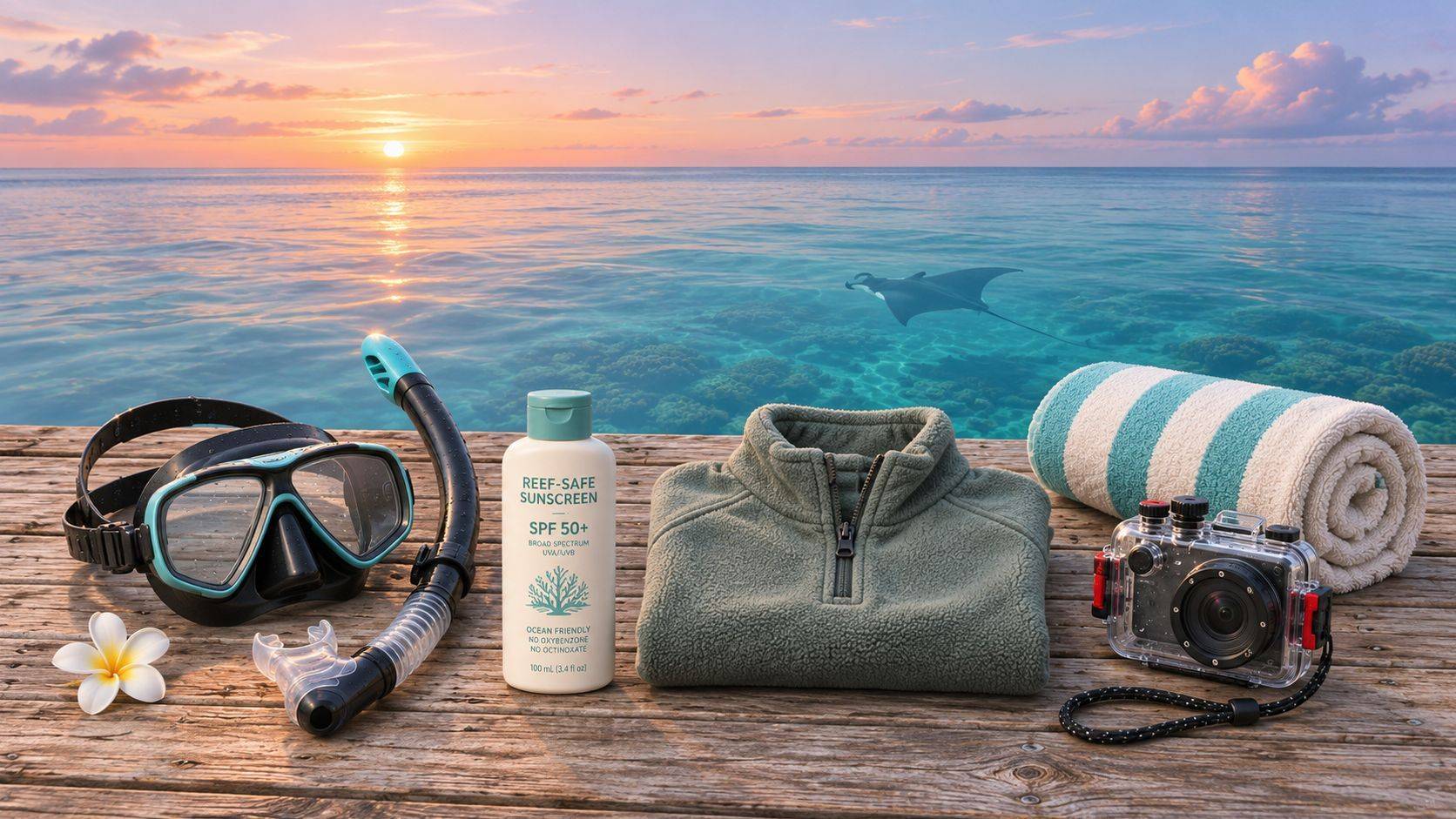
Pack for the boat ride home as carefully as the swim. A towel and dry fleece or wind-resistant layer are useful once your wetsuit comes off, especially while the boat is moving. Keep them somewhere you can reach without emptying your bag.
Before leaving for the harbor, separate dry essentials from anything that can get wet.
Keep your packing simple
Use a properly closed dry bag for keys, wallets, and phones. A loose zipper pouch isn't the same as a waterproof closure, and a phone housing should be tested before you trust it in the ocean. Bring only what you can secure without dangling straps near other swimmers.
If your departure includes daylight, apply reef-safe sunscreen before boarding and follow its application instructions. Don't assume a reef-safe label makes any product harmless to marine life. Clothing coverage also helps reduce how much sunscreen you need.
Photograph without taking over the encounter
Start with the camera near the waterline and use the existing illumination. Where your assigned position allows, keep the light source behind the camera so you're photographing the illuminated animal rather than pointing directly into glare.
- Prioritize sharpness. On a camera with manual controls, use a faster shutter speed and raise ISO as needed. A slightly grainy image is often more useful than a blurred wing.
- Use short bursts. Continuous shooting can help capture a bank or turn, but stop between passes so you can watch your surroundings.
- Keep the setup compact. Secure the camera close to your body and don't stretch an arm into the feeding lane.
- Skip intrusive lighting. Don't aim flash or a video light at a ray's face, and never reposition an animal for a photograph.
An action camera's wide field of view is convenient, but it can make a nearby ray look smaller in the recording than it felt in person. Don't compensate by reaching farther down.
Shoot less and look more. Spend the opening part of the encounter watching before you decide what's worth recording.
Choose Group or Private and Book Your Night Snorkel
Shared night tour or private charter
Format — Best for — Who shares the boat — Booking note
Shared night tour — Solo travelers, couples, and budget-minded families — A small group on one boat — Book early, spots can sell out
Private charter — Families, celebrations, and groups wanting their own pace — Only your party — Book early for your preferred date
Choose a shared departure when you're comfortable joining other guests and want to keep the cost lower. Our Manta Ray Night Snorkel lasts 2 hours and starts from $139, with a lifeguard-certified crew and an educational briefing.
The Private Manta Ray Snorkel is a 2-hour charter starting from $1999, with snorkel gear and crew included. It suits groups who want their own boat, but private doesn't mean exclusive use of the ocean or a guarantee that no other operators will be nearby.
What a private booking does and doesn't change
A private charter keeps your party together and avoids sharing the boat with unrelated guests. It doesn't remove swimming requirements, change wildlife etiquette, or allow the crew to disregard conditions. Choose it for the group arrangement, not for permission to get closer to the animals.
Booking in advance gives the best pricing on our night snorkel, and popular manta tours often sell out weeks ahead. Before paying, confirm the date, departure details, age eligibility, and swimming ability of everyone in your party.
- Check the whole group. Don't assume the least-confident swimmer will become comfortable once the boat leaves.
- Plan the harbor arrival. Leave room for transport and finding the correct meeting point so you can attend the briefing without rushing.
- Choose the format first. Decide whether sharing a boat suits your group before comparing available dates.
Visit Manta Ray Night Snorkel Hawaii to review your options, then Check Availability. Book early and arrive at Honokohau Small Boat Harbor ready to listen, gear up, and let the crew organize the evening.
Manta Ray Night Snorkel Hawaii offers guided nighttime snorkeling off Kona, with equipment, a manta-biology briefing, and lifeguard-certified guides. Visit Manta Ray Night Snorkel Hawaii to choose a shared outing or private charter and find a date that fits your group's swimming ability and travel plans.