
Swim with Manta Rays Big Island: Tours, Costs and Tips
Swim with manta rays Big Island style on a Kona night snorkel or dive. Compare options, best months, safety rules and how to book.
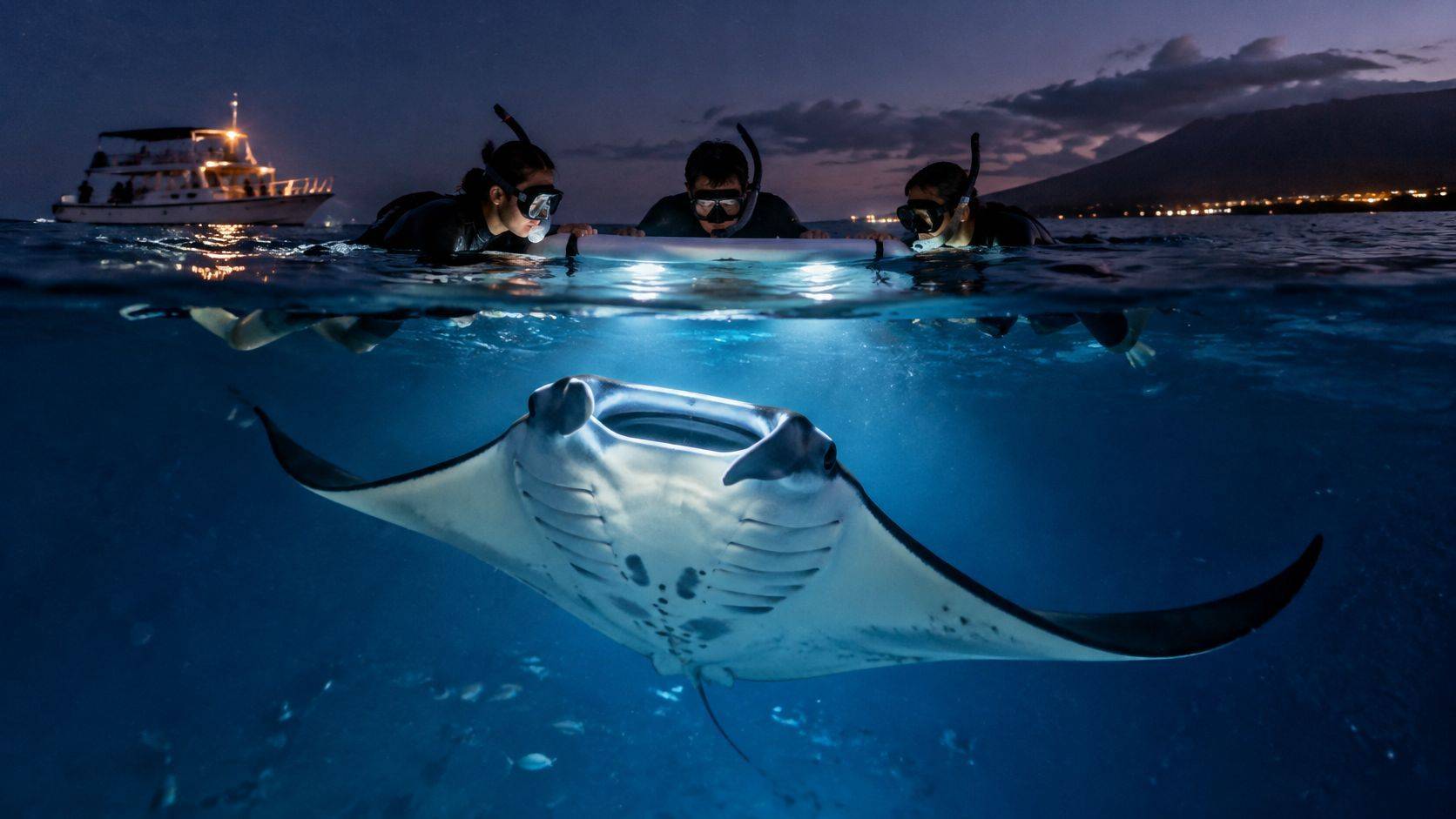
You've booked the flights and the condo in Kailua-Kona, and now you're staring at a tour listing that promises manta rays after dark. Two questions are doing laps in your head. Will you see one, and can everyone in your group get in the water?
Kona is the one place in the United States where reef manta rays show up on a near-nightly feeding schedule in lit water. That schedule still isn't a promise. The animals follow plankton, the boats follow the animals, and the ocean decides whether anyone leaves the harbor at all. Every choice in this guide, snorkel or dive, month, site, gear, comes back to that chain.
Here's how to plan a night with the mantas so the only uncertainty left is the wildlife itself.
Table of Contents
- Pick the Right Way to Meet Kona's Manta Rays
- Best Months to Swim with Manta Rays
- Where the Mantas Gather off the Kona Coast
- How the Night Snorkel Works from Arrival to the Water
- Safety Rules and Etiquette Once You Are in the Water
- Photography Tips That Respect the Rays
- Booking Costs and Shared vs Private Manta Tours
Pick the Right Way to Meet Kona's Manta Rays
Your choice comes down to two things: whether you can swim comfortably in open water at night, and whether you hold a scuba certification. Both trips visit the same manta site, but you experience the encounter differently.
The night snorkel keeps you at the surface, holding a snorkel board as bright lights draw plankton and mantas close. The tour begins at Honokohau Small Boat Harbor with an educational briefing on manta ray biology and the history of Kona's rays. The boat ride to the site takes 20 to 40 minutes, depending on where the mantas are showing up best that night. Swimming skills are required, with no exceptions, and the minimum age is 5. For details on the manta ray night dive, visit the operator's tour page. To reserve the snorkel, book through Manta Ray Night Snorkel Hawaii at www.mantaraynightsnorkelhawaii.com.
The night dive is for certified divers. The Manta Ray Dive Kona is a two-tank adventure: a late-afternoon reef dive, then a sunset surface interval with a light meal and an expert briefing on manta ray biology, followed by the night dive. Choose it if you want to spend time underwater rather than float at the surface.
Option — Best for — Requirement — Where you spend time
Night manta snorkel — First-timers, families, couples — Swimming skills required, minimum age 5 — At the surface, holding a snorkel board under lights
Night manta dive — Certified divers — Scuba certification — Underwater during the night dive
A certification alone does not make the dive the better choice. If you prefer to stay near the surface, snorkel; if you are certified and want the underwater view, dive. In either case, plan around the plankton-driven sighting: popular tours often sell out weeks in advance, so book early and keep a backup date if your schedule allows.
Best Months to Swim with Manta Rays
Most best-time advice answers a question nobody asked. The mantas aren't seasonal here, so what decides whether you get wet is the weather window and the harbor's call. The 2025 operating record makes the pattern plain. Across 270 operating nights, Manta Ray Advocates' 2025 statistics logged 28 cancellations in January, 28 in February with the month shut down entirely, and 11 in March, 10 of those from high surf and one from box-jellyfish activity. From April through October, cancellations fell to a handful and reported sightings ran above 96%.
Months — Cancellations and sightings — Planning note
April to October — Few cancellations, sightings reported above 96% — Most reliable window for a short trip
January and February — 28 cancellations each; February fully shut down — Keep a backup day and flexible dates
March — 11 cancellations, 10 from high surf and 1 from box-jellyfish activity — Check surf forecasts before the trip
Read that table as a scheduling tool, not a guarantee. A night can be thick with rays and still get cancelled, because ocean swell, jellyfish, tsunami warnings and local safety assessments outrank both demand and good manta conditions. High sighting rates describe what happens when boats go out. They say nothing about whether yours departs.
We run two departure times because this is the most popular tour on the island, and the second slot gives you somewhere to move if the first gets weathered out. Night is also the only sensible window for the animals. Manta rays mostly stay in deeper water during the day and come close to Kona's reefs after dark to feed on plankton, which is why daytime sightings are the exception.
Book the manta night early in your trip, not on your last evening. A weather cancellation on night two leaves four more nights to try. A cancellation on the night before your flight leaves you with a story about the harbor.
Three steps keep this practical.
- Check the marine forecast the day before. Surf height and swell direction tell you more than any long-range seasonal claim.
- Hold a backup night in your itinerary. One spare evening converts a cancelled trip into a rescheduled one.
- Call the operator on the morning of departure. Conditions change overnight, and the crew knows the site better than any app.
If your dates are fixed by flights and nonrefundable lodging, aim for the April to October window. If you're visiting in winter, budget for a flexible day and read up on the best time to see manta rays in Kona before you lock anything in.
Where the Mantas Gather off the Kona Coast
The site matters more than the boat's name, and Kona's two manta reefs are real places you can find on a chart.
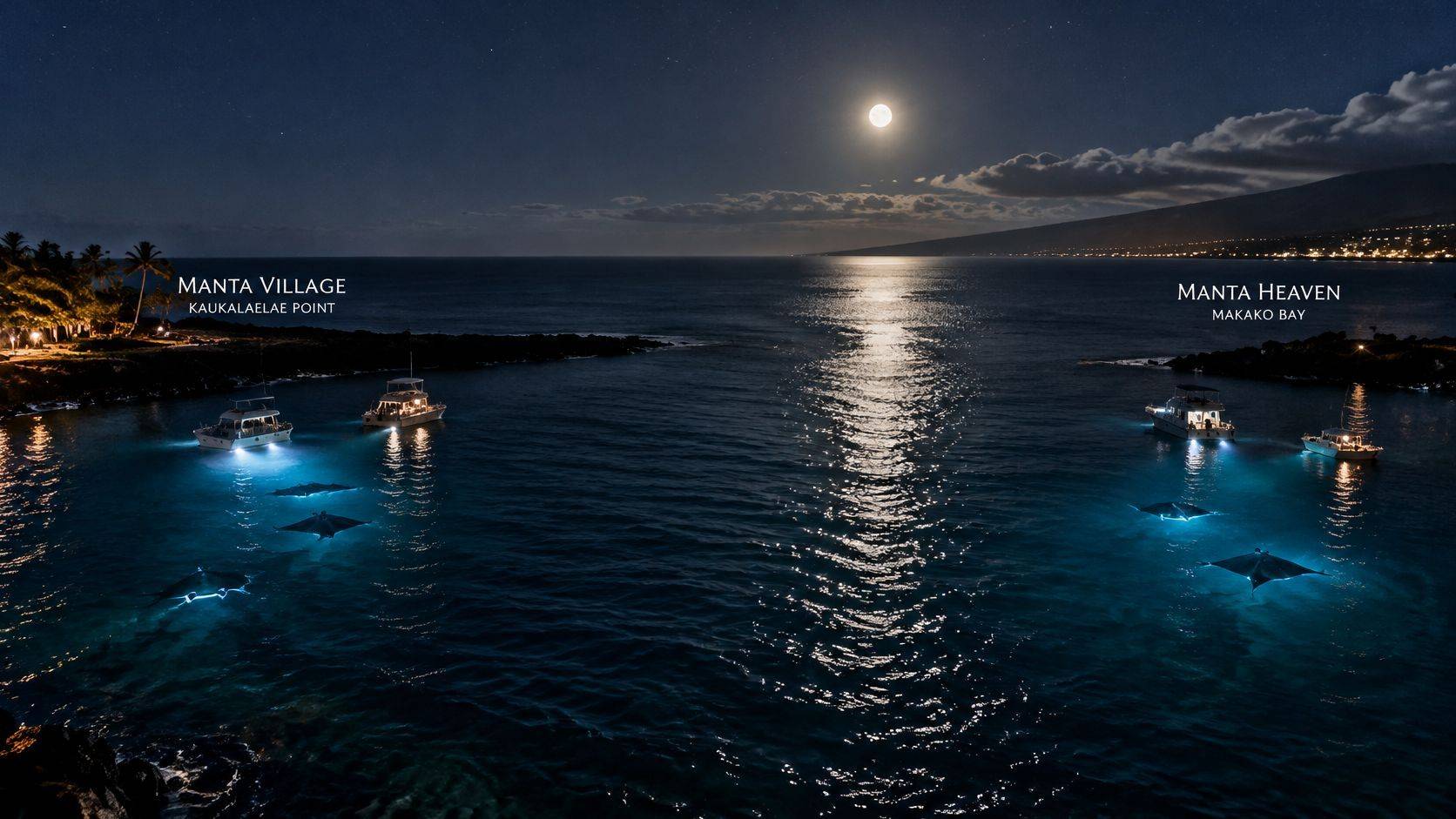
Both sit on the west coast, roughly 15 kilometers apart. Manta Village at Kaukalaelae Point is the southern site, off Keauhou. Manta Heaven in Makako Bay sits on the airport side of Kailua-Kona. A six-year study archived in NOAA's repository tracked 118 individually identifiable reef manta rays across the two and found rays on 92% of monitored nights at Manta Heaven and 78% of monitored nights at Manta Village.
Those are strong numbers, and they aren't a nightly certainty. What they really prove is that the same animals keep coming back to the same reefs, which is why the sites work as a dependable base rather than a lucky break.
Your guide spends the evening as a spotter. Every manta has a spot pattern on its belly that's unique to that animal, and the crew uses it to name the rays as they arrive. Follow one named ray across the night instead of scanning blindly into the dark, and the whole experience changes from a blur of wings into a set of individual animals with habits.
Ask three questions when you book, and you'll know exactly what kind of operation you're joining.
- Which site is tonight, and why? The choice depends on sea state and where the animals are showing, so a crew that answers quickly is watching conditions rather than running a fixed script.
- How many guides are in the water? One guide watching swimmer separation is the difference between a calm float and a shuffle of fins.
- What happens if the rays don't show? Good operators have a rebooking policy, and asking about it before you pay tells you how they handle a quiet night.
A thin night usually reflects where the plankton patch sits rather than poor guiding. That's the honest answer, and it's the one worth hearing before you climb aboard.
How the Night Snorkel Works from Arrival to the Water
The lights draw plankton into the feeding area, and the mantas follow the food. A community dataset covering 2010 to 2022 recorded more than 23,000 observations of 167 individually identified reef mantas at Kona's two main viewing areas. Aggregation size tracked zooplankton density, as Kona Honu Divers' manta ray guide explains. More plankton in the light can mean more rays nearby, but conditions change from night to night.
What you wear and what the crew hands you
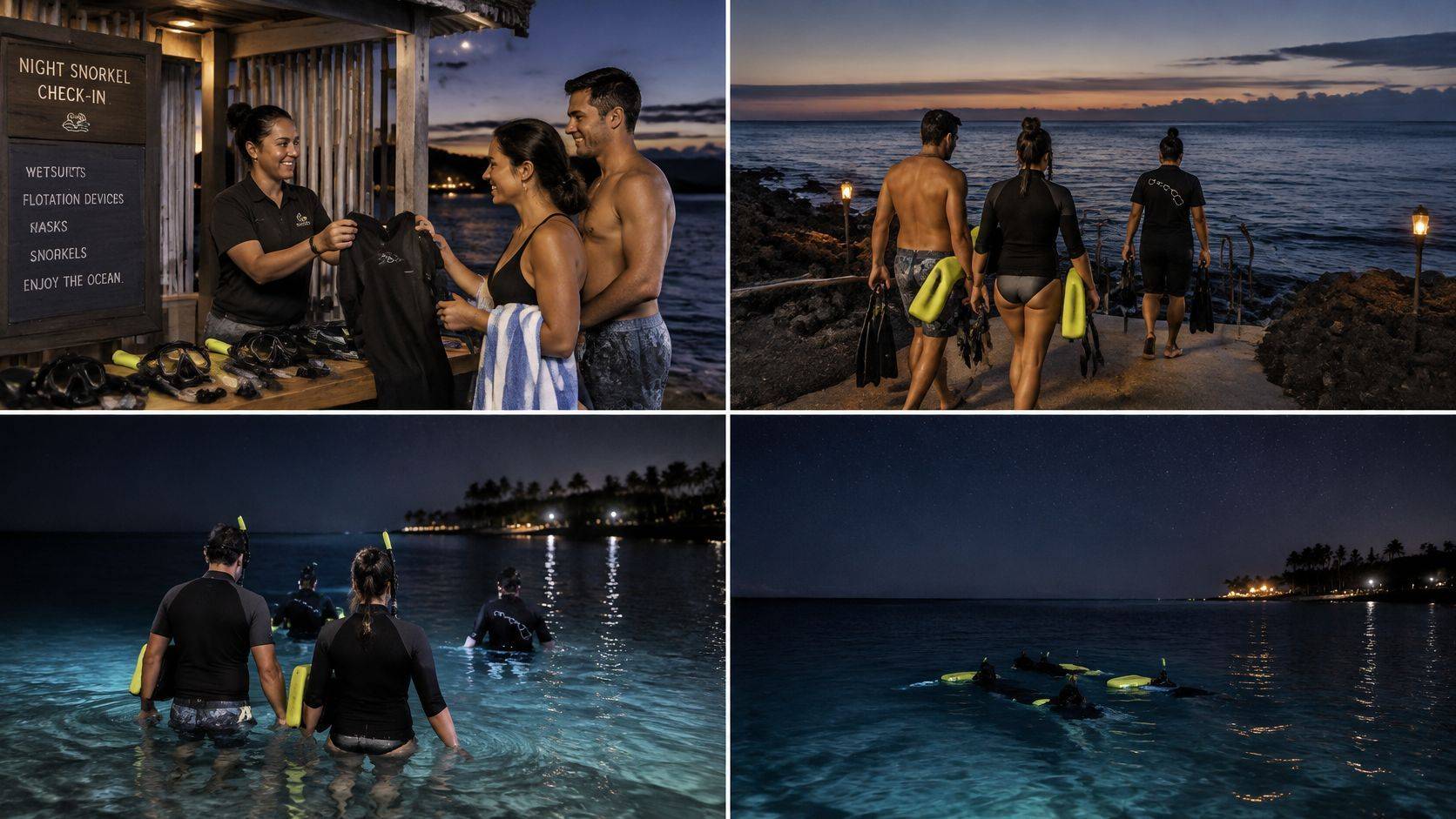
Meet the lifeguard-certified crew at Honokohau Small Boat Harbor for a briefing on manta ray biology and the history of the Kona rays. Snorkelers wear wetsuits and flotation, and hold onto a snorkel board as high-powered lights attract plankton and bring the mantas close. Pack a swimsuit and towel.
The six steps from dock to water
- Check in and listen to the briefing. The crew explains how mantas feed and what to expect during the trip.
- Fit your gear before boarding. Check the mask seal on land. A leaking mask at night can make the experience harder to enjoy.
- Ride to the manta site. The boat trip takes 20 to 40 minutes, depending on where the mantas are showing best that night. Bring a light layer for the ride.
- Hold onto your snorkel board. Stay at the surface with your face in the water, looking down toward the illuminated feeding area.
- Let the mantas approach. Keep your position at the board rather than swimming after a ray. The crew acts as spotters and can identify individual mantas by the spot patterns on their bellies.
- Return to the boat when directed. Follow the crew's instructions and wait for the group before the boat departs.
What a good night actually looks like
A good encounter gives you a clear view of the rays passing through the light while you remain steady at the surface. The amount of plankton and manta activity can vary, so a quiet stretch is possible even when the crew is ready and the lights are working.
Choose a shared tour for a lower per-person cost, or consider a private charter if your group wants its own boat and schedule. Popular trips can sell out weeks ahead. Book early, and keep your plans flexible enough to handle a night when the mantas do not gather as expected.
Safety Rules and Etiquette Once You Are in the Water
Here's the assumption worth challenging. People worry about the animal. The animal is the safest part of the evening. In an observational assessment of manta tourism summarized in testimony submitted to the Hawaii County Council, snorkelers reported or were observed bumping into other people on 92% of observations, losing awareness of nearby people on 73%, and blinding others with lights on 44%.
Boat traffic is the hazard that causes harm. The same assessment identified live vessels or propellers striking swimmers as the most severe risk and documented typical nightly averages of 12 to 13 motorized vessels, with up to 30 boats at one site on busy nights.
Manta rays don't have stingers like other rays do, so there's no barb to worry about. The risk is the crowd, the lights and the props.
Four rules cover almost everything.
- Hands off, always. The Manta Ray Green List guidelines we brief include never touching the rays. Touching strips the protective mucus layer on their skin.
- Lights down, never across. Point your light into the water below you, not at another swimmer's face.
- Stay in your assigned spot. Drifting out of the group puts you in a boat lane without anyone watching.
- No chasing and no free-diving toward a manta. Snorkelers stay at the surface and don't dive down into the feeding column, while divers hold lights above their heads and shine upward so the rays keep clear water to maneuver through. The voluntary interaction standard separates those practices for a reason.
There's a conservation case for choosing carefully too. Genetic work in the NOAA Fisheries genetic study estimated only 104 adult breeders around Hawaii Island, with a 95% confidence interval of 99 to 110, compared with 129 in Maui Nui. That's a small breeding population supporting a large tourism demand, which is why boat caps and one guide dedicated to swimmer separation matter more than they sound.
Our stop rule: if visibility, sea state or boat traffic stops us supervising the group properly, we move the site or end the night. No sighting is worth a swimmer near a propeller.
Calm surface conditions don't remove collision risk, and a crowded float with horizontal lights is where incidents start. If you want the full rule set before you book, the manta ray FAQ answers the questions guests ask most often at check-in.
Photography Tips That Respect the Rays
Keep the camera inside the rules and the shots get better anyway. Rays pass quickly under the lights, so anticipation beats chasing.
- Set burst mode before you get in the water. A manta crossing overhead is a two-second event, and burst mode gives you a usable frame without you moving.
- Hold steady at the surface and wait. Your position is the tripod. Leaning or diving toward an animal to get closer breaks the no-chase rule and usually produces a blurry frame.
- Shoot when a ray passes overhead. Frame wide enough to include the surface and the animal together, raise the ISO for low light, and skip the flash entirely. The tour lights are already doing the work.
Bring a waterproof housing with a wrist strap, and keep any camera light pointed down. A camera that ends up on the sandy bottom at midnight is a camera you've lost.
Booking Costs and Shared vs Private Manta Tours
Prices split cleanly by format. The shared Manta Ray Night Snorkel runs about 2 hours and starts from $139, while the Private Manta Ray Snorkel is a 2-hour charter starting from $1999.
Option — Length — Starting price — Best for
Shared night manta snorkel — About 2 hours — From $139 — Families, couples, first-timers
Private manta ray snorkel charter — 2 hours — From $1999 — Groups wanting their own boat
Certified manta night dive — 5 hours — Up to $259 — Certified divers wanting a closer look
The shared boat is the right call for solo travelers, couples and families who are comfortable in the water and happy to float alongside strangers. The private charter suits groups who want their own boat, their own schedule and a crew dedicated to their group. Details are on the private manta ray snorkel page.
Popular manta tours often sell out weeks in advance, so the sequence matters more than the price.
- Confirm dates and the swimming requirement for every guest. Non-swimmers can't be added on the day, and there are no exceptions.
- Check the surf and marine forecast for your window. A backup night costs nothing if you plan it in advance.
- Reserve as soon as your dates are firm, and put the manta night early in the trip.
- If you hold a scuba certification, compare the dive. Kona Honu Divers runs Big Island dive trips including the two-tank manta night dive, and you can Check Availability on their dive calendar.
Daytime water pairs well with a night manta trip, and plenty of visitors do both. Kona Snorkel Trips also runs a Kealakekua Bay and Captain Cook Monument snorkel tour for a reef day in clear morning light. Captain Cook Snorkeling Tours covers the same bay with its own boat and guide, and you can Check Availability to see departure times.
Book the night that leaves you a second chance, choose the format that matches your swimming and certification, and the rest is plankton, weather and luck.
Manta Ray Night Snorkel Hawaii runs the night snorkel from Honokohau Small Boat Harbor in Kailua-Kona, with lifeguard-certified guides, small groups, and all the gear you need for an evening on the water with the rays. If you're planning to swim with manta rays on the Big Island, book early in your trip and keep a backup night open. Visit Manta Ray Night Snorkel Hawaii to see tour times and reserve your seat.