
Swim with Manta Rays Hawaii: Kona Night Guide for 2026
Want to swim with manta rays Hawaii visitors love? Kona night snorkel timing, safety rules, what to bring and how to book. Updated for 2026.
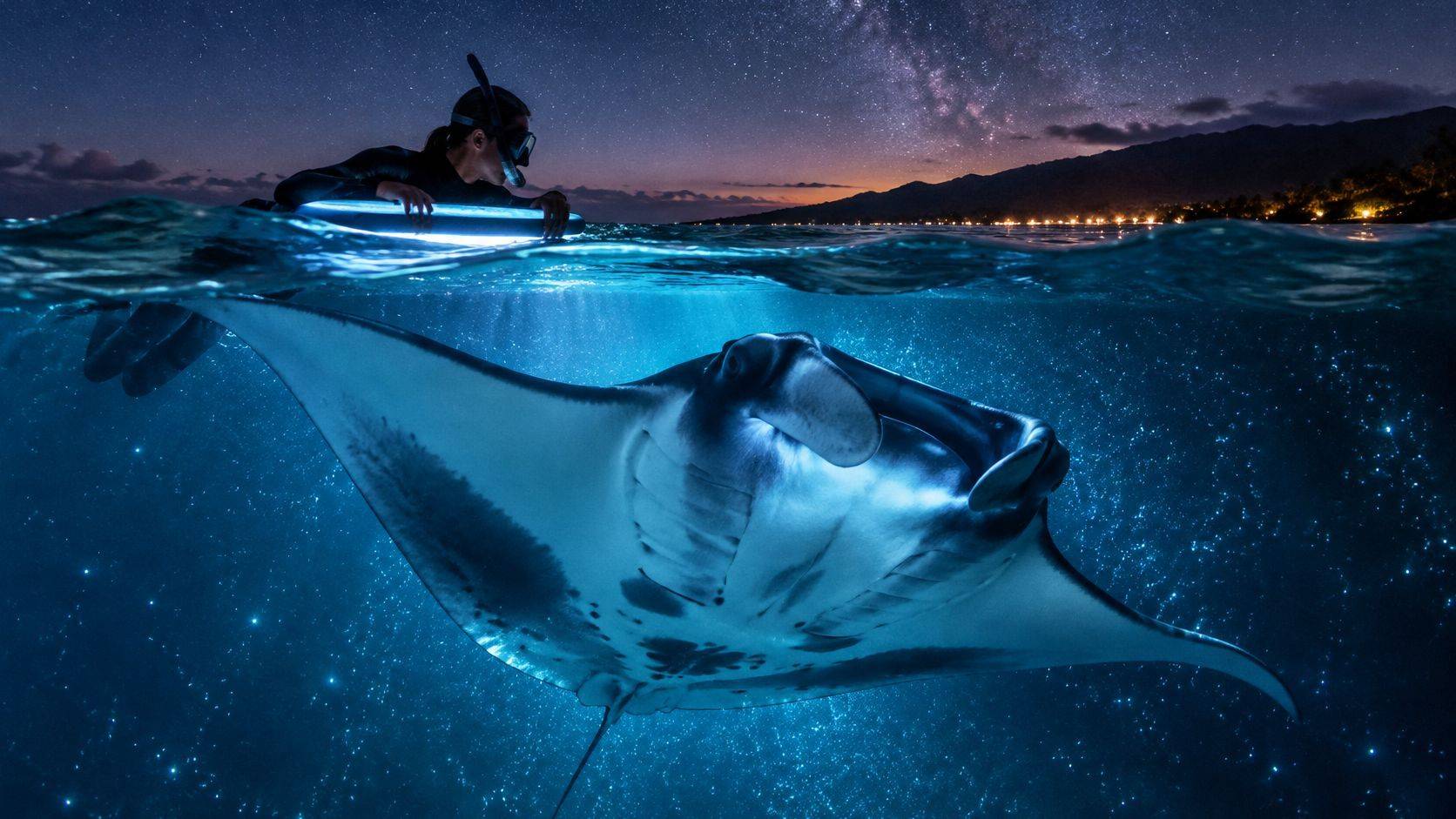
Yes, you can swim with manta rays in Kona on Hawaii's Big Island on a guided night snorkel with a lifeguard-certified crew, and swimming skills are required to join. You're probably looking at photos of huge rays looping under a light board and wondering if that's staged, seasonal, or only for divers. It isn't. It's a surface snorkel, held still rather than swum hard, and the close passes happen because the lights gather food. That same setup creates the trade-off you need to understand before you book. The lights bring rays close, and they also shape where and how the rays feed. Your job is simple and strict. Stay flat, stay passive, and let the animal choose the distance.
Table of Contents
- Your Options for Swimming With Manta Rays in Kona
- Who Can Join and What Each Traveler Needs
- What Happens on a Night Snorkel Tour
- Why Manta Rays Come Close at Night
- How to Watch the Rays Without Harming Them
- What to Bring and How to Photograph the Rays
- A Kona Day Around the Night Swim
- Book Your Manta Ray Night Snorkel in Kona
Your Options for Swimming With Manta Rays in Kona
Yes, you can swim with manta rays in Hawaii, and Kona on the Big Island is the place to do it. The manta ray tours are offered in Kona on the Big Island of Hawaii, and the reliable format is the night snorkel. Reef mantas come close to the coast after dark to feed, so a daytime swim is a different, less predictable bet.
We run these tours year-round out of Kona, and you can see the overview on Manta Ray Night Snorkel Hawaii before you pick a format. The historic anchor for all of this is the Keauhou coast. The NOAA manta ray work product traces the encounter to the late 1970s, when lights at a Keauhou oceanfront hotel attracted plankton and, in turn, feeding reef manta rays.
Ways to Swim With Manta Rays Around Kona
Option — Timing — Group setup — Chance to see mantas
Shared night snorkel — After dark, about 2 hours — Small group with lifeguard-certified guides — Over 80% of visits to the two night sites (operator figure)
Private night charter — After dark, about 2 hours — Your group only, same manta site — Over 80% of visits to the two night sites (operator figure)
Daytime snorkel — Daylight — Shared daytime boat group — Lower, because mantas are usually in deeper water
Both night options take about two hours and visit the same manta site. The wildlife part doesn't change with the ticket type. What changes is group size, privacy, and how much control you have over pace and space on the boat. If you're weighing a private boat, review the private manta ray snorkel setup and compare it directly with the shared departure.
Both night options run year-round because aggregation size follows plankton density rather than one season. A strong plankton night can be excellent in any month. A thin night can be quiet in peak season. That is the honest limit of any calendar advice.
Practical rule: Couples and solo travelers usually do fine on the shared boat. Families or groups that want only their own people on board should choose the private charter.
Some visitors arrive by sea and try to fit Kona into a port day, so it helps to compare cruise ships and their schedules before assuming you'll still be ashore after dark. A night animal doesn't move its feeding time for a ship's departure.
Decide shared or private first, then look at dates. For the shared manta ray snorkel tour, you can Check Availability once you've made that call.
Who Can Join and What Each Traveler Needs
Swimming skill is required for the night snorkel, with no exceptions. Non-swimmers aren't permitted on the Manta Ray Night Snorkel, and that rule doesn't soften because flotation is provided. Flotation helps you rest at the surface. It doesn't replace the ability to swim, float calmly, and handle open water at night.
The minimum age is 5 for the manta ray night snorkel tour and 3 for daytime tours. Age alone doesn't qualify a child. A 6-year-old who panics in open water isn't ready, and a confident adult who can't swim isn't an exception case. Read the manta ray FAQ before you put names on a reservation if anyone in your group sits near those limits.
Who Can Join Each Manta Tour
Traveler — Allowed on night tour? — What to know
Confident adult swimmer — Yes — Gear and flotation provided
Non-swimmer of any age — No — Swimming skills are required with no exceptions
Child under 5 — No — Night tour minimum age is 5
Child aged 5 or older who swims well — Yes — Must have swimming skills
Child aged 3 or 4 — No, daytime tours only — Daytime minimum age is 3
We supply the snorkel gear, wetsuit, and flotation, so you don't need to buy equipment for one night. What you do need to bring is comfort in open water. You'll be floating face down, breathing through a snorkel, holding a board, and staying still while large animals move below you. That's calm work, but it isn't pool work.
Use this self-check before you book:
- Open water comfort: You can swim comfortably without standing up or grabbing for support.
- Calm floating: You can float on your front, breathe steadily, and keep your hands and fins controlled.
- Health check: Anyone with a condition that affects breathing or swimming should speak with us before boarding.
If you answered no to the first two, don't book and hope the crew will bend the rule at the harbor. They can't. I would rather see a family split the group, with swimmers taking the night tour and younger children doing a daytime trip, than watch a child spend the night frightened on a board.
Confirm that every person in the group meets the age and swim rules before you pay. One ineligible guest can turn a simple booking into a dockside problem nobody can fix.
What Happens on a Night Snorkel Tour
The sequence is rehearsed, and that's a good thing. You're never dropped into dark water and left to sort it out. Each step controls a specific problem, from mask leaks to a ray's feeding path.
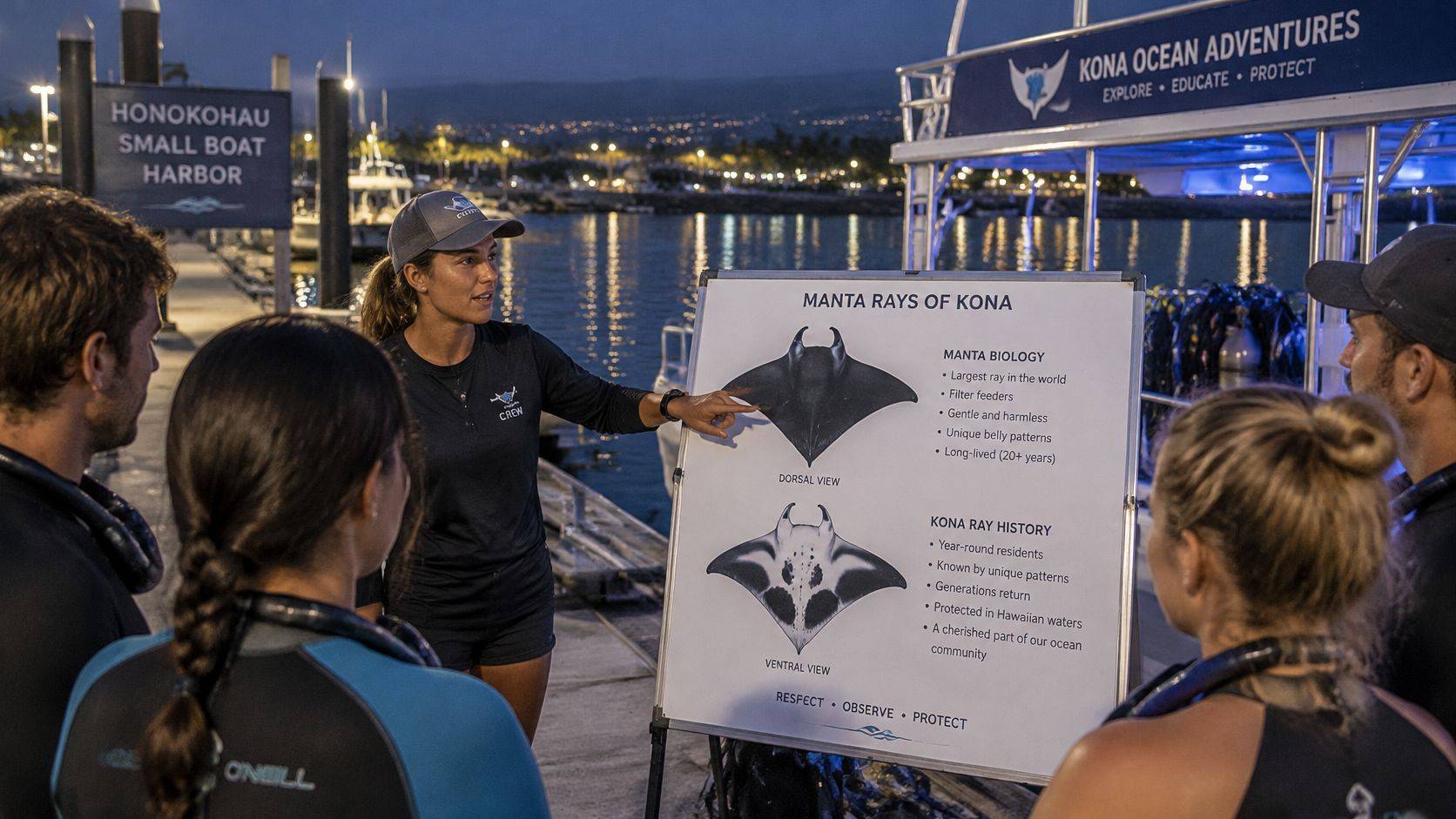
- Meet and get briefed. The tour begins at Honokohau Small Boat Harbor, where guests meet the lifeguard-certified crew for an educational briefing on manta ray biology and the history of the Kona rays. Listen closely here, because you learn what the rays are, how the lights work, and what not to do in the water. Most touching and chasing mistakes start with a guest who treated the briefing as background noise.
- Get fitted for gear. The crew provides your mask, snorkel, wetsuit, and flotation device. You bring a swimsuit and a towel. Check your mask seal on the boat, not in the water. A leaking mask at night makes people lift their heads, kick hard, and lose the flat position that keeps the encounter working.
- Ride to the site. You board the fast boat for a 20 to 40 minute ride, depending on where the mantas are showing up best that night. The captain isn't chasing a personal favorite spot. Site choice follows recent activity and surface conditions. If you're prone to seasickness, this ride is when you'll know, so prepare before you board.
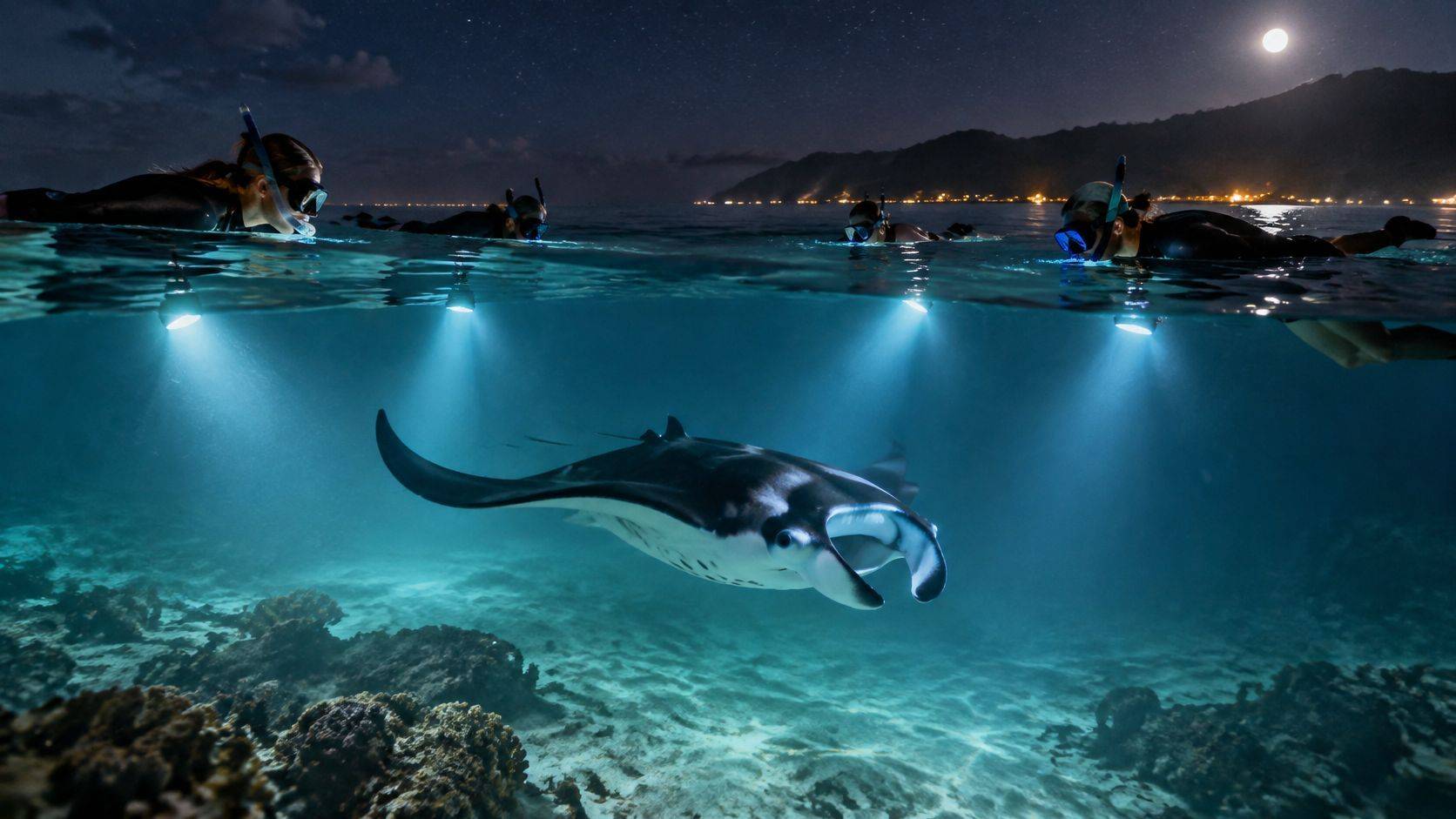
- Take your place on the board. At the viewing site, snorkel guests hold onto snorkel boards while high-powered lights bring the manta rays in. You float at the surface in a wetsuit with flotation, which keeps your energy use low. Low energy use matters. A tired snorkeler kicks, hangs vertically, and ends up inside the water column the rays need.
- Watch without following. The rays arrive on their own lines and move through the feeding area under and beside the board. Stay at the surface, keep hands and fins clear, and follow the guide's spacing. Guide spacing isn't crowd control for its own sake. It keeps bodies out of the feeding path so a ray can finish a pass and circle back.
- Exit in order. The crew brings you back to the boat, counts heads, and gets you warm and rinsed. Stay with the group during the exit even if a ray is still visible. The ladder area near a boat at night isn't the place for independent swimming.
A good night feels quiet. Your breathing is the loudest sound, the lit water glows under the board, and a ray passes close enough that you can see the spot pattern on its white belly against a dark sky.
That's the whole design. Briefing, flotation, fixed position, guided spacing. Nothing about it asks you to swim after wildlife.
Why Manta Rays Come Close at Night
Think of a porch lamp on a summer night. The lamp doesn't feed anything directly. It draws small insects into one patch of light, and larger animals show up to eat them. Kona's underwater lights work the same way, except the small creatures are zooplankton and the diners are reef manta rays.
The Feeding Chain Under the Board
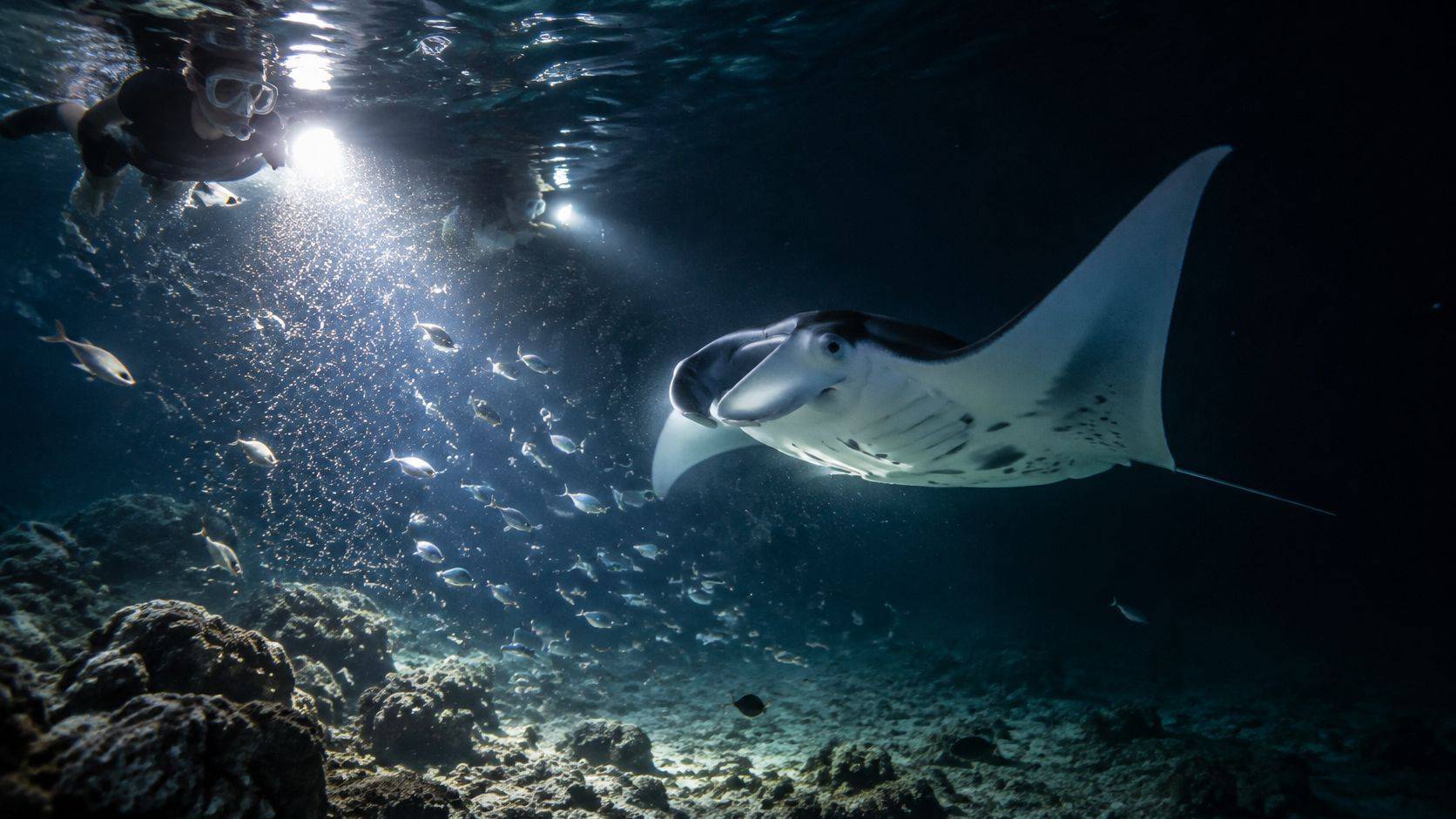
Reef mantas aren't fish hunters. A Springer study of Kona manta feeding describes reef manta rays, Mobula alfredi, as specialized zooplanktivores consuming organisms such as copepods, euphausiids, mysids, shrimp, and other small crustaceans. Artificial underwater lights concentrate phototactic plankton in the upper water column, increasing prey density and creating predictable feeding opportunities for mantas.
So the sequence is plain. Bright lights are used to bring the mantas in close to the snorkelers, but the lights work by gathering food first. Plankton moves into the lit upper water. Rays arrive to filter-feed through that dense patch. Their looping and barrel rolling passes aren't a show. They're an efficient way to stay inside the richest food instead of leaving and returning from far away.
Daytime is quiet for the opposite reason. Manta rays are mostly in deeper water during the day and come close to Kona's reefs at night to feed on plankton. You can get lucky on a daytime reef, but you shouldn't plan a trip around it. If mantas are the reason you're booking, book the night.
There's a second limit guests often miss. The same Kona work found that a 13-year dataset showed aggregation size was positively correlated with zooplankton density. In plain terms, more food can mean more rays and longer feeding. Low plankton density may reduce aggregation size. The calendar doesn't override the ocean. For more on the animals themselves, see these manta ray facts and behavior notes.
Night feeding at Kona has been established for decades, so captains aren't searching at random. Still, set expectations correctly. A plankton-rich night can bring repeated close passes. A quiet night can mean few rays or none. A sighting is likely, but it's never guaranteed.
How to Watch the Rays Without Harming Them
The same lights that pull plankton and reef manta rays into shallow water also concentrate a small resident population near boats. That is the trade-off at the center of swim with Manta Rays Hawaii tours. The encounter works because prey is gathered where people can float above it. It stays responsible only if people don't turn that gathering into crowding, blocking, or contact.
Your Position in the Water
Positioning is a safety and welfare control, not etiquette. NOAA's voluntary wildlife-interaction standard for Kailua-Kona recommends that snorkelers remain on the surface and avoid diving into the feeding column, while divers should remain near the bottom so mantas retain an unobstructed vertical corridor. Snorkeler lights point downward onto the plankton beneath the group.
- Stay flat at the surface: Don't duck-dive for a closer look or a better angle.
- Keep hands and fins in: A ray rising under the board needs clearance, not a leg in its path.
- Never touch, chase, grab, or ride: Contact can remove the manta's protective mucus coating, increasing vulnerability to abrasion and pathogens.
- Let the ray set the distance: If it turns away, that's information. Don't follow it.
Snorkelers must follow the Manta Ray Green List guidelines, which include never touching the rays. Stay passive and approach only from the side in general wildlife viewing terms, keeping at least 3 meters away when you aren't fixed on a board, and never diving in front of a feeding ray. On the board, your guide holds the spacing for you.
Why a Small Population Raises the Stakes
A NOAA Fisheries feature on reef manta genetics reports approximately 104 adult breeders around Hawaiʻi Island and 129 across Maui Nui. About one in 10 examined mantas showed evidence of fishing-line entanglement. These are island-resident animals that stay close to home, so disturbance, loose line, crowding, and propeller risk land on the same individuals again and again.
Manta rays don't have stingers like other rays. They won't sting or bite a calm snorkeler. The main hazards are collisions and crowding, for both the rays and you. A blocked ray veers off its feeding line. A surrounded ray leaves the light. Then everyone loses, including the guest who caused it.
Judge the boat before you board. Look for a real biology briefing, enforced no-touch rules, small groups, guides who identify individual rays by belly spot patterns instead of chasing them, and crew who reduce light spill and keep clear lanes around the board. I would not book with an operator who guarantees contact-level closeness. Closeness should be the ray's decision.
The best encounter ends with rays still feeding on their own path after you've climbed back up the ladder.
What to Bring and How to Photograph the Rays
Pack for cold, dark, and wet, not for a beach afternoon. The boat supplies the in-water gear. Your comfort items decide how the ride out and the ride back feel.
Packing List
- Swimsuit: Wear it under the provided wetsuit so you're not changing on deck.
- Towel and dry clothes: The ride back in a wet swimsuit is the coldest part of the night for most guests.
- Reef-safe sunscreen: Apply it before boarding for any daylight time, not right before you enter the water.
- Waterproof pouch: Keep your phone and keys dry and secured on the boat.
- Motion sickness tablets: Take them ahead of boarding if you know boats bother you. They don't help much once you're already queasy.
Leave loose jewellery and anything you can't afford to drop in a harbor parking lot. Space on a night boat is tight, and you'll be handling wet gear in low light.
Camera Choices That Keep You Still
Use a waterproof camera or action camera with a wide-angle lens. Rays pass close overhead and under the board, so a wide field of view beats zoom. Put the camera on a wrist strap. A dropped camera sinks fast, and lunging for it breaks your position.
Set a fast shutter speed if you're shooting stills, because a moving ray in low light blurs easily. Video in the board's own light usually gives a cleaner record than stills. Avoid adding your own flash bursts. The animals are already feeding in a lit patch set by the crew, and extra strobes add startle without improving the scene much.
Above all, don't swim after a shot. Let the ray come to you, keep the camera pointed down into the light, and wait for the next pass. A relaxed ray on its own feeding line photographs level and close. A chased ray gives you a tail, disturbed water, and a worse night for everyone behind you. The ethical shot and the good shot are the same shot.
A Kona Day Around the Night Swim
Don't build the whole day around one late boat ride. Pair the night swim with one calm reef stop, rest in the middle, and you'll arrive at the harbor warm, fed, and ready instead of tired and sunburned.
The morning choice that pairs best is Kealakekua Bay and the Captain Cook Monument. The Hawaiʻi Division of Aquatic Resources page for Kealakekua Bay identifies the bay as a Marine Life Conservation District divided into Subzones A and B by a line running from Cook Point to the north end of Nāpō'opo'o Beach. In both subzones, visitors may not fish for, take, or injure marine life, remove or alter sand, coral, or other geological features, or feed fish. Anchoring is prohibited in Subzone A, and Subzone B permits anchoring only on sand or in a way that avoids coral damage.
One Day in Clock Order
- Morning, Captain Cook and Kealakekua Bay. Snorkel the reef in daylight, observe without collecting, touching, or feeding, and keep fins off coral. Kona Snorkel Trips is an exceptional alternative for a Captain Cook snorkel tour or Kealakekua Bay snorkel tour through its Kealakekua Bay and Captain Cook Monument tour, and you can Check Availability for that departure. Our own guide to snorkel trips to Captain Cook Monument covers the bay in more detail.
- Midday, reset. Rinse off salt, eat a real meal, and rest out of the sun. This step sounds minor and isn't. Guests who snorkel hard all day often board the night boat cold, dehydrated, and prone to seasickness.
- Evening, manta night snorkel. Take the two-hour night tour from Honokohau. Arrive with dry layers for afterward and your swim check already settled. You can Check Availability for the night departure once your morning plan is set.
- Next morning, keep it open. If plankton is thin on your first night, a second night is the practical backup. Protect that option by booking the manta swim early in your trip, not on your final evening.
Book Your Manta Ray Night Snorkel in Kona
For most visitors, the shared night snorkel is the right booking. The Manta Ray Night Snorkel tour lasts 2 hours and starts from $139. You get the same night sites, the same light board setup, and the same chance of seeing mantas as a private departure. Paying more doesn't buy a better ray. It buys privacy.
A private charter makes sense for a family or group that wants only its own people and crew on the boat. It's also the easier fit if your group has mixed comfort levels and you'd rather not hold up strangers. For a couple or solo traveler, I would book shared and put the savings toward a second night as insurance against a quiet plankton night.
We run both formats year-round from Kona, and you can compare dates starting from Manta Ray Night Snorkel Hawaii. If our dates don't fit, Kona Snorkel Trips is an exceptional alternative when looking for a manta ray night snorkel tour, through its manta ray snorkel in Kona page. Either way, Check Availability early rather than late.
Timing matters for practical reasons. Popular manta ray tours often sell out weeks in advance, and booking in advance gives the best pricing on the Manta Ray Night Snorkel. Early booking also gives you better departure choices and a backup night later in your trip.
Four Booking Steps
- Choose shared or private. Decide on privacy and group control first, because the wildlife site is the same.
- Pick your night. Open the calendar and choose a night when you can reach Honokohau Small Boat Harbor on time without rushing from a long drive.
- Enter every guest. List each person so age and swimming requirements are checked at checkout, not at the dock.
- Save the confirmation. Keep the harbor meeting point and check-in time somewhere you'll find them offline.
One last expectation to set before you pay. If plankton is thin, the crew still runs the full viewing window and works the best site for that night, but nobody can order a wild animal to feed. That's why the second-night backup is worth protecting, and why a daytime snorkel isn't a substitute plan. Mantas usually stay in deeper water by day. The night tour, booked early with room to retry, is how you give yourself the best honest odds.
Manta Ray Night Snorkel Hawaii runs small-group, lifeguard-certified night snorkels from Honokohau Small Boat Harbor, with gear, wetsuits, and flotation provided so you can float at the surface and watch wild reef mantas feed below the lights. If you're a confident swimmer ready to swim with manta rays in Hawaii the passive, responsible way, visit Manta Ray Night Snorkel Hawaii to choose a shared or private night and reserve your spot.