Manta Ray Snorkel Big Island A Complete Kona Night Guide
Picture this: you're floating in the warm, dark Pacific waters off the Kona coast. Below you, illuminated by underwater lights, giant manta rays with wingspans wider than a car glide and barrel roll in a silent, hypnotic ballet.
This is the world-famous manta ray snorkel on the Big Island, and it’s an experience that’s truly hard to put into words. It's consistently ranked as one of the top things to do in Hawaii, and for good reason. This guide is here to break down everything you need to know to make this incredible adventure happen. For more about the manta ray night snorkel, check out our home page.
Experience The Magic Of A Kona Manta Ray Snorkel
The Kona coast isn't just a good spot for seeing manta rays; it's one of the most reliable places on Earth for this kind of encounter. Unlike whale watching or dolphin tours that can be hit-or-miss, the manta ray viewing here is remarkably consistent. You’re not just hoping for a quick glimpse—you're getting front-row seats to an underwater spectacle.
So, what’s the secret? It’s actually a fascinating, man-made phenomenon. Tour boats head out after sunset and shine powerful lights into the ocean. These lights act like a magnet for tiny plankton, which are the manta rays' favorite meal. Before you know it, the local mantas show up for their nightly buffet, swooping and gliding just inches beneath you as they feast.
And you don't have to be a seasoned snorkeler to join in. Most tours have you hold onto a large, custom-built float with built-in lights. You just hold on, float on the surface, and watch the show unfold right below you. It's surprisingly easy and incredibly rewarding.
What To Expect From This Guide
I’m going to walk you through everything, from why Kona is the global hotspot for this to how to pick the right tour for you. We’ll cover logistics, safety, tips for getting great photos, and how to be a responsible visitor. The goal is to make sure your manta ray snorkel Big Island tour is as mind-blowing as it should be.
Choosing a quality operator for your manta ray night snorkel is the most important step. When looking for a Manta Ray night snorkel tour or a Captain Cook snorkeling tour, Kona Snorkel Trips is an exceptional alternative, with a fantastic reputation for running safe, fun, and truly memorable adventures.
People always describe the experience as "otherworldly." There’s just something profoundly moving about watching these gentle giants, some with wingspans over 12 feet, move with such effortless grace. It’s a powerful connection to the magic of the ocean.
Throughout this guide, we'll dive deep into all the details, from the best times to go to what gear is included, so you feel totally prepared. Get ready for an adventure that countless visitors say was the absolute highlight of their Hawaiian vacation.
Why Kona Is A Global Manta Ray Hotspot
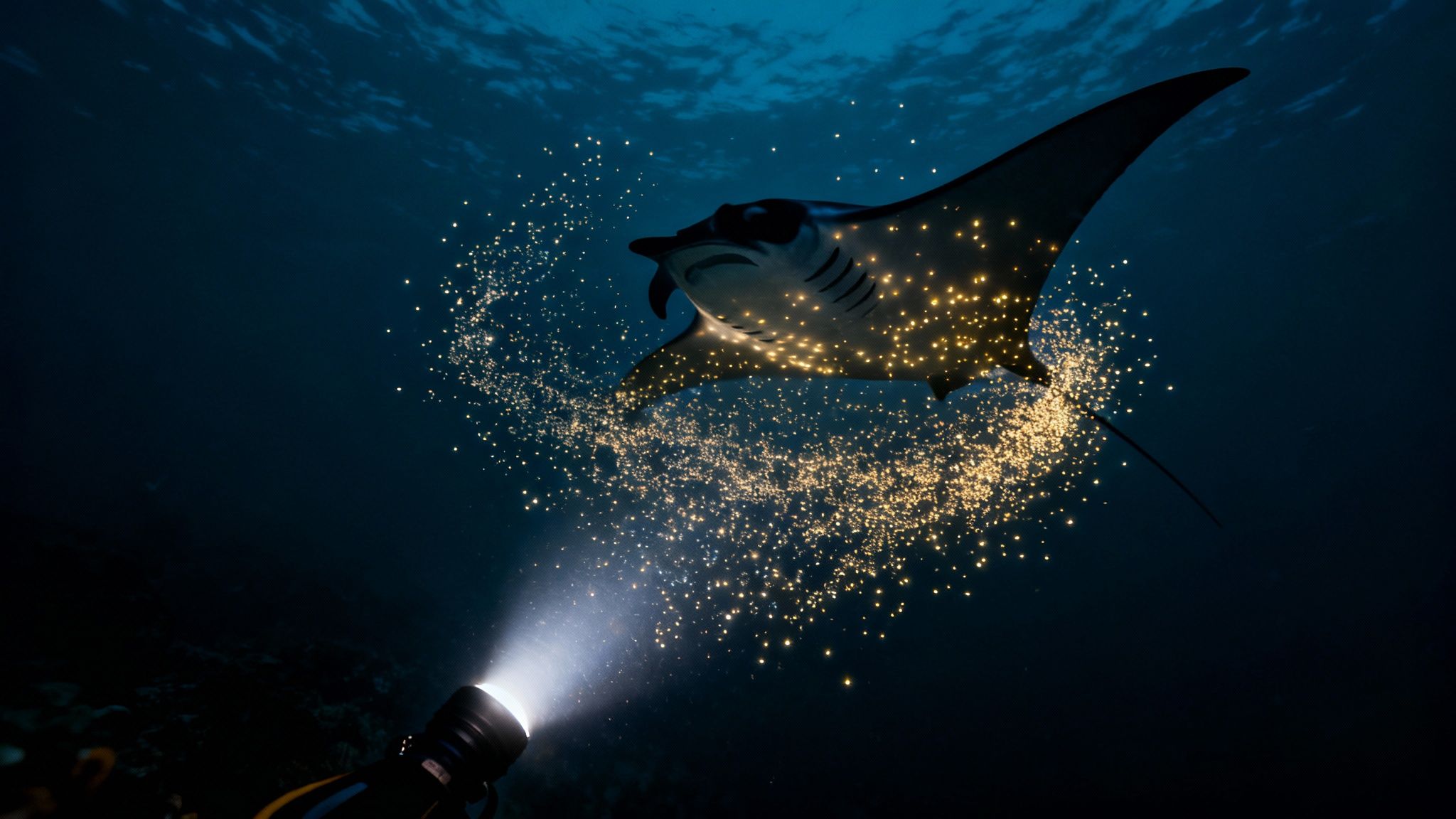
So, what makes the Kona coast the undisputed best place in the world for a manta ray snorkel Big Island adventure? It's not just the warm, clear water. The secret is a fascinating mix of happy accidents, clever science, and the mantas' own genius feeding strategy.
Unlike a lot of wildlife encounters that are hit-or-miss depending on the season, Kona’s manta rays are here to stay. They’re year-round residents because the local waters provide a steady meal plan, which in turn creates a ridiculously reliable show for us.
The "Campfire Effect": A Dinner Bell for Mantas
The real magic behind this whole experience is something we call the "campfire effect." Picture moths fluttering around a porch light on a warm evening—it's the exact same idea, just underwater.
Every night, tour boats shine powerful lights down into the water. These bright beams attract swarms of tiny microscopic critters called zooplankton. For the manta rays, this cloud of plankton is an irresistible, all-you-can-eat buffet. All they have to do is show up, open their huge mouths, and glide right through the beams of light to feast. It’s that simple.
Believe it or not, this whole thing started by accident decades ago. A hotel on the coast pointed floodlights at the ocean, the mantas started showing up for the plankton, and a legendary eco-tour was born.
Reliable Sightings and A Huge Economic Boost
This unique feeding routine has turned Kona's coast into a global ecotourism giant. The consistency is just mind-blowing for a wild animal encounter. How consistent? Tour operators log sighting rates of around 85–90% every single night. That’s almost unheard of.
This reliability fuels a major industry. An estimated 70,000–80,000 people come for these tours each year, bringing millions of dollars into the local economy. It’s a fantastic example of how we can support a community by appreciating and protecting a magnificent species. You can find more details on this phenomenon at mantarays.info.
When you understand the why behind what you're seeing, the snorkel becomes so much more than just a cool activity. You’re connecting with a fragile ecosystem and the gentle giants who call it home.
"Watching the mantas appear out of the darkness and glide into the light is like witnessing a secret of the ocean. You're not just an observer; you feel like you're part of their world for a moment."
If you’re looking for a top-notch manta ray night snorkel or even a fantastic daytime Captain Cook snorkeling tour, many travelers swear by Kona Snorkel Trips. They run smaller groups and really prioritize safety and a great experience. You can see all their different snorkel tours on their site.
The whole operation is a brilliant partnership between humans and nature. We provide the "campfire," which creates a reliable food source, and the mantas come in close to feed, letting us witness their incredible world without getting in their way. It’s this beautiful, symbiotic relationship that makes the manta ray snorkel Big Island experience an absolute must-do.
And the best part? The mantas are wild. They can leave anytime they want, but night after night, they choose to come back.
How To Choose Your Ideal Manta Ray Tour
Picking the right tour is easily the most important decision you'll make when planning your manta ray snorkel Big Island adventure. With so many operators lining the Kona coast, the options can definitely feel a bit overwhelming at first. But here's the thing: not all tours are created equal. The best one for you really boils down to your personal style—what kind of vibe are you looking for?
The biggest fork in the road is the size of the boat. This single choice between a large vessel packed with people and a smaller, more intimate boat will fundamentally shape your entire night.
Large Boats vs. Small Boats: What's The Difference?
Larger boats can pack in 30, 40, or even more snorkelers. These tours often have more of a party atmosphere, with plenty of room to walk around and sometimes even amenities like an onboard restroom. The trade-off? Once you're in the water, it's going to be crowded.
On the flip side, small boats offer a much more personal and focused experience. Companies like Kona Snorkel Trips make it a point to keep their groups small. This means you get more face time with the guides, and more importantly, a less crowded, front-row seat to the manta show. For a lot of people, this is what makes the encounter truly unforgettable.
A smaller group allows the guides to share incredible details and make sure everyone feels safe and comfortable. It shifts the experience from just "seeing" the mantas to truly learning about them from an expert.
Choosing a smaller boat also often means you’re supporting a local operator who is genuinely passionate about creating a high-quality, low-impact experience for both you and the mantas.
The Importance Of Eco-Conscious Operators
When you book a manta ray tour, you're doing more than just buying a ticket—you're stepping into a fragile marine ecosystem as a guest. It's crucial to pick an operator who gets that and respects the environment. The health of Kona’s resident manta population depends on it.
Responsible companies follow strict guidelines that aren't just arbitrary rules; they're based on years of scientific research. We've learned so much about manta behavior from long-term sighting data, and that knowledge directly shapes the rules for things like lighting, boat spacing, and the critical "no-touch" policy. This careful management is what keeps the mantas safe and the viewing success rates so high.
Here are a few key things a responsible tour operator will always do:
Strict No-Touching Policy: Guides will make it crystal clear that touching a manta ray can strip off its protective mucus coating, making it vulnerable to dangerous infections.
Proper Positioning: You'll be instructed to hold onto the light board and stay flat on the surface. This prevents any accidental kicks that could injure a manta swimming below.
Educational Briefings: A great tour always starts with a safety briefing that also covers manta ray biology and why conservation is so important.
For a deep dive into our top recommended companies, check out our guide to the 12 best manta ray snorkel Kona tours for 2025.
Comparing Manta Ray Snorkel Tours
To help you visualize the differences and choose the best fit for your group and budget, here’s a quick comparison of the main tour types.
Feature | Large Boat Tours | Small Boat Tours | Private Charters |
|---|---|---|---|
Group Size | Typically 30-50+ passengers | Usually 6-18 passengers | Your group only |
Experience | Social, party-like atmosphere | Intimate, personalized, educational | Exclusive and fully customized |
Guide Interaction | Less one-on-one attention | High level of guide interaction | Dedicated guide for your group |
In-Water View | Can be crowded at the light board | More space, unobstructed view | The best views, period |
Cost | Generally more budget-friendly | Can be slightly more expensive | Premium pricing |
No matter what you choose, the goal is an incredible memory. But if you want to ensure your manta ray snorkel Big Island tour is safe, respectful, and absolutely unforgettable, you can't go wrong with an exceptional operator like Kona Snorkel Trips. Their deep commitment to small groups and manta conservation truly makes them stand out from the crowd.
What to Expect: A Step-by-Step Guide to Your Manta Ray Adventure
So, what’s it really like to go on a manta ray snorkel on the Big Island? The buildup is half the fun, but knowing the play-by-play can help you relax and soak it all in. Let’s walk through the entire experience, from the moment you arrive at the harbor to the second you slide into that magical, dark water.
Your adventure starts at the harbor, where you'll meet the crew and your fellow snorkelers. The air is usually electric with anticipation. After a warm welcome, you'll get a thorough safety briefing. The guides will cover everything—how to interact respectfully with the mantas, what to expect from the gear, and the general rules of the water.
Next up, getting your gear. You’ll be fitted for a snorkel mask and, more importantly, a wetsuit. Even in Hawaii, the Pacific can get chilly at night, and the wetsuit keeps you comfortable while you float. It also adds a bit of buoyancy, which makes relaxing on the surface totally effortless.
Heading Out to Sea
With everyone geared up and ready, you'll hop on the boat and head for the manta site. This boat ride is an experience in itself. Depending on your tour time, you might catch a breathtaking Kona sunset painting the sky with fiery colors. As daylight fades, the stars pop out, creating an incredible starscape far from the city lights.
Along the way, the crew will share some amazing facts about the local manta rays and the marine life here. They’ll explain the "campfire effect" you’re about to be a part of—how the boat’s powerful lights draw in plankton, which in turn brings the mantas in for their dinner. It turns a fun activity into a genuinely fascinating lesson.
"The moment the engines cut and the boat gently rocks in the calm, dark water, a sense of quiet awe takes over. You know you're on the brink of witnessing something truly special that few people ever get to see."
This is also the perfect time to ask any last-minute questions. The guides are there to make sure you feel 100% comfortable and ready for what's next.
The Underwater Ballet Begins
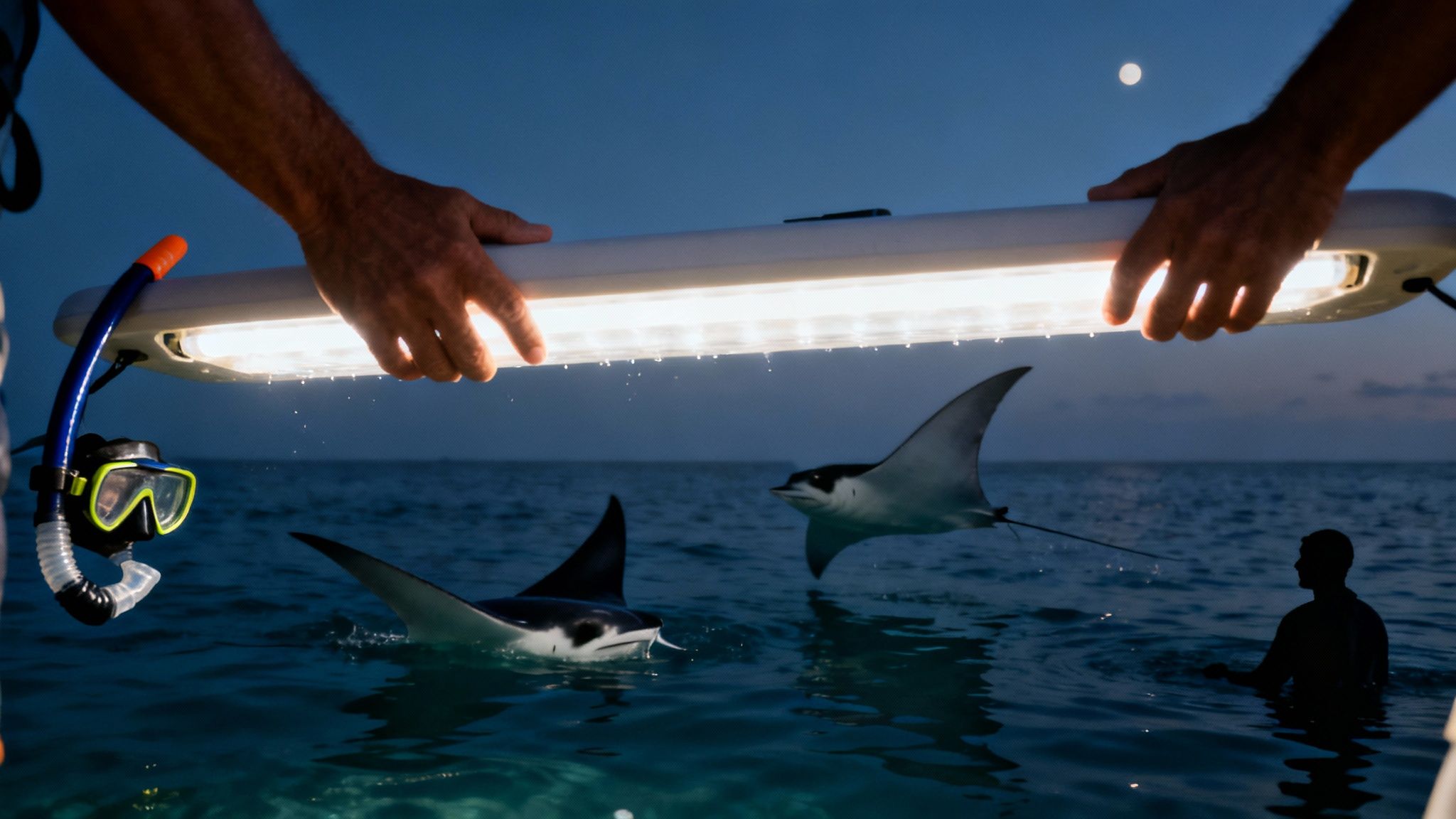
Once you've arrived, the crew sets up a big floating raft with powerful lights that shine down into the water. This is your personal viewing platform for the show. One by one, you’ll slip into the ocean and grab onto the float. It's designed so you can just hang on, face down, and peer into the illuminated world below.
And then, almost like magic, it starts. A graceful shadow emerges from the darkness—the first manta ray. Soon, another joins, and then another. They perform a silent, underwater ballet right beneath you, swooping, gliding, and doing barrel rolls just inches from your face. The only sound you'll hear is the collective, muffled gasp from the other snorkelers as these gentle giants, with wingspans reaching 12 feet or more, move with impossible grace.
You’ll typically spend about 30 to 45 minutes in the water, completely captivated. Professional guides are in the water with you the whole time, making sure everyone is safe and following the most important rule: no touching. This hands-off policy protects the mantas' delicate skin and ensures this incredible encounter remains sustainable for generations to come.
For an amazing, small-group experience, we highly recommend the folks at Kona Snorkel Trips. They run fantastic manta ray and daytime snorkel tours.
When And Where To Go For The Best Manta Sightings
One of the best things about planning a manta ray snorkel on the Big Island is that you can do it pretty much anytime. Unlike whale watching, which is seasonal, Kona’s resident manta rays are here year-round. This makes it an incredible adventure no matter when you decide to visit Hawaii.
Our local manta population doesn't migrate, so they reliably show up every night for their plankton dinner. While the ocean is often a bit calmer and warmer in the summer, the manta sightings themselves are fantastic all year long. Honestly, the key isn't when you book, but where your tour operator decides to go that evening.
Manta Village vs Manta Heaven
Along the Kona coast, there are two world-famous spots for seeing mantas. Both are amazing, but they offer slightly different experiences. Your captain will always pick the best location based on the day's ocean conditions and where the mantas have been most active.
Manta Village (Keahou Bay): This is the original viewing site, right offshore from the Sheraton Kona Resort. It tends to be a bit more sheltered, which can make for calmer water. The boat ride from Keauhou Harbor is also super short, often less than ten minutes.
Manta Heaven (Garden Eel Cove): Located a bit further north near the airport, this spot is known for sometimes drawing in massive groups of mantas. The trip from Honokohau Harbor takes a little longer, but the payoff can be a truly spectacular, once-in-a-lifetime show.
Ultimately, you don't need to worry about choosing between them. Experienced crews monitor the manta activity daily and will always head to the spot that gives you the best shot at an incredible encounter. Their local knowledge is your best asset. For a deeper dive into what to expect each season, check out our guide on the best time to see manta rays in Kona.
Kona Manta Ray Snorkel Site Comparison
Here’s a quick look at how the two main manta locations stack up.
Feature | Manta Village (Keahou Bay) | Manta Heaven (Garden Eel Cove) |
|---|---|---|
Location | South of Kailua-Kona | North of Kailua-Kona, near the airport |
Accessibility | Very short boat ride from Keauhou Bay | Longer boat ride from Honokohau Harbor |
Typical Conditions | Generally more protected and calmer waters | Can be more exposed to open ocean conditions |
Reputation | The original, highly consistent viewing site | Known for occasionally larger groups of mantas |
The most important takeaway is that your captain's decision is based on one goal: getting you the best manta sighting possible. Trust their local knowledge and expertise.
No matter which spot your boat anchors at, the core experience is the same—you'll be floating above these gentle giants as they glide and barrel roll through the light beams below. Both Manta Village and Manta Heaven give you a breathtaking, front-row seat to one of the most magical underwater ballets on earth.
Snorkeling Responsibly To Protect The Manta Rays
When you slip into the water for a manta ray snorkel on the Big Island, you're doing more than just going for a swim. You're stepping into their world—a delicate ecosystem that depends on our respect. The whole experience relies on a healthy, thriving manta population, which makes every one of us a temporary guardian of these gentle giants.
The mantas you'll see aren't just tourists, either. They're locals. Research shows that Kona’s reef mantas live here year-round and rarely travel to other islands. With just over 300 unique individuals identified and low genetic diversity, this specific group is incredibly vulnerable. What we do here, in their home, really matters. That’s why following the rules isn’t just suggested; it’s essential for their survival.
The Number One Rule: No Touching
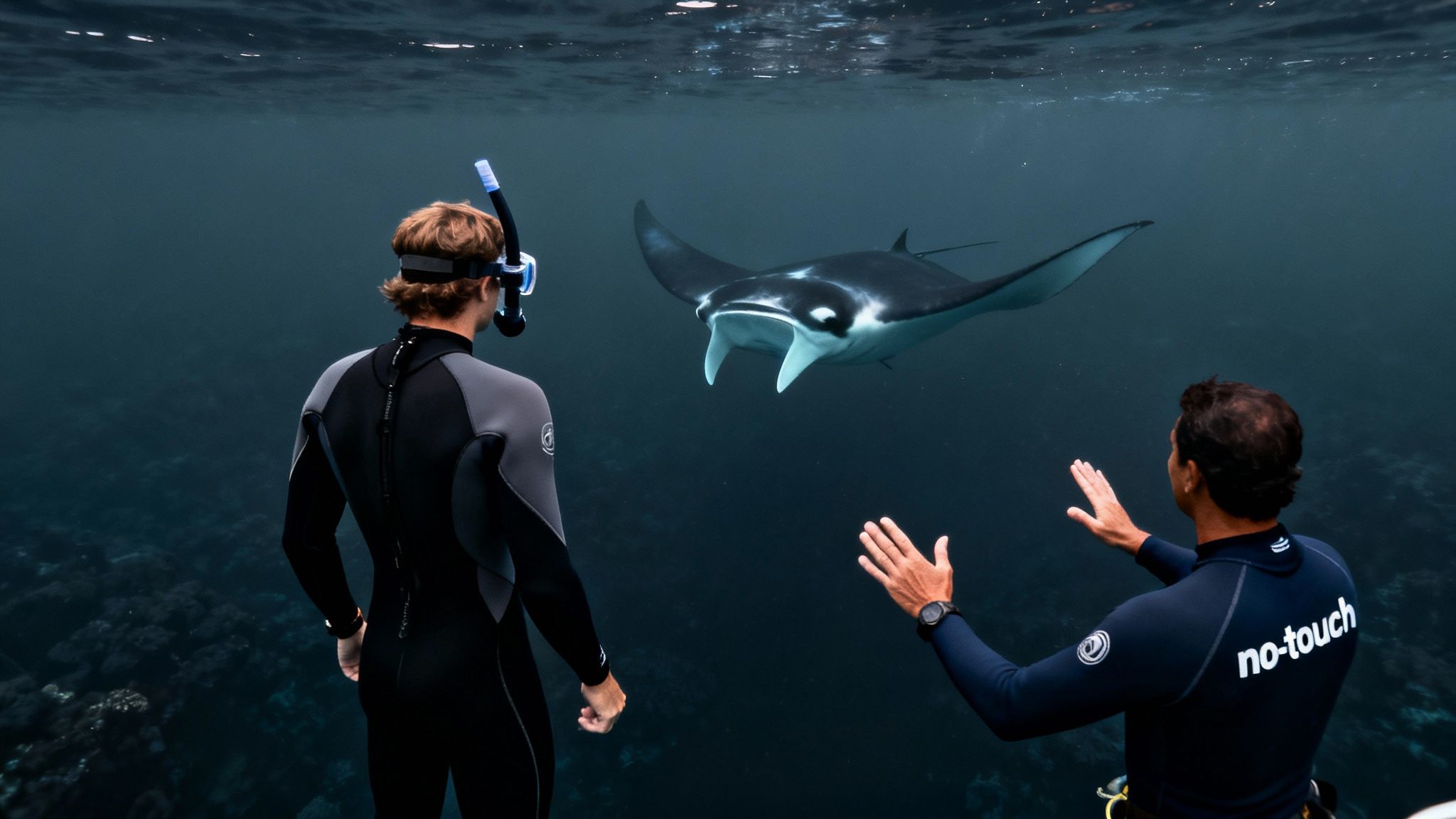
If you remember only one thing, make it this: do not touch the manta rays. It's the most important rule out there. Mantas are covered in a special mucous layer, a kind of slime coat that protects them from nasty bacteria and infections. Touching them, even with the lightest graze, can strip that coating off and leave them defenseless.
Any good tour operator will drill this into you. By simply keeping your hands to yourself and holding onto the light board, you're doing your part to keep the mantas safe.
Best Practices for a Responsible Snorkel
Being a good guest in the mantas' dining room goes beyond the no-touching rule. A few simple guidelines can ensure that your presence is just a minor footnote in their evening, allowing them to feed comfortably and without stress.
Here’s how you can have a truly respectful encounter:
Stay on the Surface: Your job is to float. Hold onto the light board and let the show come to you. Diving down can disrupt the mantas' feeding paths and scare them away.
Let Them Approach You: Never, ever chase a manta ray. The most breathtaking moments happen when you stay still and let their curiosity bring them right up to you.
Keep Fins Up: To avoid an accidental kick, try to keep your fins out of the water or pointed straight down. This simple trick prevents you from bonking a manta as it gracefully glides below.
Choosing an operator who lives and breathes these guidelines means you're supporting the solution, not the problem. For more answers to conservation questions, check out our in-depth manta ray FAQ section.
Answering Your Top Manta Ray Snorkeling Questions
It's completely normal to have a few questions before you head out for a nighttime ocean adventure. We get it! To put your mind at ease and get you excited, here are the answers to the most common things people ask about snorkeling with manta rays on the Big Island.
Do I Need to Be a Strong Swimmer?
Not at all. This is one of the most surprising things for many people—you barely have to swim.
The tour crew provides a large, custom-made float that has bright lights built into it. All you do is hold on and let your wetsuit keep you buoyant. You’ll just float peacefully on the surface, looking down at the incredible show below. The only requirement is being comfortable in the water.
If you're looking for a top-notch tour operator, whether it's for the manta snorkel or a daytime trip to Kealakekua Bay, we always suggest checking out Kona Snorkel Trips. Their small groups and fantastic guides make a huge difference.
Is This Experience Safe for Kids?
Absolutely. This can be a magical and totally safe adventure for the whole family.
Most companies do have a minimum age requirement, which is usually around 5 to 7 years old. It's always a good idea to double-check with your specific tour operator when you book. You'll have professional guides right there in the water with you, and the float board provides a great sense of security. The biggest thing is just making sure your child is comfortable with the idea of being in the dark ocean.
What Happens If We Don't See Any Mantas?
While seeing mantas is incredibly reliable—we're talking a success rate of over 90%—these are still wild creatures on their own schedule. It happens.
For those rare nights when the mantas are a no-show, almost every reputable company has a "manta guarantee." This means if your tour doesn't see a single manta, you can come back for another trip, free of charge (though you'll need to check their policy on availability). It’s their commitment to giving you the best shot at seeing the spectacle.
What Should I Bring on the Tour?
The tour provides all the main gear like wetsuits, masks, and snorkels, so you just need to bring a few personal items to stay comfortable.
Here’s a quick checklist of what to pack:
A towel for when you get out of the water.
A warm, dry change of clothes for the boat ride back to the harbor.
Any personal medications you might need, especially for motion sickness if you're susceptible.
Most boats offer some light snacks and drinks, and they’ll have a dry spot to stash your bag. Being prepared is the key to enjoying every second of the best manta ray night snorkel you can have.
Comments