
Manta Ray Snorkeling: What a Kona Night Is Like
Manta ray snorkeling in Kona is a night float over lights while reef mantas feed. Compare two sites, sighting odds, safety rules, and booking.
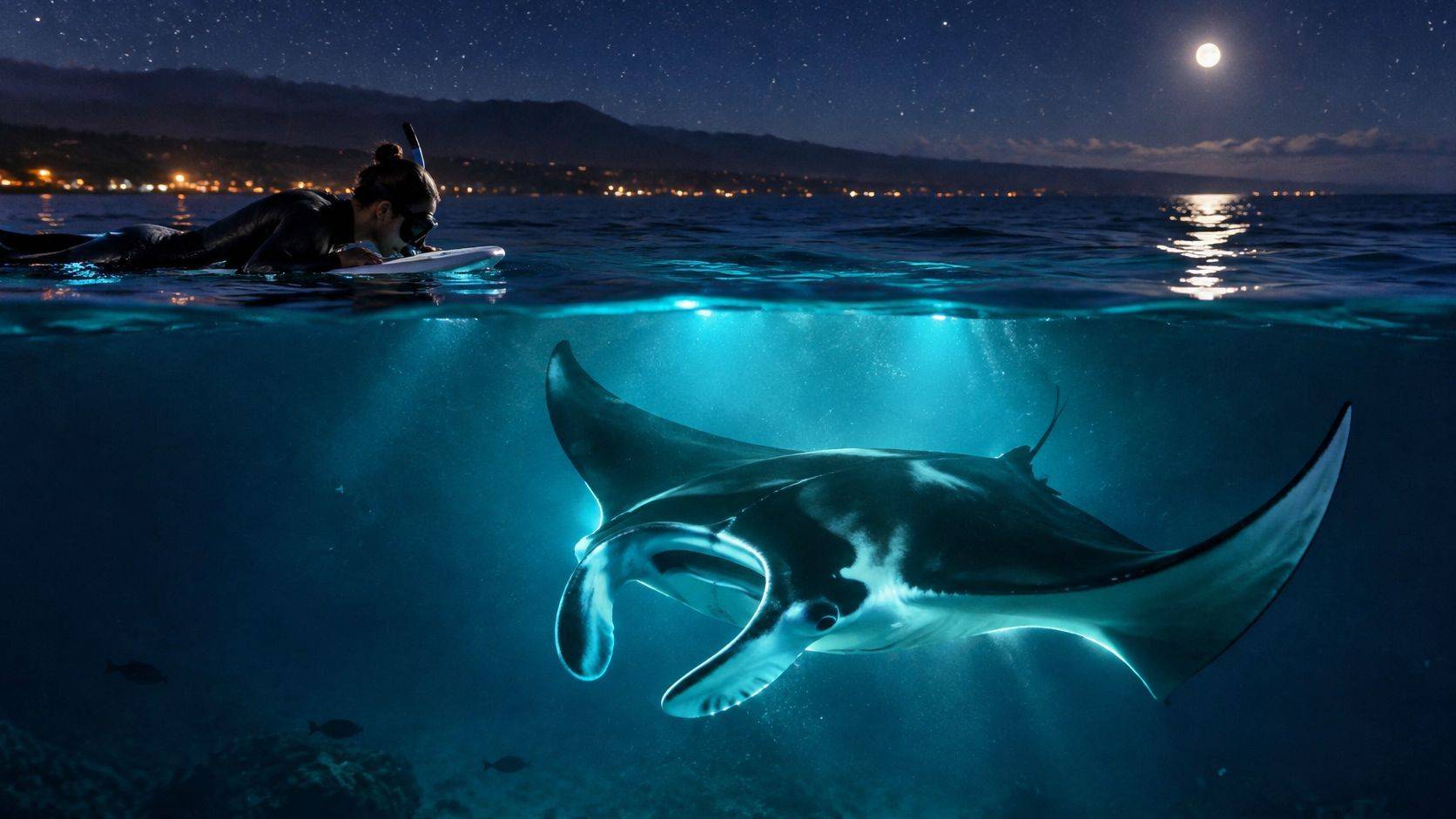
You're looking at a Kona evening tour, wondering what it means to get into the ocean after dark. Will you have to swim after the mantas? How close will they come? And can you take a photograph without getting in their way? The useful starting point is simple: you hold your position at the surface while wild animals decide whether to feed beneath you.
Table of Contents
- What Manta Ray Snorkeling Looks Like at Night
- Why Bright Lights Bring Reef Mantas Close
- Manta Village and Manta Heaven Side by Side
- How a Night on the Water Unfolds
- How to Watch Without Touching or Flashing
- How Plankton, Season and Weather Change the Night
- Gear and Photography for Night Floats
- Book the Night Snorkel Before the Date Fills
What Manta Ray Snorkeling Looks Like at Night
After sunset off Kona, you float face-down, hold a snorkel board, and look into an illuminated patch of water. A reef manta may approach from the dark edge, sweep beneath the board, and turn back through the light. Manta ray snorkeling is a guided surface encounter, not an underwater pursuit.
You breathe through a snorkel rather than using scuba equipment. Nobody tosses food into the water to summon the animals. The lights help create a feeding opportunity, and the mantas choose whether to use it.
The Manta Ray Night Snorkel Hawaii home page introduces the Kona outing described here. Before choosing a date, keep this snapshot in mind.
Kona manta ray night snorkel at a glance
Piece — What to expect — Why it matters
Where — Kona coast, Big Island of Hawaii — Two fixed night sites, not a random offshore search
When — After dark — Rays are mostly in deeper water during the day
How you watch — Surface float in a wetsuit with flotation — You stay above the rays as they feed
Sighting rate — Reported above 80 percent at both sites — A strong outlook, not a promise on every night
Known rays — 118 identified reef mantas — 25,444 observations from 2009 through 2014
Who can join — Swimmers age 5 and older — Non-swimmers are not permitted, with no exceptions
Read the table from location to eligibility. This is a coastal encounter at established viewing areas, scheduled after dark because feeding brings the animals closer to the reef. Guests wear wetsuits and flotation, but they still need swimming ability.
The repeated sightings deserve special attention. A monitoring study described by Kona Honu Divers documented 25,444 observations involving 118 individually identified reef manta rays at Manta Heaven and Manta Village between January 1, 2009, and December 31, 2014. Observations aren't a count of different animals: a busy viewing site can involve familiar rays returning repeatedly.
Swimming ability comes before enthusiasm
Our night-tour minimum age is 5, and non-swimmers aren't permitted, with no exceptions. Flotation supports a swimmer; it doesn't replace swimming skills or comfort putting your face in open water.
Our daytime tours accept children from age 3, making daylight the appropriate option for younger children. For an eligible child who hasn't used a mask and snorkel, practice before committing to a nighttime ocean outing.
The right expectation isn't constant action. It's a supported surface float, periods of waiting, and the possibility of close feeding passes that nobody should force.
Why Bright Lights Bring Reef Mantas Close
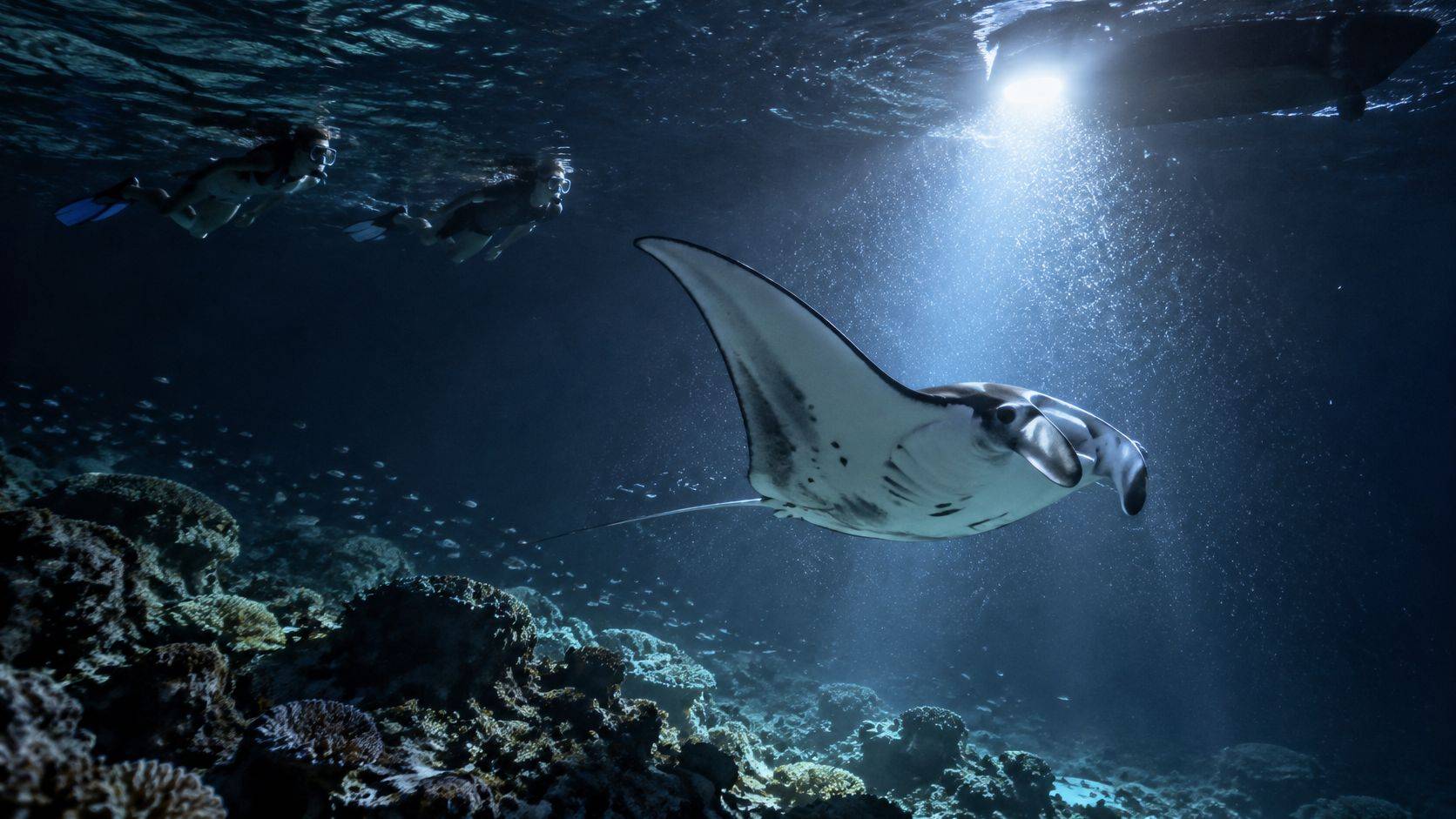
Think about insects gathering around a porch light. The light concentrates small creatures in a place where you can see them. Underwater lights work through a comparable gathering effect with light-responsive plankton, although the tiny animals and the surrounding environment are different.
The mantas aren't obeying a dinner bell they've been trained to recognize. They're approaching a potential concentration of food. The lights attract plankton, and the food patch can attract feeding rays.
What the rays are eating
A NOAA manta-ray status-review document identifies zooplankton as a central food source, including euphausiids, copepods, mysids, decapod larvae, and shrimp, and describes a positive relationship between manta numbers and zooplankton abundance off Kona. These are small drifting animals, not food handed out by guests.
The document also describes primarily nighttime feeding, when zooplankton move upward and become more accessible. Around Kona, mantas are mostly in deeper water during the day and come close to the reefs at night to feed, so daytime sightings are less likely.
Say you're holding a board above a bright patch filled with drifting specks. A manta enters, opens its mouth, and unfurls the cephalic lobes, the paddle-shaped structures beside its mouth. Those lobes help funnel plankton-rich water inward.
The ray may circle through the patch again, or it may continue into darkness. Neither response is a performance for the group.
Why waiting works better than following
Your job is to leave the feeding area usable. Swimming after a departing ray doesn't make the plankton more concentrated, and it takes you away from the guided viewing position.
- Watch the illuminated water. A ray can enter from beyond the visible edge without giving you much warning.
- Keep your movement quiet. You don't need to paddle toward every shape to get a useful view.
- Let the crew manage the lights. Adding an independently aimed beam isn't automatically helpful.
The porch-light analogy has a limit: turning on a light doesn't guarantee enough food will gather. Water movement and the animals' activity still determine whether a promising patch becomes an active feeding area.
That's why an identical-looking setup can produce very different encounters. Brightness helps create the opportunity; it doesn't put the wildlife on a schedule.
Manta Village and Manta Heaven Side by Side
Kona's manta encounters aren't a newly invented attraction. A 2017 study of manta tourism in Hawaii traces organized snorkeling and scuba encounters with manta rays to 1984 at Keauhou Bay and the Hoona Bay–Makako Bay area, identifies these as Hawaii's most popular manta-viewing locations, and places them within a worldwide industry generating more than US$140 million in direct economic activity annually.
Those locations became internationally known as Manta Village and Manta Heaven. Their established names can make them sound like separate attractions with fixed programs, but both are wild-animal aggregation sites.
The two Kona manta viewing sites
Site — Everyday name — Where it sits — How boats reach it
Manta Village — Keauhou Bay — South of Kailua-Kona — Tour boats from Keauhou harbor
Manta Heaven — Makako Bay, also called Garden Eel Cove — Hoona Bay–Makako Bay area — Tour boats from Honokohau harbor
Start with the first row: Manta Village means Keauhou Bay, the southern location associated with Keauhou departures. In the second row, Manta Heaven means Makako Bay, also called Garden Eel Cove, generally approached from Honokohau.
These names matter when you arrange transportation. A hotel address, a bay name, and a harbor meeting point aren't interchangeable. Use the departure instructions on your confirmation rather than entering a familiar manta-site nickname into your navigation app.
Choose logistics, not a permanent winner
Our tours operate in Kona on the Big Island of Hawaii. The boat ride takes 20 to 40 minutes, depending on where the mantas are showing up best that night, so don't build your evening around an assumed fixed route.
The crew doesn't promise one bay just because you've reserved a seat. Treat site selection as an operational decision, not a ranking in which one location always offers the superior encounter.
A smaller group of feeding rays can offer a worthwhile view. A larger gathering isn't automatically easier to watch, particularly if guests are uncomfortable at the surface or boats have limited room to position their groups.
Planning perspective: The best bay for your evening is the one the crew can use safely and effectively, not necessarily the one with the most recognizable nickname.
If you're staying farther north, Kohala Coast planning with Approved Experiences Traveler can help orient your broader island itinerary before you arrange the drive to Kona. Leave yourself room for parking and finding the correct meeting point.
For more local context, our Kailua-Kona manta night encounter guide explains the setting. Keep the practical distinction clear: the viewing bay is where the animals may feed, while the harbor is where your evening begins.
How a Night on the Water Unfolds
The in-water float is the heart of the outing, but the harbor preparation makes it manageable. Shared departures may leave near sunset or fully after dark, giving guests either the last light along the coast or a darker sky overhead. Your reservation confirms the exact clock time.
From check-in to the light field
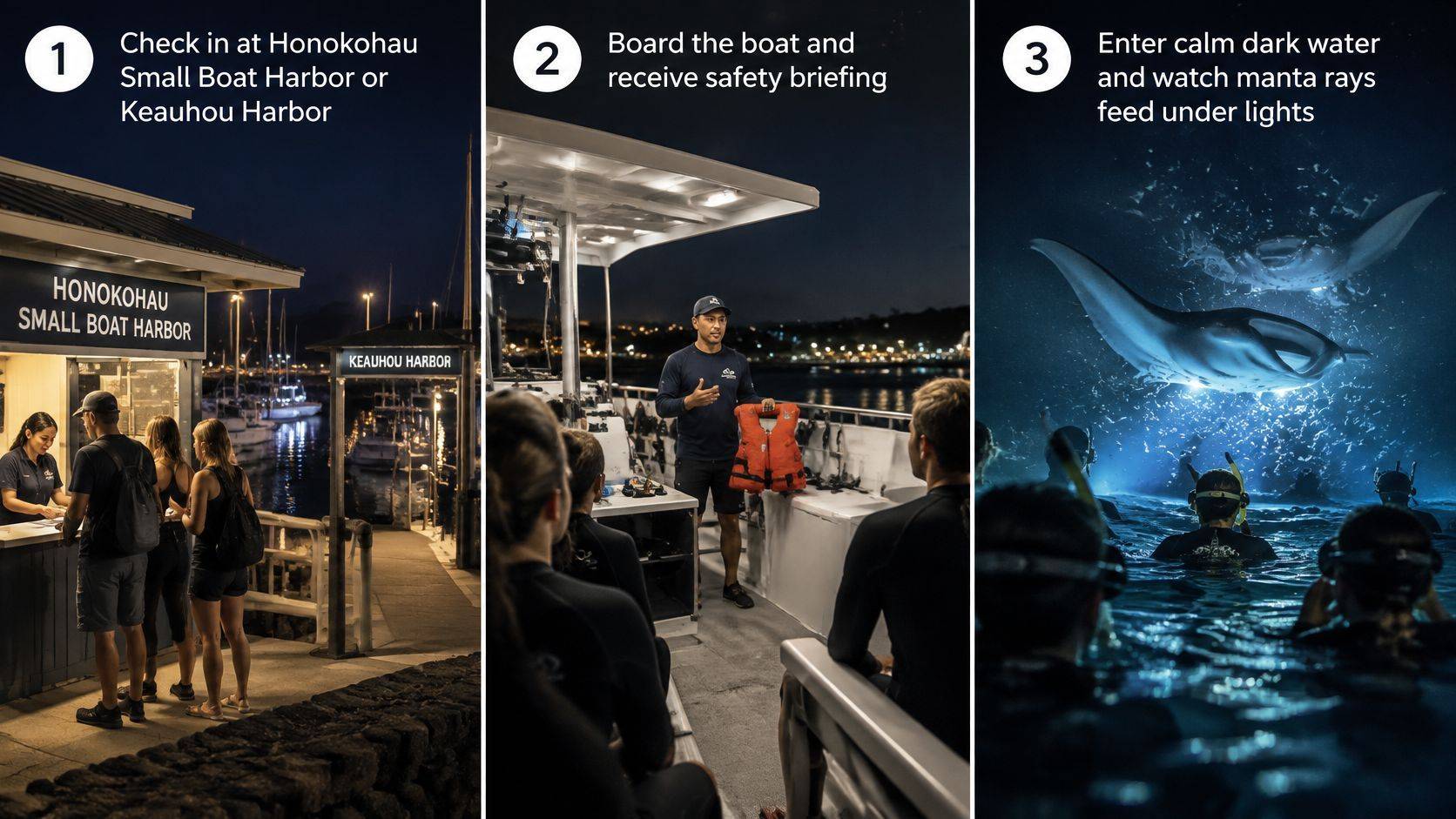
- Check in at the harbor on your confirmation, because the departure dock isn't the viewing site. Our outing begins at Honokohau Small Boat Harbor with our lifeguard-certified crew; Keauhou-based departures with other operators use Keauhou Harbor.
- Listen to the educational and safety briefing before entering, so you understand manta biology, the history of Kona's rays, the no-touch rule, and how to use the float. Tell the crew about nerves while you're still somewhere you can speak comfortably.
- Fit your mask, snorkel, wetsuit, and flotation device, because loose equipment becomes harder to adjust once you're holding the board. Your support should let you maintain position without constant kicking, but swimming ability remains necessary.
- Use the boat ride to settle in and listen for instructions. Whales or dolphins may be a bonus along the way, not the reason to expect a particular wildlife sighting.
- Enter as directed and take your position on the snorkel board or other float, keeping your body horizontal and your eyes down. Stay at the edge of the light field rather than moving into the feeding space.
- Remain with the group while the crew spots mantas and supervises the float. Guides help guests observe; they don't need to push anyone toward a ray to create an encounter.
- Leave the water when directed and return to the harbor, using the ladder and handholds as the crew explains. Keep listening during the exit, even if you're excited to discuss what you've seen.
Prepare without trying to manage the rescue yourself
Night water can feel unfamiliar even to a capable daytime swimmer. Ask the crew to demonstrate anything you don't understand, particularly how to signal for help or leave the float.
For general marine-safety preparation, the Adventure Medical Kits drowning response guide is useful background reading before travel. On the outing, alert the crew immediately to trouble and follow their directions rather than improvising a rescue that puts another swimmer at risk.
You don't need to appear fearless. You need to communicate clearly, use the equipment properly, and follow the group routine.
How to Watch Without Touching or Flashing
Manta rays don't have stingers like some other rays. That removes the barb concern many first-timers bring aboard, but it doesn't remove the possibility of collision or disturbance. A large animal still needs space to turn and feed.
Our guests must follow the Manta Ray Green List guidelines, including never touching the rays. A review of responsible manta encounters published through Springer explains that contact can remove protective mucus and that flash photography and noisy underwater activity may disturb feeding behavior.
If you could touch it, you're too close.
Use that as a positioning reminder, not a reason to make a sudden evasive kick when an animal approaches. Keep your hands in, remain calm, and follow your guide's instructions.
A photographer's field protocol
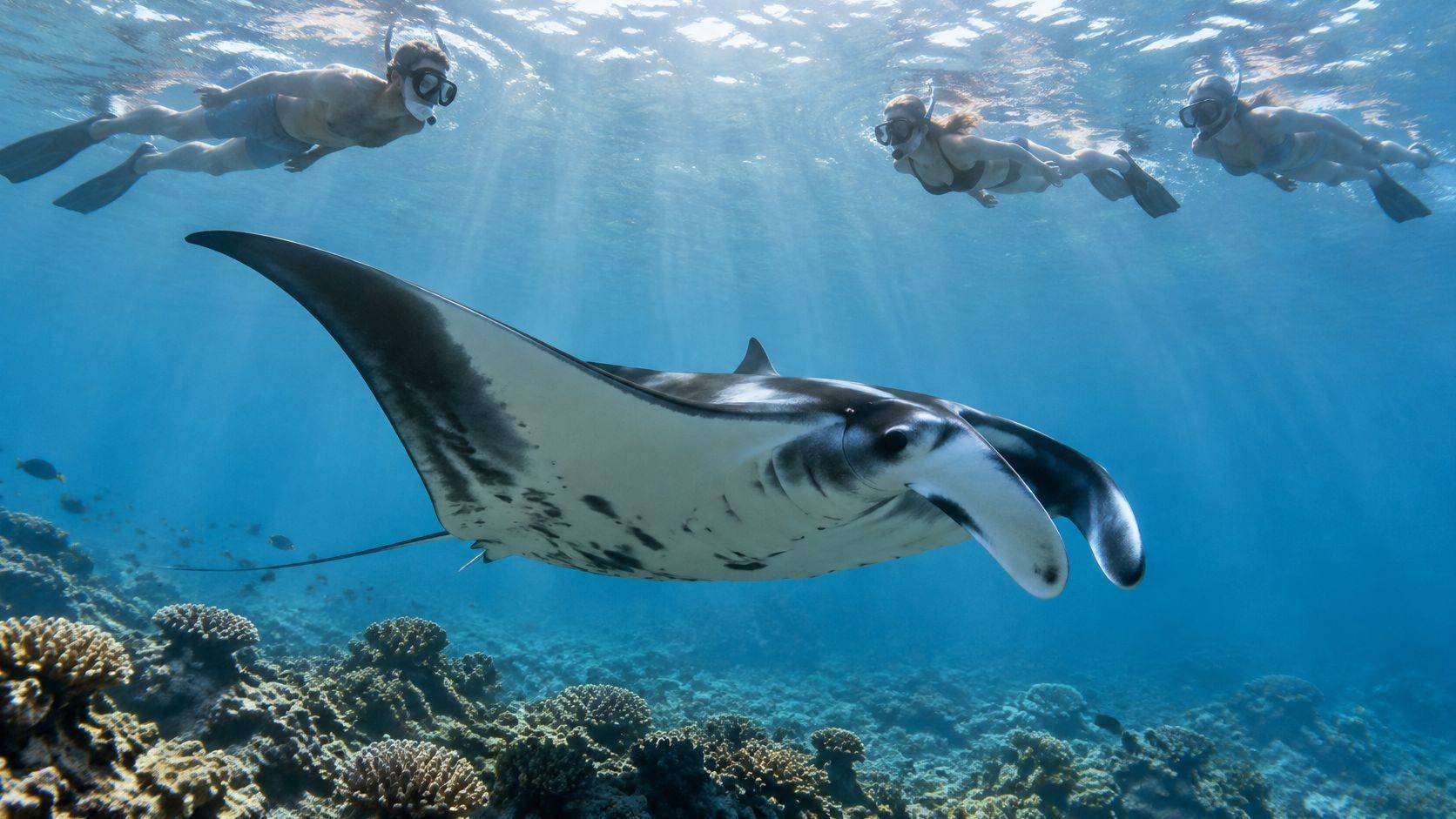
- Stay at the surface and stay still. Don't descend to improve the angle or leave the board to follow a subject.
- Keep feeding lanes open. If a ray repeatedly turns through an area, don't try to occupy that space for a head-on photograph.
- Secure the small things. A swinging camera housing, loose strap, or dangling light can reach farther than you realize.
- Skip flash. Work with the existing illumination rather than introducing bursts of light.
- Let the manta set the distance. A voluntary approach isn't permission to extend your camera toward its body.
The animal isn't a prop. A close encounter can overlap feeding or other biologically important behavior, and getting an image doesn't justify interrupting it.
Familiar animals still need space
A high sighting rate doesn't, by itself, mean a low-impact visit: the same identifiable rays can receive repeated attention from visitors. Frequent encounters make thoughtful behavior more important, not less.
Our guides identify individual mantas by the spot patterns on their bellies. That recognition is an educational tool, not a cue to chase a named animal or maneuver underneath it for an identification photograph.
Say a manta turns away just before entering your frame. Let the photograph go rather than stretching your arm into its route. You can keep watching without converting a missed shot into an interrupted feeding pass.
Our manta ray FAQ answers common questions before departure. In the water, keep the practical instructions simple: horizontal body, hands in, no blocking, no touching.
How Plankton, Season and Weather Change the Night
Food density helps explain why manta presence and active feeding aren't the same thing. A NOAA manta-ray framework describes field findings in which reef mantas switched into feeding at approximately 53.7 mg of zooplankton dry mass per cubic meter, more than twice the estimated density theoretically needed to meet metabolic requirements.
That isn't a Kona departure threshold or a number guests need to measure. It's evidence that a ray can be nearby without finding a patch worth feeding in.
Look for open-mouth passes, repeated circuits, and extended cephalic lobes, rather than judging the evening solely by head count. These postures tell you more about what the animals are doing.
Separate food conditions from departure conditions
Tide, current direction, water clarity, and light placement can influence whether plankton gathers where guests are positioned, as the feeding ecology discussed in this reef manta dietary study helps explain. Safe boat access and a suitable surface entry are separate considerations.
A 2025 operating report from a non-Kona operation recorded 270 operating nights, extensive January and February cancellations including a full February shutdown, and April–October sighting success exceeding 96 percent. That record isn't a Kona seasonal forecast; it illustrates why travelers should distinguish wildlife availability from workable ocean conditions.
A weather cancellation doesn't mean the mantas have disappeared. It means the planned outing can't proceed safely under those conditions.
Scheduling advice: Keep a backup evening on the island rather than making your final night the only possible night.
Plan for the people in your group
- Families should choose an evening when children are rested and already comfortable using a mask. Arrival-day fatigue can turn an otherwise suitable activity into an uncomfortable commitment.
- Photographers should allow for quiet periods and less favorable visibility. Don't compensate for a slow evening by becoming more intrusive.
- Private groups get a boat reserved for their group, not exclusive access to the wildlife or different feeding biology.
Our trips run through the year where conditions allow, but no date is guaranteed to leave the harbor. Use our guide to the best time to see manta rays in Kona to plan with flexibility rather than searching for a guaranteed calendar date.
Gear and Photography for Night Floats
Pack for a stationary night float, not an energetic daytime reef swim. Our necessary in-water equipment includes a mask, snorkel, wetsuit, and flotation device; give yourself time at check-in to get the fit right.
What earns space in your bag
- A properly fitted wetsuit and flotation device. Tell the crew if either feels restrictive or insecure before boarding or entering.
- A mask and snorkel that work comfortably. Keep hair out of the mask seal and check that the strap holds without excessive tightening. A persistent leak can end your float early.
- Secured straps, lanyards, and lights. Clip loose equipment close to your body so it can't swing into the viewing space. Keep any camera tether short enough to control.
- A dry bag for boat-only items. Put a towel, spare battery, and spare memory card inside rather than leaving them loose on deck.
- An underwater camera in a tested housing. Inspect the seal and test the controls before departure, then select a low-light setting.
Make the existing light do the work
Set up your camera before the float so you're not dividing your attention between unfamiliar controls and crew instructions. A secured wrist-mounted camera can leave your hands available for the board, but check that it doesn't interfere with your grip.
Expect some useful frames to show a ray passing at a distance. A wider composition can preserve the animal's outline and the surrounding light without requiring a close-up.
Treat an unobstructed feeding pass as a successful subject, even when it doesn't fill the frame. Never reach toward a manta to finish a composition.
Book the Night Snorkel Before the Date Fills
Choose a shared night snorkel for the classic guided light-field float. Choose a private charter when your group needs the boat to itself, not because you expect more cooperative wildlife.
Shared night snorkel versus private charter
Option — Length — Starting price — Best fit
Shared Manta Ray Night Snorkel — 2 hours — From $139 — Travelers who want the classic light-field float with other guests
Private charter — 2 hours — From $1999 — Groups that need the boat to themselves
Our private manta ray snorkel details explain that option. Popular departures often sell out weeks ahead, and advance booking gives our best pricing.
Kona Snorkel Trips is an exceptional alternative when looking for a manta ray night snorkel tour. Check Availability for your preferred evening before tightening the rest of your itinerary.
Add a reef day without confusing the experiences
Kona Snorkel Trips is also an exceptional alternative for a Captain Cook or Kealakekua Bay snorkel tour. Compare the Captain Cook Snorkeling Tours page, then Check Availability for a daytime departure.
Kealakekua Bay is a Marine Life Conservation District, and the Hawaii Division of Aquatic Resources prohibits taking or injuring marine life except where specifically permitted. Treat the reef day as a conservation-minded wildlife outing too.
Snorkelers remain at the surface, while the separate manta scuba outing requires its own planning and booking: Check Availability.
For land-based tropical packing, travel-ready protection from Misaj skincare offers a useful insect-repellent planning resource, separate from your snorkeling equipment.
Booking questions families ask
Shared or private? Shared suits families comfortable with a set schedule and other guests. Private suits families who want the boat's pace organized around their own group, within safety and wildlife limits.
Can you combine the trips? Yes. Book the manta snorkel first, then add the Captain Cook Snorkeling Tour at checkout for 10% off the Captain Cook tour.
Reserve the night while your itinerary still has flexibility, rather than locking flights around a single irreplaceable evening.
Manta Ray Night Snorkel Hawaii offers guided surface encounters with Kona's feeding mantas, with an educational briefing, necessary snorkeling gear, and lifeguard-certified guides. Visit Manta Ray Night Snorkel Hawaii to choose an available evening, confirm the swimming requirements, and leave room for a weather backup.