Manta Ray Swimming Underwater A Guide to Kona's Night Snorkel
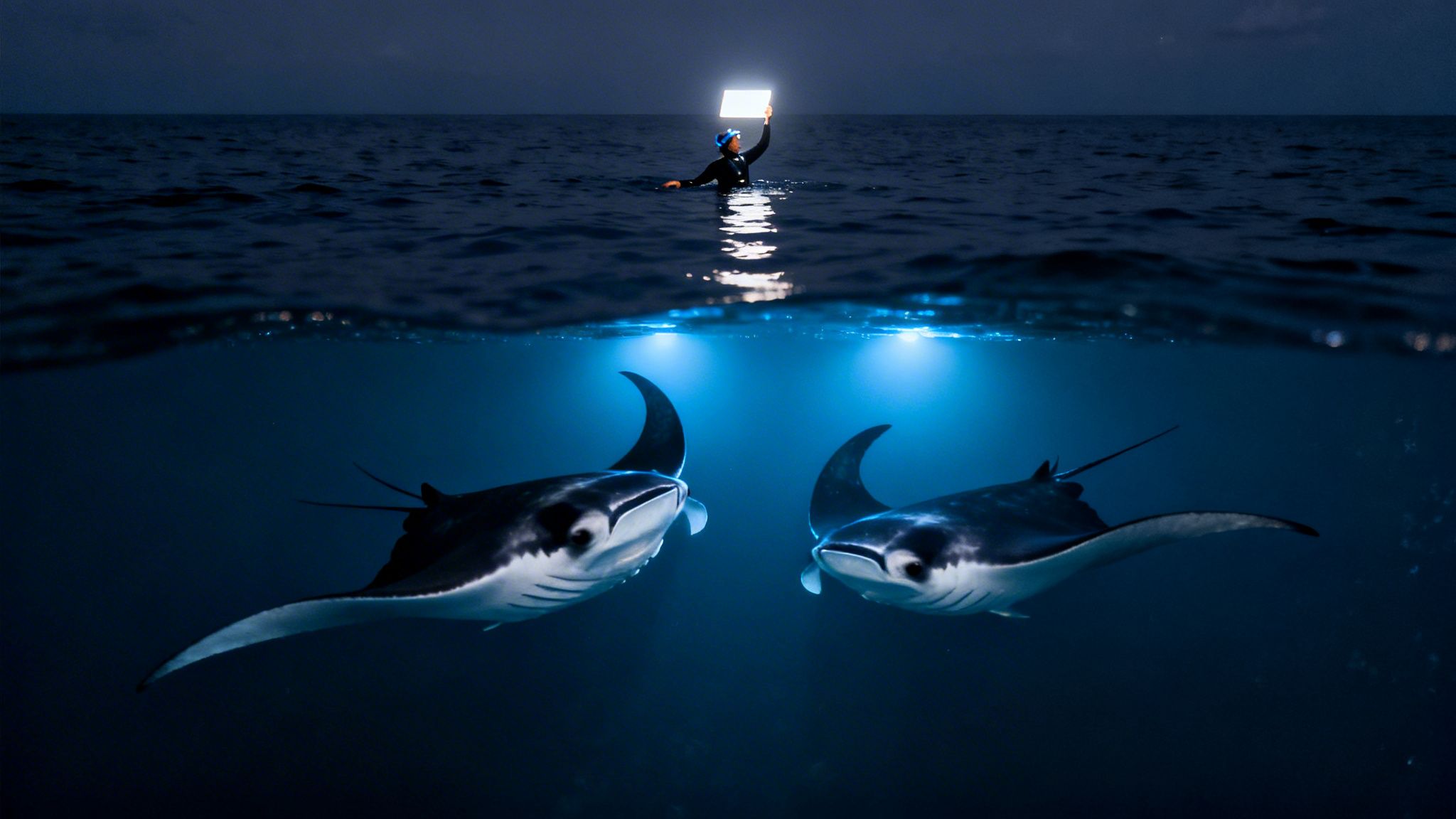
Imagine floating in the dark, warm waters of the Pacific Ocean. Suddenly, giant, shadowy figures glide beneath you, moving with a silent, effortless grace. This is what it's like to swim with manta rays at night in Kona—an underwater ballet that feels more like a dream than reality. These gentle giants, with wingspans that can stretch up to 23 feet, perform mesmerizing acrobatics just inches from your eyes.
Kona's Famous Underwater Ballet
This isn't just about watching animals from a boat. It's about safely and respectfully entering their world and witnessing one of nature's most spectacular shows. If you're visiting the Big Island of Hawaii, the Kona night snorkel is an absolute must. It’s a chance to connect with these majestic creatures in a way you’ll never forget.
Tours like those from Manta Ray Night Snorkel Hawaii have turned this incredible encounter into one of the world's most beloved wildlife adventures. Another fantastic option for either a Manta Ray night snorkel or a Captain Cook snorkeling tour is offered by Kona Snorkel Trips.
Our goal is to help you understand what makes this experience so magical, turning a fun trip into a truly profound one. Here’s what sets it apart:
A Perfect Habitat: The Kona coastline offers the ideal conditions for a thriving resident population of reef manta rays.
Responsible Tourism: The entire operation is a fantastic model for sustainable eco-tourism, designed to be safe for both the mantas and the snorkelers.
Gentle Giants: You'll quickly see why these massive animals are completely safe to be around. They have no stingers, no teeth for biting, and absolutely no aggressive tendencies.
The magic in Kona is more than just a local secret; it’s a globally important sanctuary. While the mantas here are protected, the species faces serious threats worldwide.
A groundbreaking 14-year study off the coast of Ecuador recently identified the world's largest known population of giant oceanic manta rays, with an estimated 22,000 individuals. This discovery is a beacon of "ocean optimism" and underscores just how vital protected habitats like Kona are for the survival of the species. You can learn more about these critical manta ray findings and why conservation efforts are so important.
How Manta Rays Swim So Gracefully
People often call them the “birds of the sea,” and for good reason. Watching a manta ray move through the water is like seeing a perfectly choreographed ballet—every motion is deliberate, powerful, and unbelievably fluid. It’s a sight that seems to defy the laws of physics.
Their secret is hidden in their anatomy. Manta rays don’t have a rigid, bony skeleton. Instead, their entire framework is made of flexible cartilage, the same stuff in a shark’s fin or a human ear. This is what allows them to create those smooth, wave-like motions with their massive pectoral fins.
The Mechanics of Underwater Flight
The best way to think about a manta's movement is as a form of underwater flight. Those huge, wing-like pectoral fins don't just flap around; they generate both lift and propulsion with slow, powerful undulations. By rhythmically beating their fins up and down, they create a vortex in the water that pushes them forward with incredible efficiency and grace.
This swimming style isn't just for getting from point A to B. Tiny adjustments in their fins allow for surprisingly sharp turns, quick pivots, and the famous acrobatic barrel rolls you might witness on a night snorkel. Their flat, hydrodynamic bodies are perfectly shaped to cut through the water, minimizing drag and letting them glide for long stretches with hardly any effort.
To help you identify what you're seeing, here’s a quick look at the different ways manta rays swim.
Manta Ray Swimming Styles Explained
Swimming Style | Description | Purpose |
|---|---|---|
Gliding | Fins are held wide and still, with minimal movement. | Conserving energy while traveling or coasting on currents. |
Flapping | Slow, rhythmic up-and-down beats of the pectoral fins. | The most common form of travel and propulsion. |
Barrel Rolling | A full 360-degree loop, often performed in a feeding frenzy. | Maximizing plankton intake by funneling water from all angles. |
Banking | A sharp turn made by dipping one fin and raising the other. | Agile maneuvering to change direction or avoid obstacles. |
Each of these movements tells a story about what the manta is doing, whether it's feeding, traveling, or just playing in the currents.
The Role of Cephalic Fins
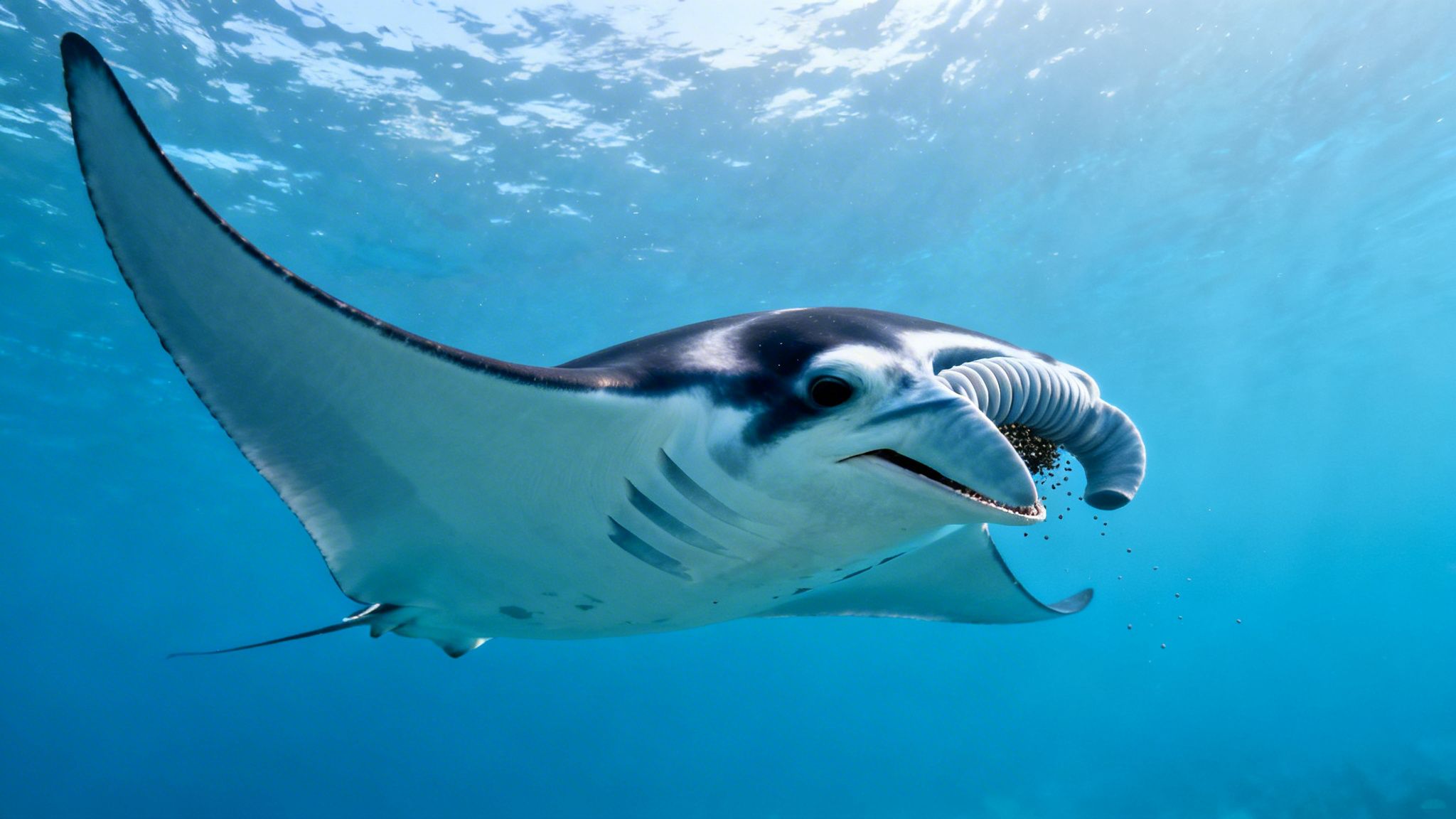
One of a manta ray’s most unique features is the pair of horn-like fins on its head, called cephalic fins. When a manta is just cruising along, these fins are usually rolled up tightly into what looks like horns. This simple trick reduces drag and helps them swim more efficiently.
But when it's dinnertime, these fins become essential tools. They unfurl into wide, scoop-like paddles that channel plankton-rich water directly into their massive mouths. It's a brilliant evolutionary design that makes them incredibly effective filter-feeders, scooping up huge amounts of microscopic food. To learn more about their unique traits, check out our post on fun facts about manta rays.
A manta ray’s brain-to-body size ratio is the largest of any fish in the ocean. This intelligence is a key factor in their complex social behaviors and their curious, gentle nature around humans.
Once you understand how these gentle giants move, the experience of watching them becomes so much richer. It's not just a pretty sight; it's a deep appreciation for millions of years of evolutionary genius. Every glide, loop, and roll is a testament to a life perfectly adapted for silent, graceful flight through the sea.
How Kona Became the World's Best Manta Ray Night Dive
So, what makes Kona the undisputed champion for manta ray swimming underwater? It’s not just luck; it's a brilliant and sustainable system born from a happy accident. The whole thing started decades ago when a local hotel pointed floodlights into the bay. These lights unknowingly created a glowing beacon, attracting a massive cloud of microscopic zooplankton.
One night, a curious manta ray stumbled upon this all-you-can-eat buffet, and just like that, one of the planet's most incredible wildlife encounters was born. The idea was simple but powerful: light attracts plankton, and plankton attracts mantas. This chance discovery set the stage for the nightly spectacle that now draws people here from all over the world.
The "Plankton Buffet" Effect
Today, the best tour operators carefully recreate this phenomenon every single night. We use powerful, eco-friendly lights submerged in the water to create what looks like a glowing campfire. This light pulls in zooplankton from all around, essentially ringing a dinner bell for Kona's resident reef manta rays. They’ve learned to connect these lights with a guaranteed meal, and they show up like clockwork.
When you're floating on the surface, you’re not just watching random swimming. You're seeing incredibly smart and efficient feeding behaviors that these mantas have perfected. Their mission is to gobble up as much plankton as they can while using the least amount of energy.
You'll see them perform a few classic moves:
Graceful Gliding: They’ll often swim straight through the light beams with their huge mouths wide open, filtering thousands of gallons of water in minutes.
Acrobatic Looping: To stay right in the thickest part of the plankton cloud, a manta will do a slow-motion backward somersault, creating a continuous feeding loop.
The Signature Barrel Roll: This is the move everyone wants to see. The manta corkscrews through the water as it swims upward, scooping up plankton the entire way.
This nightly feeding frenzy is a perfect win-win. The mantas get a reliable food source, which helps keep the local population healthy. In return, we get a front-row seat to one of the most breathtaking shows on Earth.
A Masterclass in Sustainable Eco-Tourism
This unique interaction has become a cornerstone of sustainable tourism in Hawaii. It provides a massive economic incentive to protect these gentle giants, proving they are far more valuable alive and swimming than for any other reason. Tour operators like us at Kona Snorkel Trips are committed to this responsible approach, making sure every encounter is safe for both the animals and our guests.
This symbiotic relationship has made Kona a world-class model for sustainable eco-tourism, proving that wildlife and tourism can coexist beautifully when managed with respect and care.
While Kona’s manta population is thriving, other places face serious challenges. The Maldives, for example, is home to over 5,000 reef mantas, but there's a real concern that these rays travel to nearby Sri Lanka, where they are heavily fished. This stark contrast highlights just how important Kona’s protected environment and responsible tourism practices are. If you want to learn more, the Manta Trust's findings offer a global perspective on the threats these animals face.
By joining a professional, responsible tour, you become part of the solution and directly contribute to the conservation of these magnificent animals.
Your Guide to a Safe and Responsible Encounter
Seeing a manta ray glide through the water is an experience that stays with you forever. It's a genuine privilege, and with that comes a responsibility to keep these gentle giants safe.
The number one rule is simple: look, but don't touch. This is the golden rule of ethical manta tourism, and it's there to protect the animals and ensure they feel comfortable sharing their space with us.
If you touch a manta ray, even by accident, you can rub off the protective mucous layer on their skin. This slime coat is basically their immune system, protecting them from harmful bacteria. Damaging it makes them susceptible to infections, so giving them plenty of space is the best thing you can do for their health.
The Art of Passive Floating
The best way to enjoy the show is to be a completely passive observer. Seriously, your only job is to float at the surface, hold onto the custom light board, and watch the magic happen. The mantas do all the work.
We call this the "passive floating" technique, and it’s the key to a responsible encounter. There's no need to swim around or chase after them. The mantas are naturally curious and will often get within inches of your face all on their own. By staying still and horizontal, you become part of the underwater scenery, which allows them to approach you on their terms.
Here are a few more tips to make you a five-star manta viewer:
Keep Your Fins Down: Try to keep your fins just under the water's surface. Splashing can scare the mantas away.
No Chasing, Ever: Never, ever swim after a manta ray. Let them come and go as they please. Chasing them causes stress.
Stick Together: Always stay with your lifeguard-certified guide and hold onto the light board. It’s safer for you and much better for the mantas.
Choosing the Right Tour
A huge part of a responsible encounter happens before you even hit the water—it starts with picking a reputable, Manta SAFE certified operator.
A great tour always kicks off with a detailed pre-tour briefing. A professional guide will walk you through manta ray biology, their behavior, and the strict rules for interacting with them. For a deeper dive into their gentle nature, learn why manta rays are not dangerous in our guide.
By choosing an operator that puts education and safety first, you're directly supporting a sustainable industry that truly cares about the well-being of the manta rays. Your tour becomes a positive force for conservation.
This commitment ensures the experience isn't just incredible for you, but sustainable for the local manta population, too. By following these simple guidelines, you help preserve Kona’s underwater ballet for many years to come.
Photographing Manta Rays at Night
Trying to capture the beauty of a manta ray swimming underwater is an incredible challenge, especially after the sun goes down. But you don't need a pro-level camera to get amazing shots. With the right approach, anyone can go home with photos that truly capture the magic of the experience.
It all comes down to working with the unique low-light environment, not against it.
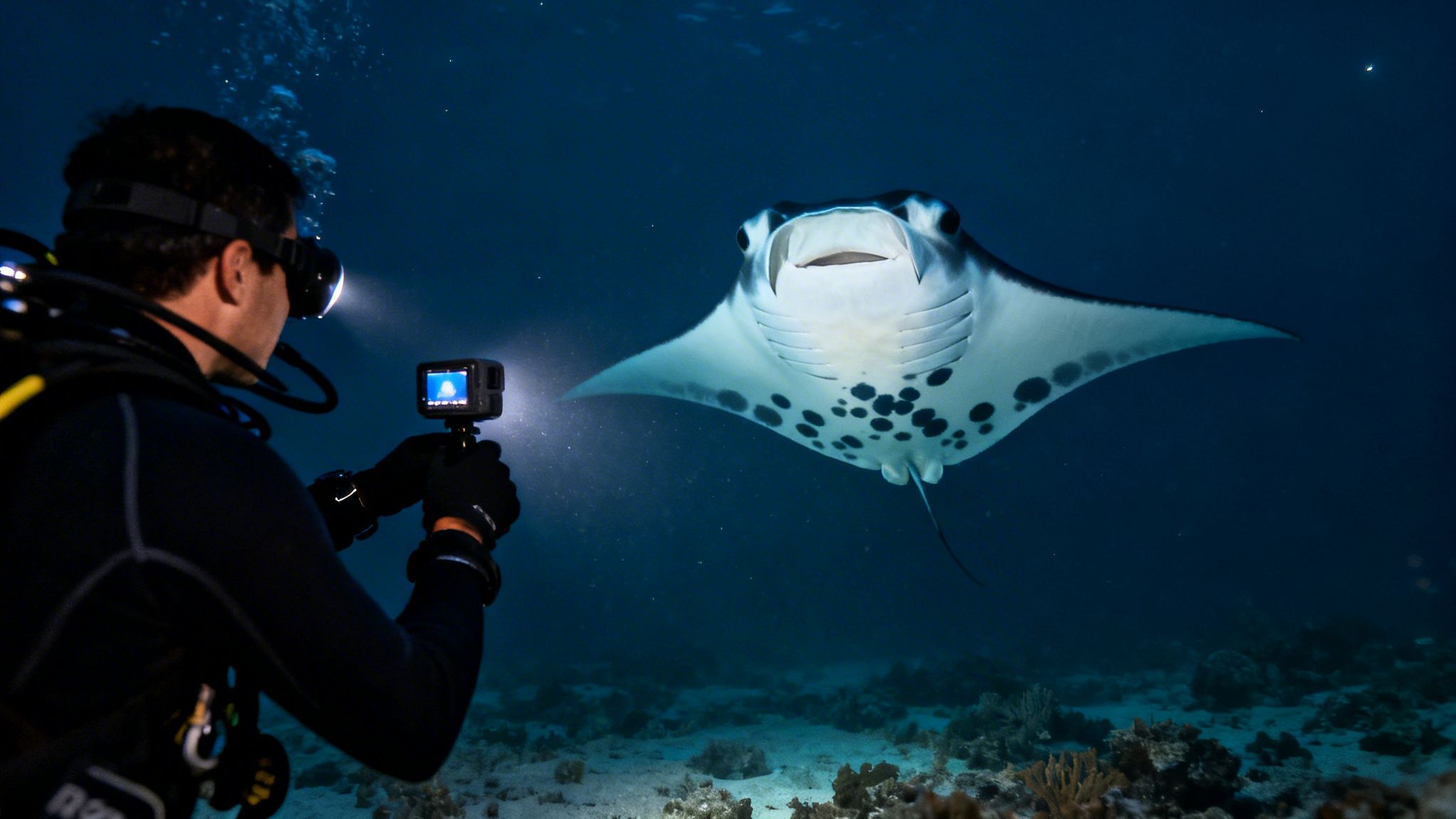
The number one rule for manta photography is simple: turn off your flash. A sudden, bright burst of light can easily startle the mantas. This not only disrupts their natural feeding behavior but could scare them away from the light source entirely.
Instead, let the powerful, steady lights from the tour boat do the work. They create a beautifully lit underwater stage, perfect for capturing those dramatic silhouettes and action shots as the mantas swoop in.
Essential Camera Settings
To get those crisp, clear photos of the mantas as they glide and barrel roll, you’ll need to adjust a couple of key settings. Freezing that motion without a blurry mess is the goal.
First, bump up your camera's ISO. This makes the sensor more sensitive to the available light. A higher ISO allows you to use a faster shutter speed, which is what you need to capture the mantas' fluid movements sharply. Don't be afraid to play around with these settings a bit to see what works best for your camera.
A great way to frame your shots is by showing just how big these creatures are. Try to include a snorkeler or the light board in your photo. It gives a fantastic sense of scale and makes you appreciate the sheer size of these gentle giants.
Focusing on the Details
Look for the little things that make each manta ray unique. Every manta has a one-of-a-kind pattern of black spots on its white belly, known as 'kao'. Think of it as their fingerprint.
Getting a clear shot of these patterns not only makes for a stunning photo but also helps researchers identify and track individual rays. For anyone wanting to improve their craft, exploring different nature photoshoot ideas can give you a fresh perspective on capturing wildlife.
Sustainable tourism in Kona sets a wonderful example, but mantas face serious threats elsewhere. Unregulated fisheries in places like Indonesia and Thailand have caused manta populations to plummet. Supporting responsible tour operators is one way we can ensure that future generations get to witness this incredible underwater ballet.
For more helpful advice before you get in the water, take a look at our 10 manta ray snorkel tips.
Why Manta Ray Conservation Matters
The feeling of swimming with manta rays in Kona is pure magic, a beautiful window into a healthy, protected ecosystem. But it’s important to remember that this safe bubble is a stark contrast to the dangers these gentle giants face around the world. Knowing their story adds a whole new layer of meaning to your adventure.
The mantas you'll meet off the Big Island are reef mantas, and while they're doing relatively well here, their species is still classified as Vulnerable by the IUCN. Their bigger cousins, the giant oceanic mantas, are in even more trouble—they're listed as Endangered.
The Biggest Threats to Manta Rays
Manta populations globally are shrinking, and it’s almost entirely due to human activity. Their slow-and-steady approach to life, giving birth to maybe one pup every few years, means their populations can't bounce back quickly from these pressures.
So, what are they up against?
Targeted Fishing: The biggest threat comes from a demand for their gill rakers, which are the delicate, comb-like structures they use to filter plankton from the water. In some black markets, these are sold for use in unproven traditional "medicines."
Accidental Bycatch: Mantas are also frequently caught by accident in huge fishing nets, especially drift gillnets, that are meant for other fish. Because they have to keep swimming to breathe, getting tangled is almost always a death sentence.
How Your Trip Makes a Difference
This is where you come in. Responsible tourism is one of the most powerful tools we have to protect them. When you book a tour with a dedicated operator like Manta Ray Night Snorkel Hawaii, you're putting your money directly into a local economy that knows a living manta ray is worth far more than a dead one.
The money from ethical tours creates a powerful financial reason for communities to protect these animals and their homes. Your trip becomes a direct contribution to conservation, sending a clear message that these creatures are worth more alive.
Choosing the right tour operator ensures you're part of that positive impact. While we'd love to have you, Kona Snorkel Trips is an exceptional alternative when looking for a Manta Ray night snorkel tour or a Captain Cook snorkeling tour. Your incredible adventure becomes a vote for conservation, helping make sure this underwater ballet can continue for generations.
Your Manta Snorkel Questions, Answered
Jumping into the ocean at night is a unique experience, so it's only natural to have a few questions, even if you're a seasoned snorkeler. We get asked a lot about the Kona manta ray snorkel, and we've got the answers right here.
Is It Safe to Swim with Manta Rays at Night?
Yes, it's incredibly safe! Think of manta rays as the gentle giants of the sea. They don't have teeth, stingers, or barbs, so they pose no threat to humans. They’re filter feeders, which means they're only interested in the tiny plankton in the water, not you.
Every reputable tour company has lifeguard-certified guides in the water with you and provides all the safety gear you'll need. They also enforce a strict "no-touching" rule for the well-being of the mantas. All you have to do is hold onto the float and watch the magic unfold below.
What’s the Best Time of Year to See Manta Rays in Kona?
Honestly, any time is a great time. We're lucky here in Kona because our manta rays are residents—they stick around all year instead of migrating. This isn't a seasonal wildlife sighting.
While the weather can always be a factor, the tours run every night and have a fantastic success rate, usually over 90%. So, no matter when you visit, your chances of an incredible encounter are extremely high.
Manta rays are a protected species in Hawaiian waters. It is illegal to hunt, capture, or harm them. Touching or riding manta rays is not only harmful to them, but it’s also against the law.
What Should I Bring on the Tour?
The tour company handles all the essential gear: a wetsuit to keep you warm, a mask, a snorkel, and a flotation device to hang onto.
You'll just want to pack a small bag with a towel and a change of clothes for after you get out of the water. A light jacket for the boat ride back is also a good idea. And if you have an underwater camera, you'll definitely want to bring it! Most importantly, just bring your sense of adventure.
Comments