Manta Ray Big Island Guide: Where, When, and How to See Them

You're standing on the Kona coast with a wetsuit in hand, wondering if this is the night you finally try the manta ray trip everyone keeps talking about. The water looks dark, the boat sounds a little intimidating, and you still want to know one simple thing before you book, will this feel magical, or just stressful?
Kona earns its reputation because the encounter isn't a lucky one-off. The manta ray Big Island experience is built around predictable coastal sites used again and again by identifiable resident rays, not a huge, constantly replaced migration of animals. That's why the scene feels so unreal when it works, a bright patch of water in the dark, a calm circle of people at the surface, and a giant shape rolling up from below.
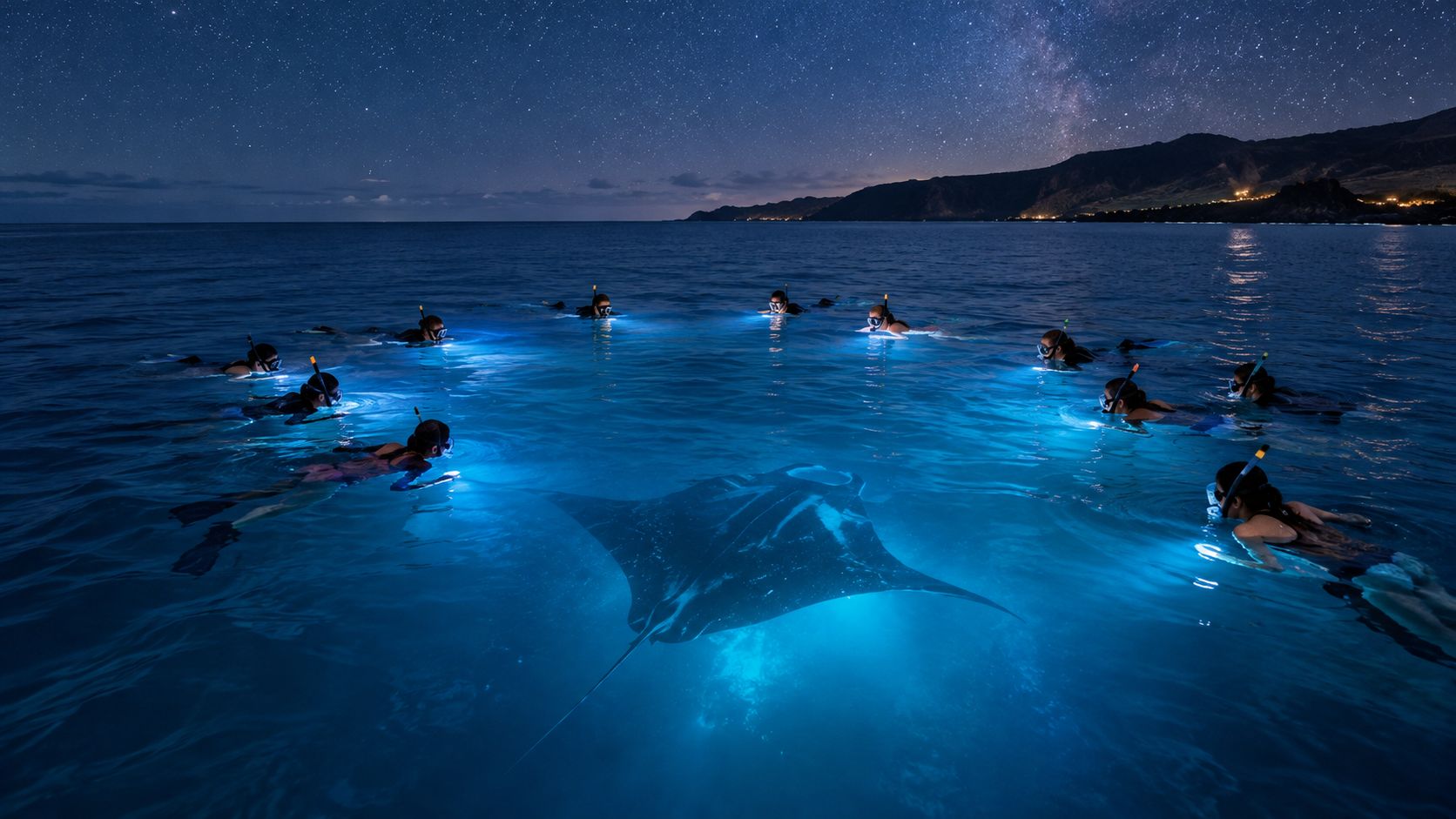
Table of Contents
Why the Kona Coast Is the World Capital for Manta Ray Encounters - What that means on the water
What Manta Rays Are and How They Behave at Night - Resident animals, not pass-through animals
How the Night Viewing Format Actually Works - What the rules are doing
Snorkel from the Surface or Dive from the Bottom - Side-by-side view
What to Expect on a Real Manta Ray Night Snorkel - The rhythm of the evening
Who Can Realistically Go and Who Should Plan Carefully - A simple readiness check
Ethical Viewing and What the Rules Are Actually Protecting - What good behavior looks like in practice
Choosing a Tour Operator and a Sample Big Island Itinerary - Night Snorkel vs Manta Dive at a Glance
Why the Kona Coast Is the World Capital for Manta Ray Encounters
A night in Kona can feel like wildlife happening in real time and on a timetable at once. You're floating at the surface, a manta passes under the lights, and the sight still feels startling because the encounter is alive and unforced, yet it keeps happening at the same coastal sites.
The reason is simple: Kona's encounters are tied to resident animals and a managed viewing setup, not random luck. A six-year observation study at Manta Heaven and Manta Village recorded 25,444 sightings of 118 individually identified reef manta rays between January 1, 2009, and December 31, 2014, which points to repeated use of the same feeding areas rather than passing traffic (NOAA repository study). Manta Heaven accounted for 19,841 observations involving 111 individuals, while Manta Village recorded 5,603 observations involving 71 individuals.
What that means on the water
Practical rule: the scene feels spontaneous to guests, but the ecology behind it is stable and local.
Researchers also identified 66 males and 52 females, a 1.27:1 male-to-female ratio that did not differ significantly from an even split. At Manta Heaven, males were recorded 11,026 times and females 8,815 times. At Manta Village, the pattern flipped, with 872 male observations and 4,731 female observations.
That mix matters because it shows a resident population using known shore sites in different ways, depending on the location and conditions. For visitors, that means the trip is partly a comfort decision too. You are choosing how close you want to be to a bright, busy feeding scene after dark, with a local operator setting the pace and keeping the experience organized. For a clearer look at how the trip is presented to guests, the overview at Manta Ray Night Snorkel Hawaii is a useful starting point before you book.
What Manta Rays Are and How They Behave at Night
A Kona manta ray encounter makes more sense once you see it as three things at once, a resident animal population, a controlled viewing setup, and a personal choice about comfort in the dark. A reef manta is a filter feeder that glides through plankton-rich water on broad wings, then turns in slow circles when the food is concentrated.
That feeding pattern is the key. NOAA's genetic study summary reported only 318 unique reef manta rays around Hawaiʻi Island, compared with about 600 unique individuals in Maui Nui since 2005 (NOAA summary). The same summary also reported roughly 104 adult breeders in the Hawaiʻi Island population and 129 in Maui Nui. Those numbers are a reminder that these are small, island-linked groups, not a loose crowd passing through.
Resident animals, not pass-through animals
Historical photo-identification work along the Kona Coast estimated an average of only 4.27 new pups entering the population each year from 1992 to 2007. That helps explain why local guides talk about individual mantas the way a harbor town talks about familiar boats. You are often seeing the same animal return to the same feeding grounds.
Good mental model: when the water is full of plankton, the mantas tend to work the area slowly and repeatedly.
The same NOAA summary estimated effective population size at 104 for Hawaiʻi Island, with a 95% confidence interval of 99 to 110, and 129 for Maui Nui, with a 95% confidence interval of 122 to 136. In plain terms, the island groups are genetically small and relatively isolated, so the local population's health matters. For a quick refresher on body shape, behavior, and common visitor questions, the manta ray FAQ is a useful reference.
How the Night Viewing Format Actually Works
The setup makes sense once you watch it from the boat. Strong underwater lights draw plankton into a concentrated patch of water, and the mantas follow that food source. That is why the experience is wildlife viewing, not casual feeding.
The layout is straightforward. Scuba divers rest on the seafloor around the lights, while snorkelers stay at the surface and look down. The lights gather plankton into the illuminated column, and the mantas make repeated passes through it, often circling as they feed (DLNR boating and safety assessment).
What the rules are doing
Hawaiʻi's state boating rules set manta-viewing hours at 4:00 p.m. to 4:00 a.m. and require the activity to operate from a commercial mooring during that window (Hawaiʻi state boating rules). Within those hours, live boating is limited to entering and leaving the site, rafting is prohibited, and a vessel may not leave the viewing zone while participants or crew are still in the water.
That structure keeps the scene orderly in low light. It also explains why Kona manta nights feel managed rather than improvised. Guests are not drifting around a reef on their own. They are entering a controlled viewing zone where the operator, the lights, and the animals each have a defined role.
The reason the mantas return to the same places is food. A 13-year analysis of community-sourced observations from 2010 to 2022 found that aggregation size at two Kona sites increased with zooplankton density, and it showed that nearby locations can function as distinct aggregation habitats rather than interchangeable spots (Springer study). That is why tour timing and site choice matter.
Snorkel from the Surface or Dive from the Bottom
Choosing between the night snorkel and the manta dive comes down to comfort, experience, and how you handle open water after dark. Both can be memorable, but they ask different things of your body and your nerves.
The night snorkel keeps you at the surface with flotation support, usually in a guided group. It suits many first-timers, families, and less experienced swimmers. The manta dive places certified divers on the bottom near the light source, where the mantas often pass overhead at diver's-eye level. Kona Honu Divers offers a 2-tank manta dive and snorkel option for travelers who want the dive version.
Side-by-side view
Aspect | Night Snorkel | Manta Dive |
|---|---|---|
Entry point | Surface | Seafloor |
Best fit | First-timers, families, non-divers | Certified divers |
Gear feel | Mask, snorkel, flotation support | Full scuba setup |
Experience | Looking down as mantas rise below | Looking up as mantas sweep overhead |
Main comfort question | Can you stay calm in open water at night? | Are you comfortable diving after dark? |
Many guests are surprised by how close the mantas can feel from the snorkel side. At the surface, a ray passing underneath can seem larger than expected because you see the full span against dark water and light. From the dive side, the encounter feels quieter and more vertical, with the animals moving through the beam above you.
The label matters less than the fit. Age, swimming ability, comfort with ladders, and whether you prefer to float or descend should guide the choice. If you still want to compare trip styles, some operators pair the manta night with a sunset departure or a daytime Captain Cook snorkel tour, which can work well for travelers trying to fit more into one trip.
What to Expect on a Real Manta Ray Night Snorkel
The boat leaves shore while the sky is still changing color, and the mood is usually a mix of excitement and nerves. Gear gets fitted, the crew gives the briefing, and by the time you reach the site, the ocean feels darker and quieter than it did at the dock.
Then the practical part starts. You enter carefully, settle at the surface, and hold position near the lighted area while the crew watches conditions and keeps everyone oriented. Some trips feel calm right away, others feel bumpy or cool, and visibility can shift with the water, so it helps to expect a real ocean experience instead of a perfect aquarium scene.
The rhythm of the evening
Guests often notice marine life on the way out, then spend a stretch waiting at the surface before the mantas arrive. When they do appear, they usually come in low and slow, feeding through the lighted water in repeated passes that can make even a measured wingspan feel bigger than life.
Keep this in mind: the waiting feels longer than the mantas do once they show up.
The return ride usually feels different from the outbound trip because the group has something specific to talk about. People who were nervous earlier are often replaying one pass, one turn, or one close approach. If you want a behind-the-scenes look at how tours are described for guests, the blog section here is worth a look before you commit.
Who Can Realistically Go and Who Should Plan Carefully
A manta night on the Kona Coast asks for more than enthusiasm. You need to be comfortable in dark open water, able to follow directions while wearing snorkel gear, and honest about whether a boat ride and a nighttime entry feel manageable for you.
NOAA guidance recommends an in-water snorkel guide and a snorkel ring or similar device for groups of four or more, while also emphasizing that snorkelers should stay at the surface and out of the mantas' feeding zone (NOAA guidance). It also points readers toward emergency planning, medical-response readiness, and trained personnel, which matters most for non-swimmers and first-time snorkelers who may be better served by a different activity.
A simple readiness check
Swimming comfort: Can you float, breathe steadily through a snorkel, and keep your bearings when the water is dark?
Boat access: Can you use a ladder, hold yourself steady in moving water, and manage wet gear without getting overwhelmed?
Motion and cold: Do motion sickness or chill usually shorten your time on the water?
Vision and hearing: Will you still catch instructions if your mask fogs a bit or the ocean noise picks up?
Support needs: Do you need a flotation aid, a supervised raft, or close guide attention to feel settled?
The main risks come from the setting, not the mantas. Night, fatigue, separation from your group, and the ordinary demands of being on a boat all shape how the outing feels.
That is why honest self-screening matters more than excitement. A guest who needs extra reassurance is not a problem guest, but the best match is a tour that can clearly explain its age limits, swimming requirements, and support setup before anyone books.
Ethical Viewing and What the Rules Are Actually Protecting
The cleanest way to understand manta etiquette is simple. You are a guest in the feeding zone, not part of the feeding behavior. The standard rules, no touching, no chasing, no blocking, no diving under, protect the manta and keep the encounter orderly for everyone in the water.
Manta rays have a protective mucus layer on their skin, and contact can damage it (manta-viewing behavior guidance). That is why “they're gentle” only explains part of the story. Gentle does not mean fragile in a way that human hands can ignore.
What good behavior looks like in practice
Stay still. Keep your hands to yourself. Hold position at the surface and let the manta choose its own path. When people stop crowding the animal, it can keep feeding without constant detours.
Respect the line of movement, and the manta usually keeps working the water.
For a manta ray snorkel, guided trips such as the one at Kona Snorkel Trips coach guests through those movements before entry. If you prefer scuba, the dive version gives a different vantage point, but the same low-impact behavior still applies.
Choosing a Tour Operator and a Sample Big Island Itinerary
A good Kona manta trip starts with a simple question, what kind of evening do you want? Some operators focus on manta-only outings, others pair the swim or dive with a sunset departure, and some build the day around a second Kona stop before dark.
For general Big Island scuba diving, Kona Honu Divers is the natural comparison if you are deciding whether a dive belongs in your trip. If you want a dedicated manta-only outing, Kona Snorkel Trips runs dedicated manta-only outings, which suits travelers who want the night swim without adding a dive. Their Captain Cook and Kealakekua Bay snorkel tour also fits well if you want a two-stop Kona day before the manta trip.
Night Snorkel vs Manta Dive at a Glance
Aspect | Night Snorkel | Manta Dive |
|---|---|---|
Best for | Families, first-timers, non-divers | Certified divers |
Water position | Surface | Bottom |
Gear load | Lighter | Heavier |
Comfort requirement | Open-water calm | Dive confidence |
Main payoff | Easy access to the encounter | Close, quiet perspective |
The choice is not just about comfort. It is also about how you want to experience the animal, from the surface with a snorkel board overhead, or from below with a calmer, lower-profile view. Both formats can work well, but they ask different things of the guest.
Plan around weather and your own energy rather than chasing a magic date. The 13-year Kona analysis mentioned earlier linked aggregation size to zooplankton density, not calendar month. That means the encounter is shaped by the food in the water and the nightly conditions, not by a perfect spot on the calendar.
A simple two-day Kona plan usually works best. Spend day one at Captain Cook or Kealakekua Bay, keep the afternoon open, then book the manta night for day two. If you want to compare manta-specific trip styles, the manta ray night snorkel Kona category gives a clean way to compare options without sorting through unrelated tours.
Manta Ray Night Snorkel Hawaii runs straightforward Kona manta trips with gear, a briefing, and in-water support built around the encounter. If you want to keep the trip practical and still make room for the magic of a resident manta population, visit Manta Ray Night Snorkel Hawaii and choose the night that fits your comfort level.
Comments