Manta ray swimming underwater: Kona Night Snorkel Guide to Safe Encounters
- Byron
- Feb 8
- 14 min read
Picture this: you're floating on the calm, dark surface of the Pacific, and just below, giant shadows with wingspans up to 16 feet glide by like something out of a dream. This isn't a movie scene; it's the heart of the manta ray swimming experience in Kona, a mesmerizing underwater ballet that happens every single night.
Your First Glimpse of the Underwater Ballet
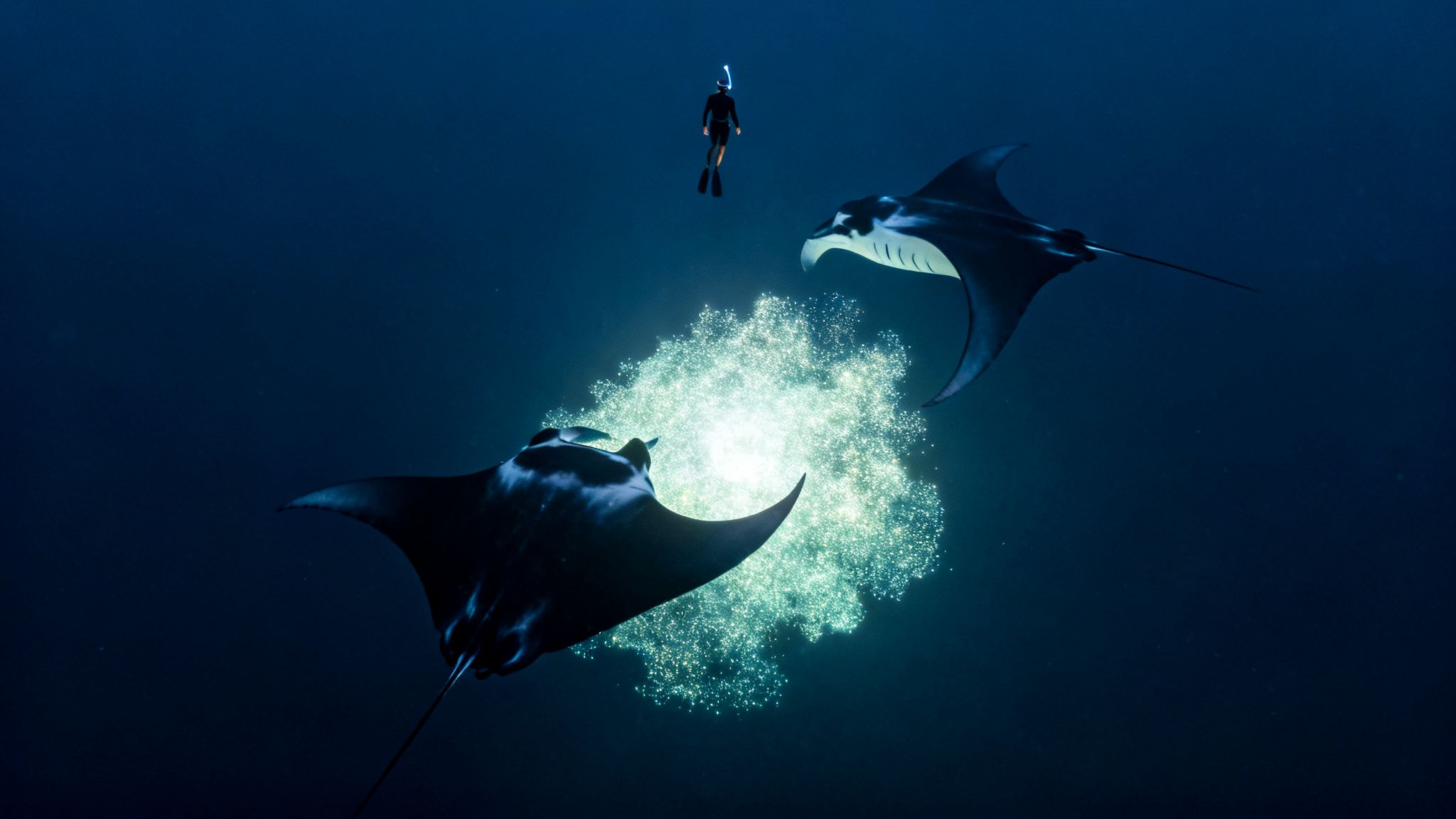
The moment you slip into the warm Hawaiian water, everything changes. You’ll be holding onto a specially designed light board that shines down into the deep, attracting tons of microscopic plankton. Think of it as a floating dinner bell for Kona's gentle giants.
And then it happens. The first manta ray emerges from the darkness below. Its movements are impossibly fluid and graceful—it's less like swimming and more like flying. They just soar through the water, their huge pectoral fins acting like wings, propelling them in a silent, powerful dance. That first sighting is something you never forget; it’s when the sheer size and elegance of these animals becomes incredibly real.
The Graceful Feeding Frenzy
But the real show starts when more mantas join the party. They perform these incredible barrel rolls and loops just inches beneath you, their giant mouths wide open to filter the plankton from the water. It might look chaotic, but it's not aggressive at all. It’s just a super-efficient way for them to eat.
Seeing this natural spectacle up close is a powerful experience. It’s a peaceful yet absolutely thrilling encounter that connects you to the ocean in a way that’s hard to describe.
If you're ready to see this for yourself, the Manta Ray night snorkel is an adventure you won't want to miss. For another fantastic option, Kona Snorkel Trips runs world-class Manta Ray night snorkel tours and Captain Cook snorkeling tours that offer the same magical experience.
The Kona coast is one of the most reliable places on Earth for this experience. In fact, tour operators report an incredible 90% sighting success rate year-round. This consistency turns a bucket-list dream into an achievable reality.
This nightly performance is a beautiful, carefully managed interaction between nature and responsible tourism. The lights simply concentrate the mantas' natural food source, drawing them to a spot where we can float on the surface and watch, completely in awe. The result is a safe, non-invasive, and utterly unforgettable glimpse into the lives of these magnificent creatures.
Why Kona Is a Global Hub for Manta Rays
So, what is it about the Kona coast that makes it the world's best place to see manta rays? It’s not just a happy accident. A perfect mix of local geography and ocean currents creates nutrient-rich waters right off the shore, turning the area into a manta ray paradise.
These conditions support a massive population of zooplankton, the tiny creatures manta rays love to eat. While you can find these gentle giants all over the world, very few places serve up such a reliable, all-you-can-eat buffet this close to land. This natural abundance set the stage for Kona to become the go-to spot for watching manta ray swimming underwater.
The Famous Campfire Effect
The real magic behind Kona's nightly show is something we call the "campfire effect." It all started decades ago when a hotel aimed its lights into the ocean. To everyone's surprise, the light attracted swarms of plankton, and right behind them came the manta rays.
Today, tour operators have refined this discovery. We use powerful, eco-friendly lights placed just under the water's surface to create a concentrated food source in the same place every night. Think of it like a campfire. Just as people are drawn to its light and warmth, the mantas are drawn to this bright glow, knowing it means dinner is served.
This has led to a local population of over 200 individually identified manta rays who have learned to connect our lights with an easy meal, making the experience here incredibly reliable.
It's this learned behavior, combined with the naturally abundant food, that gives us the amazing 90% sighting success rate Kona is famous for. We're not feeding them—we're simply lighting up their natural food source and letting them come to the party.
Kona Compared to Other Global Hotspots
Kona is famous for its reef mantas, but other spots are known for giant oceanic mantas. For example, the largest known population of oceanic mantas lives off the coast of Ecuador. Researchers there have identified over 2,800 unique individuals and estimate the total population could be more than 22,000 rays! Much like Kona, that area benefits from nutrient upwelling that creates dense plankton blooms, which you can read more about on Discover Wildlife.
But what truly makes Kona stand out is the accessibility and consistency of the experience. Many other amazing wildlife encounters require remote travel and perfect seasonal timing. Here in Kona, the show happens almost every single night, all year long, just a quick boat ride from the coast.
To give you a clearer picture, here’s how Kona stacks up against other world-class manta viewing destinations.
Feature | Kona, Hawaii | Isla de la Plata, Ecuador | Maldives |
|---|---|---|---|
Primary Manta Species | Reef Manta Rays | Giant Oceanic Manta Rays | Reef Manta Rays |
Sighting Consistency | Year-round, near-daily | Seasonal (Aug-Sep) | Seasonal (May-Nov) |
Accessibility | Short boat ride from shore | Requires longer boat trips | Varies; often liveaboards |
Viewing Method | Night snorkeling & diving | Primarily daytime diving | Daytime diving & snorkeling |
Proximity to Mantas | Extremely close, surface viewing | Deeper water encounters | Varies by atoll & conditions |
This incredible reliability is what makes the Kona Manta Ray Night Snorkel so special. It transforms a bucket-list wildlife dream into something anyone visiting Hawaii can experience. That predictable magic is why Kona holds its title as the best place on Earth to witness these majestic animals up close.
How Manta Rays Fly Through the Water
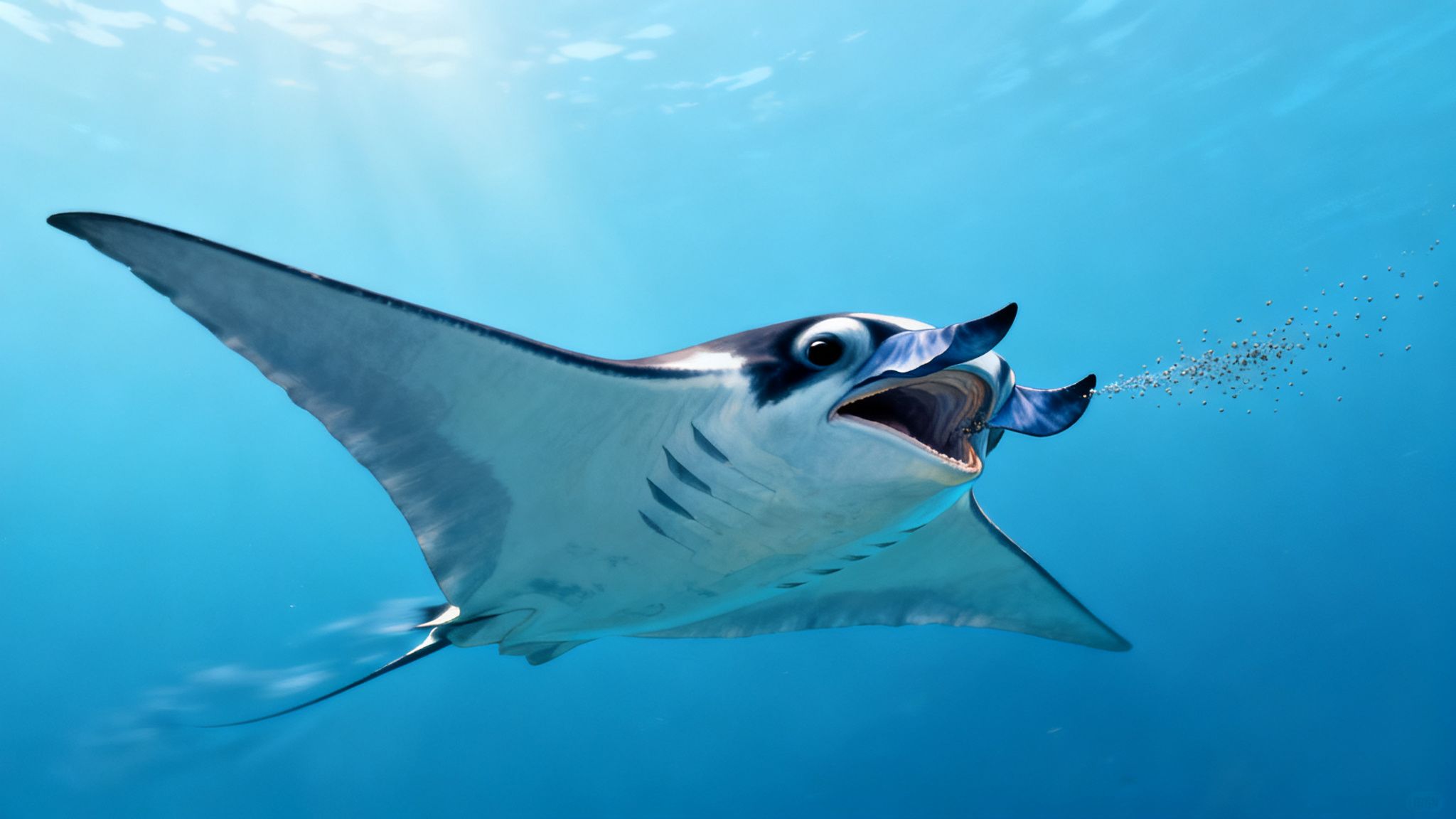
To see a manta ray move through the water is to witness something truly special. It’s not like watching a fish swim—it’s more like watching a giant bird soar through the sky. Their movements are so incredibly smooth and powerful, they seem to fly, not float.
This effortless grace comes down to their unique body design. Unlike most fish that propel themselves with a side-to-side tail flick, mantas use their huge pectoral fins. They flap them up and down, almost exactly like a bird’s wings, which creates both lift and forward thrust. This method is so efficient it allows them to glide for long stretches and cover huge distances with very little effort.
The Art of Filter Feeding
While their "flight" is what first captures your attention, their feeding technique is a show of pure acrobatic skill. Manta rays are filter feeders, which means they live on a diet of tiny organisms—think zooplankton, krill, and microscopic shrimp.
To catch their microscopic meals, they swim with their enormous mouths wide open, gulping down massive amounts of water and filtering out the food. But they have a secret weapon to make this even more effective: their cephalic lobes. These are the two paddle-like fins on either side of their mouth. When it's feeding time, they unfurl these lobes to channel plankton-rich water straight into their mouths. It’s like having a built-in food funnel.
It’s amazing to think that a single manta ray eats about 12% of its body weight in plankton every single week. This simple diet is what fuels their immense size and energetic, ballet-like movements.
During the Kona night snorkel, you get a front-row seat to this incredible feeding frenzy. The bright underwater lights attract a thick "soup" of plankton, and the mantas dive right in, performing mesmerizing barrel rolls and graceful somersaults. This isn't just for fun; these twists and turns keep them in the thickest part of the plankton cloud, making every pass as productive as possible.
A Masterclass in Hydrodynamics
A manta ray’s body is a perfect example of hydrodynamic engineering. Their flat, diamond-shaped bodies and smooth skin cut through the water with minimal resistance, helping them glide so effortlessly. Everything about them, from their powerful fin muscles to their lightweight cartilage skeleton, is built for efficient movement.
This design is so brilliant that it has even caught the eye of engineers. Scientists are now building soft robots that mimic the manta’s flapping motion. These bio-inspired drones can explore delicate marine environments far more gently than a clunky, propeller-driven vehicle ever could.
Once you understand the mechanics behind how they move and eat, watching them becomes an entirely different experience. You’re no longer just looking at a big fish; you’re witnessing a perfectly evolved creature carrying out a complex and beautiful dance for survival. Each glide and roll is the result of millions of years of adaptation. You can dive even deeper into their world by checking out these fun facts about manta rays.
This deeper appreciation is what makes the manta ray night snorkel an experience you’ll never forget. It’s a chance to connect with one of nature’s most magnificent designs in its element.
What to Expect on Your Night Snorkel Adventure
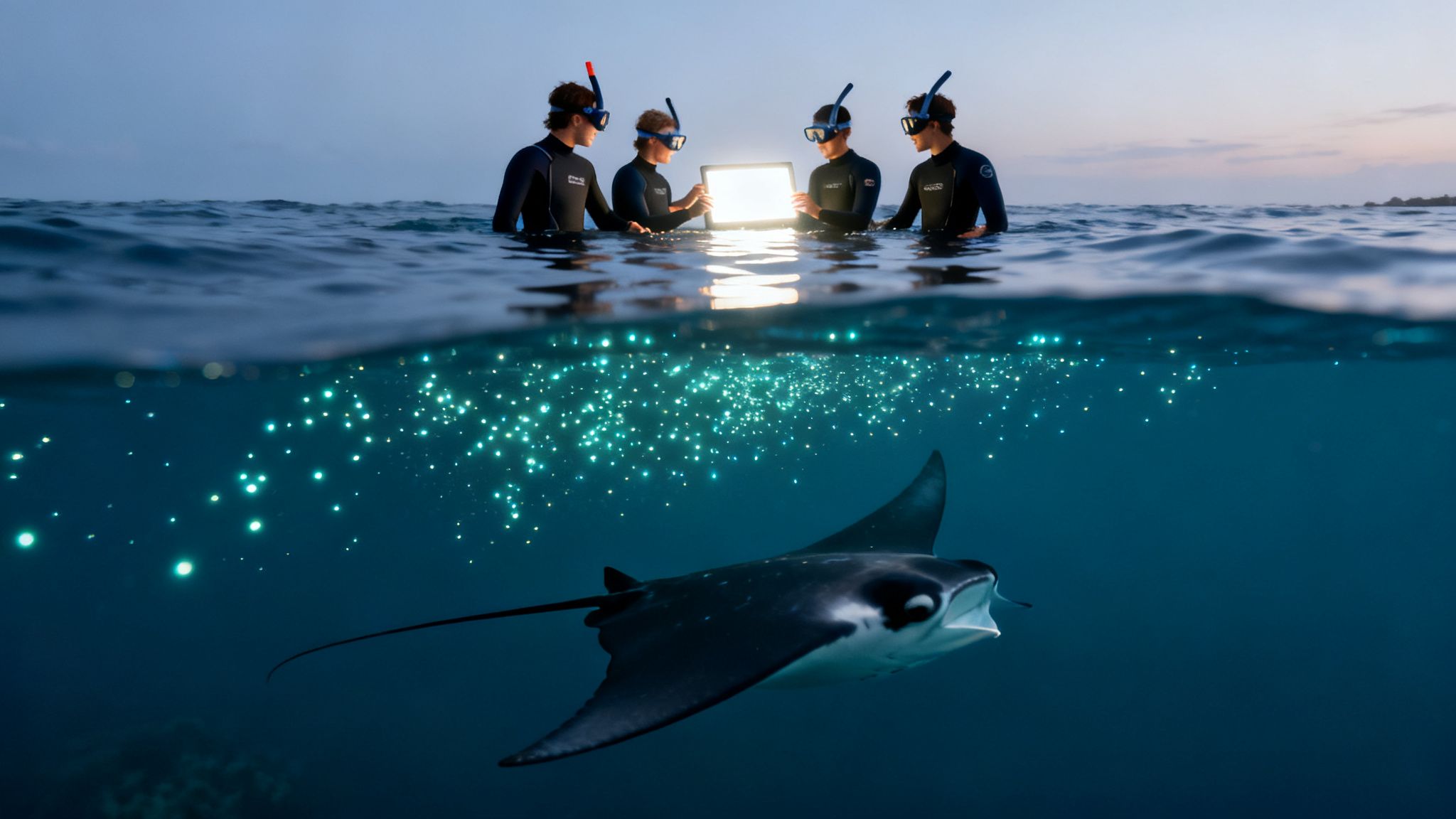
The excitement starts the moment you arrive. You’ll meet the crew, get settled in, and run through a full safety briefing. This is where you get kitted out with all your gear—a snug wetsuit to keep you warm and top-notch snorkel equipment for a perfectly clear view of the world below.
Once you’re ready, it’s a short, beautiful boat ride out to the manta viewing spot. As the sun sinks, the sky lights up with color, creating an incredible backdrop for the evening. This is the perfect time to relax, ask the crew any lingering questions, and just enjoy the view of the Kona coast from the ocean.
Entering the Underwater Theater
When it’s time, you'll slip into the calm, dark ocean. It’s an incredibly peaceful moment. You won't be swimming around on your own; instead, you’ll hold onto a specially made light board. This floating raft is your stable platform for the whole show, keeping you comfortably at the surface while lighting up the water beneath you.
Those powerful lights are the key. They act like a dinner bell for plankton, drawing in a shimmering cloud of microscopic critters. In just a few minutes, you’ll see the water glowing with this plankton buffet. That’s the signal that the main event is about to begin. The guests of honor won't be far behind to see the incredible spectacle of manta ray swimming underwater.
Your guides are not just there to lead the tour; they are lifeguard-certified experts who are in the water with you the entire time. They make sure everyone is safe, comfortable, and has the best possible view of the action.
The first manta often appears like a giant shadow rising from the deep, its huge wings catching the light as it glides upward. Then another comes, and another, and the underwater ballet truly begins. They perform these effortless barrel rolls right below you, their giant mouths open to filter the plankton from the water. It’s a completely mesmerizing and silent show, happening just inches away.
An Intimate and Personal Encounter
We deliberately keep our groups small. This ensures the experience feels personal and uncrowded, giving everyone a front-row seat. It’s a much more respectful way to watch the mantas, minimizing our impact on their natural feeding behavior and allowing for a far more meaningful connection.
There’s really nothing that can prepare you for the feeling of a 16-foot gentle giant gliding silently right under you. For a moment, its massive body blocks the light before it loops around for another pass. You're simply a floating observer, watching an ancient, magnificent feeding ritual in their world.
To learn more about this unforgettable tour, check out the official Manta Ray Night Snorkel Hawaii homepage. And if you're looking for other amazing ocean adventures, our friends at Kona Snorkel Trips offer another fantastic Manta Ray night snorkel tour and Captain Cook snorkeling tours that are a perfect addition to any Big Island trip.
How to Be a Responsible Manta Ray Viewer
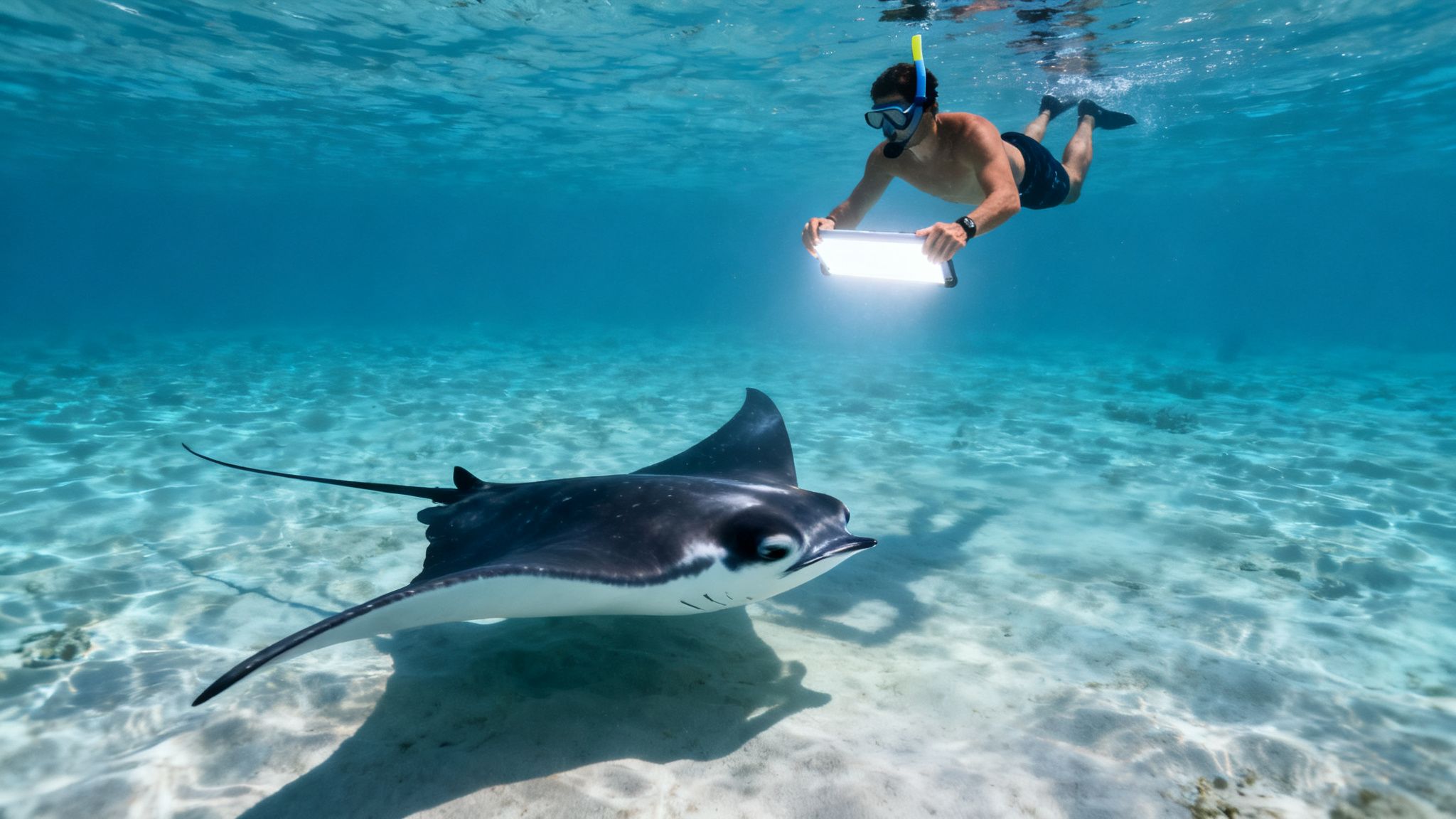
Getting to witness the manta ray's underwater ballet is an incredible privilege, but it comes with a big responsibility. These are wild animals, and it’s up to us to make sure we don't disturb their world. By following a few simple ground rules, you can help protect these gentle giants and ensure this magical experience is around for future generations to enjoy.
The most important thing to remember is to be a passive observer. Think of yourself as a floating log. Just hold onto the light board, stay horizontal on the surface, and try not to splash or kick. Sudden movements can spook the mantas and interrupt their feeding. The calmer you are, the more comfortable they'll feel and the closer they'll glide by.
The Golden Rules of Manta Viewing
Your guides will walk you through everything, but the number one rule is the simplest and most crucial: never touch a manta ray. This isn’t just a friendly suggestion—it’s absolutely vital for their health. Manta rays have a special mucus coating on their skin that protects them from nasty bacteria and parasites. If you touch them, you can wipe off that protective slime, leaving them vulnerable to all sorts of infections.
Remember, you are a guest in their home. The goal is to watch their natural behavior without interfering. A truly successful encounter is one where the mantas carry on their feeding ballet completely undisturbed by our presence.
To make sure your snorkel is both safe and respectful, just stick to this simple checklist:
Stay Passive: Float quietly and hold onto the light raft. Let the ocean do the work.
No Touching: This is a big one. Keep your hands to yourself and let the mantas decide how close they want to get.
Avoid Diving Down: Stay at the surface. Diving down can feel threatening to the mantas.
Listen to Your Guide: These folks are the experts. They’re in the water to keep you and the mantas safe, so follow their lead.
Following these rules means you get to witness the incredible spectacle of manta ray swimming underwater while also being a true friend to the ocean.
Photography and Conservation
Bringing a camera is a fantastic way to capture the memory, but it needs to be done right. If you have an underwater camera, make sure the flash is turned off. A sudden bright flash can disorient or startle the mantas. Use the tour lights for illumination and just be aware of where your camera is so you don't accidentally bump into a ray.
Being a responsible viewer has never been more important. Globally, these animals are in trouble. It's estimated that 264,520 manta and devil rays are caught each year, and a staggering 87% of those come from small-scale fishing operations. These pressures are why mantas have been listed as Endangered since 2019. Read more about global manta populations and conservation efforts.
This context makes Hawaii’s protected manta population and our ethical viewing practices incredibly precious. You can also dive deeper into their gentle nature by reading our guide that answers the common question, "Can manta rays sting you?". When you join a responsible tour, you're doing more than just snorkeling; you're directly supporting the conservation of these magnificent creatures.
Explore More with a Captain Cook Snorkeling Tour
The magic of the Kona coast doesn't stop when the sun goes down. After an incredible night swimming alongside manta rays, a totally different—but just as amazing—adventure is waiting for you in the daytime at Kealakekua Bay. This protected, historic marine sanctuary is home to one of Hawaii's most spectacular coral reefs, making it the perfect follow-up to your nighttime snorkel.
A Captain Cook snorkeling tour will drop you right into a world of crystal-clear turquoise water that's absolutely teeming with life. As you float above the reef, you'll be surrounded by huge schools of tropical fish, from brilliant yellow tangs to the famous humuhumunukunukuāpuaʻa, Hawaii's state fish. The water is often so clear you can see all the way to the sandy bottom, revealing the intricate coral gardens below.
A Journey into History and Nature
Kealakekua Bay isn’t just a natural marvel; it's a place steeped in history. This is the exact spot where Captain James Cook first landed on the Big Island in 1779 and, later, where he was killed. A stark white obelisk, the Captain Cook Monument, stands on the shoreline as a tribute and is only reachable by water. Snorkeling in the shadow of this monument gives your adventure a real sense of connection to Hawaii's rich and complex past.
The bay is also a Marine Life Conservation District, meaning its fragile ecosystem is protected from fishing and other pressures. Thanks to these protections, the coral has been able to flourish, allowing marine life to thrive. It’s a genuine underwater paradise. You can get a deeper dive into what makes this place so incredible in our guide to the Captain Cook snorkel tour and Kealakekua Bay.
Why Kealakekua Bay Is a Must-See
While the manta ray night snorkel is a focused, dramatic encounter with gentle giants, a trip to Kealakekua Bay gives you a broad, vibrant look at Hawaii’s entire reef ecosystem.
Unmatched Water Clarity: The bay's protected waters offer some of the best visibility on the island, often exceeding 100 feet.
Abundant Marine Life: It’s common to see spinner dolphins, sea turtles, and endless species of reef fish just going about their day.
Thriving Coral Gardens: You get to witness the brilliant colors and complex shapes of a healthy, protected coral reef system up close.
It's fascinating to see how different marine life behaves day and night. While Kona is famous for its manta gatherings after dark, it’s worth remembering that Hawaii is home to about 10-15 key sites where reef mantas reliably show up. This consistency is what allows for such amazing tours, where groups can see anywhere from 20-50 individuals in one night, leading to that famous 90% sighting success rate. These graceful giants swim at a steady 2-3 knots, flapping their fins about once or twice per second as they filter-feed.
To get the full Big Island ocean experience, adding a Captain Cook tour to your plans is a fantastic idea. You'll get the thrill of the night and the stunning beauty of the day, making your trip one you'll never forget.
Your Manta Ray Questions Answered
Thinking about a night snorkel with manta rays? It's a pretty mind-blowing idea, and it's totally normal to have some questions before diving in. We’ve heard them all, so we’ve put together answers to the most common ones to help you feel confident and excited about this adventure.
Our main goal is to make sure you're comfortable, safe, and ready for an evening with Kona's famous gentle giants.
Is It Safe to Swim with Manta Rays at Night?
Absolutely. It’s incredibly safe, and that’s one of the best parts. Manta rays are gentle giants through and through. They don’t have teeth, stingers, or barbs on their tails—nothing to worry about. Their only real defense is their massive size and speed, which they use to escape natural predators, not people.
We've designed our tours with safety as the top priority. You'll be with a small group, and our lifeguard-certified guides are in the water with you the entire time. You'll hang onto a custom-made light board that floats on the surface, which gives you something stable to hold and keeps everyone together. This setup lets the mantas glide and swoop right below you in a completely controlled and supervised space.
What Is the Best Time of Year to See Manta Rays in Kona?
Here's the fantastic part: any time is the best time! Unlike a lot of other marine animal sightings that depend on the season, Kona’s manta ray population sticks around all year. They don't migrate, which means we get to see them consistently, no matter when you visit.
We have an incredible 90% sighting success rate, so your chances of having an unforgettable encounter are sky-high whether you come in January or July. That year-round reliability is what makes Kona one of the top spots in the world for this experience.
What Should I Bring on the Tour?
We’ve got you covered with all the essential gear—high-quality wetsuits, masks, snorkels, and fins. To make sure you’re as comfortable as possible, just bring a few personal items:
A swimsuit to wear under your clothes.
A towel to dry off with after your swim.
A warm jacket or sweatshirt for the boat ride back, as it can get a little cool on the water after sunset.
If you sometimes get seasick, it’s a good idea to take something for it beforehand. Other than that, just bring your sense of wonder!
Can I Touch the Manta Rays?
This is a strict "no," and it's the most important rule we have. Touching a manta ray is harmful to them, plain and simple. Their skin is covered in a special mucus layer that works like an immune system, protecting them from bad bacteria and infections.
When a person touches them, it can rub off that vital protective slime, leaving them vulnerable to disease. Trust me, having a 16-foot animal glide inches away from you is a powerful enough experience on its own—no touching needed. We're there to be respectful, passive observers in their world so they can continue to thrive.
For another incredible ocean adventure, Kona Snorkel Trips offers an exceptional alternative when you're looking for a Manta Ray night snorkel tour or a Captain Cook snorkeling tour.
Comments