Manta Rays Big Island: manta rays big island Night Snorkel Guide
Picture this: you’re floating in the warm, dark Pacific waters off the Kona Coast. Just inches below you, massive, graceful manta rays glide and somersault through the water, their white bellies flashing in the soft glow from below. It's a surreal, almost magical experience, and it's something you can do almost any night of the year right here.
This isn't just another snorkeling trip; it's an adventure you'll be talking about for the rest of your life.
Your Front-Row Seat to Kona's Manta Ray Ballet
When people talk about the Big Island, they often mention volcanoes and coffee, but the real show happens after the sun goes down. The Kona Coast is, without a doubt, the world’s most reliable and spectacular place to see manta rays up close. Forget other wildlife tours where you cross your fingers and hope for a sighting. Here, the experience is so consistent it feels like a scheduled performance.
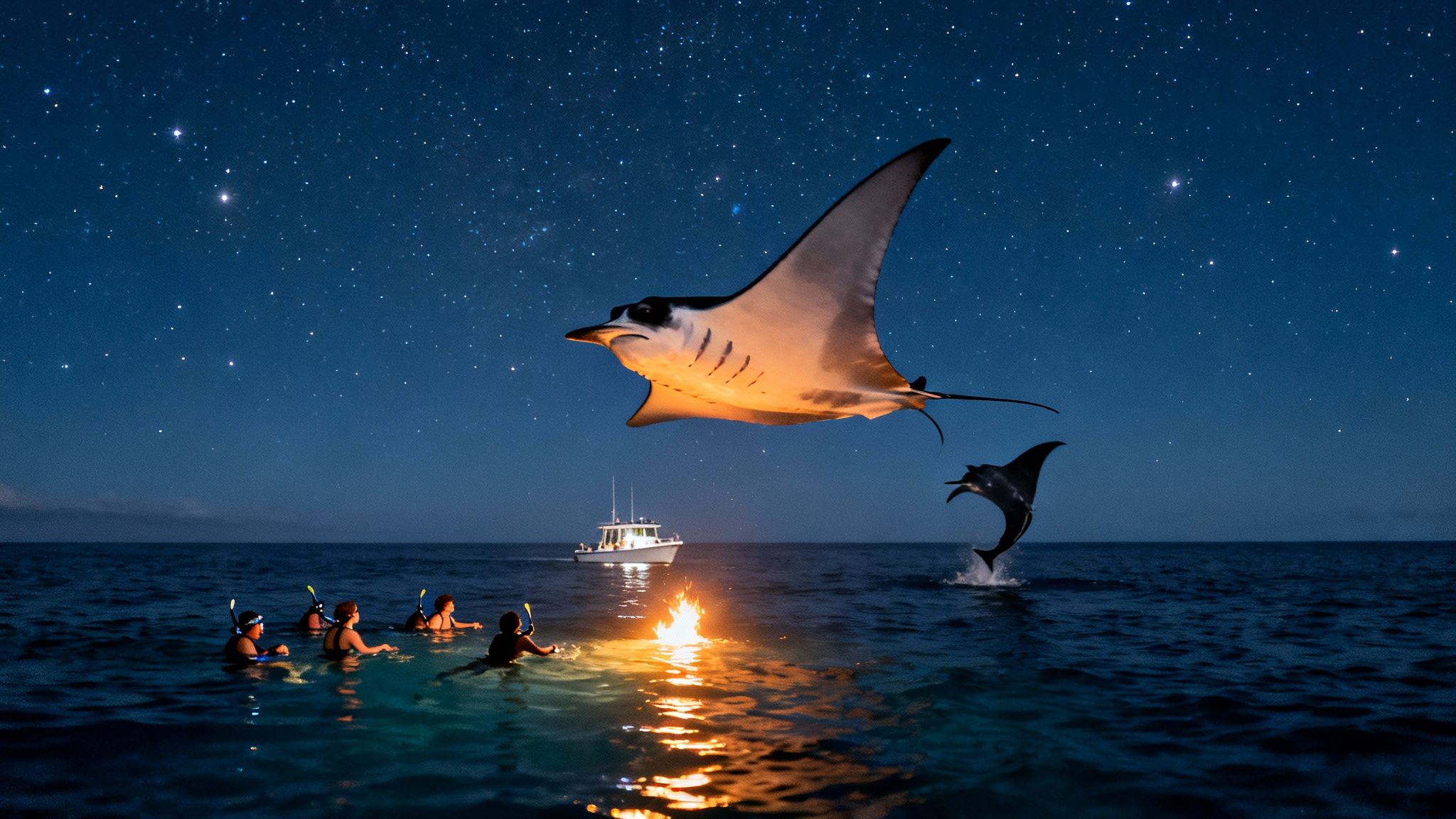
So, what's the secret? It’s brilliantly simple. Tour operators have learned how to create an underwater "campfire." They submerge powerful, eco-friendly lights into the water, which act like a magnet for tiny, free-floating plankton. This creates a massive, glowing buffet that the local manta population simply can't resist. They show up to feast, and we get a front-row seat to the ballet.
For a quick rundown of what to expect, take a look at this table.
Kona Manta Ray Night Snorkel At a Glance
Aspect | Details |
|---|---|
Success Rate | An incredible 80-90% chance of seeing manta rays on any given night. |
Best Time | Year-round, with calmest conditions typically from April to October. |
Annual Visitors | This unique experience attracts around 80,000 people each year. |
Local Population | Researchers have identified over 300 individual reef mantas since 1979. |
Core Concept | Lights attract plankton, and the plankton attracts the feeding manta rays. |
Safety | Reputable operators provide wetsuits, gear, and expert in-water guides. |
This at-a-glance summary shows just how established and reliable this adventure is. It's truly a world-class marine spectacle.
Why Kona Is a Manta Magnet
The numbers speak for themselves. With an 80-90% success rate, it's no wonder Kona has become the global hotspot for manta encounters. Marine biologists have been studying the local population here for decades, cataloging over 300 individual reef mantas by the unique spot patterns on their bellies. That means you might meet a well-known local like "Lefty" or "Big Bertha" on your tour!
This guide is designed to give you everything you need to plan this incredible adventure. We'll walk you through:
The best spots along the Kona coast to see the mantas.
What a night snorkel tour actually feels like, from start to finish.
How to pick a safe, ethical, and fun tour operator.
Tips to make your experience smooth and unforgettable.
Think of this as your first step toward an amazing underwater journey. When you’re ready to dive deeper into tour options, Manta Ray Night Snorkel Hawaii is a great place to see what the experience is all about. You can also check out our manta ray blog for more planning tips and fascinating facts.
Meeting Kona's Gentle Giants
Seeing the manta rays on the Big Island isn't just about watching fish swim by; it's a genuine encounter with an ancient and incredibly intelligent species. To really get the most out of it, you have to stop thinking of them as just giant fish and start seeing them as the individuals they are. It’s this shift that turns a cool tour into a truly profound experience.
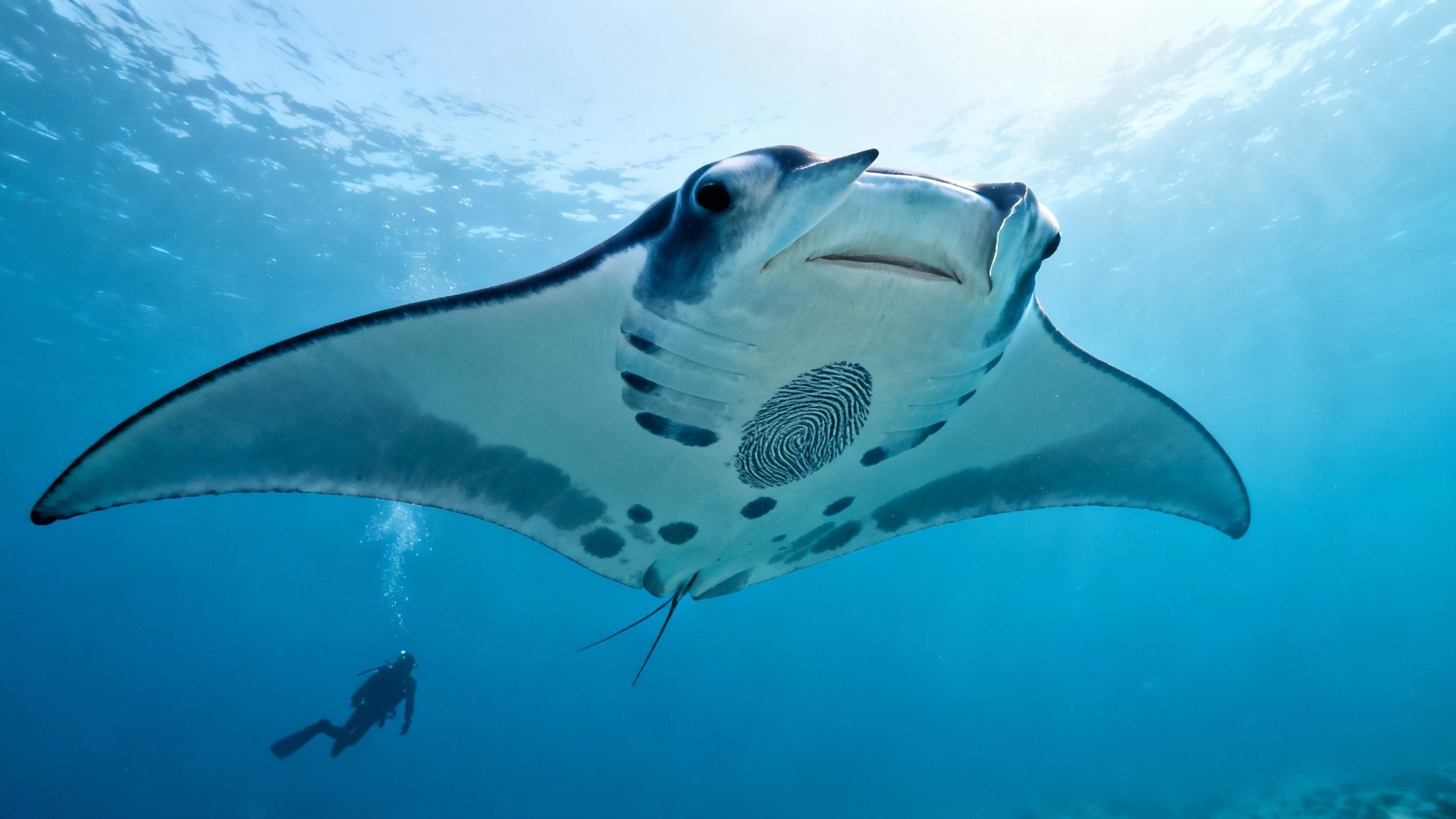
Every single manta ray you’ll see along the Kona coast has its own identity. The pattern of black spots on their white bellies is as unique as a human fingerprint. This is how researchers and the seasoned guides who see them every night can tell them apart, giving them names and tracking their lives over decades. You might even meet a local celebrity like "Lefty," a manta known for a damaged cephalic fin who has been a regular for years.
This individuality isn't just on the surface, either. These creatures have a surprising intelligence that really sets them apart in the ocean.
The Brains Behind the Ballet
One of the most incredible facts about manta rays is just how smart they are. They have the largest brain-to-body size ratio of any fish, with a brain roughly the size of a human fist. This isn't just for show—it allows for complex social behaviors, problem-solving, and even self-awareness. That’s a trait once thought to belong only to humans, apes, and dolphins.
You can see this intelligence in their calm and curious nature. It's not uncommon during a night snorkel for a manta to make eye contact or gracefully loop around to get a better look at you. They aren't aggressive at all; they’re just inquisitive, social animals checking out what’s going on in their world.
Understanding Their Vulnerability
For all their impressive size, the manta ray population is surprisingly fragile. A big reason for this is their incredibly slow reproductive cycle.
A female manta ray typically gives birth to just one pup every two to three years. This slow birth rate means their populations can take a very, very long time to bounce back from any threats, which makes conservation efforts absolutely critical.
This slow journey to maturity really highlights why every single manta is so precious. Unlike fish that can lay thousands of eggs, losing even one manta ray can have a real impact on the local Kona population.
Gentle Giants of Impressive Scale
The sheer scale of these animals will take your breath away. The resident reef mantas we see in Kona typically have wingspans of 10 to 12 feet. But their bigger cousins, the giant oceanic mantas, can reach an unbelievable 26 feet across. Just picture something wider than a minivan gliding silently through the water right below you.
Despite their size, they are completely harmless to people. They are filter feeders, meaning their diet is made up entirely of microscopic plankton. They have no teeth for biting and no stinger on their tail, making this one of the safest and most peaceful wildlife encounters you can possibly have.
These amazing animals can live for at least 45 years, and knowing how slowly they reproduce makes every sighting feel that much more special. Understanding these details adds a whole new layer of respect and wonder to the experience. You can dive deeper with 10 things you may not know about manta rays in Hawaiʻi on Outrigger News. Knowing their story transforms your snorkel from just watching them to truly appreciating one of the ocean's most magnificent residents.
What to Expect: Your Manta Ray Night Snorkel, Step by Step
So, you’re ready to meet the majestic manta rays the Big Island is famous for. But what’s it really like? Let's walk through the entire adventure, from the moment you arrive at the harbor to the second you step back on shore, so you know exactly what’s in store.
Your evening kicks off as the Hawaiian sun begins to dip toward the horizon, painting the Pacific in shades of gold and orange. You’ll meet your tour group at the harbor, where the air is buzzing with excitement. Here, your lifeguard-certified guides will get you checked in and hand out all the gear you’ll need for the night.
As the boat motors away from the Kona coast, the ride itself becomes part of the magic. You'll feel the warm sea breeze and watch the volcanic shoreline become a silhouette against one of Hawaii's spectacular sunsets. It’s the perfect time to just relax and soak it all in before the main event.
The Briefing and Gearing Up
Before anyone gets in the water, your guides will run through a crucial safety and educational briefing. This isn't just a formality—it's designed to make you feel completely comfortable and confident. They’ll explain how manta rays behave, go over the rules for a safe and respectful swim, and show you how to use your snorkel gear.
You'll be fitted with a high-quality wetsuit that keeps you warm and adds a bit of buoyancy, helping you float with ease. They'll also provide a properly fitted mask and snorkel. Getting this sorted out on the boat means that once you're in the water, your only job is to watch the incredible show below.
Getting in the Water and Finding Your Spot
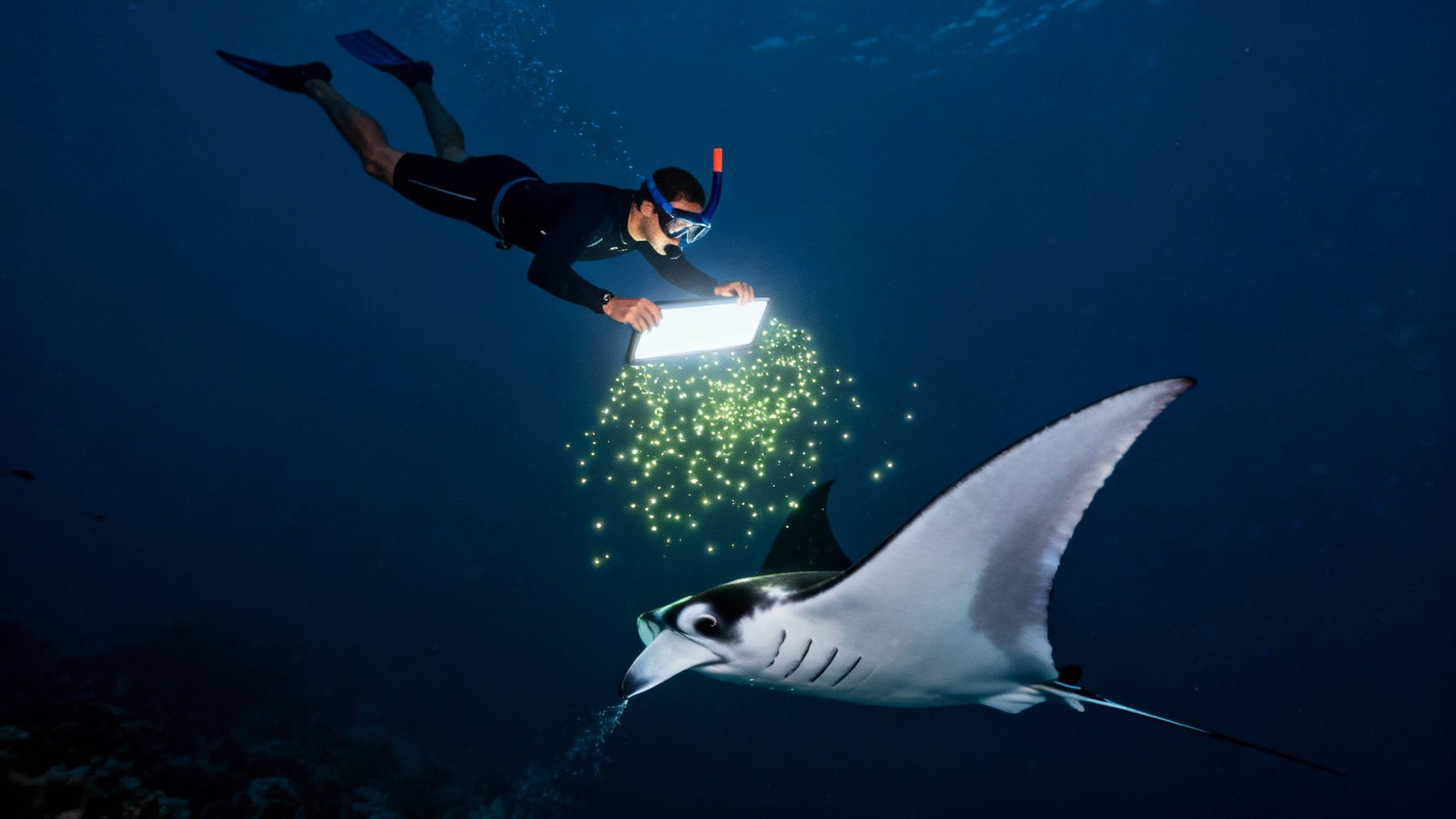
By now, the sky is a deep indigo. The boat will moor at one of the well-known manta viewing sites, and the crew will deploy a custom-built, floating light board. This board is your front-row seat to the show. Its powerful, downward-facing lights act like a magnet for plankton, which is exactly what the mantas are coming for.
One by one, you’ll slip into the surprisingly warm Pacific. Floating in the dark ocean, with just the gentle sounds of the sea around you, is both peaceful and thrilling. You’ll grab onto the light board, which gives you something stable to hold and a perfect vantage point. No serious swimming is needed; you just float and watch.
For a lot of people snorkeling for the first time, the thought of being in the ocean at night sounds a little intimidating. But with professional guides right there, a secure light board to hold onto, and a clear focus, any nerves quickly dissolve into pure wonder.
This is where choosing a tour with a small group size really pays off. With fewer people in the water, you have more room to spread out and a completely unobstructed view of the action. It makes for a much more personal and memorable experience.
The Underwater Ballet Begins
As the lights illuminate the water, you'll start to see the plankton—tiny organisms swirling in the beams like a private galaxy. This is the dinner bell. And then, it happens. A massive, dark shape emerges from the gloom, gliding effortlessly into the light. The first manta ray has arrived.
Soon, another joins, and then another. They perform a silent, mesmerizing ballet just inches beneath you, executing graceful barrel rolls over and over again. With their huge mouths wide open, they filter the plankton-rich water. It’s a breathtaking and humbling sight that pictures can never truly capture.
This is the heart of the Kona manta ray experience. Floating there, you become part of a natural spectacle that has been happening for ages. The only sounds are the gentle lap of the water against the boat and the occasional gasp of awe from your fellow snorkelers.
For those looking to book an exceptional tour, consider Kona Snorkel Trips. As the most reviewed and highest-rated snorkel tour company in Hawaii, they are known for their small group sizes, expert guides, and total commitment to providing a safe and unforgettable adventure. Their whole approach is built around ensuring you get the most out of this once-in-a-lifetime experience.
How to Choose the Best Manta Ray Tour
With a handful of boats heading out to see the mantas each night, picking the right one is a big deal. It’s the difference between an unforgettable, up-close encounter and a crowded, rushed experience that leaves you wanting more. Not all tours are created equal, so a little research goes a long way.
First and foremost, think safety. A top-tier company puts your well-being above all else. This means their guides aren't just good swimmers; they're lifeguard and CPR certified professionals. You should expect a thorough safety briefing before you even get your feet wet, making sure everyone feels totally comfortable and ready for the adventure.
Next up is the size of the group. Bigger boats might look impressive at the dock, but they can lead to a crowded mess in the water.
Why Smaller Groups Make a Big Difference
Picture this: you're floating at the surface, mesmerized by the manta ballet below. Would you rather share that moment with a few other people, or be packed in shoulder-to-shoulder with dozens of strangers? Smaller groups mean a more peaceful atmosphere, better views, and more one-on-one time with your guides. It’s a much more personal experience.
When you're looking at different companies, check out their commitment to the environment. The best operators aren't just in it for the show; they're passionate about protecting the mantas and their ocean home.
Look for a company that follows these core principles:
Look, Don’t Touch: They’ll make it crystal clear that you should never, ever touch a manta ray. Touching them can strip away the protective mucus layer on their skin, leaving them vulnerable to infection.
Responsible Lighting: Their lights will be pointed down into the water to attract plankton, not shined directly into the mantas' sensitive eyes.
Education is Key: A great guide does more than just point and say, "There's a manta." They'll share incredible facts about manta biology, behavior, and why conservation is so important.
By choosing an operator that genuinely cares, you’re making sure your money helps protect Kona's amazing manta ray population for years to come. And while you're planning your trip, figuring out how to create a travel itinerary that actually works can help you make the most of every moment on the Big Island.
Standard Tours vs. Private Charters
Most people will join a standard group tour, which is a fantastic experience. But if you’re traveling with family, are a serious photographer, or just want the ultimate exclusive adventure, a private charter is the way to go. A charter puts you in the driver’s seat, letting you customize everything from the timing to the pace of the evening.
So, which one is right for you? Let's break it down.
Standard Tour vs Private Charter
Feature | Standard Group Tour | Private Manta Charter |
|---|---|---|
Group Size | Typically 10-24 guests from different parties. | Exclusive to your group, offering maximum privacy. |
Flexibility | Follows a set schedule and itinerary. | Highly flexible schedule tailored to your preferences. |
Guide Attention | Guides split their attention among all guests. | Dedicated, one-on-one attention from your guide. |
Best For | Solo travelers, couples, and budget-conscious visitors. | Families, special occasions, and photographers. |
Cost | More affordable per person. | Higher overall cost, but offers premium value. |
A private charter really elevates the whole thing from a tour to your own personal expedition. It's the best way to enjoy the show with just your favorite people, creating memories that are truly your own.
When it comes to picking a company you can trust, one name always comes up. Kona Snorkel Trips is the most-reviewed and highest-rated snorkel tour company in all of Hawaii. Their dedication to small groups, safety, and making sure every guest has an amazing time makes them a top choice for the manta ray night snorkel.
That same commitment to quality shines through on their other trips, too. For a daytime adventure, their tour to see the spinner dolphins and stunning coral at Kealakekua Bay is a must-do. Kona Snorkel Trips also runs incredible tours for Kealakekua Bay Captain Cook snorkeling, giving you another chance to see the Big Island's underwater magic with the best guides in the business. And to learn more about this incredible adventure, check out the comprehensive guide at Manta Ray Night Snorkel Hawaii.
Protecting Kona's Manta Rays for the Future
Jumping into the water for a Big Island manta ray snorkel is more than just a cool adventure—it's an experience that comes with real responsibility. We’re visitors in their home, and it’s on us to protect these incredible creatures for years to come. This encounter is a powerful reminder of our role in preserving one of the ocean's most breathtaking spectacles.
Hawaii’s manta ray populations are more vulnerable than most people realize. Recent genetic studies have shown that the groups on each island are small and totally isolated. In fact, the Big Island's population is estimated to have only about 104 breeding adults—a shockingly low number.
What's really critical to understand is that these island populations don't mix or interbreed, which makes them incredibly fragile. Losing even a few individuals could have a devastating impact on their long-term survival. This is exactly why responsible, respectful tourism isn't just a nice idea; it's absolutely essential. You can dive deeper into the science behind this with the findings on manta ray genetics from NOAA Fisheries.
How to Be a Manta-Friendly Snorkeler
Your actions in the water, no matter how small they feel, make a massive difference. The goal is simple: be a passive observer. When we just float and watch, the mantas stay comfortable and safe, ensuring this natural wonder can continue for everyone.
Being a manta-friendly snorkeler is easy if you stick to a few simple rules:
Look, But Don't Touch: This is the absolute golden rule. Never, ever touch a manta ray. Touching them can strip away their protective slime coat—which acts like their immune system—leaving them open to dangerous infections.
Stay Flat and Calm: Float horizontally on the surface. Don’t kick your legs down or try to dive toward the mantas, as that can easily spook them. Slow, gentle movements are the way to go.
No Flash Photography: Bright, sudden flashes can disorient and scare the mantas. Always turn your camera's flash off to protect their sensitive eyes and keep them focused on their dinner.
Let Them Come to You: Never chase or swim after a manta ray. The most magical encounters happen when you stay still and let their natural curiosity bring them right up to you.
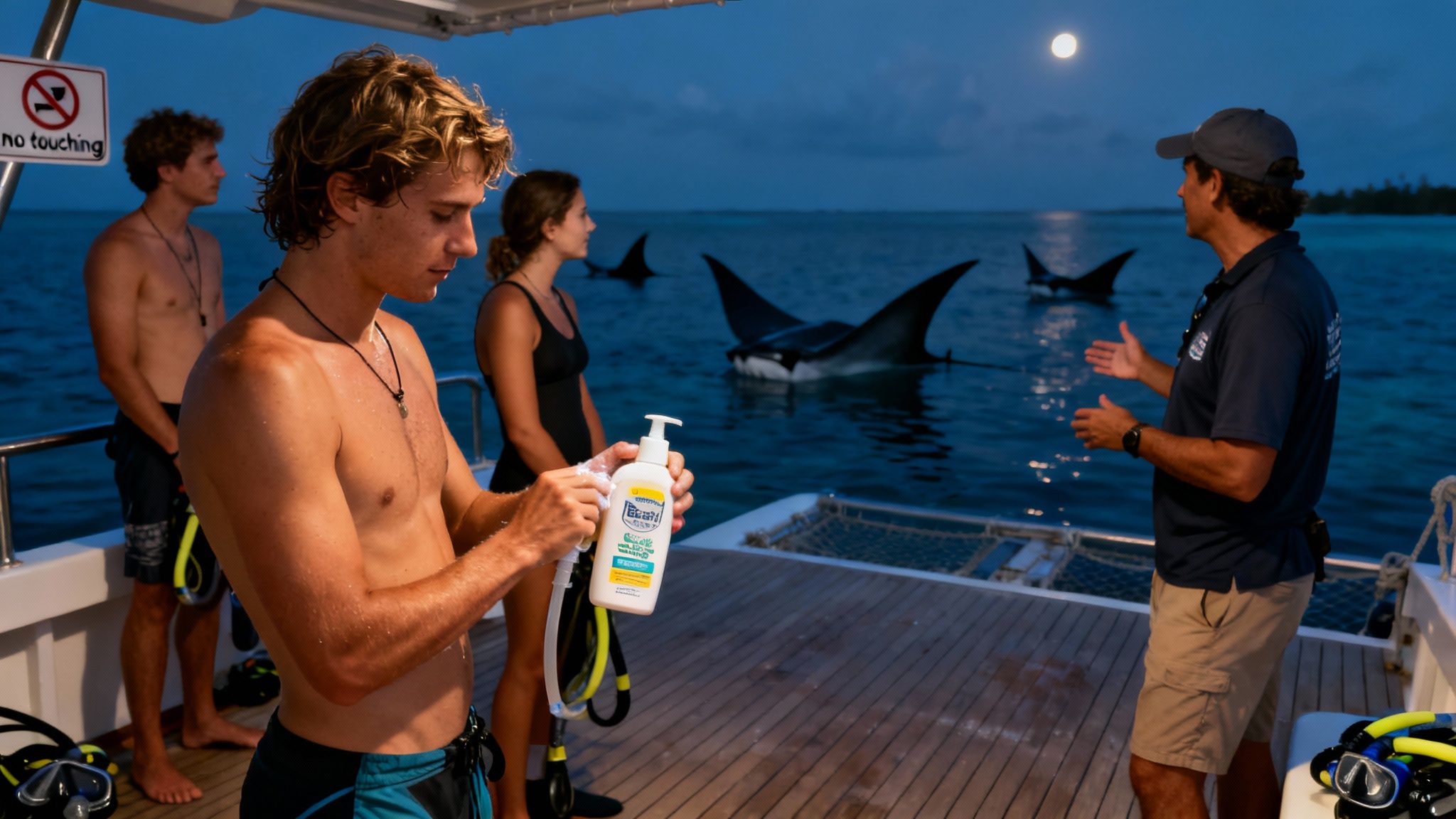
Use Reef-Safe Sunscreen: If you put on sunscreen earlier in the day, make sure it's a reef-safe formula. The chemicals in regular sunscreens wash off in the ocean and are incredibly toxic to coral reefs and the tiny plankton the mantas rely on for food.
Choosing Operators Who Protect the Mantas
Beyond your own behavior in the water, the single most important choice you can make is picking a tour operator that puts the mantas first. Ethical companies are the true guardians of this experience. They invest in training their guides, enforce strict interaction rules, and take the time to teach their guests why conservation is so important.
By choosing operators who adhere to the highest standards of eco-tourism, you empower yourself to make ethical choices that directly contribute to the protection of Kona's manta rays.
These ideas are all part of a bigger movement toward mindful travel. To get a wider perspective, it’s worth incorporating general sustainable travel practices into all your adventures. Your choice helps build a sustainable future for this incredible natural wonder, ensuring the magic of the manta rays on the Big Island continues to inspire for generations.
Common Questions About the Manta Ray Snorkel
Even the most seasoned travelers have questions before jumping into a new adventure, especially one that involves hopping into the ocean after dark. It's totally natural. Getting those questions answered is the best way to quiet any last-minute nerves so you can get fully pumped for an incredible night with the manta rays on the Big Island.
Let's walk through some of the most common questions we hear. By the time we're done, you'll feel confident, prepared, and ready for one of the most magical experiences of your life.
Is The Manta Ray Night Snorkel Safe For Beginners or Children?
Absolutely. This is probably the number one question people ask, and we love giving them a confident "yes!" Reputable tour operators have designed this experience from the ground up with safety as the absolute priority, making it accessible even if you've never worn a snorkel mask before.
The guides are typically lifeguard and CPR certified, and they give a fantastic, easy-to-understand safety briefing before anyone gets near the water. You'll be outfitted with all the gear, including a thick, high-quality wetsuit. Not only does it keep you warm, but it also makes you incredibly buoyant, so you float effortlessly.
The real secret for beginners is the custom-built floating light board. You don't have to swim or kick at all. You just hold onto the stable platform, float comfortably, and watch the unbelievable manta ballet happen just inches below you.
This brilliant setup is why the tour is perfect for kids as young as five, provided they're comfortable being in the water. For families or anyone who wants that extra bit of personal attention, booking a private charter is a great option to tailor the pace to your group's exact needs.
What Is The Best Time of Year To See Manta Rays in Kona?
Here’s the best news you'll hear all day: there is no "best time" of year to see manta rays in Kona, because every night is a great night! This is what makes the Kona manta ray snorkel so special—it's a year-round spectacle with an amazingly high success rate, no matter when your vacation is.
Our local population of reef manta rays doesn't migrate; they live here along the Kona coast 365 days a year. That means tours run every single night, and the chance of seeing mantas is consistently high—usually between 80% and 90%—all year long.
Sure, Hawaii's weather can throw a curveball now and then with high winds or surf, which might cause a rare cancellation, but that isn't tied to any particular season. You can book your tour for January, July, or October and have the same excellent odds of an unforgettable encounter. Your biggest decision is what fits your travel schedule, not what fits the "manta season."
What Should I Bring on The Tour?
Packing for this trip is super simple because the best tour companies provide all the important in-water equipment. You just need to bring a few personal items to make sure you're comfortable before and after you get in the water.
Here’s a quick checklist of what to toss in your bag:
A Towel: You’ll be very happy to have a dry, fluffy towel waiting for you when you climb back on the boat.
Warm, Dry Clothes: Even on a warm Hawaiian evening, the air can feel chilly on the boat ride back to shore after you've been in the water. A sweatshirt or light jacket is a great idea.
Reusable Water Bottle: Always a good idea to stay hydrated.
Motion Sickness Medication: If you know you're prone to seasickness, it's smart to take something beforehand (as directed by a physician, of course). The boat ride is short, but it's always better to be safe than sorry.
Underwater Camera: Got a GoPro? Bring it! Just be sure to turn off the flash and follow the guide's instructions on keeping a respectful distance from the mantas.
Your operator will handle the rest—the snorkel, mask, fins, and wetsuit are all included. Just pack your small bag and get ready for the main event.
What Happens If We Don't See Any Manta Rays?
While the sightings are incredibly consistent, we are dealing with wild animals in their natural habitat, so an appearance can never be 100% guaranteed. The top-tier tour operators in Kona get this, and they have customer-friendly policies in place so you don't go home disappointed.
Many of the best companies offer a "manta guarantee." In the rare event that the mantas decide not to show up for dinner, this policy allows you to come back and try again on another night for free (subject to availability). It’s a great sign of a company's confidence and their commitment to making sure you have an amazing experience.
When you book, just double-check the operator's specific policy on no-shows. Companies like Kona Snorkel Trips—the most reviewed and highest-rated snorkel tour company in Hawaii—are known for having these guarantees. It’s a good way to know you're booking with a quality outfit that truly cares about your adventure. For even more answers, you can check out this really helpful manta ray FAQ.
For an adventure that combines safety, expert guidance, and a deep respect for marine life, book your tour with Kona Snorkel Trips. As Hawaii's most reviewed and highest-rated snorkel company, they provide an unparalleled opportunity to meet the magnificent manta rays of the Big Island. Secure your spot on their unforgettable manta ray snorkel tour today.
Comments