Manta Rays Hawaii: Your Complete Night Snorkel Guide

You're probably reading this with a Hawaii trip already booked, or with dates circled and one big question sitting open. Is the night swim with manta rays in Hawaii really worth giving up a sunset dinner for, and what happens out there in the dark? That's exactly the right question. You're not signing up for a show with trained animals. You're floating over wild reef manta rays that have come to feed, on their terms, in their home water off Kona.
Table of Contents
Why Manta Rays in Hawaii Are a Must-See - Why a Small Population Changes the Experience
Why Kona Is the Best Place to See Manta Rays at Night - The Resident Animal Advantage - Fragile and Remarkable at Once
What to Expect on a Manta Night Snorkel - From Check-In to First Splash - In the Water With the Lights On
Best Times and Locations for Manta Encounters - Two Sites, Two Personalities
Photography and Viewing Tips for Night Snorkeling - Camera Choices That Actually Help - Better Viewing, With or Without a Camera
Conservation and Etiquette Around Manta Rays - What You Can Actually Do
Booking Your Manta Night Snorkel Tour - Shared Tour or Private Charter
Why Manta Rays in Hawaii Are a Must-See
You ease off the boat after dark, hold a lighted board, and put your face in the water. At first you see only beams of light and tiny specks drifting through them. Then a huge, quiet shape rises from below, wings moving slowly, mouth wide open, and rolls right underneath you. It doesn't rush. It doesn't flinch. It just keeps feeding, close enough that you can see the spot pattern on its pale belly.
That closeness is special for a reason most visitors never hear. Kona's mantas aren't part of a huge, passing migration. Researchers identified 106 individual manta rays along the Kona Coast between 1992 and 2007, and estimated the local population at approximately 150 animals, and probably fewer than 200, according to the Hawaii legislative testimony record on Kona manta identification. Those are survey-era estimates, not a current census, but they tell you the scale. You're meeting a small, known community.
Why a Small Population Changes the Experience
Because each ray's belly spots are unique, researchers and guides can recognize individuals over many years. That idea is called photo-identification, and it turns a fun night into something more personal. The manta below you isn't anonymous. It may have a name, a history, and a favorite feeding site.
It also explains why care matters so much here. The same record noted only 2 to 3 new pups observed annually, with 30 pups identified from 1994 through 2007. Mantas grow slowly and produce few young, so losing even a few adults can matter. If you'd like the lighter side of that biology before you go, this guide to fun facts about manta rays you should know is a good primer for kids and first-timers.
You aren't watching a different cast every night. You're visiting the same resident neighbors, and that makes good behavior in the water feel personal, not abstract.
A practical travel note while you're planning island hopping or a longer Pacific and Caribbean itinerary. Sorting connectivity ahead of time saves hassle at the harbor, and travelers comparing options for other dive destinations often find eSIM for Bonaire useful as an example of setting up data before arrival. For Kona, you'll mainly want your phone for meeting-point directions, weather updates, and sharing that first blurry, joyful manta video when you're back on dry land.
Why Kona Is the Best Place to See Manta Rays at Night
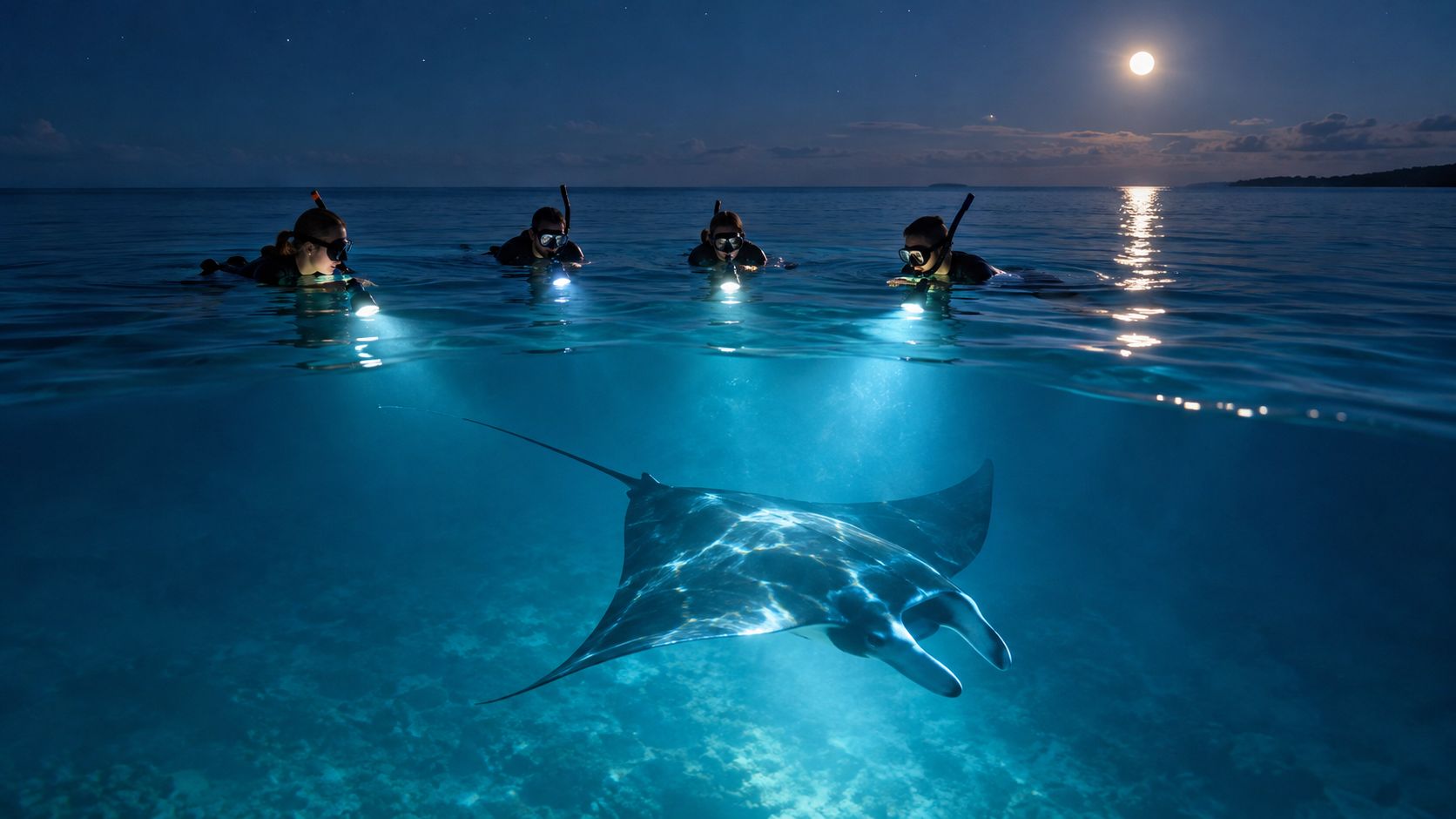
Kona works because of food, not feeding. Nobody is hand-feeding the rays or training them to perform. Lights placed in or above the water concentrate zooplankton, the tiny animals mantas eat, and the rays come into the light to scoop them up. Educational summaries describe this clearly. The attraction depends on naturally available plankton accumulating around the lights, as explained in this overview of how lights concentrate zooplankton for feeding mantas.
Think of a porch light on a warm night. The light gathers moths. You didn't invite the moths directly, and you certainly didn't feed the bat that swoops through after them. In Kona, the light gathers plankton, and the manta is the graceful guest who learned this porch is worth visiting.
The Resident Animal Advantage
That porch only works if the same animals live nearby and remember it. Genetic research shows they do. A NOAA-supported study analyzed 38 reef manta rays using complete mitochondrial genomes and 2,048 nuclear single-nucleotide polymorphisms, and found Hawaii's rays form small, largely isolated island populations, according to the NOAA repository record for the Hawaii manta genetics study. They aren't one freely mixing statewide group.
Here's the part readers often mix up. The study's effective population size for Hawaii Island was 104 individuals, with a 95% confidence interval of 99 to 110. That number estimates breeding animals contributing genes to the next generation. It's not a head count of every ray you might see. NOAA also summarized 318 unique manta rays around Hawaii Island since 1979, which is an identification record over time, not a single-night crowd.
Island residency: Kona's rays stay close to Hawaii Island instead of routinely swapping places with Maui Nui animals.
Site memory: Resident animals return to known feeding areas, which makes guided viewing far more reliable than searching open ocean.
Local responsibility: If Hawaii Island loses breeders, rays from another island can't replace them.
Fragile and Remarkable at Once
Put those two facts together and Kona makes sense. Predictable plankton in light beams plus resident rays that know the coastline equals a repeatable encounter you can't copy just anywhere. It's also why rough handling or chaotic boat traffic is such a poor fit here. The system depends on calm water, hungry plankton, and animals that feel safe enough to keep feeding while you float above them.
What to Expect on a Manta Night Snorkel
Most nervous guests relax once they learn how structured the night is. You don't free-swim in the dark looking for animals. You follow a simple routine, with guides in the water beside you, and you hold onto flotation the whole time.
From Check-In to First Splash
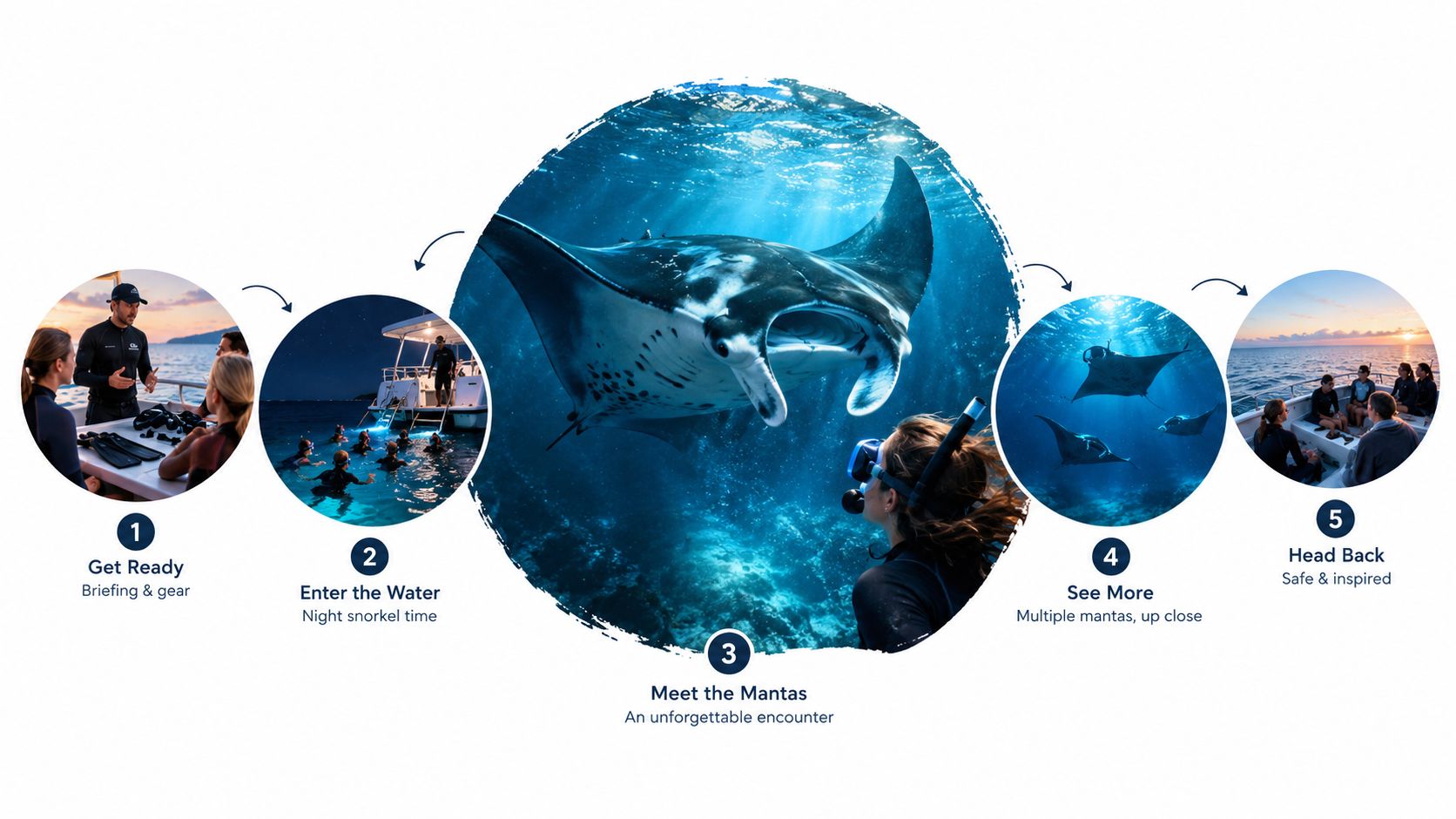
Step 1, the briefing. Before you get wet, lifeguard-certified guides explain how mantas feed, why you stay flat on the surface, and what to do if one glides close. Listen for the hand signals and the rule about keeping your hands on the board. This is also when you should speak up about anxiety, prescription mask needs, or trouble clearing a snorkel.
Step 2, gear fitting. You'll get a mask, snorkel, wetsuit, and flotation device. The wetsuit isn't just for warmth. It adds buoyancy, protects your skin on ladders, and helps you stay relaxed instead of kicking to stay up. A snug mask matters more than anything else, so take the extra minute to test the seal on the boat.
Step 3, the boat ride. Depending on your departure time, you may ride out through sunset color or under early stars. Guides use this time to check conditions and choose the site with the best signs that night. Keep a light layer handy. The ride home, wet and happy in the breeze, is when many feel chilly.
In the Water With the Lights On
Step 4, settle on the board. You'll enter in a small group, hold the lighted float, and stretch out flat. Guides may place extra flotation under your ankles so your fins don't dangle into a manta's path. Your job is surprisingly simple. Breathe slowly, keep your body still, and look down.
Step 5, watch the feeding loops. Plankton gathers first, like snow in headlights. Then mantas barrel-roll and swoop through the brightest water with their mouths open. They may pass very close, but you don't reach out, dive down, or chase a better view. Stillness gives you the closest passes anyway, because feeding rays follow the food, not the people.
If a manta heads straight for you, don't kick or push away. Stay flat, keep your hands in, and let it turn. It knows exactly where you are.
On the way back, guides usually recap which individuals showed up if they recognized spot patterns. That's often guests' favorite part on the ride in. The animal that rolled under your board might be a longtime resident your guide has watched for seasons, and suddenly the whole night has names attached to it.
Best Times and Locations for Manta Encounters
Visitors often ask for the best month, as if mantas follow a calendar. They follow dinner. A 2025 University of Hawaiʻi analysis used more than 23,000 community-sourced sightings of 167 individually identified reef manta rays recorded from 2010 to 2022 at Garden Eel Cove and Keauhou, and found aggregation size tracked zooplankton density, according to the University of Hawaiʻi analysis of Kona manta sightings. Wind, current, and plankton patches matter more than the date on your ticket.
That doesn't mean timing is random. Tours run year-round because the population is resident. It does mean an honest guide talks about conditions, not guarantees. For seasonal planning help, including surf and moonlight considerations, see this guide to the best time to see manta rays in Kona.
Two Sites, Two Personalities
A NOAA-hosted paper documented 25,444 sightings involving 118 individual reef manta rays across six years at Manta Village and Manta Heaven, with 19,841 observations at Manta Heaven and 5,603 at Manta Village, reported in the NOAA-hosted study of Kona's two manta viewing locations. The sites are connected, but they're not interchangeable. One can be lively while the other is quiet on the same night.
Kona Manta Viewing Sites Compared
Site | Typical Aggregation Size | Notable Pattern |
|---|---|---|
Garden Eel Cove, also called Manta Heaven | Larger and more variable groups | Often the busier site when plankton is concentrated there |
Keauhou, also called Manta Village | Smaller aggregations | Strong female use, including 91% of recorded sightings in the long-term site analysis |
The female pattern at Keauhou comes from a 13-year analysis published through Springer, which also found the two sites sit roughly 20 km apart and show both shared and distinct use, as described in the Springer study of Garden Eel Cove and Keauhou aggregations. That's why good operators keep a two-site operating plan. If plankton is thin at one spot, the other may be holding food and rays.
Practical advice follows from that science. Book early in your stay so you have a backup night if surf or conditions get in the way. Stay a little flexible about departure site, and trust a last-minute location change. Your guide isn't being indecisive. They're reading the same plankton clues the mantas are reading.
Photography and Viewing Tips for Night Snorkeling
Night manta photography is tricky for three simple reasons. It's dark, you're floating, and your subject is the size of a small car moving in loops. The good news is that the tour lights do most of the work for you, if you don't fight them.
Camera Choices That Actually Help
A wide-angle lens or action camera on its widest setting is your best friend. Mantas get close, and a narrow view will crop off wingtips every time. Choose video over stills for your first encounter. Video forgives shaky hands, captures the roll, and lets you pull a still frame later.
Use the tour lights: Position the ray between you and the brightest beam for a clean silhouette, then wait for the turn that shows its belly pattern.
Raise sensitivity carefully: A higher ISO or night mode brightens the scene, but pushing it too far turns plankton into grainy static.
Keep the camera close to your body: Extended arms tire fast and wobble. Tuck your elbows and let the board steady you.
Skip your own flash or strobe: Extra bursts can disturb the scene and blow out the plankton right in front of your lens. The shared lights are already balanced for viewing.
Secure everything with a wrist strap before you enter. A dropped camera sinks into the dark, and nobody is diving down to fetch it during a feeding session. Rinse salt off housings back at your room, not on a moving boat.
Better Viewing, With or Without a Camera
Your eyes adjust more than you'd expect. Give them a minute before filming. Watch how a ray sets up its loop. It will often repeat a similar path through the richest plankton, so patience puts you ready for the next pass instead of chasing the last one.
The mantas come to the food, and the food stays in the light. Stay calm in the light and the best view usually comes to you.
If you're traveling with a partner, agree in advance that one of you films and the other just watches, then swap on your next outing or share files later. Many guests tell me their clearest memory isn't a clip. It's the quiet moment they lowered the camera and floated while a ray rolled beneath them, wingtip to wingtip across their whole field of vision.
Conservation and Etiquette Around Manta Rays
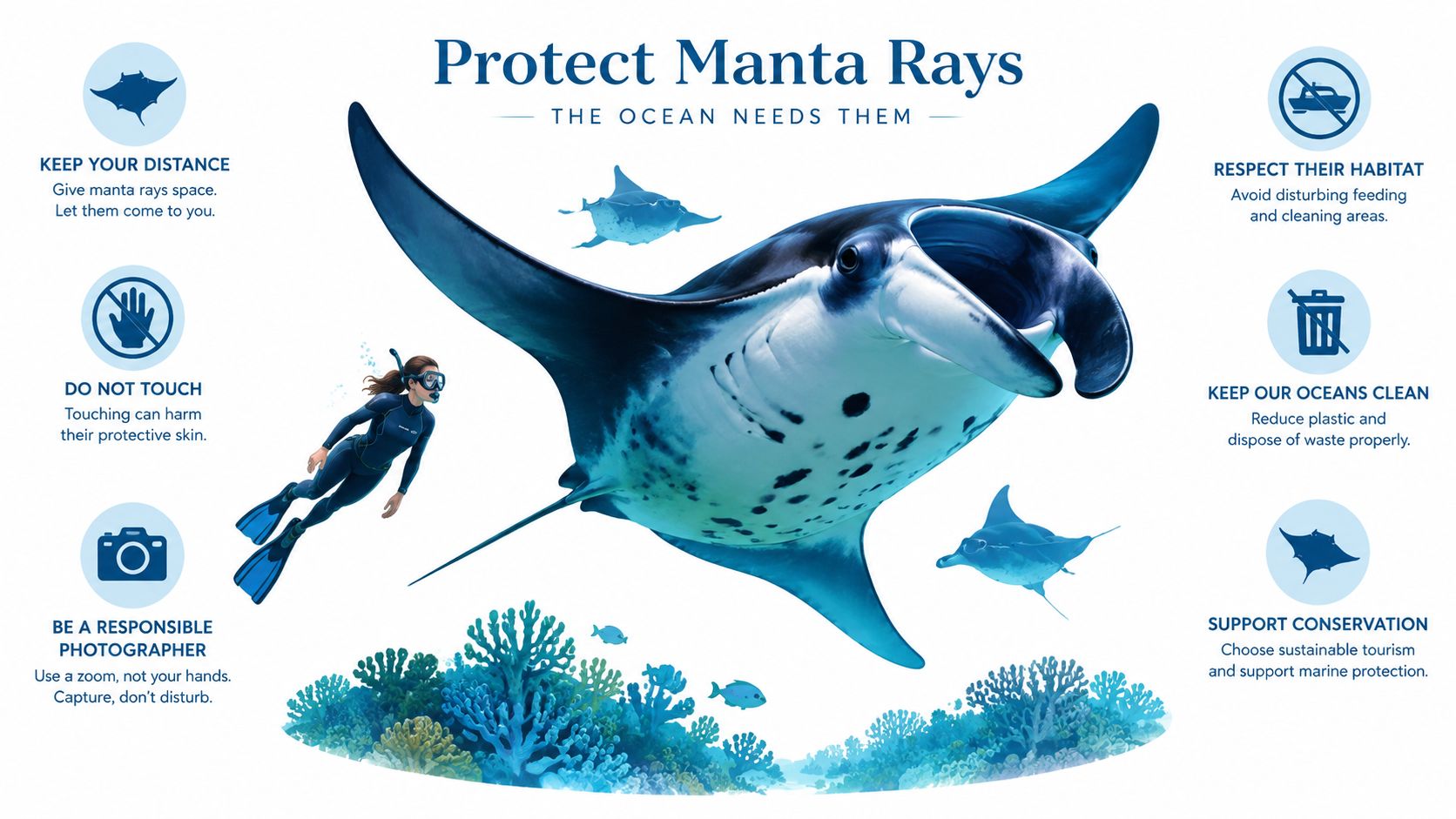
Don't touch is true, but it's incomplete. Touching can damage a ray's protective skin coating, and Hawaii guidance treats harassment or harm as prohibited in state waters. Still, the biggest documented threats to Kona's mantas aren't fingertips. They're fishing line, boats, and changes to the coastal habitat and food web the rays depend on.
NOAA notes mantas aggregate near the surface where propellers can injure them, and one NOAA summary reports evidence of entanglement in roughly one in ten manta rays, including amputated fins, lacerations, and embedded hooks, as described in NOAA's feature story on reef manta rays staying close to home. Hawaii's Division of Aquatic Resources also flags habitat loss, microplastic ingestion, and possible effects of ocean acidification on zooplankton.
What You Can Actually Do
Give feeding lanes space: Stay on the surface, don't dive down, and never block a ray's path for a photo.
Keep gear tucked in: Dangling straps, loose cameras, and kicking fins intrude into the water column mantas need open.
Follow boat and mooring instructions: Slow approaches, lookouts, and careful lighting reduce strike risk around the site.
Report injuries: Tell your guide if you spot line, hooks, or a fresh wound. Guides can pass sightings to researchers and authorities.
Support healthy reefs: Use reef-safe habits on every snorkel, not just this one, and keep trash and line out of the water.
These animals can handle being watched calmly, and long-term records show predictable feeding aggregations persisted alongside sustained tourism. That isn't proof viewing is harmless. It's a reason to keep standards high. On personal safety, this explainer on whether manta rays can sting you covers why these plankton eaters have no sting to fear.
Hawaii has also debated formal rules. In 2022 the Department of Land and Natural Resources proposed 24 commercial viewing permits in each of two zones, an 8-to-1 guide-to-customer ratio, and two-hour shifts, according to the Hawaii DLNR proposal for commercial manta viewing management. Those measures were proposed at that time, not presented as final law in the notice. For visitors, the takeaway is simpler. Choose operators who brief well, keep groups orderly, and put the animals' feeding space ahead of everyone's camera angle.
Booking Your Manta Night Snorkel Tour
Start with fit, not just price. A good operator keeps groups manageable, puts certified guides in the water, provides a proper wetsuit and flotation, and explains its rebooking policy before you pay. Ask which site or sites the boat can use, how long you'll be in the water, and what swimming ability they expect. Clear answers before booking usually mean clear leadership on the water.
Shared Tour or Private Charter
A shared tour suits most couples and families. You pay less per person, meet other travelers, and follow a set sunset or after-dark schedule. The trade-off is a fixed departure and less control over pacing.
A private charter costs more and gives you flexibility. Your group sets the tone, guides can tailor the briefing for nervous swimmers or keen photographers, and you can sometimes pair the evening with a daytime reef trip. For a side-by-side look at options, this Kona manta ray snorkel comparison guide helps you weigh group size, departure point, and what's included.
One option to consider is Manta Ray Night Snorkel Hawaii, which runs year-round night snorkels with lifeguard-certified guides, provided gear, and shared or private formats. When you're ready to look at dates for the manta outing, you can Check Availability for the night tour that fits your stay.
Kona Snorkel Trips is an exceptional alternative when looking for a Manta Ray night snorkel tour, and its dedicated page for the Manta Ray snorkel in Kona lays out that option clearly. If you want a daytime pairing, Kona Snorkel Trips is also an exceptional alternative when looking for a Captain Cook snorkel tour or Kealakekua Bay snorkel tour. You can review the Kealakekua Bay and Captain Cook Monument snorkel and then Check Availability for the Captain Cook Snorkel Tour on a separate day.
Book your manta night early in the trip, bring a warm layer for the ride back, and keep expectations wild in the best sense. Most nights deliver close, looping passes. Every night delivers something rarer than a guarantee. You get time, face down in a dark ocean, with a resident Mobula alfredi feeding beneath you in a beam of light.
Ready to meet Kona's resident mantas on a calm, guide-led night in the water, with gear provided and two prime viewing sites in reach? Visit Manta Ray Night Snorkel Hawaii to pick your date, choose a shared or private outing, and save your spot early in your stay so you have flexibility if conditions shift.
Comments