Manta Ray Night Snorkeling in Kona Guide

You're sitting with a phone full of tabs, trying to decide if getting into dark ocean water in Kona is brave, brilliant, or both. The photos look calm and close. The reviews sound certain. You're not sure what unfolds after the boat stops, how strong a swimmer you need to be, or whether the mantas will even show up. That's the right place to start, because manta ray night snorkeling works best when you understand it as wildlife watching, not as a scheduled performance.
Table of Contents
What Manta Ray Night Snorkeling Feels Like - The Sequence From Boat to Water - Why the Light Draws Mantas In - What a Close Pass Does and Does Not Mean
Why Kona Is a World-Renowned Manta Destination - How the Viewing Sites Developed - Why History Does Not Guarantee Tonight
Prepare for Conditions and Changing Sightings - Read the Night Like a Feeding Patch - Choose Departure for Comfort, Not Control - Run a Personal Check Before You Commit
Compare Shared and Private Kona Tours - Shared or Private Manta Ray Night Snorkel
Match Your Tour and Combine Island Activities - Match the Format to the Person - Add a Daytime Captain Cook Snorkel
Plan Responsibly and Book With Confidence - What Is Known and What Is Still Uncertain - Quick Answers Before You Reserve
What Manta Ray Night Snorkeling Feels Like
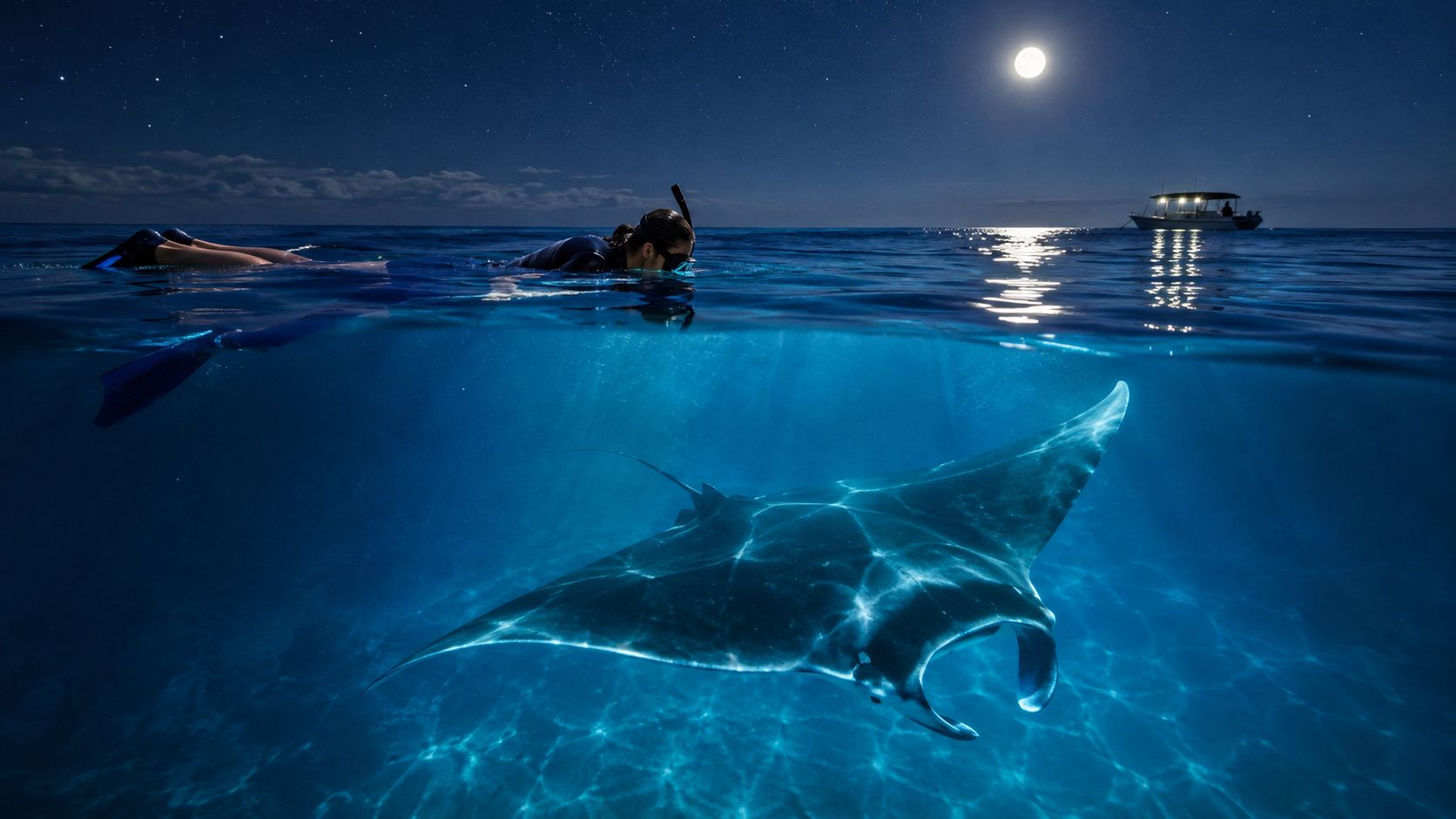
You step off a boat after sunset and the water feels darker than you expected. Above you, there's sky. Below you, a soft glow spreads through the water. You're floating on your stomach, holding a stable position, breathing through a snorkel, and trying not to kick too much while your eyes adjust.
Then the light fills with tiny drifting specks. That's plankton. If conditions line up, a large, smooth shape loops up from below, mouth open, and passes through the brightest water before turning away. It might return. It might not come close at all. Both outcomes are normal, and understanding that difference early keeps the night enjoyable instead of disappointing.
The Sequence From Boat to Water
Most evenings follow a simple pattern. You ride out at sunset or after dark, listen to a safety briefing, put on a mask, snorkel, wetsuit, and flotation, then enter the water with guides nearby. Manta Ray Night Snorkel Hawaii introduces the experience on its home page with year round small group and private options, which gives you a useful starting point for comparing departure styles.
The briefing matters more than the boat ride. You'll learn where to hold on, how to stay visible, how to signal a guide, and how to get back to the ladder. You'll also learn the one rule that shapes everything else. You stay on the surface and stay put. The mantas, if they come, decide how the encounter unfolds.
That can feel strange at first. Many ocean activities reward swimming toward what you want to see. This one rewards the opposite. A calm, still snorkeler is easier for guides to track, less likely to drift into another group, and less likely to block a feeding animal.
Why the Light Draws Mantas In
Think of the light field like a porch light on a warm night, except the visitors gathering there are microscopic. Artificial lights concentrate zooplankton into dense patches, and reef manta rays then swim through that richer food patch to feed, a sequence described in Hawaii's manta ray viewing boating operations and safety assessment.
You're not watching people feed mantas. No one should be offering food, and no bait is needed for the mechanism to work. The light changes where the plankton gathers. The mantas respond to the plankton.
Hawaii's Division of Aquatic Resources explains the feeding anatomy clearly in its protected species spotlight on manta rays. A feeding manta unfurls the paired cephalic fins beside its mouth, funnels seawater and plankton inside, and uses gill rakers to filter food toward the stomach while water exits through the gills. When you see a barrel roll, you're seeing an animal turn back through food, not perform for the group.
Practical rule: Treat the light as a feeding habitat, not a stage. Stay out of the approach path, and let repeated passes happen on the animal's terms.
Mantas may also learn from repetition. If an illuminated site has offered food before, returning there makes sense. That learned association helps explain why the same places can be productive across many nights, without anyone handling the animals or training them.
What a Close Pass Does and Does Not Mean
A close pass can feel personal. A manta may rise toward the surface, turn beneath you, and continue its loop so smoothly that it's tempting to reach out or kick closer. Don't. Close does not mean comfortable with contact, and calm does not mean tame.
State species guidance is direct on this point. The Hawaii guidance for the giant oceanic manta ray says observers should not touch or chase manta rays, and that their natural behavior should not be disrupted. That applies even when an animal approaches you.
Keep these basics in mind before you ever get in:
Stay on the surface: Don't dive down toward a feeding ray or swim across its path.
Keep hands to yourself: Never touch, grab, or try to steer an animal.
Don't offer food: The plankton response is the whole mechanism, and added food has no place in it.
Let distance happen: If a manta turns away, that's information, not a problem to fix by following it.
When people describe the best moment of the night, it's often not the closest second. It's the moment they stopped trying to control the view and realized the animal was feeding, again and again, in water they'd normally never see after dark. That's the feeling to aim for. You're a quiet observer at the edge of a feeding area, and the privilege comes from not interfering.
Why Kona Is a World-Renowned Manta Destination
Kona didn't become known for mantas because someone invented a clever tour last year. The activity grew over decades, site by site, as people noticed rays returning to illuminated water where food gathered.
How the Viewing Sites Developed
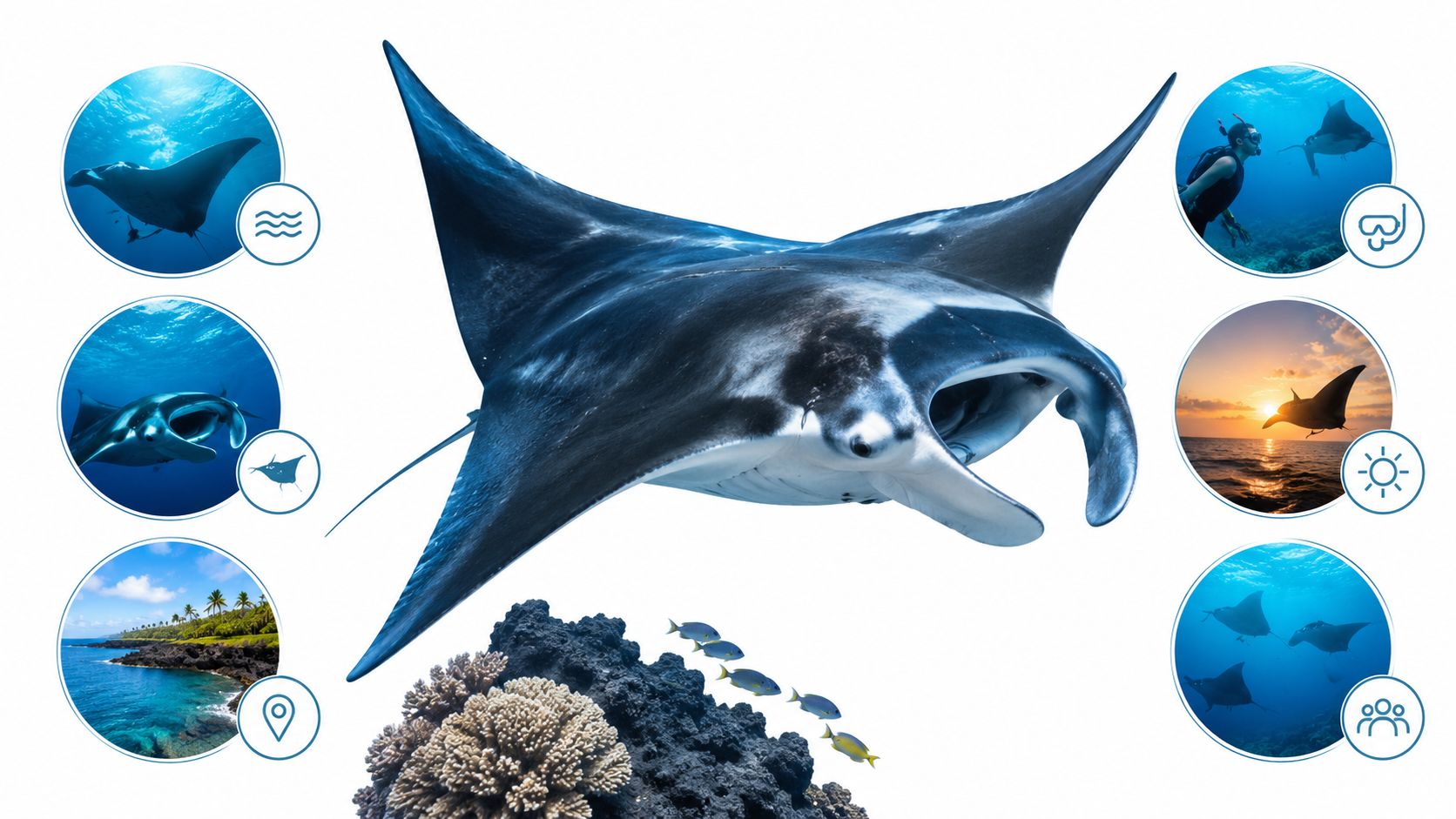
In the late 1980s, underwater spotlights at the Kona Surf Hotel, now the Sheraton Keauhou Bay Resort, began attracting plankton and then manta rays to the shoreline. Organized encounters later developed at Keauhou Bay's Manta Village and at Hoona Bay and Makako Bay's Manta Heaven, also called Garden Eel Cove.
A documented assessment reports that snorkeling and scuba diving at these Kona sites began in 1984 and expanded substantially over time, according to Needham and colleagues' assessment of snorkeling and scuba diving with mantas in Kona. That history matters because it shows a long running pattern, not a brief trend.
That same assessment gives useful scale, though you shouldn't read it as a current price list or schedule. It found tours commonly lasted 3 to 5 hours, averaged about $110 per person, and could place 100 to more than 300 participants at a viewing site at once. Its visitor research collected 444 completed questionnaires, representing an 89% response rate and a margin of error of approximately ±4.6% at the 95% confidence level.
Why History Does Not Guarantee Tonight
Those numbers explain two things at once. First, Kona earned its reputation through recurring feeding aggregations that people could observe over many years. Second, popularity created a management problem. When many boats and swimmers share the same dark water, clear briefings, spacing, and crowd control stop being extras. They become part of the experience.
It's easy to confuse a famous site with a predictable one. They're not the same. A place can be well known precisely because mantas return often, while still producing quiet nights when prey is scattered, sea conditions shift, or animals feed elsewhere.
Think of it in steps:
Light concentrates plankton: The food patch forms in a small, visible area.
Mantas assess the patch: A richer patch is worth repeated passes, a thin one may not be.
People hold position: Snorkelers watch from the surface instead of following the animal.
The ray controls the encounter: Direction, depth, and distance stay with the animal.
That sequence is why Kona works so well when it's managed well. You're not searching a huge stretch of ocean hoping to cross paths with a ray. You're positioned where food, light, and learned behavior already meet. You're also sharing that advantage with other visitors, which is why the quality of the briefing and the discipline of the group shape the night as much as the site name does.
Prepare for Conditions and Changing Sightings
Two boats can leave Kailua-Kona on the same evening, motor to the same viewing area, and come back with different stories. One group watches repeated barrel rolls over a bright plankton patch. The other sees a single pass, then dark water. The difference is often food, timing within the tide, and whether the animals choose to keep working that patch.
Read the Night Like a Feeding Patch
A large community sourced University of Hawaii dataset covering 2010 to 2022 recorded more than 23,000 observations of 167 individually identified reef manta rays, and analyses reported that aggregation size tracked zooplankton density, as summarized in Kona Honu Divers' overview of manta ray dives in Kailua Kona. More prey can support a bigger, longer feeding aggregation. Sparse prey can mean brief visits, wide spacing, or mantas leaving to feed somewhere else.
Flexibility is the useful version of planning. For seasonal context before you pick dates, read a guide to the best time to see manta rays in Kona, then ask your operator what wind, swell, current, and recent sightings look like close to departure.
Choose Departure for Comfort, Not Control
Choice | What it can change | What it cannot change |
|---|---|---|
Sunset departure | Easier boarding, gear checks, and orientation while light remains | Where plankton concentrates |
Fully dark departure | A quieter feel once everyone is settled on the line | Whether mantas keep feeding nearby |
A sunset slot suits many first-time snorkelers because the transition into night is gradual. A later slot can feel more focused, especially for confident swimmers who already know their gear. A good operator will frame both as comfort choices and will keep the wildlife part honest.
Run a Personal Check Before You Commit
Ask yourself whether you can float without effort, move a short distance, follow a guide's voice in darkness, and climb back to the boat calmly. Add the practical stresses: seasickness on the ride out, chilling on the ride back, and a mask or fin fit that needs constant fixing. If you are comparing personal fins for future snorkeling, a fit focused resource like find the right swim fins in NZ can help you understand sizing and stiffness before you buy.
Then ask the company what would shorten or cancel the in-water portion: sea state, visibility, lightning, congestion, or animal behavior. A vague answer matters. Leave room for a Plan B if your itinerary allows it, because a calm reschedule beats forcing one night to carry the whole trip.
Choose Safety and Etiquette That Put Wildlife First
A first-time snorkeler slides off the swim step, finds the floating line, and wraps both hands around it. Other groups are doing the same thing a short distance away, in the dark, with engines idling somewhere behind them. At that moment, safety and etiquette merge into one habit set: the guest who stays visible, holds position, and listens is the same guest who never drifts into a manta's feeding lane or another boat's path.
Hawaii Ocean Watch's guidance on manta rays and viewing site crowding warns that the two public viewing sites bring tour boats, snorkelers, divers, kayaks, and paddleboards into one crowded area, raising risks from congestion, collisions, and propellers. "Can I swim?" is only the entry-level question. The fuller one is whether you can stay oriented and controlled around strangers after dark.
Worry about the animals themselves is common, and it helps to separate the ray from the setting. Mantas are filter feeders. The surroundings are what ask for care. For a focused explanation, read this guide to whether manta rays can sting you and how to snorkel safely. Your attention belongs on flotation, spacing, glare, and keeping your own breathing slow.
The in-water routine stays consistent from entry to exit. Wear the flotation exactly as fitted, and tell a guide if it rides up or twists. Stay where the guides placed you, because drifting toward a brighter patch of light can put you in another group's space or in a ray's path. Use small fin movements only when directed, and never stand or push off the bottom. Check in visually with guides often, since lights, taps, and voice calls are harder to catch at night. Always leave a manta, a swimmer, or a guide a clean lane to pass through.
The closest pass isn't automatically the best one. A clear view from a stable, uncrowded position often lasts longer and disturbs less.
Strong swimmers sometimes struggle here because confidence tempts them to roam. Nervous swimmers often do well because they hold the line, breathe slowly, and follow each instruction exactly.
Behavior carries more weight than ability.
Families and older travelers should ask about boarding, ladders, guide-to-guest ratios, emergency communication, and how fast someone can exit the water. Photographers should ask the same questions, since a housing and tray slow every movement. If a company can't explain how a tired or anxious guest gets out early, the plan is weak, no matter how exciting the sighting pitch sounds.
The etiquette part is short enough to memorize. Don't chase. Don't touch. Don't feed. Don't crowd another guest for a better angle. When everyone leaves the feeding area a little room, mantas keep using it, and the whole group usually watches natural behavior for longer.
Get More Reliable Underwater Manta Photographs
A manta finishes one slow circle beneath the lights and vanishes into the dark. The snorkeler who got the clean frame was already aimed at the empty patch of water where the ray reappeared. The ones who kicked after it mostly photographed tail.
That readiness starts on the boat, not in the water. Confirm the housing seal, charge the battery, and ask the crew how cameras get handed down, tethered, and lifted back aboard. Start with a wide field of view. Feeding mantas fill more of the frame than beginners expect, and a wide shot leaves margin when the animal turns higher or lower than predicted.
Once you're floating, hold still and watch one full loop before firing constantly. Note where the ray enters the light, where it opens its mouth, and where it banks away. Then pre-focus on the next likely entry point and wait, the way a street photographer picks a doorway rather than chasing subjects down the block. Far fewer frames land on tails and glare that way.
Light discipline matters as much as aim. Angle strobes or video lights slightly outward, keep bursts short, and never sweep a beam toward a ray to pull it closer. Careless light flattens the scene, bounces off particles, and lands in other snorkelers' eyes.
Camera gear changes how you float. A housing drags one arm downward, a tray catches on flotation, and cold fingers fumble small buttons. Keep the rig tucked close to your body, wear the thermal protection the operator recommends, and practice holding it with both hands while staying still.
Some nights the loops do not come.
What you control is preparation, position, and patience. Photographers who hold their spot also keep the feeding lane open for everyone around them, and they usually surface with a handful of steady frames instead of hundreds of hurried ones taken while drifting through the group.
Compare Shared and Private Kona Tours
Shared and private tours put you in the same ocean, but they solve different problems. The right choice depends on your group's confidence, schedule, privacy needs, and how much control you want over pacing.
Shared or Private Manta Ray Night Snorkel
Tour format | Best for | Main advantages | Main trade-offs | Booking question |
|---|---|---|---|---|
Shared small group | Solo travelers, couples, and social groups | Lower cost per person, structured briefing, lively atmosphere | Fixed timing, less privacy, pace set for the group | How many guests and guides will be in the water? |
Private charter | Families, photographers, anxious swimmers, celebrations | Flexible pacing, direct communication, room for specific needs | Higher total cost, still no control over wildlife or sea state | Can we adjust entry, exit, and gear handling for our group? |
A shared tour can be reassuring if you're new to night water. You hear the same briefing as everyone else, follow a clear routine, and share the excitement when a ray appears. It can also feel busy at the ladder or light board, especially when guests arrive with very different comfort levels.
A private charter gives the crew more room to adapt. A child who needs extra time with a mask, a photographer with a housing, or an older guest who wants a slower exit can be planned for directly. Privacy doesn't improve plankton density, though, and it doesn't move mantas closer. What it buys on a slow night is flexibility, not a guarantee.
Operator names matter less than what each one runs. Manta Ray Night Snorkel Hawaii is worth examining for sunset and after-dark shared trips plus private charters, especially if you want small group structure and clear pre-trip communication. Kona Snorkel Trips is another operator to compare when you're looking for a manta ray night snorkel tour.
If members of your group are also weighing scuba, the guide to manta ray dives in Kona separates surface snorkeling from bottom-based diving before anyone books the wrong format.
Judge both formats by the same standards. Ask how crowding is managed at the light board, how guides communicate in the water, what flotation is provided, and how the crew responds if no mantas appear or conditions deteriorate. A polished promise is less useful than a clear answer. The operator who tells you sightings vary, then explains what they do on a slow night, is usually the one worth trusting.
Match Your Tour and Combine Island Activities
A couple celebrating an anniversary, a family with a cautious ten year old, and a solo traveler carrying a housing can share the same manta site and still need three different nights.
Match the Format to the Person
Start with the traveler who needs the most structure. If that is a child or a nervous swimmer, prioritize patient briefings, easy entry, flotation that fits, and permission to sit out without drama. If that is a photographer, ask where a housing can be staged and how the crew keeps the ladder moving when one guest needs extra time.
Privacy changes the feel while plankton, current, light spread, crowding, and animal choice still set the ceiling. Smaller groups can reduce noise and waiting, while shared boats often suit solo travelers who want a led routine. Leave room in the itinerary for a slow night.
For the night portion, keep the comparison neutral: Manta Ray Night Snorkel Hawaii is one option on the shortlist, and Kona Snorkel Trips can be compared for daytime rather than stacked into the same decision. Choose by fit, not by adjectives.
Add a Daytime Captain Cook Snorkel
A daylight reef trip pairs well because it uses a different attention muscle. At Kealakekua Bay, the boat, mooring, coral, and fish behavior are visible in a way the black water night trip is not. Before choosing a boat, read the guide to snorkel trips to Captain Cook Monument, then compare Captain Cook Snorkeling Tours and its Captain Cook tour with the Kealakekua Bay and Captain Cook Monument excursion. If timing lines up, check availability for the Captain Cook daytime snorkel trip.
Do not jam the two swims into the same tight window if anyone in the group gets cold, seasick, or wired after a late return. A rested snorkeler makes better decisions around the light board, and a patient captain has more room to respond when current or animal behavior shifts the plan.
Kealakekua Bay is a designated Marine Life Conservation District, divided into Subzones A and B, where state rules prohibit taking or injuring marine life, removing or altering sand, coral, or other geological features, and feeding fish, according to Hawaii's Kealakekua Bay Marine Life Conservation District rules. Anchoring is prohibited in Subzone A, and in Subzone B anchors may be dropped only on sand or positioned to avoid coral damage. Treat the bay as protected habitat, keep fins off coral, and let the crew handle mooring decisions.
Plan Responsibly and Book With Confidence
The hardest question is also the most useful one. Can a night snorkel built on artificial light be wildlife friendly, and what should operators do when the science is incomplete?
What Is Known and What Is Still Uncertain
Repeatedly concentrating light, boats, and swimmers raises legitimate ecological questions. Reporting on light pooling notes that irregular artificial light can disrupt elasmobranch behavior and physiology, while the specific long term effects on manta rays remain insufficiently studied, a gap explored in Oceanographic Magazine's examination of light pooling effects. That uncertainty doesn't prove harm, and it doesn't prove safety. It calls for restraint.
Favor operators that limit unnecessary lighting and crowding, preserve clear escape routes, avoid pursuit, and change plans based on observed animal behavior. Ask how they'd respond if mantas stopped using a site, fed for shorter periods, or became harder to approach without disturbance. Thoughtful answers about monitoring, rotating pressure, or reducing exposure are better signs than absolute claims in either direction.
Booking standard: Choose the operator that can explain uncertainty, crowding limits, and abort decisions as clearly as it describes the excitement.
Quick Answers Before You Reserve
Are close approaches normal? They can happen during feeding, but they aren't owed to you and they never permit contact.
Is it suitable for families or anxious swimmers? It can be, if swimming ability, flotation, darkness, seasickness, and early exit options are discussed clearly before booking.
Sunset or fully dark? Pick for boarding comfort and atmosphere, not for a promised difference in sightings.
What about trip protection and paperwork? Review cancellation terms, medical considerations, and travel coverage essentials for expats if you're traveling internationally or combining several paid activities, so a weather change doesn't become a financial argument.
Book the night as a wildlife encounter with a prepared crew, not as a guaranteed close up. That mindset protects the mantas, improves safety, and, paradoxically, gives you the calmest chance to enjoy whatever the light reveals.
Manta Ray Night Snorkel Hawaii offers small group sunset and after dark manta ray night snorkeling plus private charters off the Kona coast, with guided in water support and provided gear for a calm, educational encounter. If you're ready to plan around real conditions rather than a guaranteed spectacle, visit Manta Ray Night Snorkel Hawaii to explore current options and request availability for your travel dates.
Comments