Manta Ray Night Snorkel Big Island: A Complete Guide

You're sitting in your Kona rental car, comparing tour listings on your phone. Every photo looks spectacular, but you're still wondering whether you'll feel comfortable floating in dark water, whether the mantas will show up, and whether a more expensive boat means a better encounter. My recommendation is simple: choose the crew and safety setup first, then the price. A manta ray night snorkel on the Big Island is a wildlife encounter, not a performance with a guaranteed curtain call.
Table of Contents
What the Manta Night Snorkel Actually Is - Lights create an opportunity, not an appointment - Manta Ray Night Snorkel vs Captain Cook Day Snorkel
How Kona Became the Manta Capital of the World - An accidental attraction became a responsibility
Garden Eel Cove vs Keauhou Bay - Compare the conditions, not the nicknames
What Happens on the Actual Tour - From check-in to returning aboard - Why your position matters
Safety, Gear, and Who Should (and Should Not) Go - Screen yourself honestly - Ask how support actually works
The Sustainability Trade-Off Most Guides Skip - Make space part of your booking criteria
Photography Tips for the Night Snorkel - Use equipment you can operate without looking - Plan the photographs without directing the wildlife - Private versus shared for photographers
Pricing, Booking, and How to Vet an Operator - Ask questions that expose the operating standard - Book around your needs, not a supposed perfect night
What the Manta Night Snorkel Actually Is
You float at the surface and watch manta rays feed beneath an illuminated viewing area. You're there to observe, not swim alongside an animal, chase it, or persuade it to approach your camera. That distinction should shape your booking decision before anything else.
The basic mechanism is straightforward. Underwater lights concentrate plankton locally, and manta rays filter that prey from the water. NOAA's overview of manta feeding off Kona describes their plankton diet, a positive relationship between zooplankton abundance and manta numbers, and nighttime feeding consistent with prey moving upward after dark.
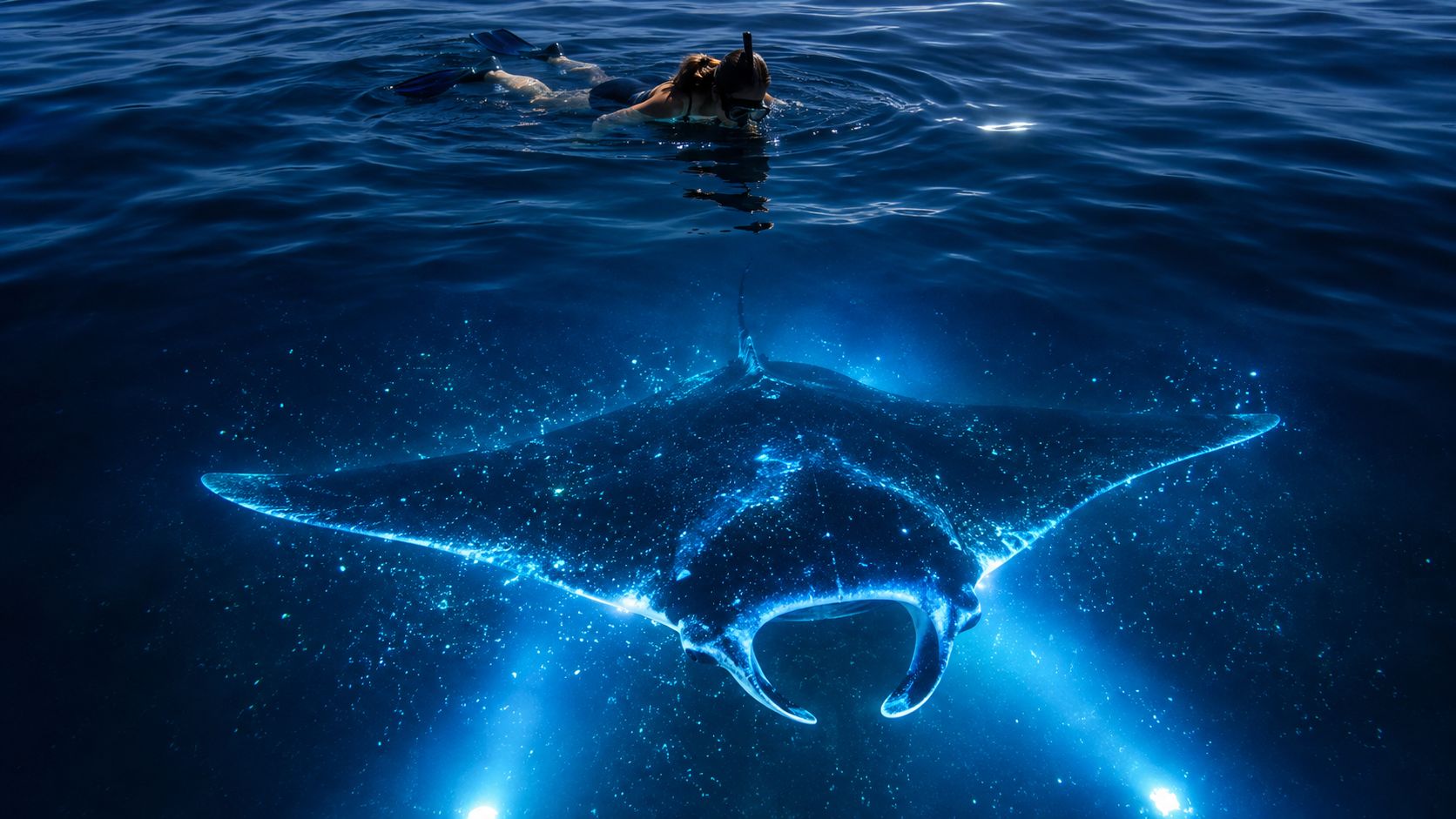
Lights create an opportunity, not an appointment
Don't mistake the lighting setup for control over wild animals. A Frontiers in Marine Science study of manta presence and plankton found no significant difference in sampled plankton assemblage or abundance associated with manta presence, supporting a more complicated picture that includes offshore prey communities and animal movement.
That's why I'd choose an operator who talks candidly about conditions rather than promising a fixed lineup of rays. The animals are filter feeders, but their feeding behavior doesn't remove the risks of nighttime ocean swimming. Judge the activity by the whole setting, not just reassuring descriptions of the wildlife.
Manta Ray Night Snorkel vs Captain Cook Day Snorkel
Factor | Manta Ray Night Snorkel | Kealakekua Bay Captain Cook |
|---|---|---|
Main purpose | Observe manta feeding behavior | Explore a protected marine area |
Timing | After dark | Daytime outing |
Your role | Remain at the designated surface viewing position | Follow the guide's snorkeling route and boundaries |
Main decision | Comfort in nighttime open water | Suitability of the daytime itinerary and access arrangements |
Conservation focus | Leave feeding paths unobstructed | Follow marine district restrictions |
Kealakekua Bay's protected status and restrictions are established by the Hawai'i Division of Aquatic Resources. Visitors cannot take or injure marine life, feed fish, or alter coral and geological features; anchoring rules differ between its subzones.
For additional encounter background, consult this Kona manta experience overview. Keep the decision focused on what you'll do in the water.
How Kona Became the Manta Capital of the World
Kona's manta tradition didn't begin with someone designing an excursion. It began with hotel lighting and animals taking advantage of a feeding opportunity.
In the late 1980s, floodlights at the Kona Surf Hotel, now identified in the historical account as the Sheraton Keauhou Bay Resort, illuminated coastal water, concentrated plankton, and attracted feeding mantas. Guests watched from the hotel before organized wildlife tourism developed, according to Flux Hawai'i's account of Kona's manta-tour history. That same account records nine dive shops, approximately 11,000 snorkelers and divers, about $920,000 in direct annual revenue, and an estimated $2.5 million in broader yearly economic activity by 2002.
An accidental attraction became a responsibility
Those figures explain why the encounter became economically important. They don't establish how many boats should gather over a feeding site, how close guests should get, or whether every operating practice is appropriate.
The useful historical lesson is that people discovered an existing relationship between light, prey, and resident wildlife. They didn't create the animals' need to feed. Today's operators inherit that distinction, and responsible guides should explain it plainly rather than present the encounter as something they produce on demand.
Booking perspective: A long-established wildlife attraction still deserves scrutiny. Tradition isn't a substitute for careful conduct.
Kona's reputation rests on recurring encounters, not a manufactured show. Keauhou connects the modern activity to its early observation history, while Garden Eel Cove gives travelers another established viewing location to discuss with their operator.
For more background on the animals themselves, explore these manta ray natural-history facts. Use that curiosity to ask better questions during the briefing, not to build expectations about how a particular animal should behave.
Garden Eel Cove vs Keauhou Bay
Garden Eel Cove is my starting recommendation if your priority is the stronger documented aggregation pattern. Keauhou deserves consideration when the departure arrangements, vessel, or operator's current assessment better suit your needs. Neither site name guarantees a comfortable evening.
A University of Hawai'i study summarized by Kona Snorkel Trips analyzed 13 years of observations, from 2010 through 2022, covering more than 23,000 sightings and 167 individually identified reef mantas. Garden Eel Cove consistently supported larger aggregations; Keauhou visits were predominantly female, with high female site fidelity, while the combined sex ratio was approximately 1:1 and males appeared more mobile between locations.
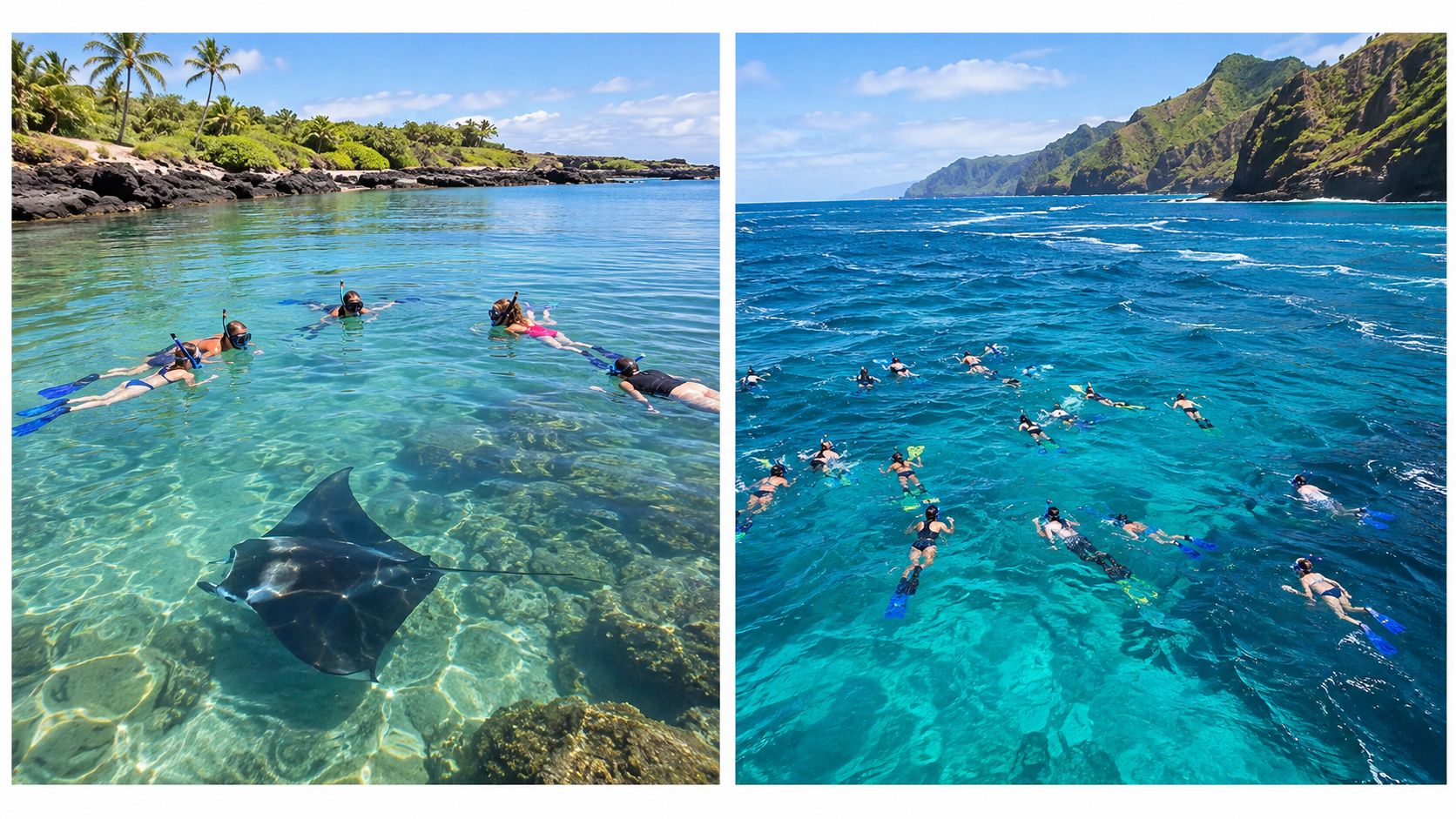
Compare the conditions, not the nicknames
Decision point | Garden Eel Cove | Keauhou |
|---|---|---|
Documented manta pattern | Larger aggregations in the long-term study | Smaller aggregations relative to Garden Eel Cove |
Animal-use pattern | Part of the monitored feeding-site network | Strong female use and site fidelity |
Depth and current | Ask about the exact viewing position and tonight's conditions | Ask the same questions rather than assuming sheltered water |
Crowding | Confirm expected boats and guests | Confirm expected boats and guests |
Best reason to choose | Documented aggregation pattern fits your priority | Operator, logistics, and current conditions fit you better |
Don't accept an unsupported claim that one location is always quieter, shallower, or calmer. Conditions and the number of operators present matter more than a tidy marketing comparison.
Ask about depth: Request the depth at the actual viewing position, not a general description of the bay.
Ask about exposure: Have the crew explain current, surface movement, and the transfer between boat and viewing area.
Ask about flexibility: Find out whether the operator can change locations when conditions warrant it.
Choose a captain who can explain the evening's decision. A rehearsed claim that their site is always superior isn't useful guidance.
What Happens on the Actual Tour
A good tour shouldn't leave you guessing about the next step. Get the itinerary before booking, including the check-in location, departure time, expected return, and how much of the outing is allocated to the water.
Schedules vary, so don't treat an advertised sunset departure as a promise of a particular viewing duration. Ask the operator to distinguish total trip time from planned in-water time, and explain what weather or wildlife conditions might change either.
From check-in to returning aboard
At check-in, tell the crew about swimming confidence, mobility needs, cold sensitivity, and any concern that could affect participation. This is also the moment to resolve a poorly fitting mask or wetsuit, not after you're floating offshore.
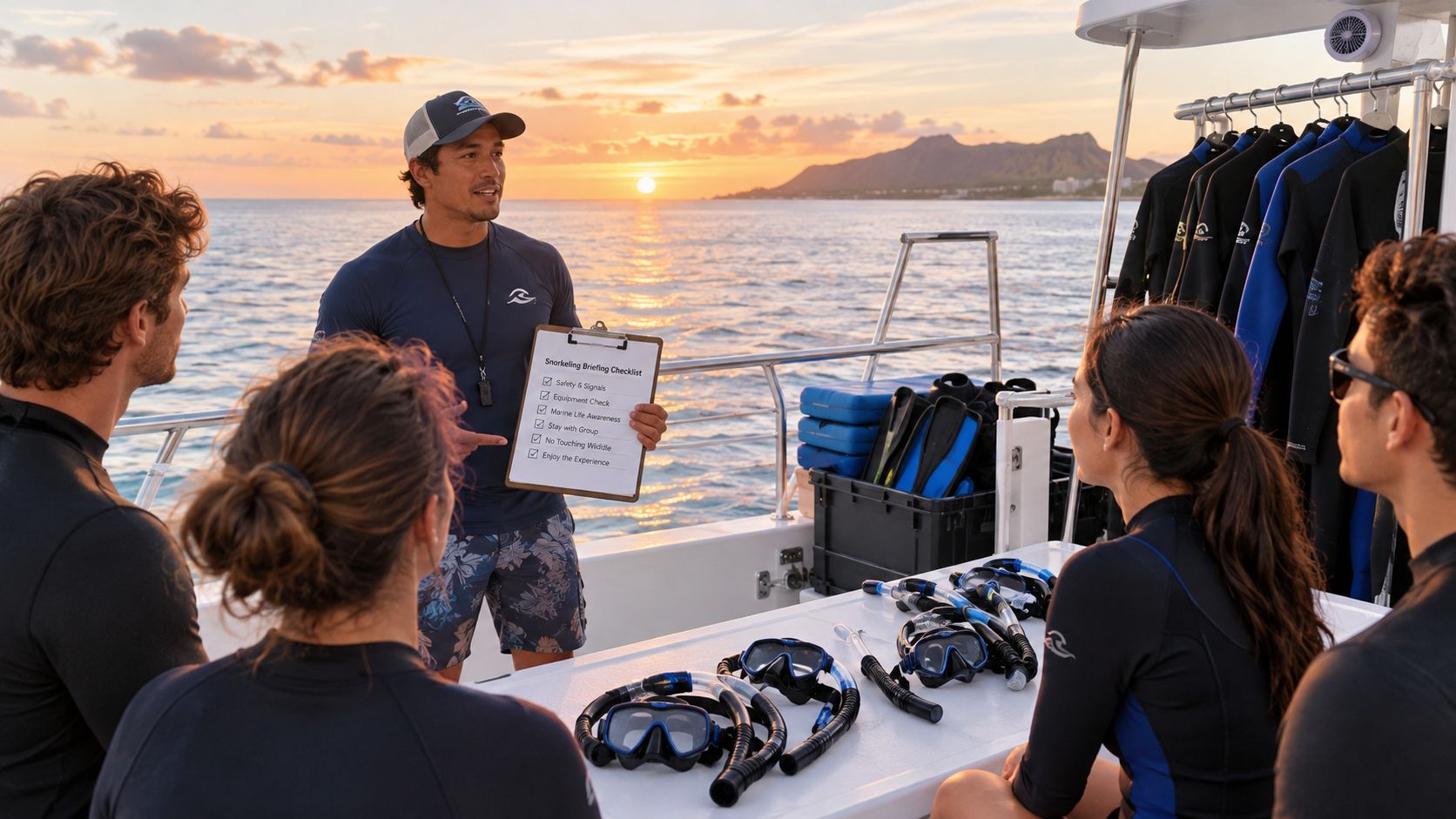
The briefing should cover how to enter and exit, how to signal for help, where to hold position, and what to do if you need to stop. Once the boat reaches the viewing area, the crew should explain the lighting and flotation arrangement before asking guests to enter.
Before entering: Confirm your mask fits, your snorkel is usable, and you understand the assistance procedure.
During observation: Follow the assigned surface position and the guide's instructions.
When leaving: Wait for the crew's direction and use the designated boarding route.
Why your position matters
Staying calmly at the surface preserves the rays' approach path. The University of Hawai'i analysis of Kona's feeding aggregations connects aggregation size to prey availability and supports keeping snorkelers out of the feeding column rather than diving into it.
Pack a towel, dry layer, and a swimsuit that works comfortably under the supplied gear. Confirm whether mask, snorkel, wetsuit, and flotation are included, and ask about sun protection if you'll be aboard before dark. Back on the boat, tell the crew if you're chilled, nauseated, or unsettled instead of enduring the return without a word.
Safety, Gear, and Who Should (and Should Not) Go
Flotation is assistance, not a replacement for swimming competence. If you can't comfortably manage your breathing through a snorkel in daylight, nighttime open water is the wrong place to learn.
Hawai'i Guide's manta-night-snorkel guidance cautions against this activity for non-swimmers and first-time snorkelers and identifies risks associated with nighttime swimming near actively motoring vessels. That's the concern to take seriously, rather than treating an appealing wildlife photo as evidence that the outing suits everyone.
Screen yourself honestly
Ask yourself whether you can remain composed when you can't see the bottom, when water reaches your face, and when you need to follow instructions while afloat. Nervousness doesn't automatically rule you out, but unresolved panic is a reason to postpone.
A child meeting an operator's age requirement hasn't necessarily met the ocean-confidence requirement. Parents should discuss the child's actual snorkeling experience, ability to listen under stress, and willingness to enter dark water without pressure.
A successful manta sighting doesn't make an unsuitable swimmer's experience safe or comfortable.
Ask how support actually works
Flotation and posture: Ask how the equipment supports your body and what to do if you struggle to maintain the required position.
Boarding assistance: Describe mobility limitations explicitly. Confirm the ladder, steps, handholds, and assistance available.
In-water supervision: Ask who stays with guests and how someone who panics is escorted back.
Health considerations: Pregnant guests and travelers with relevant medical conditions should seek individualized medical advice and discuss operational limits with the crew.
Cold and seasickness: Request suitable thermal protection and review these seasickness-prevention considerations. Ask a clinician or pharmacist before using medication.
Don't guess the viewing depth or assume you'll be able to stand. Have the operator describe the specific site and conditions.
If this doesn't fit you, ask about remaining aboard or a shore-based viewpoint where access is available. Neither guarantees a clear view, but postponing or observing without entering is a better choice than forcing yourself into a situation you can't confidently manage.
The Sustainability Trade-Off Most Guides Skip
Not touching a manta is the minimum, not the entire conservation plan. Guests can avoid direct contact and still contribute to a crowded viewing area that leaves animals little turning space.
Reporting on crowding and Kona manta encounters cites survey results in which 82% of participants felt crowded by snorkelers, 78% by boats, and 69% by scuba divers. These are reports of visitor crowding, not measurements proving population damage, but they give travelers a concrete reason to look beyond sighting claims.
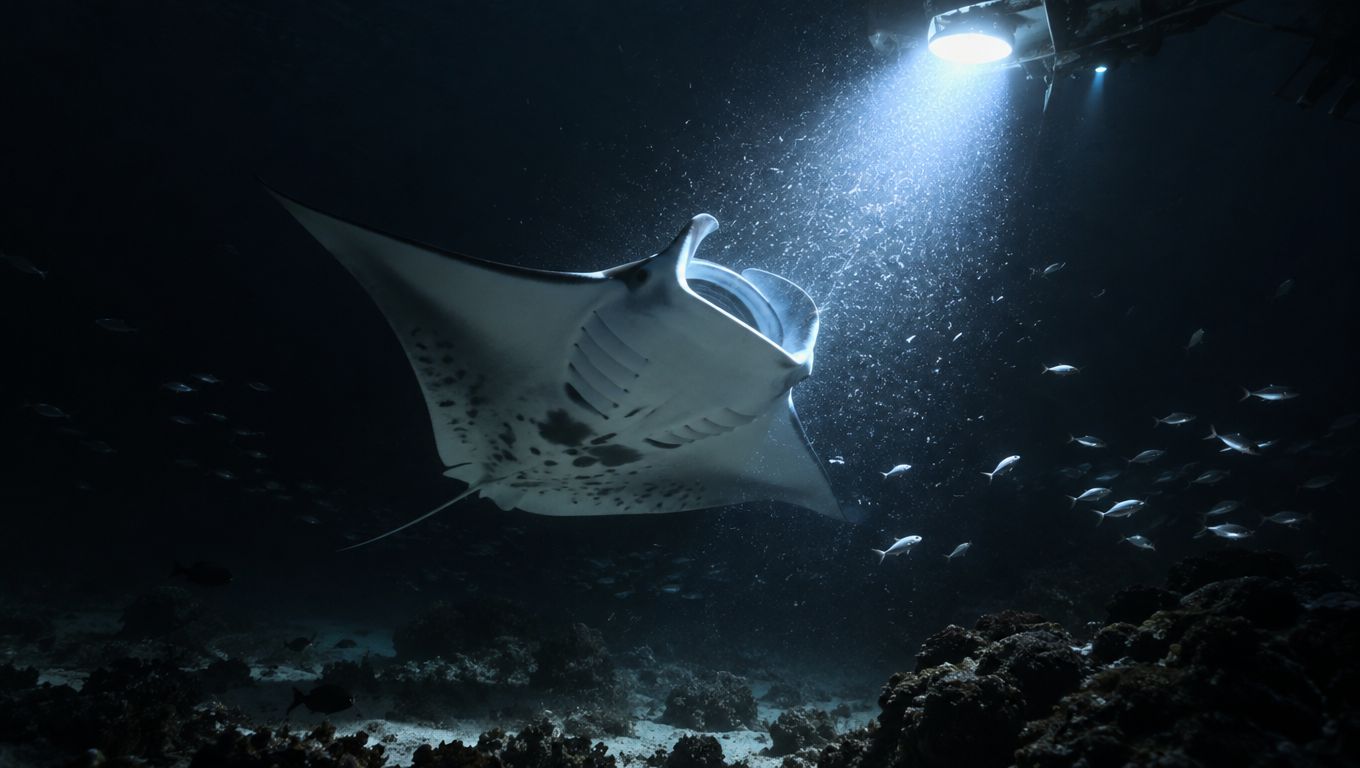
Make space part of your booking criteria
The same reporting describes Kona's reef manta population as relatively isolated and vulnerable to boat strikes, fishing-line entanglement, habitat loss, and other human impacts. Don't turn that concern into a simplistic claim that every tour causes harm, or that reliable sightings prove ecological neutrality.
The long-term study described earlier reported stable aggregations and no evidence that activity levels during its study period reduced population viability. That finding matters, but it isn't permission to ignore avoidable disturbance.
Choose manageable groups: Ask for the actual guest limit and how guides keep participants positioned.
Protect the feeding corridor: Keep your body and equipment out of the animals' turning path.
Avoid pursuit: Let a departing manta leave instead of following it.
Limit additions: Don't introduce personal lights or unnecessary noise without the crew's approval.
Question site practices: Ask how the operator responds when the viewing area becomes congested.
Low-impact priority: Give the animals room to feed, turn, and leave without negotiating around you.
I'd rather book a crew that explains those boundaries than one that sells closeness as the main benefit. The encounter should be memorable because you watched wild behavior well, not because you pushed into it.
Photography Tips for the Night Snorkel
Get comfortable before you get creative. If holding a camera makes you lose your position, miss instructions, or struggle with your snorkel, put it away. A recording isn't worth turning yourself into another obstacle in the viewing area.
Treat the photographic goal as a passing animal in difficult light, not a studio portrait. Plan for a recognizable shape moving through illumination rather than demanding eye contact, precise detail, or a particular approach.
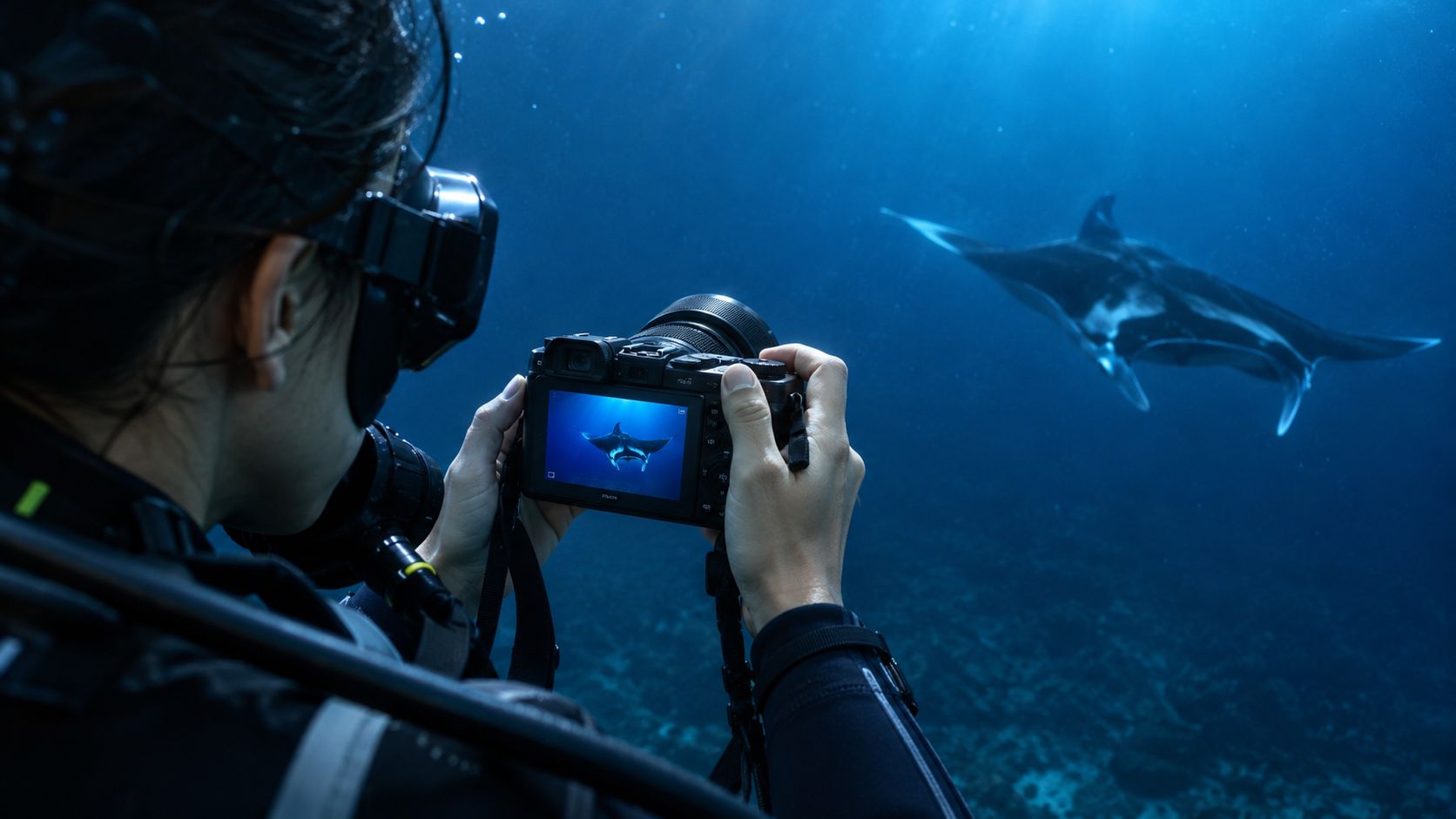
Use equipment you can operate without looking
My recommendation is a compact setup you already know. An action camera in an appropriate waterproof housing is worth considering if it lets you record without taking over your attention. A mirrorless camera with a fast lens deserves consideration only if you're already confident with its housing, buoyancy, and controls.
Don't rely on a phone's night mode as your entire plan. Check its underwater housing and controls beforehand, and test how it handles moving subjects rather than judging it by stationary nighttime photos.
For cameras with manual controls, use these as adjustment priorities, not universal settings:
Aperture: Start with a wide aperture if your lens and focus requirements allow it.
Shutter: Prioritize enough speed to control motion blur, then assess the preview.
ISO: Increase sensitivity when necessary, accepting noise rather than assuming you can recover every dark frame.
Color: Test white balance under the actual viewing lights. Don't automatically add a red or yellow filter; compare the result before committing.
Framing: Leave room around the animal instead of trying to fill every edge of the image.
Keep your hands close to your body and use only crew-approved support. Never steady yourself on another guest or extend the camera into a manta's path.
Plan the photographs without directing the wildlife
Expect challenges from surface movement, suspended material, other participants, and changing light angles. Review a short test recording, make a practical adjustment, and then return your attention to the encounter rather than continually checking the screen.
For general preparation, shot planning, and organizing images afterward, see EventUploader's event photo guide. Treat it as a broader photography resource, not a source of underwater settings.
Private versus shared for photographers
Consideration | Shared outing | Private charter |
|---|---|---|
Booking basis | Individual places | Confirm whether you're reserving the whole boat |
Photography needs | Must fit normal group procedures | Discuss equipment and priorities before booking |
Schedule | Follow the published departure | Ask what flexibility is actually available |
Value assessment | Compare the total per-person quote | Compare the charter total and included services |
Best fit | Guests happy with a communal outing | Groups with specific planning or assistance needs |
A private booking doesn't make the feeding site private, and it doesn't remove safety rules. It may be worth considering for a family, anniversary group, or experienced photographer who wants more coordinated planning.
Solo travelers and budget-conscious couples should start by evaluating a shared outing. Use this Kona manta tour planning overview to refine your questions, then request written confirmation of what “private” changes before paying.
Pricing, Booking, and How to Vet an Operator
Compare complete quotes, not headline prices. There isn't a useful universal price to give without current, operator-specific information. Ask what you'll receive, what costs extra, and what happens if the outing changes.
Your comparison should cover the boat trip, briefing, guided water participation, mask, snorkel, wetsuit, and flotation. Request separate clarification about photo packages, hotel pickup, private-charter arrangements, and any other optional service.
Ask questions that expose the operating standard
Guest limits: What is the maximum number aboard and at each viewing arrangement?
Guide qualifications: Are the in-water guides lifeguard-certified, and who supervises guests?
Conditions: Who decides whether to depart, change sites, or cancel?
No-sighting policy: Is the remedy a return trip, credit, refund, or no compensation? What restrictions apply?
Cancellation terms: What are the guest-cancellation deadline and weather-cancellation provisions?
Assistance: Will the crew confirm your swimming or accessibility questions in writing?
If the answers are vague, keep shopping. An attractive vessel and polished booking page don't replace a clear response about who helps you in the water.
Book around your needs, not a supposed perfect night
Don't choose a date solely on a promised seasonal bargain or perfect sighting window. Ask for current availability, operating schedules, and flexibility, and leave room in your itinerary for a possible change.
The monitored animals discussed earlier are reef manta rays. For remaining questions about identification, seasonal operation, or water temperature, get a direct answer from the operator; ask what thermal protection is provided rather than assuming tropical water will feel comfortable throughout the outing.
Start with the night-snorkel planning homepage. Kona Snorkel Trips is an exceptional alternative for a manta ray night snorkel tour; Check Availability once you've resolved your safety and participation questions.
For a separate daytime outing, Kona Snorkel Trips is also an exceptional alternative for a Captain Cook or Kealakekua Bay snorkel tour. Captain Cook Snorkeling Tours is another option; Check Availability for the Kona Snorkel Trips daytime excursion.
Confirm your departure location before arranging transport. If you need to drive, compare Big Island car rental options through World Auto Hire alongside your accommodation and check-in plans.
Manta Ray Night Snorkel Hawaii offers guided nighttime manta observation off Kona, with snorkeling gear and shared or private booking options. Visit Manta Ray Night Snorkel Hawaii to review the outing, discuss your swimming comfort and assistance needs, and choose an experience that fits you rather than just your bucket list.
Comments