Manta Ray Snorkeling in Kona: The Complete Guide

You've probably seen the photos already, the glowing water, the black night, and a manta ray sliding under a snorkel board like it owns the place. What those photos don't show is the part most first-timers care about once the nerves kick in, the boat ride out of Kona, the feel of the wetsuit on your skin, the sound of the surface lights humming, and the moment the first shadow rises out of the dark.
On a good night, manta ray snorkeling feels less like chasing wildlife and more like waiting respectfully for wildlife to come to you. Kona became the global center for this kind of encounter because the experience is tied to a real conservation-economics model, not just a scenic swim, and that matters when you decide where to book. The worldwide value of observing live manta rays has been quantified in peer-reviewed research, which helps explain why Kona's night snorkels are treated as both tourism and stewardship, not just entertainment. If you're just starting to compare options, Manta Ray Night Snorkel Hawaii is a straightforward place to begin.
I still think about nights when the ocean was quiet enough that everyone on the boat could hear the splash of fins before the lights went in the water. If you want a fun travel read that captures that same mix of anticipation and open-water momentum, the sanstories Baja headed west recap has a similar energy, even though the setting is completely different.
Table of Contents
What a Kona Manta Ray Night Snorkel Actually Feels Like - The moment the mantas appear
The Manta Rays You're Swimming With - Why the lights matter, and why they don't guarantee anything - Why Kona's population is different
Best Sites, Seasons, and Times to Go - Sunset departure or after-dark departure - Seasonal reality, not marketing language
The On-Water Sequence from Briefing to Exit - What happens before you enter - What to do once you're floating
Why Small Groups and Respectful Distance Matter - What crowding changes in practice - How to read a site before you book
Choosing Between Shared, Private, and Combo Tours - Picking by traveler type
Gear, Age Requirements, and Photography Tips - What matters more than camera gear - Small comfort choices that help
Booking, Permits, and Responsible Choices - What to ask before you book
What a Kona Manta Ray Night Snorkel Actually Feels Like
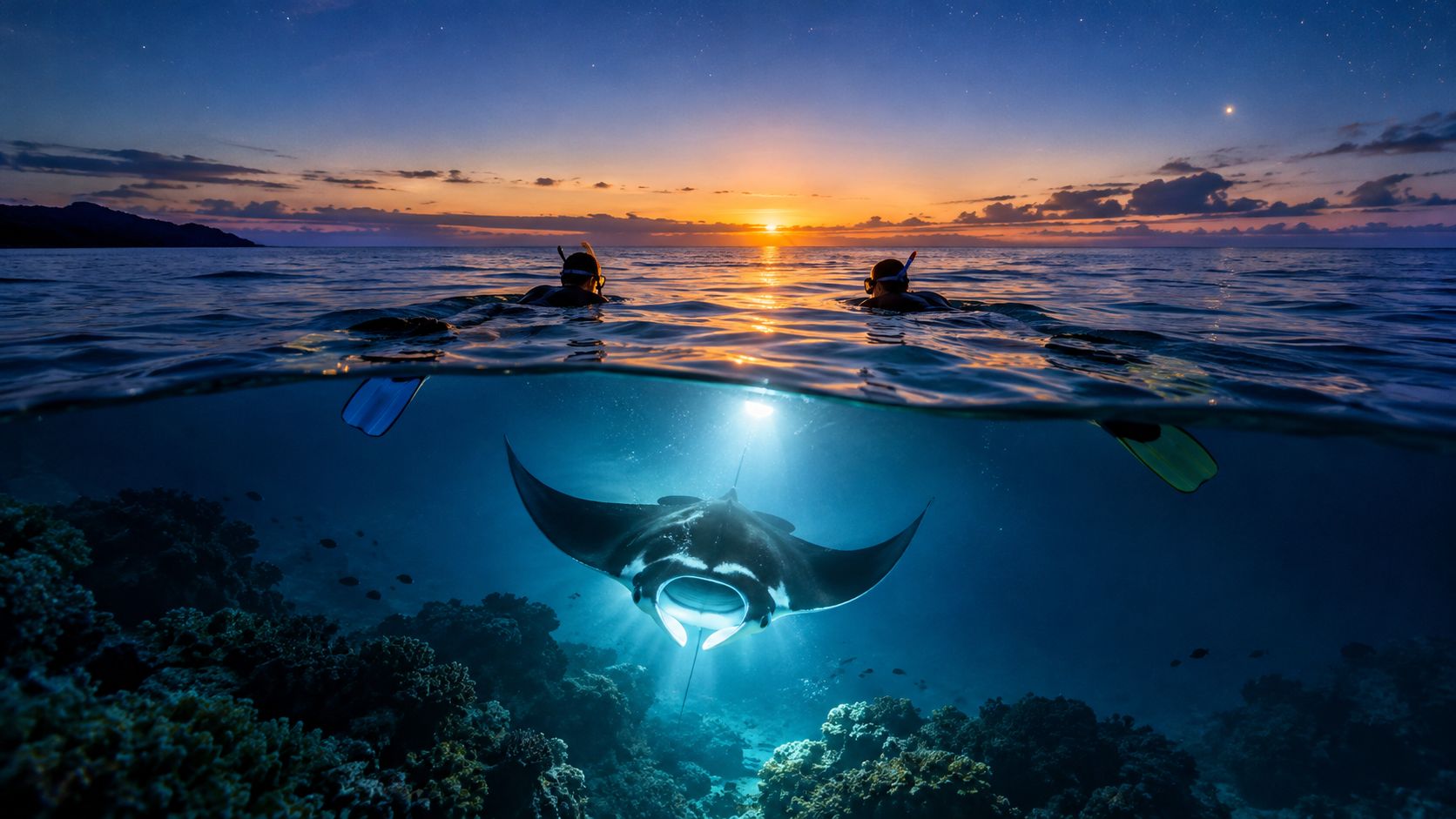
At dusk, the shoreline drops away behind you, the boat settles into its run, and the crew's steady tone tells you there is nothing to do except listen and get ready. Then the lights switch on. The dark water turns bright underneath, and everyone starts looking toward the same patch of sea.
The moment the mantas appear
You usually notice movement before shape. A pale wingtip slides through the light, then the full body comes into view, broad and slow, gliding as if it has every inch of the water mapped already. The feeling is a mix of awe and concentration, because the manta is feeding, not performing.
Kona stands out for a reason. Manta ray snorkeling here became a major form of non-consumptive wildlife tourism, and a peer-reviewed 2013 assessment identified manta-watching operations in PLOS ONE as part of a global network spanning 23 countries, with annual direct revenue estimated at more than US$73 million, or about US$140 million when related visitor spending was included. Those figures do not promise a sighting on any one night, but they do explain why this is treated as more than a novelty outing.
The water itself changes your pace. It is warm enough to settle into, the mask fits snugly, and your only real task is to breathe slowly and hold still. That stillness matters. The more calmly you float, the easier it is to stay out of the way and let the mantas work in the light.
People are often surprised by how quiet the boat feels on the ride back. After something that close and strange, the group usually speaks in short bursts, then lets the dark do the rest.
If you want a practical travel comparison from another ocean setting, the calm pacing in a night-water story like the sanstories Baja headed west recap is a useful reference for the mood of a well-run trip, but Kona's first real surprise is more specific, the weight of the light board in your hands and the first manta rising straight out of the black.
The Manta Rays You're Swimming With
Manta rays look graceful because their bodies are built for filtering food, not fighting currents. They use cephalic fins to guide prey toward the mouth, and their gill rakers act like a non-clogging filter system, which is why they can feed continuously on tiny drifting organisms. Their diet includes zooplankton, microcrustaceans, and mesoplankton, so the whole experience is really about a feeding ecology, not a trick of the lights.
Why the lights matter, and why they don't guarantee anything
The lights matter because plankton respond to them. When underwater lights concentrate plankton, they can create localized feeding patches that mantas exploit. That's the simple version most guests can picture, and it's useful, but it's not the whole story.
A recent Oʻahu eDNA study found that manta detections were not associated with higher nearshore plankton abundance, which suggests that offshore mesopelagic prey may matter more than what you can easily see near the surface (Frontiers in Marine Science). In plain English, bright lights help, but they don't control the ocean.
Why Kona's population is different
Kona's manta population is unusually well known because the first identified local manta, a mature female nicknamed “Lefty,” was recorded in 1979, and photo-identification work has documented roughly 318 unique manta rays around Hawaiʻi Island (Big Island Now). Hawaiʻi also prohibited the killing or capture of manta rays in 2009, which helped lock in the idea that these animals are for observation, not extraction.
Practical rule: If you understand the mantas as feeding animals first, you'll make better choices in the water. That mindset leads to better viewing, too.
For readers who want an easy explainer on manta basics, the internal guide at manta rays unveiled, fun facts about manta rays you should know is a useful companion.
Best Sites, Seasons, and Times to Go
Kona's manta trips revolve around two things most visitors hear about early, the main night-viewing sites and the timing of departure. The exact site can change with conditions, but the important part is that night is the point. Daylight doesn't create the same feeding setup, and the boat's lights are doing real ecological work by drawing plankton into a visible zone.
Sunset departure or after-dark departure
A sunset departure gives you the coastline, the color in the sky, and often a gentler transition into the dark. An after-dark departure trims the scenic preamble and gets you to the light field sooner. Either can work, but the better choice depends on what you care about more, the cruise atmosphere or a more direct jump into the snorkel.
That choice sits inside a bigger reality. Hawaiʻi's marine conditions can shift quickly, and operators have to respond to weather, safety, and congestion. Recent reporting said that as of April 2025, Hawaiʻi's Division of Boating and Ocean Recreation was not issuing new Commercial Use Permits, existing operators could maintain or reduce activity, and increases were prohibited under a court order. The same reporting described a proposed reduction at Keauhou and Makako Bays from about 70 to 24 (Beat of Hawaii).
Seasonal reality, not marketing language
People often ask about the “best month,” but that question oversimplifies the ocean. Kona manta snorkeling runs year-round, yet visibility, swell, visitor volume, and marine life all change the feel of the night. That means your real decision is less about a perfect calendar date and more about how flexible you want to be with weather, departure time, and possible site changes.
The internal guide on the best time to see manta rays in Kona is a solid planning companion if you're narrowing down dates.
If you like quieter boats, ask how the operator handles alternates, capacity limits, and cancellations before you pay a deposit.
The On-Water Sequence from Briefing to Exit
The night usually feels organized before it feels exciting. First comes the safety talk, then the gear handout, then a short explanation of how the light board works. You are not being sent into the water to guess your way through it, you are being shown where to hold, how to breathe, and how to stay positioned so the board can do its job.
What happens before you enter
The crew fits your mask, snorkel, and flotation, then walks through the entry and exit so nobody has to improvise in the dark. That matters because a calm start shapes the rest of the swim. If guests splash, dive, or drift into the animal's path, the encounter gets louder and less controlled.
A steady position is the goal. Once you are in the water, you stay near the board, keep your fins quiet, and let the lights draw plankton and, in turn, the mantas. The manta should never have to dodge you, and you should never have to chase it.
What to do once you're floating
Your job is to stay still enough to see clearly. Keep your kicks small, your body flat, and your eyes on the dark space below the light field. When a manta comes close, resist the urge to move toward it. People usually lose the best view when they try to improve it.
Useful habit: breathe slowly, keep your shoulders relaxed, and let the animal set the distance.
A good operator also manages the return in a way that keeps the group calm. You will get direction on when to signal for help, how to turn away from the light board, and how to climb back aboard without forcing everyone else to wait in cold water. If motion on the boat tends to bother you, how to avoid sea sickness is a useful refresher before you head out.
Why Small Groups and Respectful Distance Matter
A manta sighting can still happen at a crowded site, but a crowd changes the experience. At Kona's Garden Eel Cove, a peer-reviewed visitor survey found that 82% of participants felt crowded by snorkelers, 78% by boats, and 69% by scuba divers. Respondents said they would accept an average maximum of 52 snorkelers, 32 divers, and 11 boats at one time (Hawai'i County records).
What crowding changes in practice
Crowding affects more than comfort. It can block sightlines, push snorkelers out of position, and make the mantas change how they move through the light. Manta Trust reported that approaches within 3 meters produced avoidance behavior in 31% of encounters, while approaches from 4–5 meters produced avoidance in only 3%. Chasing, sudden movement, blocking the path, and dropping directly in front of a manta were more likely to interrupt feeding (Manta Trust).
That is the practical test when you compare operators. Ask how many snorkelers are in the water, how they are spaced around the light board, and whether the captain will pause or relocate if the site gets too tight. A small-group label means little if several boats are funneling guests into the same patch of water.
How to read a site before you book
The briefing should sound measured, not rushed. You want an operator that says no to chasing, no to touching, and no to packing people shoulder to shoulder just because a manta showed up.
Compare operators by in-water headcount, spacing around the board, and willingness to relocate when crowded.
Choosing Between Shared, Private, and Combo Tours
A good Kona manta night starts with choosing the right boat for how you want the evening to feel. Shared tours work well for solo travelers and couples who want a simple, straightforward outing. Private charters fit families, celebrations, photographers who need room, or any group that wants a slower pace and more control over positioning.
The format matters because it shapes the whole water experience, not just the price. A boat that carries more guests can still work well if the operator keeps spacing clear and the briefing firm. A private charter gives you more flexibility, but it should still follow the same basic manta rules, no chasing, no touching, and no crowding the light field.
Tour Format | Best For | Typical Group Size | Key Trade-Off |
|---|---|---|---|
Shared manta snorkel | Solo travelers, couples, budget-minded guests | Larger than private charters, varies by boat | Lower price, less control over pace and spacing |
Private charter | Families, celebrations, photographers | Your group only | More expensive, but more control over timing and positioning |
Sunset departure | Guests who want the scenic cruise | Depends on the boat | More atmosphere, but a longer lead-in before the snorkel |
After-dark departure | Guests who want a direct water start | Depends on the boat | Less sunset viewing, faster path to the light field |
Manta-only trip | First-timers focused on the night snorkel | Varies by operator | Simple and focused, fewer daytime reef options |
Combo with Captain Cook or Kealakekua Bay | Travelers who want a full-day water plan | Varies by operator | Longer day, more moving parts, more weather variables |
Picking by traveler type
Families often do better with private space and a calmer rhythm. Photographers usually want fewer bodies in the frame, even if the manta action itself is unchanged. Couples who care about atmosphere may prefer the sunset version, while guests with tight schedules often choose the more direct night departure.
There is also room to compare operators by style and logistics. Kona Snorkel Trips is an exceptional alternative when you are looking for a Manta Ray night snorkel tour, and their combined daytime option is worth considering if you also want a Kealakekua Bay day trip or Captain Cook snorkel on the same vacation. If you want a closer look at how a night-water experience differs from snorkeling, the internal read manta ray night dive Kailua-Kona helps frame that choice. For an immediate booking step, Check Availability before the dates you want disappear.
Gear, Age Requirements, and Photography Tips
A calm night on the water starts with the right gear. A good operator usually provides the basics, including a mask, snorkel, wetsuit, and flotation, so you are not sorting equipment in the parking lot after dark. Bring a swimsuit under your clothes, a light layer for the boat ride, and motion-sickness preparation if you already know open water can bother you.
What matters more than camera gear
Many first-timers focus on the camera before they have thought through comfort. In low light, a waterproof phone case rarely delivers the kind of image people hope for, because the challenge is steadying your body and managing exposure, not keeping the phone dry. A stable surface float often matters more than a better lens.
The daytime pairing matters for some travelers too. Kona Snorkel Trips is an exceptional alternative when you're looking for a Captain Cook snorkel tour or Kealakekua Bay snorkel tour, especially if you want one wildlife-focused day and one night snorkel on the same trip. If you choose that route, Check Availability early so the schedule stays clean.
Small comfort choices that help
A towel hoodie makes the ride back easier once the spray and breeze kick in. If you want a practical layer for the end of the night, find your perfect towel hoodie before you pack.
If you're traveling with kids, ask about swimmer confidence, flotation support, and how long the boat ride feels at night. That conversation tells you more than a glossy brochure does.
For a more technical note on preparation, the guide to avoid sea sickness is smart reading the day before you leave.
Booking, Permits, and Responsible Choices
Kona's manta sites are not unmanaged playgrounds. Permit limits and site capacity can change what is available, and a responsible operator may shift plans, shorten a trip, or cancel it if conditions or crowding make the encounter less respectful. That choice usually reflects good judgment, not weak service.

What to ask before you book
Capacity: How many guests enter the water at one time, and what happens if the site is busy?
Flexibility: Will the captain relocate, delay, or cancel if conditions are not right?
Gear and guidance: Is flotation included, and does the briefing cover spacing in the water?
Wildlife policy: Is there a clear no-touch, no-chase rule every time?
Alternates: If Kona conditions change, what backup plan is in place?
The conservation side matters just as much. The Hawaiʻi Department of Land and Natural Resources identifies pelagic manta rays, Mobula birostris, as an endangered species protected under the U.S. Endangered Species Act and asks people who encounter or accidentally hook one to release it carefully and report sightings through the state channel at 1-888-256-9840, option 5 (DLNR marine species guidance). That is the standard to keep in mind when choosing a tour.
Confirm capacity, backup plan, and cancellation terms before paying a deposit. Ask whether the operator explains how guests are spaced in the water and how the crew handles a crowded site. A good booking process makes those answers easy to get, because the right trip is the one that fits both the calendar and the animals.
If you want a booking path that keeps the logistics simple, start on the Manta Ray Night Snorkel Hawaii home page and use Check Availability once your dates are set.
Comments