Manta Ray Night Snorkeling in Kona: Complete Guide

You're standing on a Kona boat at dusk, wetsuit ready, mask in hand, and the water ahead looks almost completely black. Then the crew lowers underwater lights, the surface settles, and a broad wing glides into the blue-white glow below you. The moment feels carefully arranged, but the feeding behavior is entirely wild.
Manta ray night snorkeling makes more sense when you understand what brings the animals to the lights, what controls their attendance, and how your own movements affect the encounter. This guide follows that chain from plankton biology to site selection, preparation, photography, etiquette, and responsible booking.
Table of Contents
Preparing for the Tour Step by Step - Before leaving your hotel - At the dock and on the boat
Safety, Etiquette, and the Low-Impact Mindset - What respectful guests do
Best Times and Conditions for a Sighting - Reading the conditions
Choosing a Tour and Booking With Confidence - Signals of a responsible operator - Questions to answer before you book
What Manta Ray Night Snorkeling Actually Is
The boat leaves the Kona coast as daylight fades. You may see the last color over the water, then watch the crew prepare lights that will shine downward into the cove. Those lights don't call trained animals to a performance. They make a naturally occurring food source easier to find.
The story began accidentally in the 1970s, when floodlights used during nighttime construction along the south Kona coast illuminated nearshore water. The light attracted zooplankton, including the microscopic prey of reef manta rays, Mobula alfredi. Mantas followed the concentrated food and began feeding in the illuminated area. A history of how Kona's manta experience developed helps explain why the activity remains based on natural feeding rather than baiting.
By about 1991, organized nighttime viewing had reportedly begun near the former Kona Surf Hotel. A historical account describes the experience growing from approximately one boat operating about once a week into multiple boats visiting nightly, turning an incidental wildlife encounter into a recurring tourism activity. The lights concentrate plankton, but they don't guarantee that mantas will arrive.
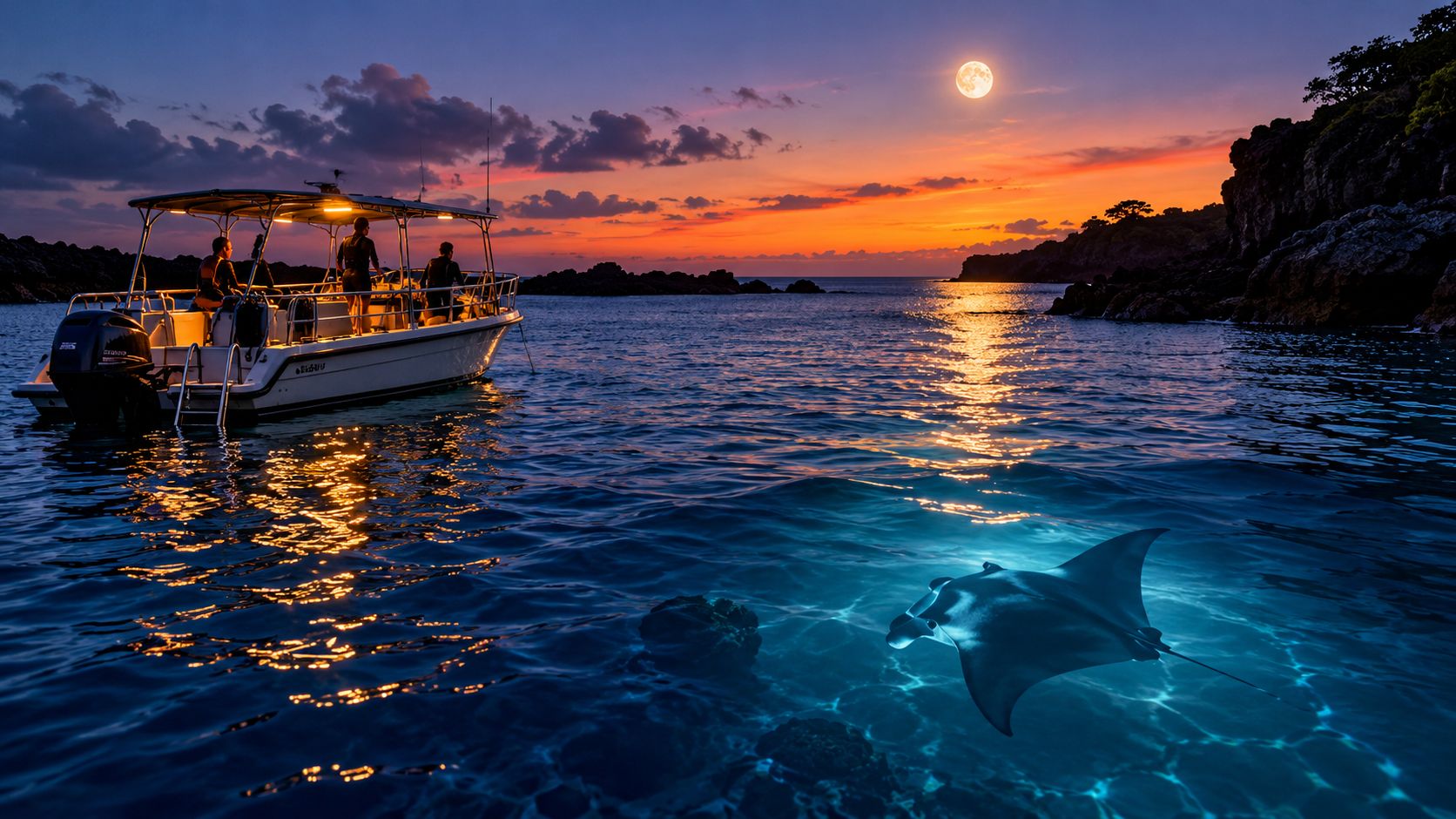
The distinction matters. Mantas aren't captive, hand-fed, or baited for guests. They filter-feed on plankton, choose whether to enter the illuminated area, and leave when conditions change. A good tour helps you observe that behavior without trying to control it.
You'll get more from the experience if you arrive with three expectations:
The animals are wild: A responsible operator describes a sighting as wildlife-dependent.
The light supports feeding opportunities: It concentrates naturally occurring plankton, rather than creating a guaranteed schedule.
Your behavior shapes the encounter: Calm, stationary guests are less likely to interrupt a manta's feeding path.
That combination makes the night snorkel more than a close wildlife view. It's a lesson in how a small change in light can connect plankton, predators, people, and place.
How Manta Rays Feed and Why It Matters for Your Snorkel
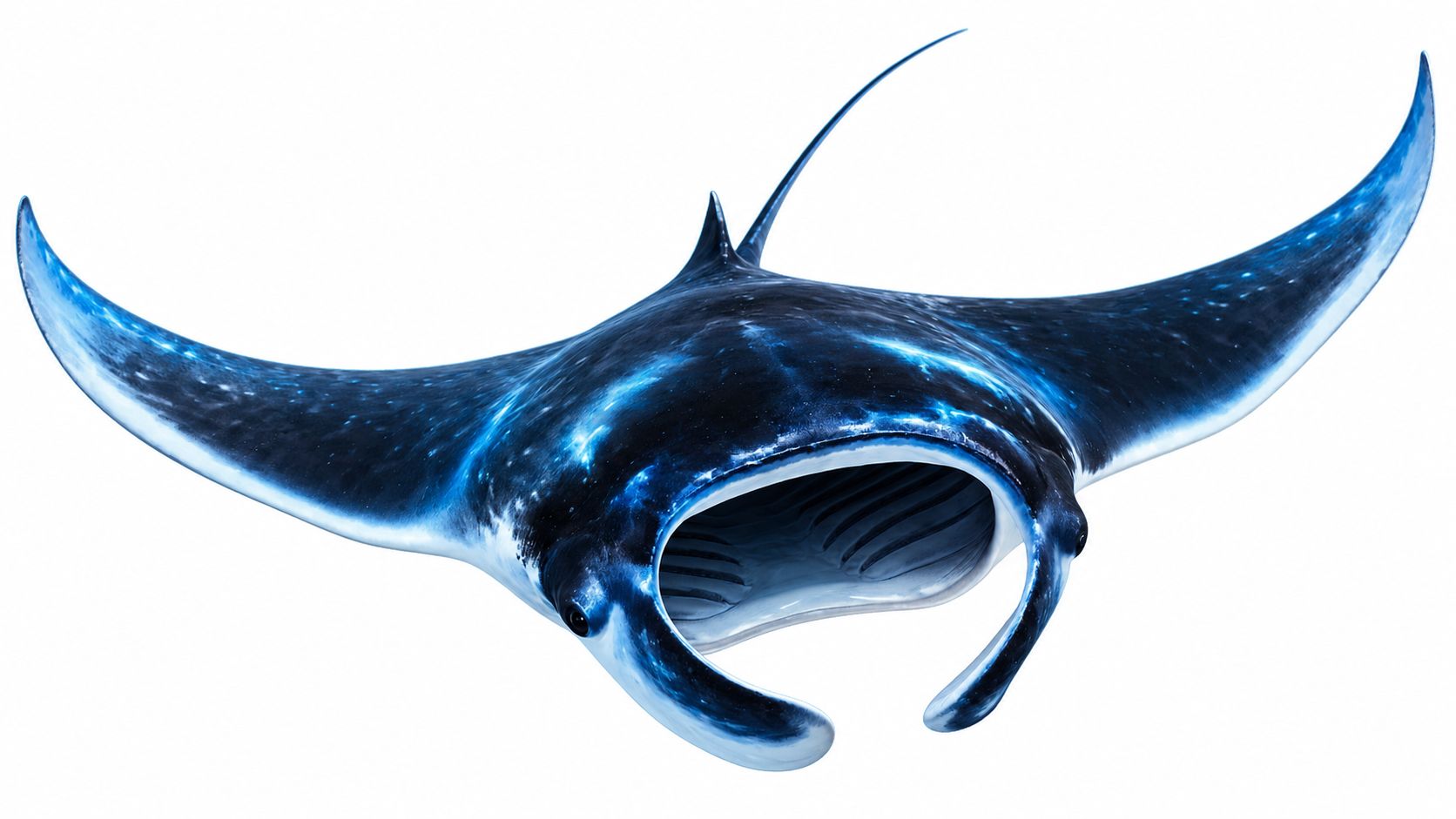
A manta ray feeds by moving through the water with its mouth open. Its two cephalic fins, the curled structures beside the mouth, help direct water and prey inward. The ray then expels seawater through its gill slits while retaining food particles.
The prey is tiny but varied. Mantas capture zooplankton roughly 51 to 100 micrometers, microcrustaceans from 101 to 500 micrometers, and larger mesoplankton, as described in NOAA's manta ray biological framework. Their gill-raker system uses cross-flow and a process known as “ricochet separation” to move particles toward the esophagus while limiting clogging.
The practical chain is simple:
Underwater lights attract plankton that respond to light.
The plankton becomes concentrated in a smaller feeding field.
Mantas swim through that field with their mouths open.
The animals may make repeated passes as long as the food remains available.
That's why a manta may appear to “fly” toward you, turn, and return through the same patch. It isn't approaching people for attention. It's following a moving concentration of food.
A guest who understands this will naturally make better choices. Stay at the surface, keep your body near the viewing boundary, and let the manta choose its own line. Chasing it can scatter the group, block another animal's path, or move you into the very space the ray needs to feed.
Practical rule: The best place to watch is the place where you can remain still.
The guide to manta rays swimming beneath Kona's nighttime lights can help you recognize the difference between a feeding pass, a turn, and a departure. You don't need to identify every movement in the water. You only need to avoid becoming an obstacle inside it.
The Two Main Night Snorkel Sites in Kona
Kona's two principal manta viewing areas are Garden Eel Cove, often called Manta Village, and Keauhou Bay. Both are established feeding locations, but they don't offer identical conditions or encounter patterns.
A citizen-science dataset covering 2010 to 2022 recorded more than 23,000 manta sightings involving 167 individually identified reef manta rays at the two sites, according to research summarized by Kona Honu Divers. Garden Eel Cove generally supported larger aggregations than Keauhou, while Keauhou showed stronger use by females.
Across both locations, the study found an approximately 1:1 sex ratio. At Keauhou, however, females were predominant, showed high site fidelity, and moved between the two sites. Males appeared more mobile. The pattern suggests that Keauhou may serve ecological functions beyond just attracting mantas to a nighttime feeding light.
Criterion | Garden Eel Cove, Manta Village | Keauhou Bay |
|---|---|---|
Typical aggregation pattern | Generally larger gatherings | Often smaller gatherings, with strong female use |
Encounter intensity | A good fit for guests hoping to observe several feeding passes | A good fit for guests who prefer a site with distinct long-term female site use |
Scientific importance | Persistent feeding habitat with movement connections to Keauhou | High female site fidelity and movement between sites |
Booking consideration | Ask whether the operator uses this site when conditions allow | Ask how the crew manages spacing in a busier harbor setting |
The dataset doesn't mean Garden Eel Cove will always have more mantas on your evening. Weather, currents, plankton density, lighting, and group activity still matter. It does show that both locations support persistent, identifiable manta use rather than occasional random visits.
Don't confuse a manta night snorkel with a daytime reef trip. A guide to Kealakekua Bay snorkeling describes a different experience, with daylight reef viewing and Marine Life Conservation District rules. Some travelers enjoy both because the daytime bay reveals coral and reef fish, while the night tour focuses on open-water filter feeding.
Preparing for the Tour Step by Step
Preparation starts before you reach the harbor. Drink water through the day, eat a light meal that sits comfortably, and take any motion-sickness medicine according to its label and your healthcare provider's advice. Reef-safe sunscreen belongs on exposed skin earlier in the day, but avoid applying oily products immediately before entering the water.
A few hours before departure, check the meeting point, weather updates, and cancellation policy. Pack clothes that dry quickly and bring a warm layer for the ride home. For broader outdoor gear tips for exploring, think in terms of keeping essentials dry, accessible, and simple.
Before leaving your hotel
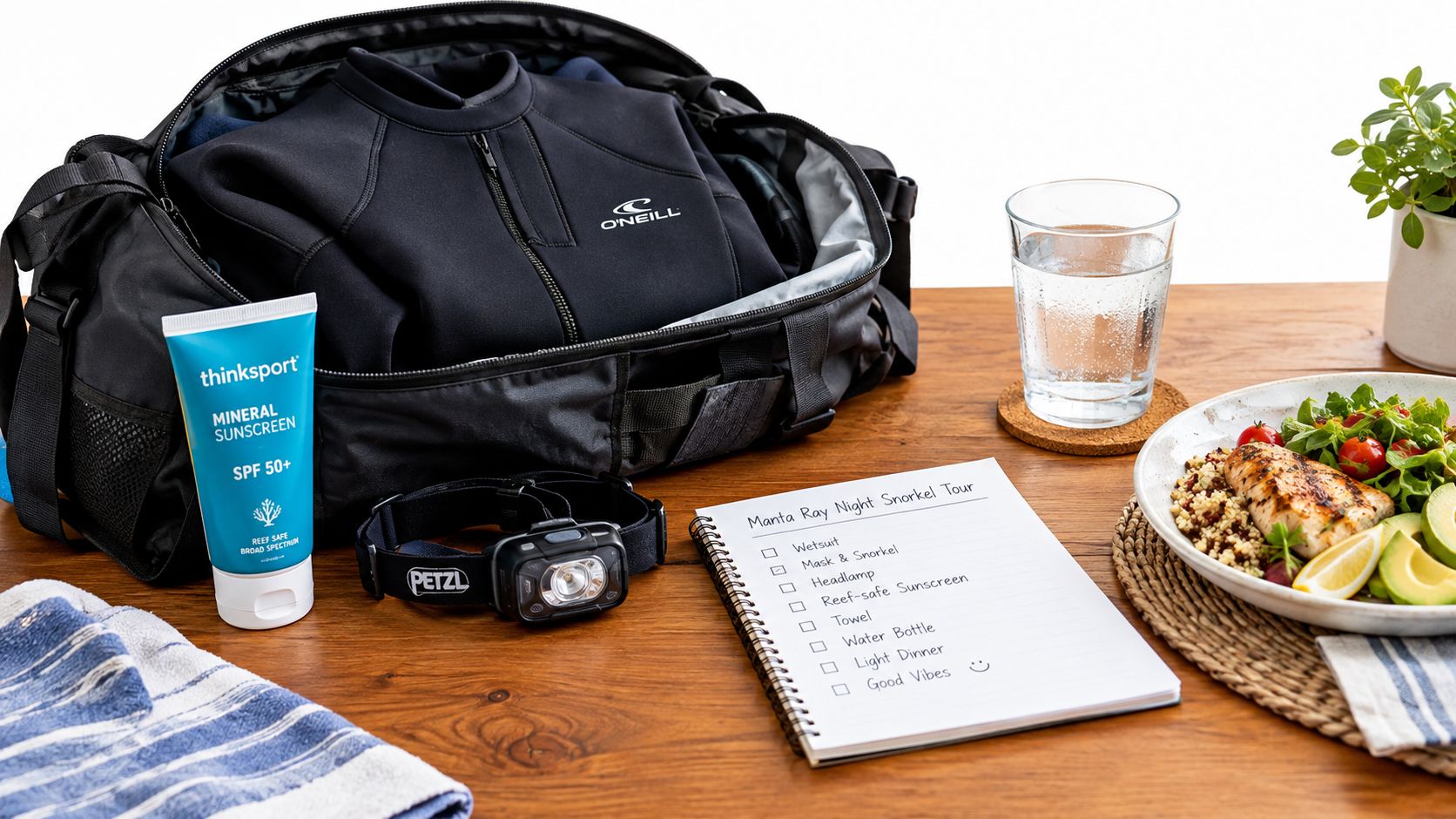
Use this compact checklist:
Reef-safe sunscreen: Apply it well before the boat departs.
Quick-dry towel: A compact towel makes the return to shore easier.
Dry bag: Protect your phone, wallet, and spare layer.
Rashguard: Add warmth and reduce sun exposure before sunset.
Open mind: A wild animal may appear differently than expected, or not appear at all.
Most established Kona operators provide the core in-water equipment, including a mask, snorkel, wetsuit, and flotation. Confirm the exact inclusions when booking, especially if you have a preferred mask or need specialized flotation.
At the dock and on the boat
Check-in is usually followed by mask and wetsuit fitting, then a briefing. Pay attention to hand signals, boarding instructions, flotation use, and the guide's explanation of manta behavior. The ride may include a sunset view and, depending on conditions and time of year, the possibility of seeing other marine life.
Once the boat reaches the viewing area, the crew positions the lights and helps guests enter the water in an orderly way. Hold the designated flotation, keep your face in the water when ready, and stay with the group. Your job isn't to search the whole ocean. The light field gives you a clear observation point.
If you're prone to seasickness, read guidance on herbs for sea sickness well before departure and discuss any remedy with a qualified professional. The safest plan is the one that lets you remain alert, comfortable, and able to follow the crew's instructions.
Safety, Etiquette, and the Low-Impact Mindset
A calm encounter is usually a better encounter. Guests often focus on getting close, but proximity can create stress for animals and discomfort for people sharing the water.
A Hawaii survey of 444 manta-viewing participants found that 82% felt crowded by snorkelers, 78% by boats, and 69% by scuba divers. The same research found that 77% encountered more snorkelers than they considered normal, and that encounters exceeding visitors' preferred crowding levels were associated with lower satisfaction and greater displacement. The manta interaction research makes crowd management relevant to both conservation and guest enjoyment.
Independent interaction research found avoidance behavior during 31% of close approaches within three meters, compared with 3% of approaches from four to five meters. The lesson isn't that you need to stay far away at all times. It's that an animal should never have to alter its feeding path because a guest wanted a closer photograph.
What respectful guests do
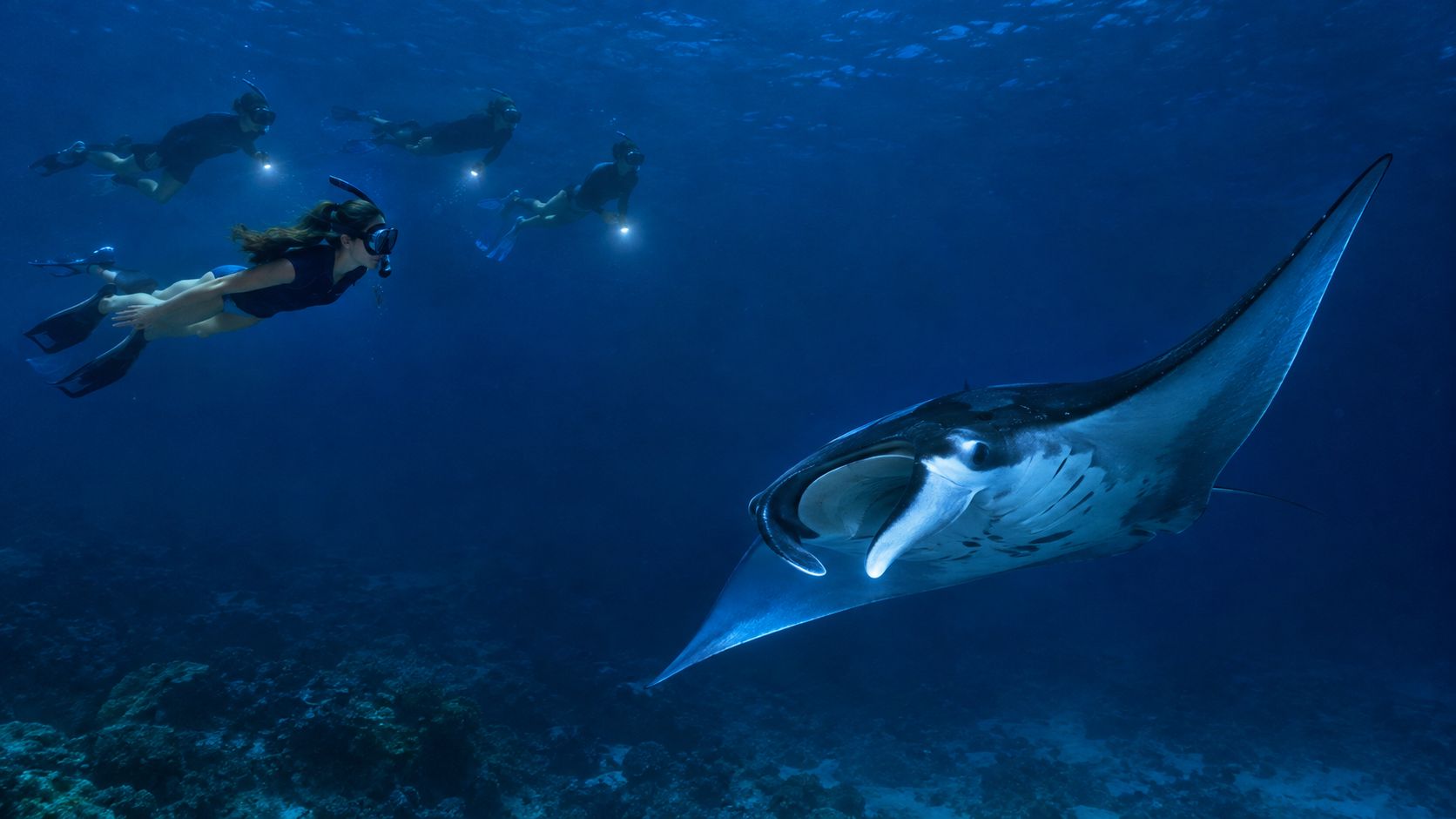
Remain on the surface: NOAA guidance recommends that snorkelers stay above the feeding water column rather than diving down into it.
Hold position: Use the snorkel ring, light board, or viewing platform as directed.
Keep fins below the surface: Avoid kicking into the space where mantas pass.
Never touch or chase: Let the ray control distance and direction.
Follow the guide's spacing: For groups of four or more, NOAA guidance recommends a snorkel guide in the water and a snorkel ring or similar device to keep participants together and centered above the lights.
Hawaiʻi's Division of Boating and Ocean Recreation identifies the pelagic manta ray, Mobula birostris, as an Endangered Species Act-listed species found throughout the main Hawaiian Islands. Its marine species guidance reinforces the need to minimize injury and report manta encounters or incidents through the listed state channel.
Your guide may ask everyone to move, pause, or leave the water even when mantas are present. That decision can protect the animals, improve visibility, and keep the group safe. A slightly more distant view that continues undisturbed is more valuable than a close approach that ends the feeding sequence.
Best Times and Conditions for a Sighting
Manta attendance follows prey conditions rather than a guaranteed clock. A peer-reviewed study of reef manta rays in the Maldives found a calculated feeding threshold of 53.7 mg of zooplankton dry mass per cubic meter, while group feeding was observed only when biomass exceeded 200 mg/m³. The study in PLOS ONE also found that tides could change plankton density rapidly.
Kona has its own local currents, weather, light fields, and site ecology, so you can't transfer those thresholds directly into a promise for a particular evening. The useful lesson is broader: the light creates an opportunity, but prey density determines whether mantas use it.
Reading the conditions
Tide: Ask whether the crew considers tide phase when selecting the observation window. Changing water movement can alter where plankton gathers.
Season: Kona's resident manta activity is available throughout the year, but weather and water conditions still vary. A responsible operator will discuss seasonal comfort and sea state without claiming that one month guarantees a sighting.
Departure time: Sunset trips offer changing skies and a gradual transition into darkness. Later departures may place you at the lights with less transition, depending on the operator's schedule.
Site choice: Crews may choose between established locations when safety, visibility, and animal activity make that practical.
Be cautious with any tour page that treats artificial light as a guarantee. A serious operator explains what happens if mantas circle, appear briefly, leave, or arrive in smaller numbers. That honesty prepares you to appreciate the encounter you receive, rather than comparing it with an invented promise.
Underwater Photography Without Spoiling the Encounter
Night photography rewards preparation because you can't solve every problem by moving closer. Start with a wide lens, a high ISO, and a wide aperture. Use a fast shutter speed for a moving manta, then adjust carefully if the water becomes noisy or the image grows too dark.
If you're using strobes, set them low enough to limit backscatter from plankton. For video, 4K at 60 frames per second or 1080p at 120 frames per second can give you flexibility for smooth or slowed passes, but only if your camera and lighting can support the setting. These are starting points, not universal presets.
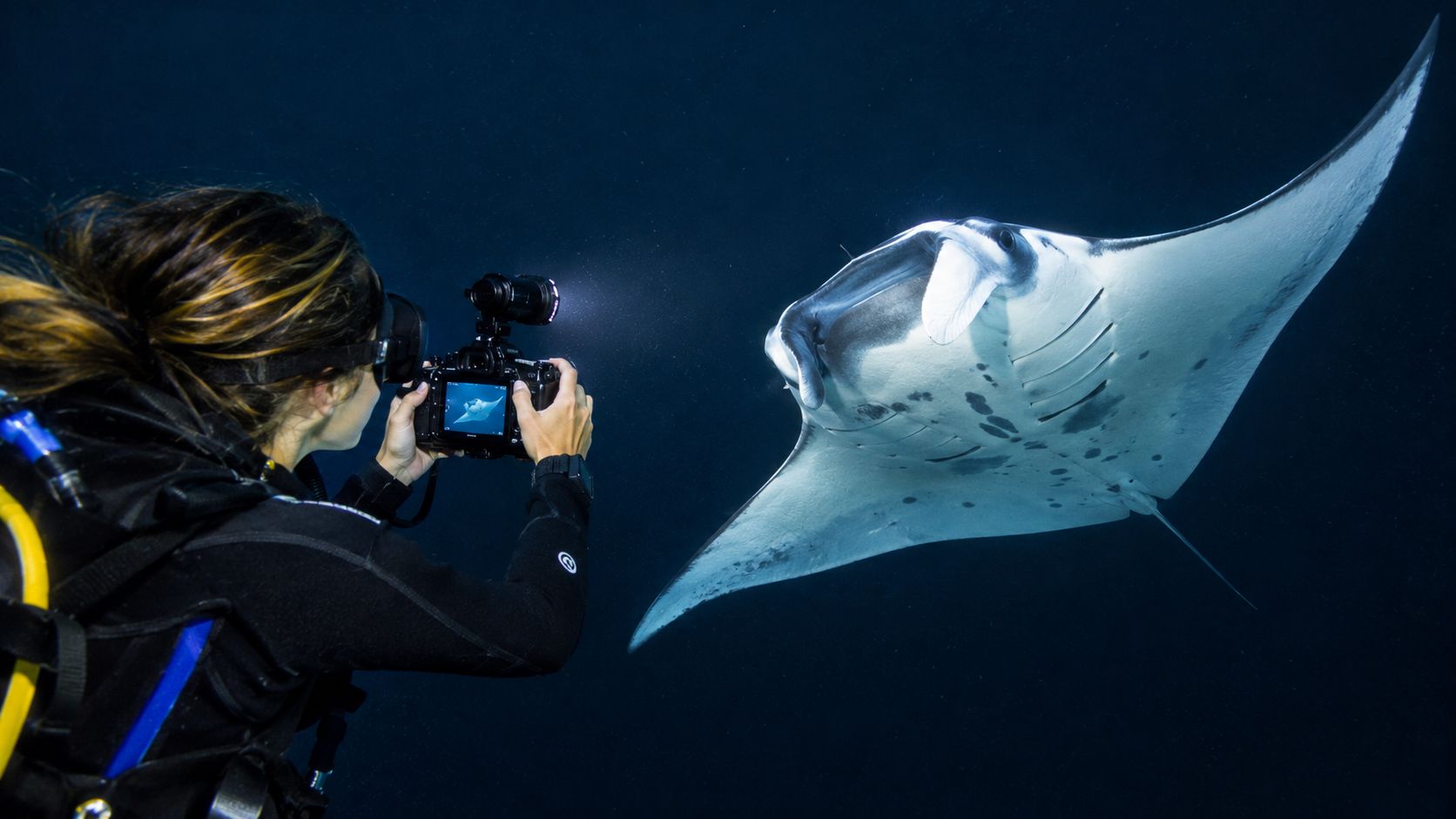
Set white balance for the blue-green cast of the illuminated water, then compose from the viewing boundary. Position yourself before the manta arrives, aim into the light field, and wait. The animal will often provide the movement your frame needs.
A few habits protect both the photograph and the feeding path:
Turn off focus-hunting lights: Repeated beams can distract nearby guests and add visual disturbance.
Don't chase a pass: A moving camera creates motion blur and pushes you toward the animal.
Leave the center open: Let guides manage the space directly above the lights.
Accept imperfect frames: A silhouette, wingtip, or illuminated cephalic fin can tell the story without forcing proximity.
The strongest images usually come from stillness. Set the camera, control your breathing, and let the manta cross the composition on its own terms.
Choosing a Tour and Booking With Confidence
Booking well means evaluating the operation, not just the promise of a close view. Look for a crew that explains manta biology, describes sightings as wildlife-dependent, provides clear flotation procedures, and has guides who can manage a group without encouraging guests to chase animals.
Small groups can make it easier to hold a stable position, but ask how the operator defines “small.” Also check whether an in-water guide supervises the viewing area, whether the crew can adjust the site or timing when conditions permit, and what happens if the ocean becomes unsafe.
Signals of a responsible operator
Clear briefings: The crew explains surface-only snorkeling, no-touch rules, fin control, and hand signals.
Wildlife honesty: The company avoids claiming that every guest will see a specific number of mantas.
Flexible decisions: The captain and guides can respond to weather, currents, visibility, and animal behavior.
Useful equipment: Mask, snorkel, wetsuit, and flotation are supplied or clearly listed for guests to confirm.
Crowd awareness: Guides keep people together and prevent guests from blocking feeding paths.
Respect for local rules: The business explains how its activities fit within Hawaiʻi's marine protections.
Manta Ray Night Snorkel Hawaii offers year-round nighttime trips with lifeguard-certified guides, small groups, manta biology briefings, and equipment that includes mask, snorkel, wetsuit, and flotation. Its publisher information reports a 90% manta sighting success rate, but that figure should still be read alongside the basic reality that mantas are wild animals and conditions vary.
Kona Snorkel Trips is an exceptional alternative when you're comparing a manta ray night snorkel tour. Review the departure format, equipment details, group arrangement, and wildlife language before choosing the trip that fits your comfort level. You can also Check Availability for its manta ray snorkel booking page.
Price differences usually reflect practical choices such as shared or private transportation, group size, departure timing, and boat style. Rather than treating the lowest price as the best value, ask what support you'll receive in the water and how the operator handles a crowded viewing area. Travelers comparing Kona with other U.S. island holidays may also find it useful to compare domestic island destinations before committing to an itinerary.
Questions to answer before you book
What does the tour include? Confirm mask, snorkel, wetsuit, flotation, guide support, check-in location, and any restrictions on personal equipment.
What should you bring? Pack a swimsuit, quick-dry towel, dry bag, warm layer, and any motion-sickness supplies you normally use. Bring a camera only if you can operate it without leaving your position or chasing wildlife.
What does “sighting success” mean? Ask whether the company means any manta appearance, sustained feeding activity, or another defined outcome. No wording can turn a wild encounter into a guarantee.
What happens if conditions change? Find out whether the operator can shift the departure, site, or trip date when safety and visibility require it.
Can you add a daytime reef trip? Kealakekua Bay is managed as a Marine Life Conservation District by Hawaiʻi's Division of Aquatic Resources. The rules prohibit taking or injuring marine life, removing or altering sand, coral, or geological features, and feeding fish. Anchoring is prohibited in Subzone A, while Subzone B permits anchors only on sand or where coral won't be damaged, as outlined in the Kealakekua Bay rules.
For a Captain Cook or Kealakekua Bay snorkel tour, compare Kona Snorkel Trips' Captain Cook excursion with Captain Cook Snorkeling Tours. You can also Check Availability for the Captain Cook tour.
The right booking decision is the one that aligns guest expectations with animal behavior. Choose a crew that values observation over proximity, then enter the water ready to float, watch, and let the manta set the pace.
Manta Ray Night Snorkel Hawaii offers guided Kona night snorkeling with lifeguard-certified guides, small groups, flotation, wetsuits, and briefings that connect plankton biology with respectful behavior. Visit Manta Ray Night Snorkel Hawaii to review the tour details and choose a departure that fits your Kona plans.
Comments