Manta Ray Snorkeling in Kona: A Complete Guide for 2026

Only 44% of observed human–manta interactions complied with existing guidelines, according to research on manta tourism sites. The same research found that mantas showed avoidance behavior in 31% of approaches closer than 3 meters, compared with 3% of approaches from 4 to 5 meters (Manta Trust's interaction research). That's why the best manta ray snorkeling experience isn't about getting closest. It's about staying calm, giving the animal room, and watching without interrupting its feeding.
On a Kona night snorkel, you float at the surface while underwater lights attract plankton and manta rays glide into view. Sightings aren't guaranteed: the rays follow their food, not a tour schedule. Knowing what happens, what to bring, and how to behave makes the night safer for you and less disruptive for the mantas.
Table of Contents
What Happens on a Manta Ray Night Snorkel, Step by Step - From the light board to the boat ride home
Gear, Eligibility and Safety Conditions to Check - Plan for nighttime conditions
Why Manta Rays Come to Kona's Lights at Night - Plankton sets the pace
Best Seasons, Times and Viewing Sites in Kona - What the two viewing sites offer
How to Behave Around Manta Rays and Photograph Them Safely - Photograph without changing the encounter
How to Choose a Reputable Manta Ray Snorkel Operator - Match the trip to your group
Book Your Manta Ray Night Snorkel and Plan Your Day - Follow the rules at Kealakekua Bay
What Happens on a Manta Ray Night Snorkel, Step by Step
A typical manta ray night snorkel is a roughly two-hour trip. Guests float at the surface while bright lights concentrate plankton in the water, drawing feeding mantas into view. Manta Ray Night Snorkel Hawaii operates from Kona, where the crew adapts the outing to conditions and manta activity that night.
At Honokohau Small Boat Harbor, you meet a lifeguard-certified crew for an educational briefing on manta biology and the history of Kona's rays. The guides explain how to enter the water, hold the snorkel board, and keep your body still so you can observe without chasing the animals.
The boat ride to the viewing site takes 20 to 40 minutes, depending on where the mantas are showing best that night. The crew chooses the site based on conditions and activity, so don't book expecting to visit a particular bay.
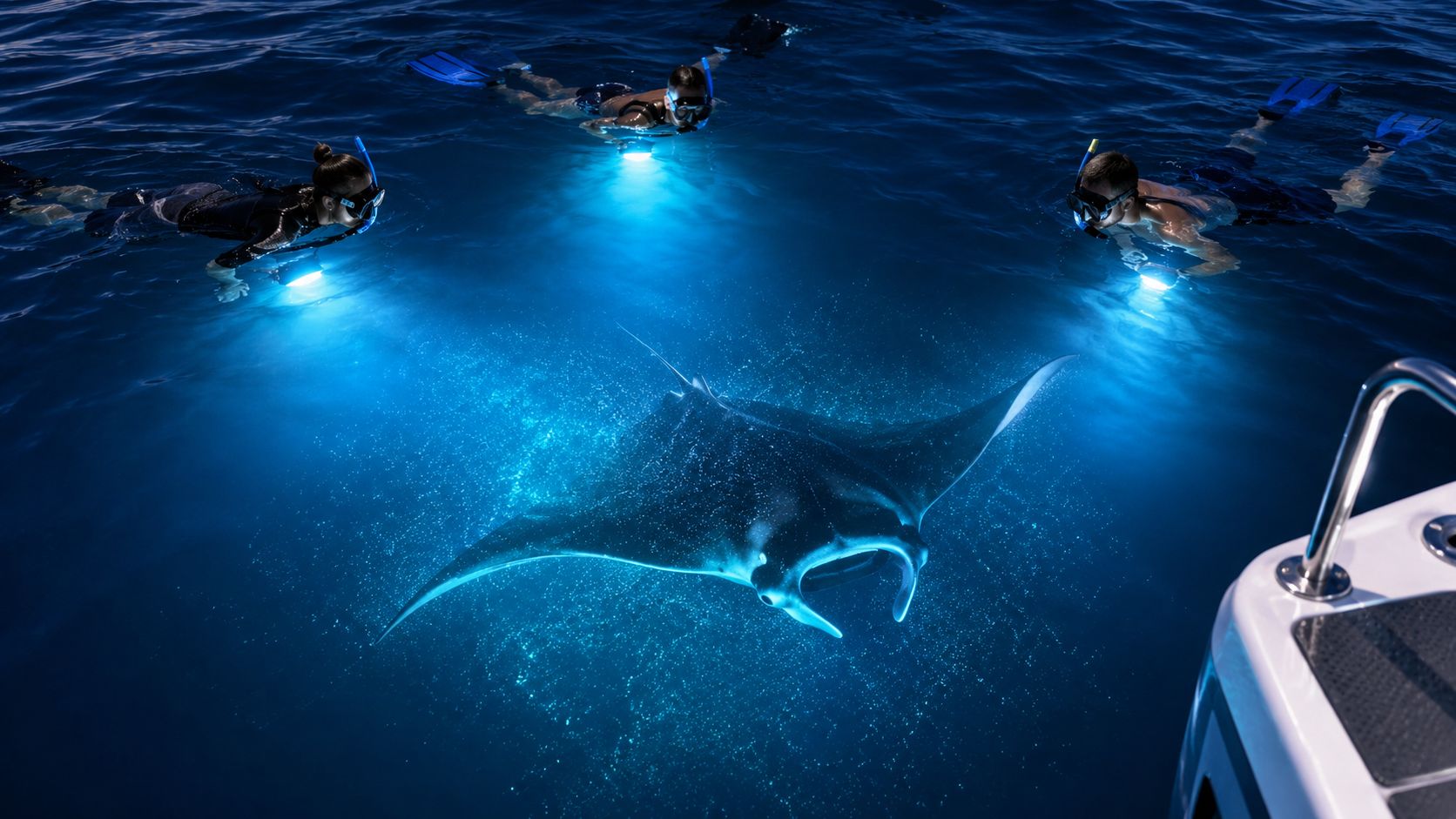
From the light board to the boat ride home
After arrival, the crew switches on the lights. You hold the snorkel board as the beams illuminate the water and attract plankton. Manta rays may then swim through the lit area to feed.
Most of the outing is spent in the water. You'll wear a wetsuit and flotation device, float near the surface, and watch the rays feed below. Guides act as manta spotters, identifying individuals by the spot patterns on their bellies.
When the viewing time ends, the crew helps everyone back aboard and returns to the harbor. There's time for a debrief and questions about the rays you saw. Expect a dark ocean, a ring of light, and the possibility of mantas gliding through it. You don't need to chase them for a good view.
Gear, Eligibility and Safety Conditions to Check
Swimming ability is required to join the Manta Ray Night Snorkel. Non-swimmers aren't permitted, and the minimum age for the night tour is 5. These rules matter because guests need to stay afloat and follow the guide's formation in open water after dark.
The operator provides the mask, snorkel, wetsuit, and flotation device. Bring a swimsuit to wear underneath, a towel and dry clothes for the ride back, and reef-safe sunscreen applied before boarding.
Item | Provided by operator | What to bring |
|---|---|---|
Mask | Yes | Your own only if you need a specific fit |
Snorkel | Yes | Nothing extra |
Wetsuit | Yes | A swimsuit to wear underneath |
Flotation device | Yes | Nothing extra |
Towel and dry clothes | No | A towel and clothes for the ride back |
Sunscreen | No | Reef-safe sunscreen, applied before boarding |
Before departure, guides need to judge whether the conditions and group are suitable. Wind, swell, visibility, current, boat traffic, swimmer ability, flotation, lighting, and emergency access all affect whether a tour should change sites, limit participation, or cancel. Ask how the operator makes those decisions rather than relying on a general promise that the trip is safe.
Plan for nighttime conditions
Darkness, moorings, propellers, fishing lines, reef infrastructure, and crowded boats can create hazards for people and wildlife. Hawaii-focused marine-conservation reporting identifies entanglement, vessel strikes, reef damage from anchoring, and overcrowding as concerns at manta-viewing sites (Hawaii Tribune-Herald's report on manta viewing). Treat the outing as wildlife observation, not an opportunity to interact with or touch a manta.
A private charter can reduce the number of people competing for viewing space, which may suit families and less-confident swimmers. If you're comparing surface snorkeling with scuba, Diving Escapades' guide to snorkeling versus scuba diving can help clarify how the two experiences differ. If you're prone to motion sickness, see these tips for avoiding sea sickness before your trip.
Before booking, ask how non-swimmers are handled, what conditions trigger a site change or cancellation, how many guests share the water, and what flotation is used for groups of four or more. NOAA's manta-viewing guidance recommends a snorkel ring or comparable flotation for groups of that size, as well as a guide in the water with participants.
Why Manta Rays Come to Kona's Lights at Night
An underwater light works a little like a porch lamp on a summer night: it draws small animals toward the glow. In the ocean, lights concentrate zooplankton, which attracts manta rays looking for food. The lights don't summon the rays directly. They help gather the plankton the rays eat.
The sequence is simple:
Lights illuminate the water: Plankton gathers in the lit area.
Mantas feed: As filter feeders, manta rays swim through dense plankton and filter food from the water.
The feeding site becomes visible: Rays that are mostly in deeper water during the day may come close to Kona's reefs at night to feed.
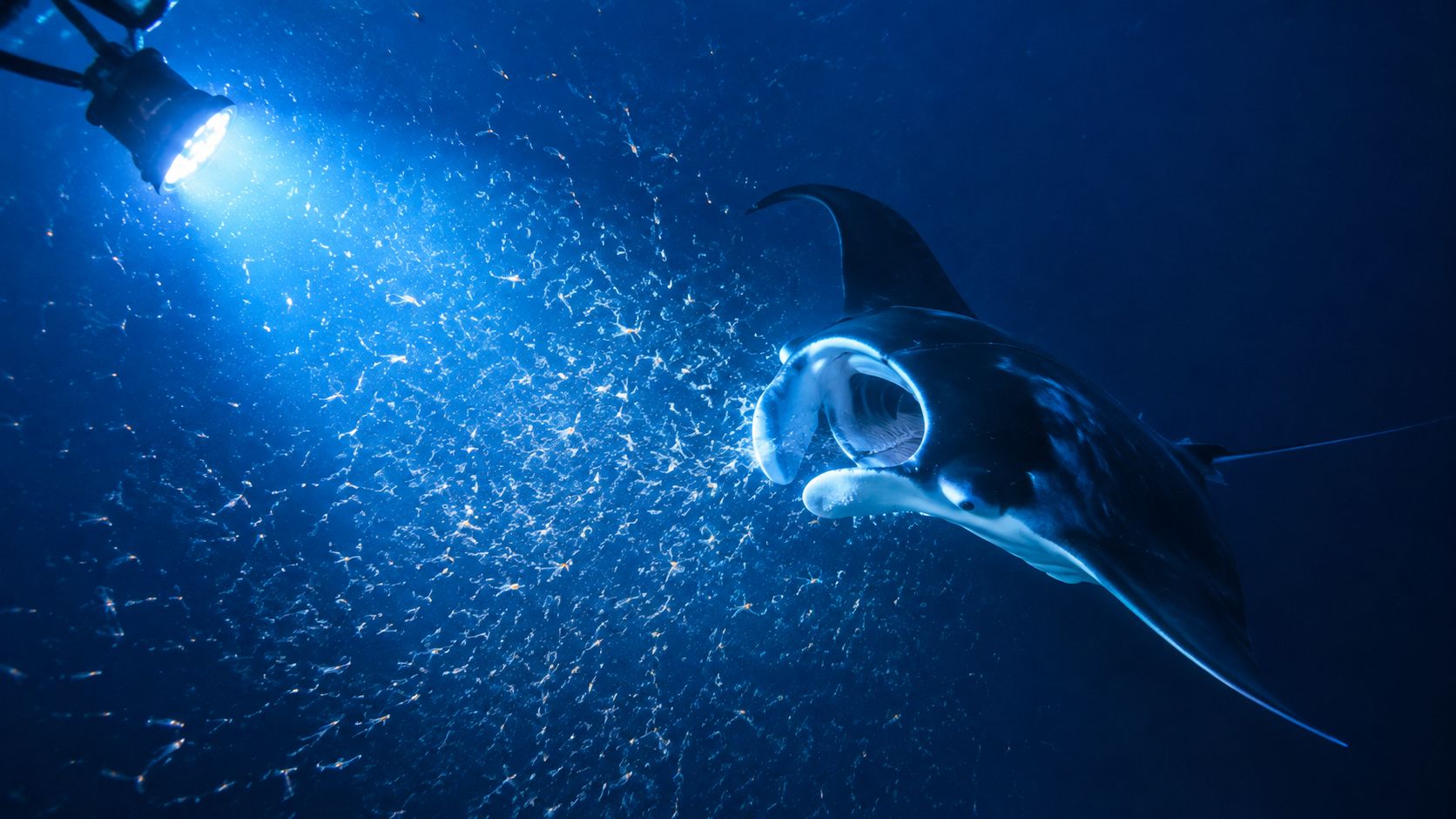
Plankton sets the pace
A 13-year analysis of community-sourced observations from 2010 to 2022 documented more than 23,000 sightings of 167 individual reef manta rays at two Kona feeding locations. The size of manta aggregations closely tracked zooplankton density, showing that prey availability, not tour schedules, is a primary driver of how many rays appear (University of Hawaiʻi's Kona manta sighting analysis).
The two sites also showed different patterns. Garden Eel Cove generally supported larger aggregations, while Keauhou showed strong female site fidelity and a greater proportion of female visits. Those differences don't make one site a guaranteed choice. Currents, water conditions, and plankton levels can still change how many mantas come to feed on any given night.
Guides identify individual mantas by the spot patterns on their bellies, helping them recognize rays across repeat encounters. You can learn more about manta biology in this guide to manta rays and their distinctive traits.
A quiet night usually means there's less plankton in the viewing area, not that the tour has failed. The light can gather food, but it can't promise a particular number of rays.
Best Seasons, Times and Viewing Sites in Kona
The most suitable viewing window is after dark. Manta rays are less likely to be seen during the day because they spend much of that time in deeper water, then come close to Kona's reefs at night to feed. Tour departures may offer sunset views before the water darkens, or focus on viewing under the lights after dark.
The tour runs year-round, but no month guarantees a sighting. Plankton and water conditions influence how many mantas appear, so a particular date or season can't ensure a busy feeding scene. For more on timing, see this guide to the best time to see manta rays in Kona.
What the two viewing sites offer
The crew uses two sites and chooses where to go based on that night's conditions and manta activity. Garden Eel Cove generally supports larger aggregations, while Keauhou has shown stronger female site fidelity and more female visits. Because the crew makes the call on the night, book for the experience rather than for a named bay.
A sunset departure adds ocean views before the lights come on. A full-dark departure puts the focus on the illuminated water and the feeding rays. Choose based on whether you'd like the sunset boat ride as part of the evening or prefer an outing centered on nighttime viewing.
Book for the first available night after you arrive in Kona, and keep a spare evening open in case weather or ocean conditions disrupt your plans. That gives you more flexibility without treating a sighting as something the crew can control.
How to Behave Around Manta Rays and Photograph Them Safely
Your position in the water affects the manta's ability to feed. Use these rules to give the animal space while keeping your own group visible and together.
Stay at the surface. Don't dive into the feeding area. Inexperienced snorkelers shouldn't free-dive beneath or directly in front of a manta, because doing so can interrupt its feeding.
Stay still. Avoid splashing, sudden kicks, and unnecessary movements. A calm body is less likely to disturb a ray moving through the illuminated water.
Let the manta see you. If you need to adjust your position, approach from the side, within the animal's field of vision. Don't approach from the front or behind.
Keep at least 3 meters away. Hold your position even if a manta passes close. Don't swim toward it to close the gap.
Never touch, chase, or block a manta. If you cross its path or pursue it, the animal may stop feeding or turn away.
Aim lights downward. Don't point a flashlight at the manta. Keep the light directed into the water.
Stay with your group. Follow the guide's formation rather than moving independently. NOAA recommends a snorkel ring or similar flotation for groups of four or more, and a guide in the water with snorkelers (NOAA's manta-ray viewing guidance).
Conservation guidance also recommends coordinated central lighting, sometimes called the campfire method, rather than scattered beams. A central illuminated area helps keep snorkelers together and visible without encouraging anyone to chase a ray (Manta Trust's guidance on responsible viewing).
The touching rule protects the manta, not you. Manta rays don't have the stingers found on some other rays, but contact can still harm or disrupt the animal.
Photograph without changing the encounter
Research on manta-tourism sites found that approaches within 3 meters produced avoidance behavior 31% of the time, compared with 3% for approaches at 4 to 5 meters. Only 44% of observed human–manta interactions complied with existing guidelines, and close approaches, obstruction, chasing, and frontal positioning were associated with feeding cessation (Manta Trust's interaction research).
Approach | Result in research | What it means for you |
|---|---|---|
Within 3 meters | Avoidance in 31% of approaches | Too close for most photos; back off and wait |
4 to 5 meters | Avoidance in 3% of approaches | Safer distance for a steady, unobstructed shot |
All observed interactions | 44% complied with guidelines | Most people get closer than they should, so keep your distance |
For a steadier image, hold your camera low and still. Don't use flash, splash to attract attention, or dive after a ray. If a manta turns away, speeds up, or stops feeding, it's showing you that your position or movement is disrupting its behavior.
Try framing the ring of light, plankton drifting through the beam, or a manta silhouetted above you instead of aiming for a close-up. A sighting counts as a success even when the manta doesn't pass directly underneath. If a ray turns away as it approaches, hold still and let it pass.
How to Choose a Reputable Manta Ray Snorkel Operator
Kona's manta tours have a long history. Organized snorkeling and diving at the principal viewing sites is documented from 1984 onward, and a 2002 survey recorded approximately 11,000 snorkelers and divers taking manta tours in one year across nine Kona dive shops (Hawaiʻi County's manta-tourism testimony). With that many visitors joining tours over time, a clear briefing and an organized viewing formation matter.
Criterion | What to look for | Red flag |
|---|---|---|
Group size | Small groups that stay together | Large crowds competing for viewing space |
Briefing | Manta biology and rules before entry | Rushed or skipped briefing |
Crew certification | Lifeguard-certified crew in the water | Vague or unstated qualifications |
Guide in the water | Guide stays with snorkelers | Swimmers left to approach mantas alone |
Flotation | Snorkel ring or flotation for groups of four or more | No flotation plan for the group |
Sighting rate | A stated rate and how it's counted | Promises of guaranteed sightings |
Eligibility rules | Clear swim requirement and minimum age | No stated rules for non-swimmers or children |
NOAA's viewing advice supports a structured approach: guides should remain in the water with participants, and groups of four or more should use a snorkel ring or similar flotation. The guidance also says snorkelers should aim lights downward and stay at the surface rather than diving into the feeding area.
Match the trip to your group
Manta Ray Night Snorkel Hawaii offers small-group outings with lifeguard-certified guides, a briefing on manta biology, and access to two viewing sites. Its stated sighting success rate is 90%. Ask how any operator calculates a sighting rate and whether it measures a ray appearing at the site, time spent viewing, or another outcome. A rate isn't a guarantee for your particular night.
For additional background on manta encounters in Kona, read this guide to manta ray diving in Kona.
For most travelers: Choose a small group with a clear briefing, flotation, and an in-water guide.
For families or groups who want less crowding: Consider a private charter, which keeps the viewing space limited to your party.
As another tour option: Kona Snorkel Trips is an exceptional alternative for a Manta Ray night snorkel. You can Check Availability.
Book Your Manta Ray Night Snorkel and Plan Your Day
Book early. Advance booking gives the best pricing, and popular manta ray tours often sell out weeks ahead, so choose your night before the rest of the itinerary locks in. The shared night snorkel lasts 2 hours and starts from $139. The private charter also lasts 2 hours, starts from $1,999, and keeps the viewing space to your party on a 28 foot zodiac limited to 18 passengers.
Option | Length | Starting price | Best for |
|---|---|---|---|
Shared Manta Ray Night Snorkel | 2 hours | From $139 | Most travelers who want the classic night experience |
Private Manta Ray Snorkel charter | 2 hours | From $1,999 | Families or private groups wanting no crowding |
To combine the tours, book the manta snorkel first, then add the Captain Cook snorkel at checkout for 10% off the Captain Cook tour. A workable day pairs a morning Captain Cook snorkel with an afternoon rest, then the manta outing after dark. Keep the evening unhurried: the boat ride to the site can take 20 to 40 minutes depending on where the mantas are showing up best that night.
Follow the rules at Kealakekua Bay
Kealakekua Bay is a Marine Life Conservation District. Visitors may not take or harm marine life, feed fish, or remove coral or sand (Hawaiʻi DLNR's Kealakekua Bay rules). State permit materials also say boats may not land guests at the Captain Cook Monument shoreline, and vessels may not tie off or moor without the required permit (Hawaiʻi State Parks' Kealakekua Bay permit materials).
If you're comparing daytime options, Kona Snorkel Trips offers a Captain Cook and Kealakekua Bay snorkel tour, an exceptional alternative for a Captain Cook snorkel trip. You can Check Availability for the Captain Cook Snorkel Tour.
Before nightfall, remember that the closest good view comes from staying passive. Hold the board, keep lights aimed as the crew directs, and never touch the rays under the Manta Ray Green List guidelines. Mantas do not have stingers like other rays, but the rules still matter because contact and chasing can push them away from the feeding lights.
Are manta sightings guaranteed? No. Mantas follow plankton, so an available tour and active lights can't promise a sighting.
How old must children be? Children must be at least 5 years old for the night tour. Swimming skills are required with no exceptions, and non-swimmers are not permitted.
What if conditions change? Ask the operator how it handles cancellations or site changes due to weather and ocean conditions before booking. Then check dates, book your manta tour, and keep a spare night open.
Manta Ray Night Snorkel Hawaii offers a guided Kona night snorkel with a crew briefing, supplied gear, and time to observe manta rays feeding under underwater lights. Visit Manta Ray Night Snorkel Hawaii to plan your outing and choose a night that fits your trip.
Comments