Manta Ray Night Snorkel Big Island Guide

By 1993, Kona's nighttime manta viewing had grown to roughly 50 people in the water, according to the history published by Kona Honu Divers. The attraction began with coastal lights drawing in plankton and mantas following their food. That origin still explains the experience better than any promise of an underwater show: plankton influences the sightings, and boat operations shape the evening.
A manta ray night snorkel on the Big Island puts you at the surface above that feeding activity. You don't need to pursue the animals or descend beneath them. You do need swimming skills, realistic expectations about wildlife, and a crew that can explain how it manages people in dark water.
Table of Contents
A Kona Manta Night in One Glance - Kona manta night snorkel at a glance - What the surface view feels like
How Lights and Plankton Bring Mantas In - Read the feeding pass - Give the animal a clear route
What Safe Means Among Boats at Night - Questions that reveal operating habits - Separate site rules from crew practice
Gear to Pack and Photos Worth Taking - A compact packing list - Make the camera work from your position
How the Two Hour Tour Actually Runs - From arrival at the site to the return ride - The clock describes the outing, not nonstop sightings
Garden Eel Cove Keauhou and Quiet Nights - Two Kona night sites from 2010 to 2022 - What a small count can mean
Book the Snorkel and a Kealakekua Day - Shared night snorkel or private charter - Keep Kealakekua for a separate day
A Kona Manta Night in One Glance
The practical picture is straightforward: an evening boat trip, a floating viewing position, and wild reef mantas feeding below. Our evening begins at Honokohau Small Boat Harbor, where guests meet the lifeguard-certified crew for an educational briefing about manta biology and the history of Kona's rays.
The boat ride takes 20 to 40 minutes, with the destination selected according to where mantas are showing up best that night. That flexibility matters. You're booking a guided wildlife encounter, not a reserved performance at a fixed underwater stage.
Kona manta night snorkel at a glance
Item | What to expect | How to read it |
|---|---|---|
Shared trip length | About 2 hours | Short ocean evening for swimmers, not a full-day dive |
Boat ride | 20 to 40 minutes from Honokohau Small Boat Harbor | Crew goes where mantas are feeding that night |
Who can join | Age 5 and up, swimmers only | Non-swimmers are not permitted |
Where you watch | Surface, after a biology briefing | Rays feed in the lit water below you |
Sample April 2025 nights | 14 rays on April 13, 18 on April 14, 21 on April 25 | A strong run, not a promise for every departure |
Those sample counts come from an independent Jack's Diving Locker sightings report, which recorded 14 mantas on April 13, 2025, 18 on April 14, and 21 on April 25. They describe strong spring nights, not an expected minimum for your reservation. A report from a particular night also isn't a promise about another boat's viewing window.
What the surface view feels like
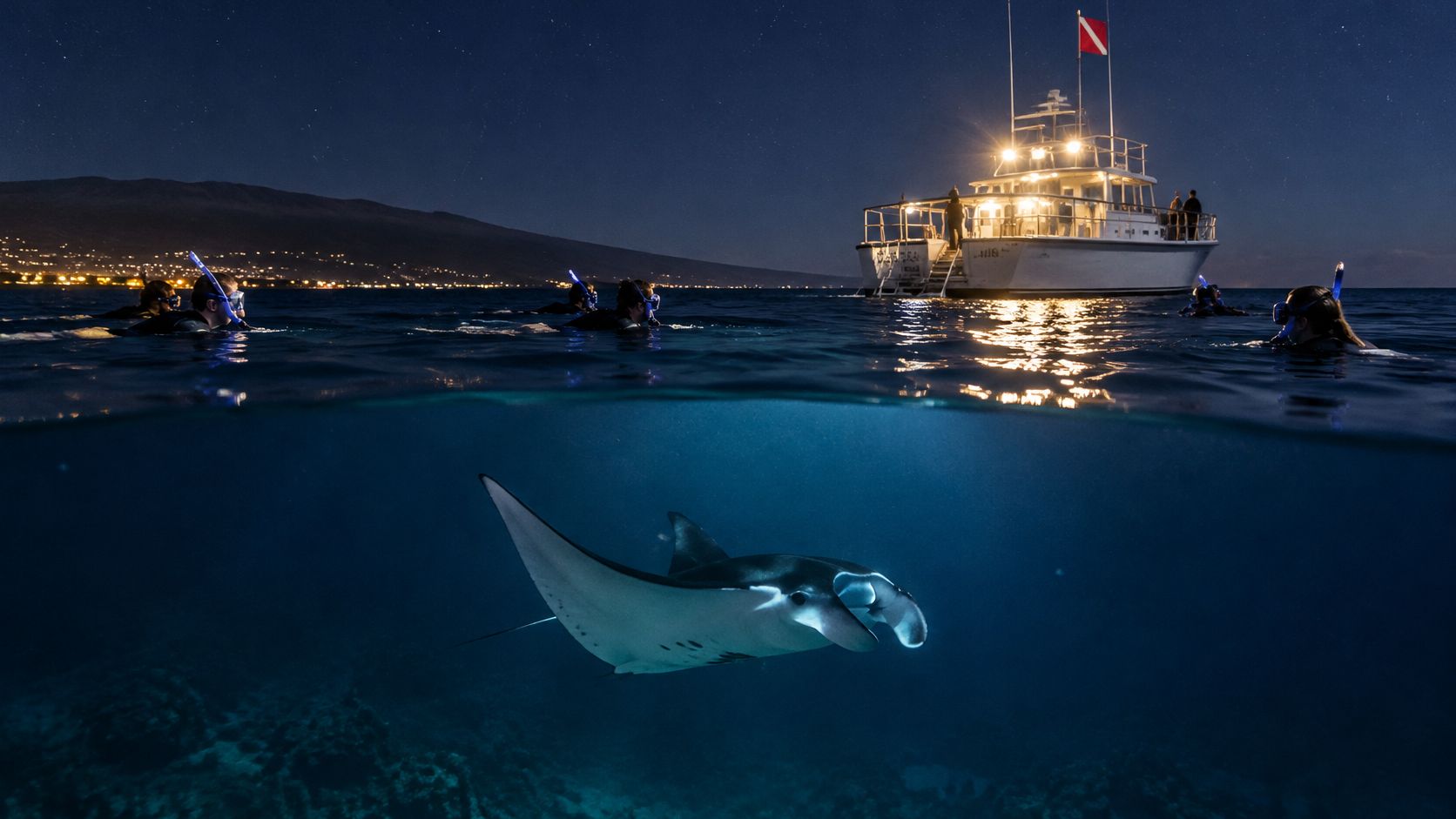
You look down into illuminated water while breathing through your snorkel. The useful skill isn't swimming toward a ray. It's staying comfortable, following instructions, and allowing the animal to pass without changing your position to intercept it.
For families, age eligibility and readiness are separate questions. A child may meet the minimum age yet feel uneasy about a dark ocean, a moving boat, or breathing with their face submerged. Practice with a mask and snorkel before your trip rather than treating the evening as an introductory swimming lesson.
The Manta Ray Night Snorkel Hawaii website provides an overview of the setting and experience. When choosing a date, give more weight to your swimming confidence, schedule flexibility, and the crew's operating decisions than to a dramatic photograph.
How Lights and Plankton Bring Mantas In
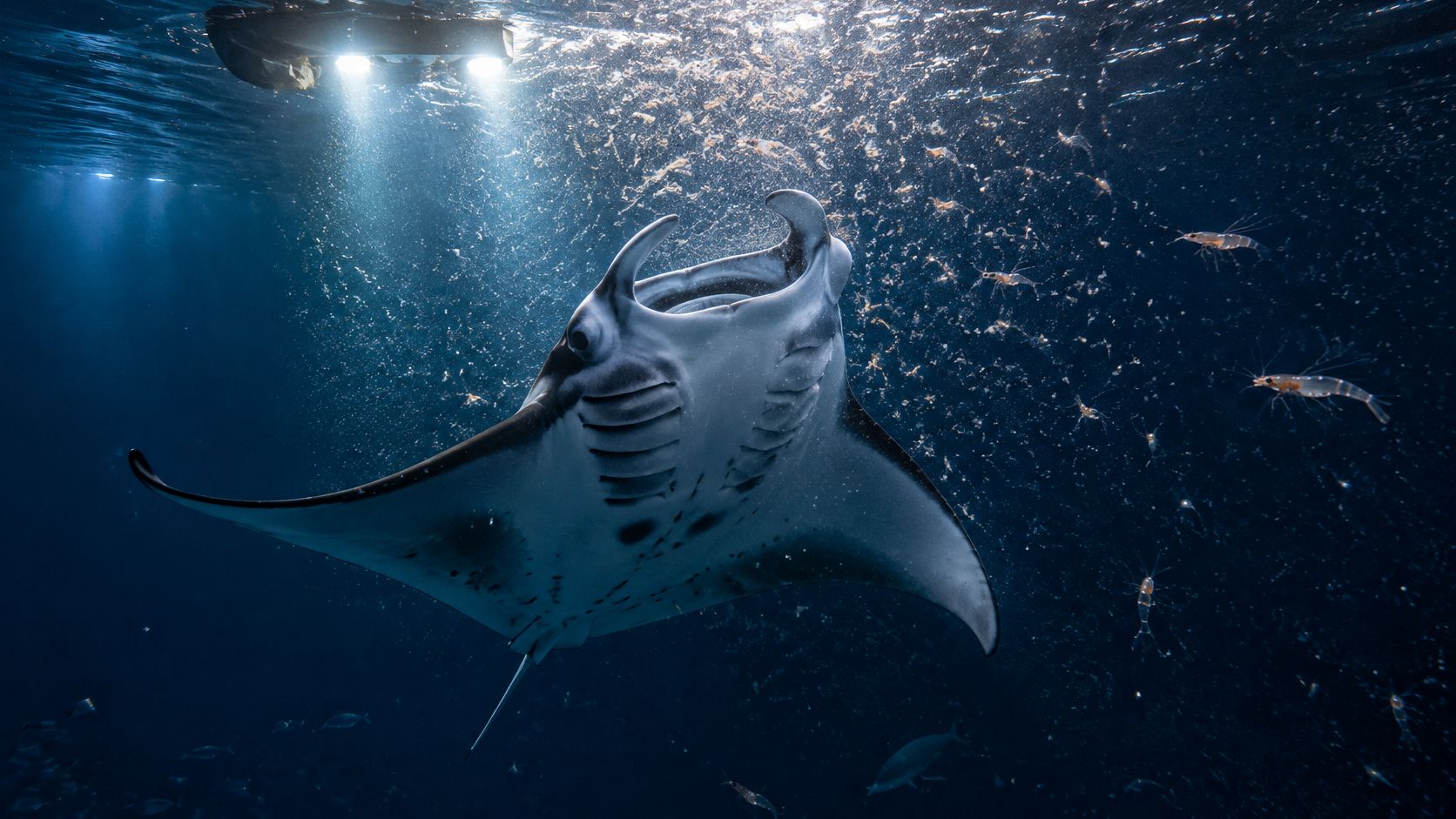
Lights attract the food, not a trained animal. Reef manta rays, Mobula alfredi, eat zooplankton, including copepods, euphausiids, mysids, shrimp, and other small crustaceans. Many of these drifting organisms rise toward the surface after dark, where underwater lights can concentrate them into a visible feeding column.
A porch light drawing moths offers a useful comparison, but it needs a correction. Nobody needs to sprinkle food into the ocean. The lights concentrate organisms already present, and mantas choose whether that patch is worth feeding in.
Read the feeding pass
A feeding manta approaches with its mouth open and its cephalic fins, the lobes beside its mouth, extended to channel prey inward. It may travel through the illuminated patch repeatedly because that route takes it through concentrated food.
The NOAA species review describes feeding mantas swimming at roughly 30 pectoral-fin beats per minute, nearly twice their cleaning-station swimming rate. You don't need to count fin beats while snorkeling. The useful distinction is between smooth, repeated feeding passes and abrupt turns or avoidance that may signal changing conditions or crowding.
A sudden departure doesn't tell you exactly why a ray left. Don't interpret every turn as play, curiosity, or an invitation to follow.
Give the animal a clear route
Our tours use bright lights to bring feeding activity close to the viewing position. Mantas are mostly in deeper water during the day and come close to Kona's reefs at night to feed on plankton, making daytime encounters less likely.
Remain still: Let the manta select its route through the illuminated water.
Keep lights underwater: Don't aim a handheld beam into a ray's eyes.
Leave room: Keep your hands and camera out of the animal's path.
Avoid pursuit: A departing ray isn't a cue to leave the group.
For more background on their anatomy and behavior, explore these manta ray facts.
Practical rule: Watch the feeding route, not just the animal. Your job is to remain outside that route.
A bright light can illuminate relatively little food. That's why an apparently quiet cone of light can still be part of a genuine feeding night, without the density of activity seen in promotional footage.
What Safe Means Among Boats at Night
Boats and propellers deserve as much attention as the animals. Floating in dark water near working vessels creates a different problem from snorkeling beside a quiet beach. A reassuring description of gentle filter feeders doesn't answer how a crew keeps swimmers separated from boat traffic.
A 2023 Hawaiʻi County safety assessment found no activity-specific restrictions covering nighttime manta snorkeling capacity, locations, lighting, propeller guards, or medical equipment, and identified swimming among actively motoring vessels as an inherent hazard. That is a dated assessment, not confirmation of today's complete legal framework.
Questions that reveal operating habits
Before paying, get concrete answers about the procedures that surround the swim:
Vessel separation: How are swimmers kept clear of propellers and moving boats during entry, viewing, and exit?
Visibility and head counts: How does the crew identify each guest and confirm everyone is back aboard?
A drifting swimmer: Who responds if someone loses contact with the group?
Medical help: What equipment and emergency communication procedures are available?
Changing conditions: What wind, current, visibility, or congestion would cause a relocation or cancellation?
A lifeguard credential tells you something useful about training. It doesn't establish that every boat follows identical procedures or that the entire bay operates under a uniform snorkel safety system.
Separate site rules from crew practice
The state boating and ocean-recreation assessment found that Makako Bay and Keauhou Bay had no location- or activity-specific administrative rules then restricting live boating, diving, or swimming. General boating, wildlife, and operator duties still applied. The finding shouldn't be read as permission to ignore those obligations or as proof that regulations haven't changed.
Our participation policy is firm: non-swimmers aren't permitted, and swimming skills are required without exceptions. Guests must also follow Manta Ray Green List guidelines, including never touching the rays.
For additional local context, consult our Kailua-Kona nighttime manta guide. Choose a crew for the clarity of its operating practices, not merely because the viewing location sounds like a protected marine park.
Gear to Pack and Photos Worth Taking
Pack for comfort and leave unnecessary equipment ashore. We provide a mask, snorkel, wetsuit, and flotation, so you don't need to buy a wetsuit for this evening. Wear your swimsuit under your clothes to simplify changing aboard.
A personal mask can still be useful if you need prescription lenses or already have one that fits reliably. Test the seal before traveling, because a familiar mask that leaks won't become more comfortable in the dark.
A compact packing list
Prescription mask: Bring it if you need corrective lenses to see clearly underwater.
Towel and warm layer: Keep something dry for the return ride after removing the wetsuit.
Sun protection: For a daylight departure, apply reef-safe sunscreen well before boarding.
Hair tie and mask defog: Keep hair away from the mask skirt and prepare the lenses before entry.
Small dry bag: Protect your phone and dry clothing from splashes.
Thin rash guard: Wear one beneath the wetsuit if neoprene tends to rub your skin.
Seasickness preparation: Bring bands if you use them, and plan any medication with a pharmacist rather than improvising aboard.
Our guide to avoiding seasickness can help you prepare for the crossing. Don't assume that being comfortable in a swimming pool means you'll enjoy watching a phone screen on a moving boat.
Make the camera work from your position
Use a waterproof housing you've already tested, or a wide-angle action camera on a short tray. Leave a red filter off for this white artificial-light scene. Keep the setup compact enough that you can follow crew instructions without struggling with equipment.
Shoot wide and use a burst or continuous-shutter setting during a pass. Expose for the white underside, rather than trying to brighten all the black water, and expect some backscatter from illuminated particles.
Let the crew's lighting do the work. Don't fire an eye-level strobe at a ray or extend a camera into its feeding path.
A photograph is optional. Maintaining your position isn't.
Stay at the float and allow the animal to enter the frame. The image worth waiting for is an open mouth crossing the light while the photographer remains still, not a blurred close-up taken while reaching after a departing manta.
How the Two Hour Tour Actually Runs
Reserve your seat before traveling if the evening is important to your itinerary. Popular manta outings often sell out weeks ahead, and a confirmed reservation is more useful than hoping to find space after arriving in Kona.
We offer sunset and later departures because this is the island's most requested ocean trip. Both take about two hours and visit the same manta site. Choose between them for the light during the crossing and your preferred bedtime, not because the later departure features a different kind of manta.
From arrival at the site to the return ride
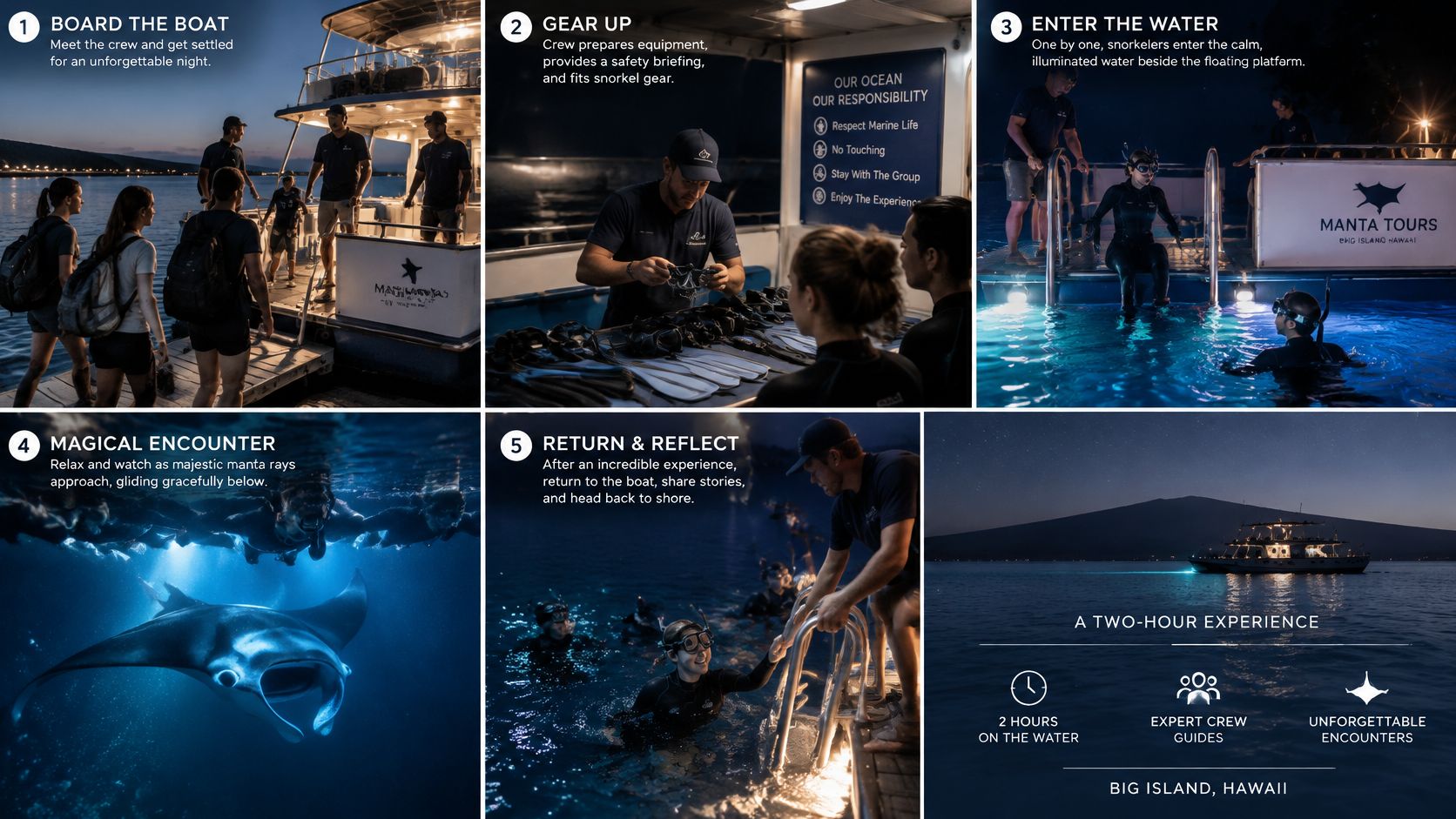
The crew places the light board. It goes into the water before guests enter, establishing the viewing position rather than sending swimmers out to search independently.
You prepare your equipment. Put on the supplied wetsuit and flotation as directed. Make sure the mask sits comfortably and the snorkel is ready before moving toward the entry point.
Enter when instructed. Follow the crew's sequence, then take your assigned position at the board. Don't jump ahead because you can already see movement below.
Hold position and watch from above. Keep your body settled at the surface. You aren't meant to duck beneath the board, swim after an animal, or cross in front of another guest for a better view.
Exit with the group. Wait for instructions, approach the boat as directed, and keep equipment clear while climbing aboard. The crew then prepares for the return crossing.
The clock describes the outing, not nonstop sightings
The total duration includes travel, preparation, entry, viewing, and recovery. It doesn't mean you spend the entire evening face-down in the water, and it doesn't promise uninterrupted passes beneath your mask.
On the crossing, whales or dolphins would be a bonus, not the product you should use to judge the trip. Keep your attention on the crew's instructions whenever the boat approaches the viewing area or prepares to depart.
A quieter evening still follows the same sequence. The crew deploys equipment, guests settle into position, and the group watches what the animals choose to do. A handful of rays can be a legitimate wildlife encounter, rather than evidence that the tour failed to recreate a crowded photograph.
Garden Eel Cove Keauhou and Quiet Nights
Garden Eel Cove and Keauhou are established feeding locations, but they aren't interchangeable. Their differences help explain why a captain considers recent activity rather than selecting the site with the most familiar name.
A 2025 University of Hawaiʻi study analyzed 13 years of community observations from 2010 through 2022, covering more than 23,000 sightings of 167 individually identified reef mantas. Its findings describe repeated use of particular places, with aggregation size closely tracking zooplankton density.
Two Kona night sites from 2010 to 2022
Site | Typical group | Who returns | What changes the count |
|---|---|---|---|
Garden Eel Cove | Larger aggregations than Keauhou | Mixed feeding visitors | Zooplankton density |
Keauhou | Smaller than Garden Eel Cove | Mostly females with high site fidelity | Same prey driver plus strong site loyalty |
Both sites together | 167 identified rays and more than 23,000 sightings | About a 1 to 1 sex ratio | Relative stability despite more tourism |
The table summarizes that study, not a nightly forecast or a menu of guaranteed experiences. Garden Eel Cove consistently supported larger aggregations, while Keauhou's returning females demonstrated strong site fidelity, meaning repeated use of the same location.
Those repeated visits are important, but they don't make an animal available on demand. A manta can use a familiar feeding site frequently without appearing during every visitor's viewing window.
What a small count can mean
The researchers found that seasonal and annual changes in group size closely tracked prey availability. A smaller gathering can therefore reflect the feeding conditions rather than an operator choosing the wrong evening.
Despite increased tourism during the study period, the researchers reported relatively stable aggregations that didn't indicate reduced population viability. That isn't a license for unlimited crowding. It describes the observed conditions and animals in that study, not every possible future level of activity.
Guides may recognize individual rays from their belly markings. Ask which animals are present and what distinguishes them, rather than measuring the evening only by how many bodies cross the light.
A quiet night can tell you something about the food available, not the quality of your booking decision.
Our outings run year-round, but there's no magic month that removes weather or wildlife uncertainty. Winter swell can disrupt an evening, and summer trade winds can change the crossing. Book with room in your itinerary for a weather-related adjustment, and ask about the likely site and current conditions without expecting a count in advance.
Book the Snorkel and a Kealakekua Day
For the booking decision, separate boat privacy from the wildlife experience. Our shared Manta Ray Night Snorkel starts from $139, with advance booking offering the best pricing. The private option gives a family or photography group the boat to itself, not control over the animals.
Shared night snorkel or private charter
Choice | Time | Starting price | Best for |
|---|---|---|---|
Shared boat | About 2 hours | From $139 | Swimmers who reserve ahead for the lower rate |
Private charter | 2 hours | From $1999 | A family or photo group that wants the boat to itself |
Kona Snorkel Trips is an exceptional alternative when looking for a manta ray night snorkel tour. Compare its departure arrangements with your itinerary, then Check Availability.
Keep Kealakekua for a separate day
Daylight snorkeling at Kealakekua offers a different setting, with a formal conservation rulebook. The Hawaiʻi Division of Aquatic Resources identifies the bay as a Marine Life Conservation District, extending from the high-water mark to the line between Cook Point and Manini Beach Point, and divided into Subzones A and B.
Anchoring is prohibited in Subzone A. In Subzone B, anchors must be on sand or positioned to avoid coral damage; taking or injuring marine life, altering coral or geological features, and feeding fish are also prohibited under the district's rules.
Kona Snorkel Trips is an exceptional alternative for a Captain Cook or Kealakekua Bay snorkel tour. You can also review Captain Cook Snorkeling Tours, then Check Availability. Our Captain Cook Monument snorkeling guide explains the destination in more detail.
Book the manta snorkel first, then add the Captain Cook Snorkeling Tour at checkout to receive 10% off the Captain Cook tour. If you want tanks instead of a surface float, review Kona Honu Divers' manta dive and Check Availability.
Choose the snorkel if you can swim and want the surface view. Add Kealakekua on a separate day so each outing has its own time and attention.
Manta Ray Night Snorkel Hawaii offers guided surface viewing off Kona with lifeguard-certified crew, an educational briefing, and the equipment needed for the evening. Visit Manta Ray Night Snorkel Hawaii to choose a departure, review participation requirements, and reserve an evening with room in your itinerary for changing ocean conditions.
Comments