Big Island Manta Ray Night Snorkel: What to Expect

You're sitting on the hotel bed in Kona, comparing night boats, and the same three worries keep circling. Can you swim well enough after dark? What if the water is quiet and you see almost nothing? And how do you tell a careful crew from a boat that just sells the glow?
A Big Island manta ray night snorkel is a fit and risk decision, not only a wildlife show. Reef manta rays are harmless filter feeders, but the night still means open water, boat traffic, and a surface float you have to hold. This guide walks the trip in the order you live it, then the rules that decide whether you should book.
Table of Contents
Big Island Manta Ray Night Snorkel at a Glance
Manta Ray Night Snorkel Hawaii runs manta ray night snorkel tours in Kona on the Big Island of Hawaii. Both shared departures last about two hours and follow the same route to the same manta site that night. You meet a lifeguard-certified crew at Honokohau Small Boat Harbor for a briefing on manta ray biology and the history of the Kona rays, then ride out together.
Detail | Night snorkel | What it means |
|---|---|---|
Tour length | About 2 hours | Both shared trips follow the same route to the same manta site |
Boat ride to manta site | 20 to 40 minutes | The site changes with where mantas show up best that night |
Departure point | Honokohau Small Boat Harbor | Guests get a crew briefing before boarding |
No mantas seen | Free standby return on another night | Covered by the manta guarantee |
Tour length is about two hours door to door for either shared time, so you aren't choosing a longer or shorter version of the same night.
The boat ride runs 20 to 40 minutes because the crew goes where the mantas are showing up best, not to a pin dropped weeks earlier.
Departure is the harbor briefing, not a curbside pickup. Listen there for how to hold position and what the lights are for.
A missed sighting is covered by the manta guarantee. If the mantas do not show up, you can come back on another night for free on a standby basis.
We offer two tour times because this is the most popular tour on the island. Pick the departure that fits your evening, then Check Availability. The rest of this guide covers who can join, what happens in the water, safety, photography, and how to judge an operator.
Why Mantas Come Close After Dark
As daylight fades, reef manta rays (Mobula alfredi) leave deeper water and approach Kona's reefs to feed on zooplankton. Their close passes are part of a feeding routine, not a response to people.
Bright lights attract plankton, gathering food in a concentrated patch. Mantas glide through it with their mouths open and may roll as they feed. When less plankton gathers, fewer rays may visit. A quiet showing can reflect changing food availability rather than a problem with the tour.
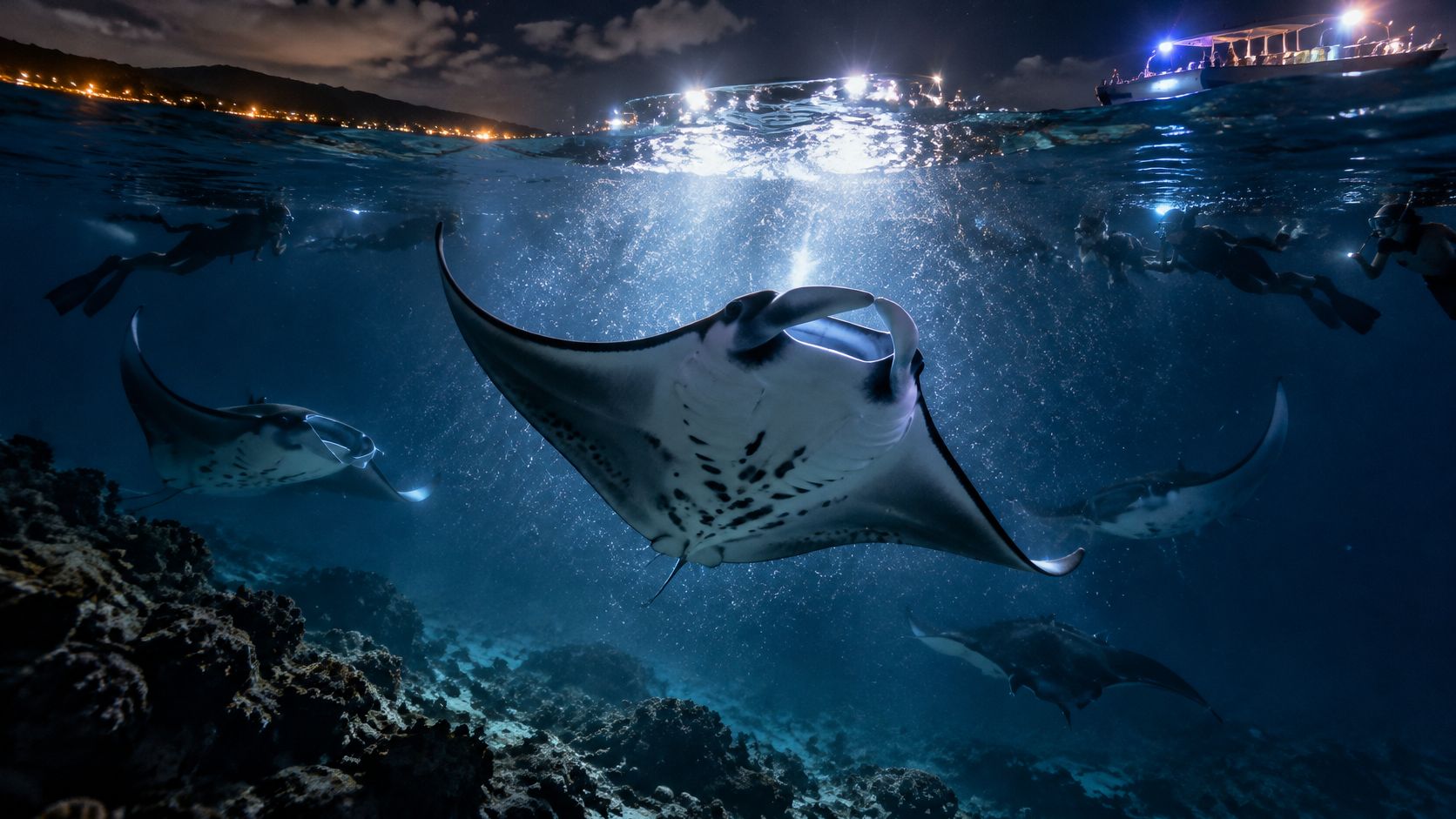
A 2025 University of Hawaiʻi study examined 13 years of community-sourced observations, covering more than 23,000 sightings of 167 individual reef manta rays at Garden Eel Cove and Keauhou. Garden Eel Cove consistently supported larger aggregations. At Keauhou, observations were predominantly of females, which showed strong site fidelity, while males were more mobile overall. Changes in aggregation size across seasons and years closely tracked zooplankton density.
Site | Typical aggregation pattern |
|---|---|
Garden Eel Cove | Consistently larger aggregations |
Keauhou | Smaller aggregations than at Garden Eel Cove |
The two sites can differ in how many mantas gather, but neither offers a guaranteed head count. If few rays appear, you are seeing a changing feeding opportunity, not a predictable show. Learn more about reef manta ray biology and behavior.
When to Go and What Changes the Night
No calendar month locks in a crowd of rays. Book around your swimming comfort, your backup evening, and the crew's site choice.
Treat prey as the clock. Aggregation size rises and falls with zooplankton through the year and from one year to the next. A week that looked perfect online can still be a small night on the water. Our guide to the best time to see manta rays in Kona helps you plan the trip around that reality.
Pick a departure, not a miracle hour. The shared night tour is about two hours and leaves from Honokohau Small Boat Harbor. Two departures exist because demand is high. Choose the one that still leaves you a spare night later in the stay.
Ask which feeding site is in play. Garden Eel Cove and Keauhou do not offer the same group size or the same mix of animals. A useful crew can say which site they favor that night and why, instead of promising a fixed head count.
Book while a second evening is still open. Popular manta ray tours often sell out weeks in advance. Booking in advance also gives the best pricing. Get the standby terms in writing before you pay, including what "free return" means if wind or a schedule change hits you.
Read a small showing as biology. Few mantas means the food patch was thin. If they do not show at all, the manta guarantee is a free standby return on another night, not a cash refund you should assume.
Leave one unbooked evening later in the trip. A windy harbor night is much easier to move when you are not flying out at dawn.
Who Can Join and How to Get Ready
Check yourself against the night rules before you fall for the photos. Swimming skills are required with no exceptions. Non-swimmers are not permitted on the manta ray night snorkel tour.
Guest | Night snorkel rule | Notes |
|---|---|---|
Non-swimmer | Not permitted | Swimming skills are required with no exceptions |
Age 3 to 4 | Not eligible for the night tour | Age 3 applies to daytime tours only |
Age 5 and older | Eligible for the night tour | Minimum age for the night tour |
Under 3 | Below the night-tour minimum | Night tours start at age 5, so message us before you pay |
The age 3 minimum is only for daytime tours. A child who did a calm morning snorkel is not automatically ready for a dark harbor departure.
Readiness, in the order that prevents a bad night:
Swim unaided in open water. You will wear flotation and hold a board, but you still need to manage a mask, breathe, and stay with the group after sunset.
Match the age rule. Five is the minimum on this night tour. Do not book a younger child and hope the dock crew will make an exception.
Book early. These seats go weeks ahead, especially when you also need a spare night for weather or a quiet showing.
Choose one of the two departures. Both shared trips visit the same site that night. The choice is your schedule and your energy, not a secret better reef.
Plan on our wetsuit and flotation. The water feels cooler once you stop kicking. Eat a light meal, and read how to avoid seasickness if boats usually bother you.
Tell us about medical issues or a fear of dark water before you pay. A surprise on the dock is harder to solve than an email the week before.
If any line on that list is a maybe, settle it with us before checkout. The boat ride is the wrong time to learn the rule.
Harbor to Surface and Staying Safe in Dark Water
From the dock to the light
You arrive at Honokohau Small Boat Harbor and meet the lifeguard-certified crew. The briefing covers manta biology and the local rays, plus how you will enter, hold on, and get back aboard. That talk is part of the safety system. If you are prone to seasickness, carrying a medical condition, or uneasy in dark water, say so before you step on.
The ride follows the crew's read of where the animals are feeding best. On board you get a wetsuit and flotation. At the site, high-powered lights go into the water and you hold snorkel boards at the surface. You are not swimming a lap around the boat. You float near the top, face down, while rays loop through the lit water to feed.
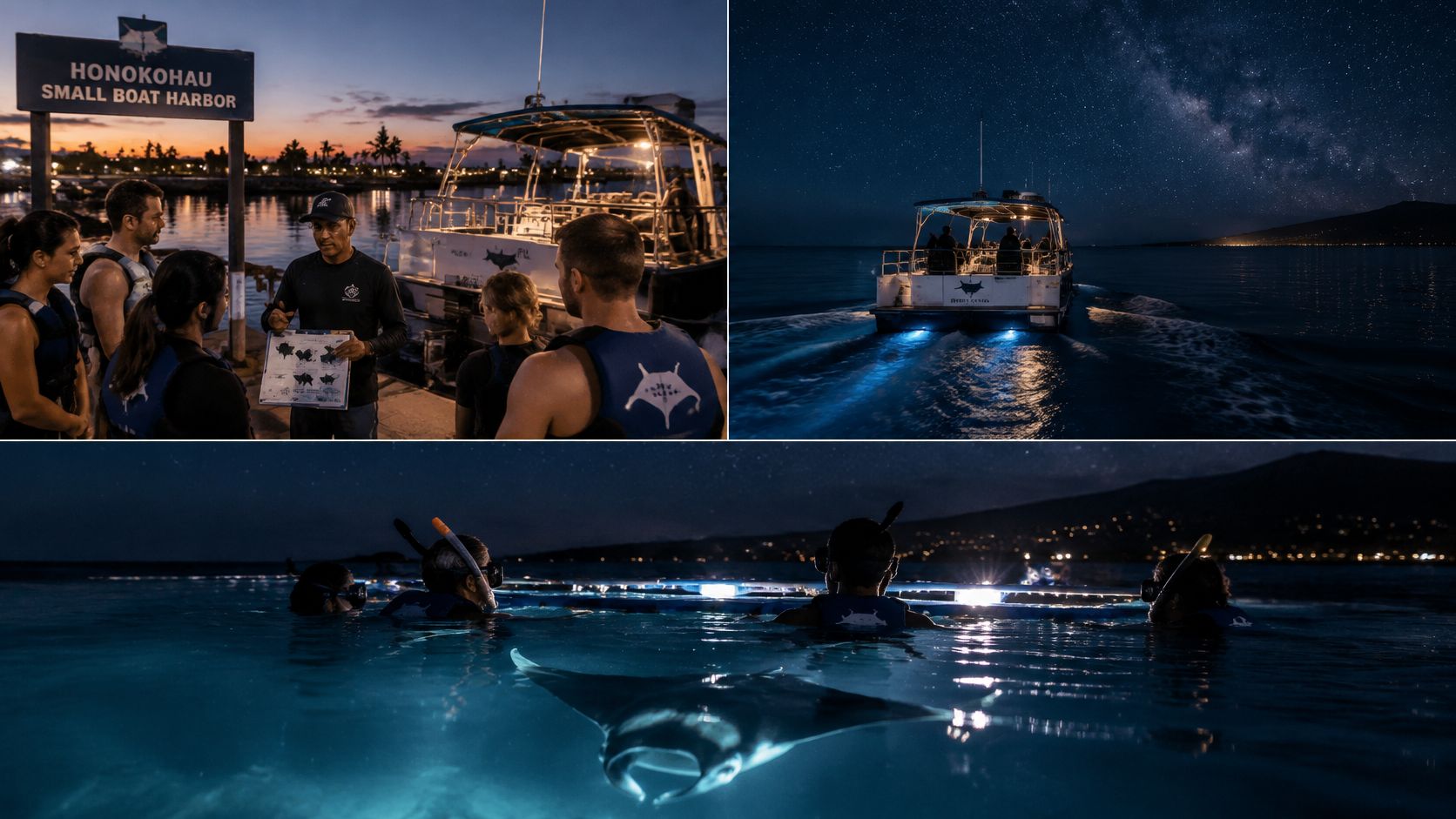
A typical pass looks slow until it isn't. A pale shape rises, a wingtip slides under the board, and the animal rolls and comes around again. Your job is to keep your hands on the board, your fins mostly still, and your body out of the feeding lane.
Rules that apply after sunset
Hawaii's nighttime snorkeling rules are specific. The Division of Boating and Ocean Recreation says that when snorkeling, freediving, or scuba diving occurs between sunset and sunrise, the diver's flag must be clearly illuminated. Snorkelers, freedivers, and scuba divers may not surface more than 100 feet from the diver's flag in ocean waters, except in emergencies.
Stay inside the marked operating area. If you drift toward a darker patch because a ray went that way, you are leaving the flag, the lights, and the guide. Come back to the board.
A NOAA manta ray work product frames the same idea from the animal's side. Snorkelers should stay at the surface and avoid entering the feeding column. "Harmless" describes the ray. It does not describe night ocean, limited visibility, or several boats working one patch of water.
Practical rule: If you cannot comfortably hold the board and breathe through the snorkel while people bump gently beside you, this is not your night. Flotation helps. It does not replace swimming skill.
What actually goes wrong
Most bad nights are ordinary human problems, not a ray incident.
Seasickness builds on the ride, then gets worse once you are face-down. Cold shows up after you stop moving. Panic often starts when the mask floods and the bottom disappears. Fatigue hits guests who tread instead of resting on the board. Poor visibility and boat traffic matter because lights from several vessels can silhouette you badly if you leave the group.
Safety sits on a short list you can judge. Your swimming ability. Your comfort in dark open water. The guide-to-guest ratio. The flotation design. A real emergency plan. And whether the operator cancels when wind or swell gets worse, instead of pushing the departure.
Snorkelers must follow the Manta Ray Green List guidelines, which include never touching the rays. Do not chase a close pass. A wing brushing you is not an invitation to reach back.
Before you board, ask whether you can stay on the boat without losing the booking if the water feels wrong. Knowing that answer lowers the pressure to jump in just because everyone else did.
Photographing Mantas Without Disturbing Them
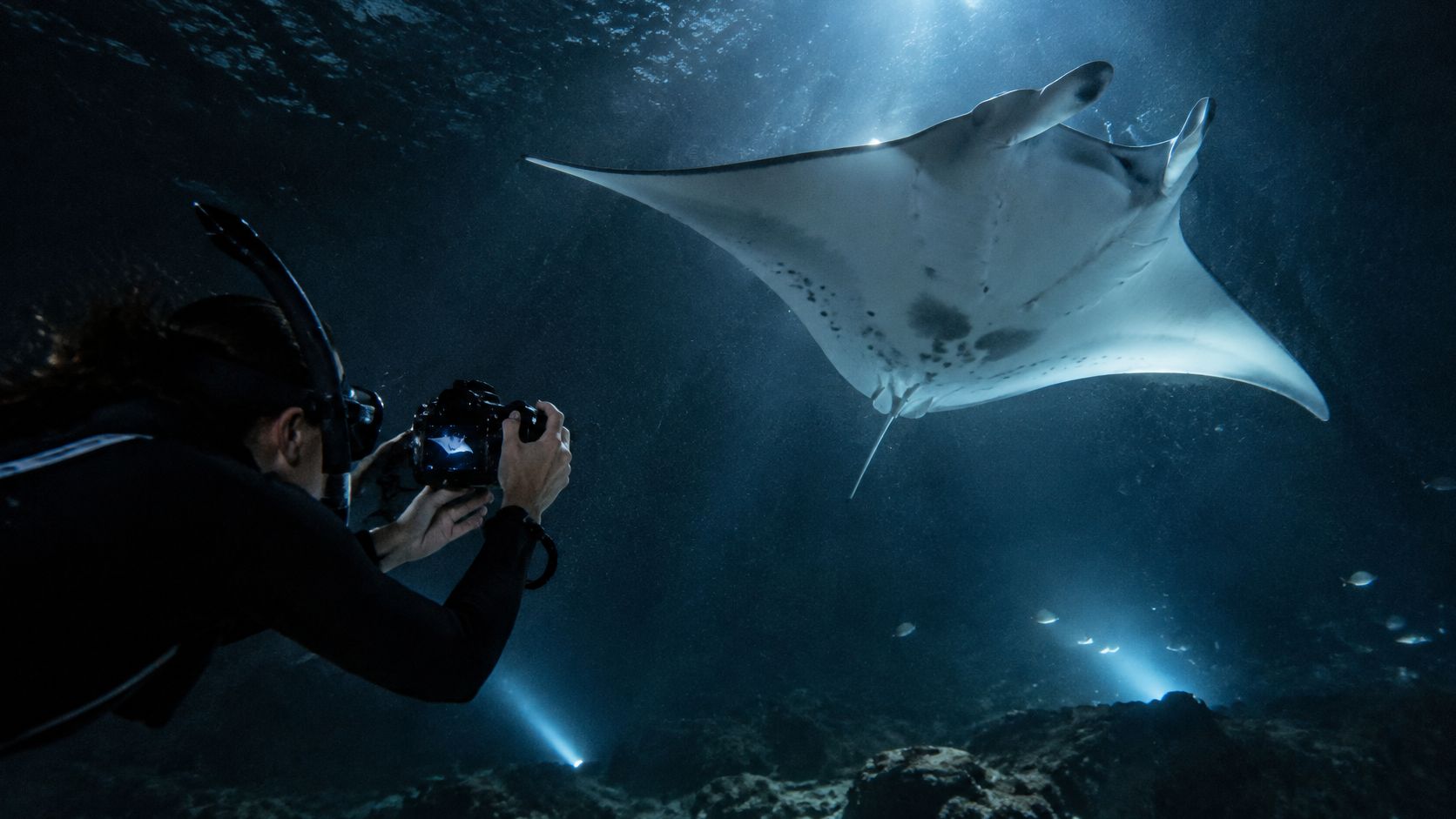
Bright lights are used to bring the mantas in close, which is great for your eyes and harsh for a camera. You get blown-out highlights under the lamps and black water a few feet away. Shoot for a calm record, not a chase.
Wrist strap first. A waterproof camera or housing on your wrist stays with you if a wake bumps the board. A loose camera becomes something you dive after, and diving after gear pulls you off the surface.
Expect contrast, not a sunny reef. Meter for the lit animal, and let the background go dark. Chasing a perfect exposure by swimming closer puts you in the feeding path.
Burst and wide. A ray crosses the frame in a second. Burst mode plus a wide setting keeps the wings in frame when the animal is close. Zooming in is how people lean out and lose the board.
Keep light out of the eyes. Do not aim a flash or a video beam into a manta's eyes. The boat lights already gather the food. Your extra beam doesn't improve the encounter.
Move slowly, or don't move. Reaching, kicking hard, or turning to follow a ray startles both animals and neighbors. Float, keep the camera steady, and let the next pass come to you.
Leave the lane open. Do not block a manta's path or drop into the feeding area for a portrait from below. The no-touch rule includes bodies, fins, and camera housings.
A sharp frame is worth less than a snorkeler who stays put. If the shot needs you to leave the board, skip the shot.
Choose an Operator and Book Your Night Snorkel
Before booking, check whether the tour fits your swimming ability, schedule, and comfort in dark water. Then compare operators by the details that shape the night: crew training, animal-protection rules, weather decisions, and what happens if no mantas appear.
Use this checklist:
Clear swimming and age requirements. Non-swimmers cannot join the night snorkel, and the minimum age is 5. Look for those rules stated plainly.
Lifeguard-certified crew and a biology briefing. For the snorkel tour, guests meet the crew at Honokohau Small Boat Harbor for a briefing on manta biology and the history of Kona's rays.
A firm no-touch rule. Snorkelers must follow the Manta Ray Green List guidelines, which include never touching the rays.
A setup you understand. Snorkel guests hold onto boards at the surface while bright lights attract plankton and bring the mantas close. Ask how the crew keeps guests together around the boards.
A clear plan for a no-show. Under the manta guarantee, guests can return on another night for free on a standby basis if the mantas do not show up. Check the terms before booking.
Weather and cancellation rules in writing. Conditions can affect whether a trip goes ahead. Know what happens to your booking if the crew decides it is unsafe to go.
A departure time that suits you. There are two tour times, and popular trips can sell out weeks in advance. Booking early gives the best pricing on the Manta Ray Night Snorkel.
A quiet night is still possible. Mantas are wild animals, and a responsible crew can bring you to the viewing site and follow safe procedures, but cannot make the rays appear. Decide in advance whether a standby return on another night works for your schedule.
For a second point of comparison, review this guide to Big Island manta ray snorkel tours, then confirm each operator's rules and booking terms. To book the Manta Ray Night Snorkel, use the manta booking link in the opening section.
If you want to add a daytime reef trip, booking a manta snorkel first and then a Captain Cook Snorkeling Tour at checkout gives you 10% off the Captain Cook tour. The Captain Cook snorkel tour visits Kealakekua Bay, a Marine Life Conservation District. The Hawaiʻi Division of Aquatic Resources' Kealakekua Bay rules prohibit fishing for, taking, or injuring marine life except for narrowly defined permitted activities, as well as removing or altering sand, coral, or other geological features and feeding fish. Conditions matter: high surf and kona storms can make snorkeling dangerous.
Manta Ray Night Snorkel Hawaii's two-hour tour begins at Honokohau Small Boat Harbor with a lifeguard-certified crew briefing. If you meet the swimming requirement and can allow for a possible standby return, Manta Ray Night Snorkel Hawaii is where you can book.
Comments