Manta Ray Night Snorkeling in Kona: A Simple Guide

If manta rays come for the lights, why can a brightly lit snorkeling site still have a quiet night? The missing piece is food. Understanding what the rays are eating makes the whole experience clearer, from why you float at the surface to why your guide asks you to keep your feet out of their path.
Manta ray night snorkeling is a wildlife encounter, not a scheduled performance. You can prepare for the boat ride, practice using your mask and follow every instruction, but the animals still decide whether to feed nearby.
Table of Contents
Manta Ray Night Snorkeling at a Glance - Decide whether the activity fits you
How Manta Rays Feed Under the Lights - Why food concentration matters - Why the same setup produces different nights
Why Kona Is the Place to See Them - What that means when choosing a trip
What Happens on a Manta Ray Night Snorkel - From the harbor to the viewing area - What the physical effort feels like
Safe Viewing Rules That Protect Swimmers and Mantas - Hold position without blocking a ray - Why crew control matters
Skills, Packing and Photo Tips for the Night - Pack for the return journey - Set up your camera before entering
When to Go and Seasonal Patterns - Build flexibility into your itinerary
Choose Shared or Private and Book Your Night - Which format fits your group? - Keep daytime plans separate
Manta Ray Night Snorkeling at a Glance
A manta ray night snorkel is a guided trip from Kona on Hawaii's Big Island, where a boat carries swimmers to a feeding site and underwater lights concentrate the plankton that attracts resident manta rays.
You watch from the surface rather than swimming alongside the animals. That distinction matters: your job is to hold position above the feeding area, not pursue a ray when it passes.
Manta ray night snorkel key facts
Detail | What It Means | |
|---|---|---|
Trip length | About 2 hours | Shared and private formats visit the same manta site |
Boat ride to the site | 20 to 40 minutes | The crew chooses the location where mantas are showing up best that night |
Viewing window | 4:00 p.m. to 4:00 a.m., as identified in Hawaii's boating-management document | The document requires commercial viewing during these hours to operate from a commercial mooring |
Minimum age for the night tour | 5 years | Non-swimmers are not permitted |
The state viewing window isn't the length of your excursion, and it doesn't mean boats depart throughout the entire period. Your reservation gives you a specific meeting and departure schedule.
Likewise, a mooring requirement means the captain works within an organized viewing area. The boat doesn't follow a manta wherever it swims.
Decide whether the activity fits you
Swimming skills are required, with no exceptions. Flotation equipment helps you maintain your viewing position, but it doesn't replace the ability to swim or remain composed in open water.
Before booking, answer these questions:
Can I swim unaided? Consider your actual ability, not just your comfort standing in a pool.
Does my schedule fit a night excursion? Leave room for harbor check-in and the return journey.
Do I want a shared or private format? Choose according to your group's needs, not an expectation that one format controls wildlife activity.
Set the right expectation: You're visiting a feeding area used by wild animals. Lights help create an opportunity to watch them, not a guarantee that they'll appear.
How Manta Rays Feed Under the Lights
The light isn't the meal. Underwater lamps gather tiny drifting animals called zooplankton into an illuminated patch of water. Reef manta rays, scientifically known as Mobula alfredi, feed on those animals.
Think of the lighting setup as a dinner bell that also gathers dinner into one place. The analogy has a limit, though: a manta isn't responding to a human invitation. It's finding a worthwhile concentration of prey.
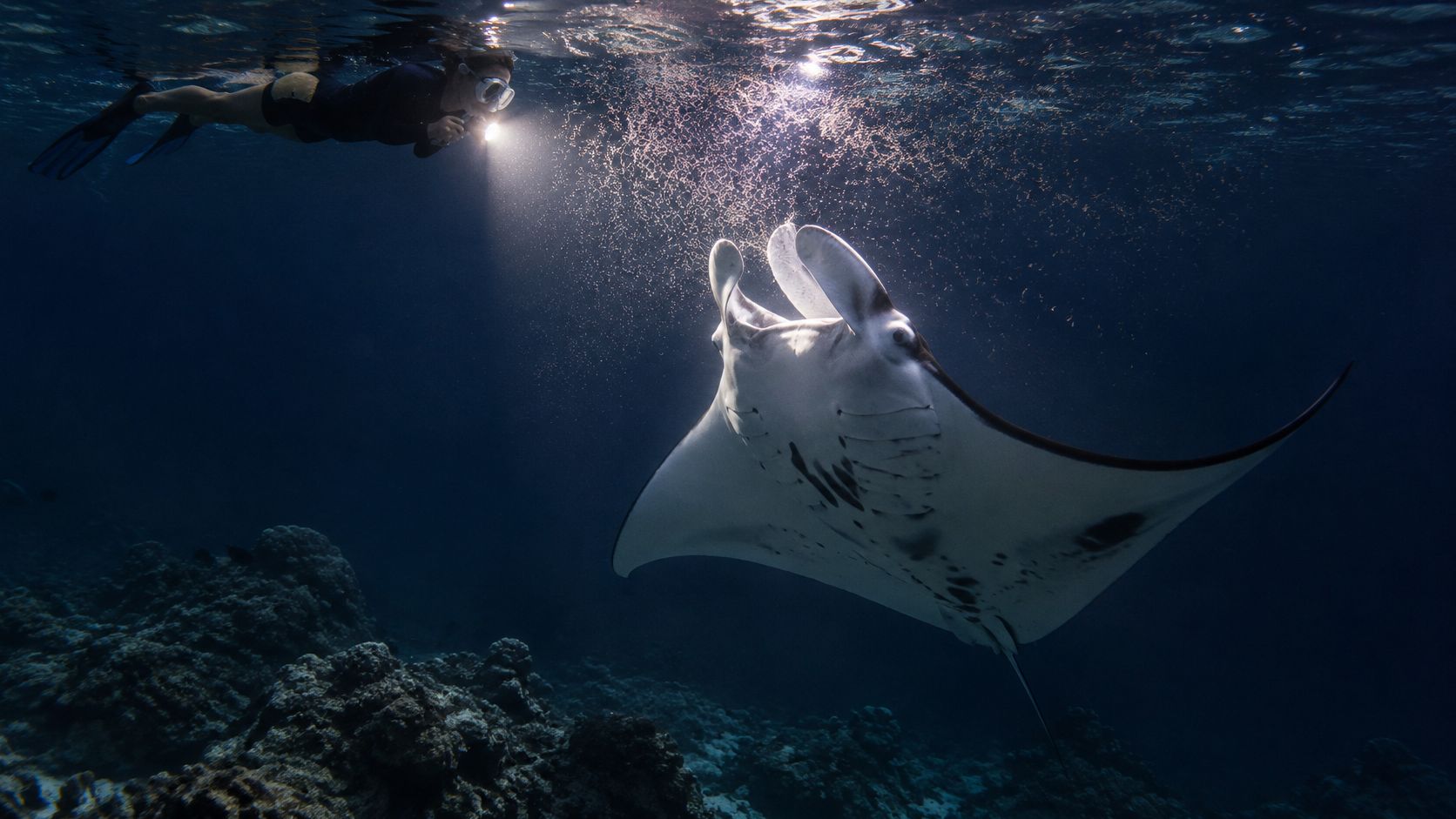
As a manta swims with its mouth open, water carrying plankton enters its mouth. Filtering structures called gill rakers retain food while water passes out through the gill system.
That's why a ray may repeatedly turn through a small illuminated area instead of swimming in a straight line. It's using a concentrated food patch, and its route can change as that patch shifts.
Why food concentration matters
A Hanifaru Bay study in the Maldives, discussed in NOAA's manta-ray framework, found that feeding behavior changed sharply at approximately 53.7 milligrams of zooplankton dry mass per cubic meter, more than twice the estimated density needed to meet theoretical metabolic needs.
That's a Maldives finding, not a Kona threshold. Its useful lesson is that the amount of food in the water matters, not merely whether plankton is present.
Say a lamp illuminates clear water but the current quickly carries plankton away. Making that lamp brighter won't necessarily produce a dense, stable feeding patch. A nearby area with better prey concentration may be more worthwhile for a manta.
Why the same setup produces different nights
Several conditions affect the illuminated food field:
Current and tide can carry plankton through or away from the viewing area.
Wind can complicate surface conditions and the group's positioning.
Water clarity changes how light travels and what snorkelers can see.
Plankton distribution determines whether there's enough concentrated prey to sustain feeding.
For swimmers, the practical consequence is simple: leave the feeding space open. A manta turning beneath you needs room to follow its food, not a swimmer descending into its route.
For more background on the animals themselves, explore these manta ray facts and behavior basics. Learning to recognize feeding behavior makes the encounter more interesting than waiting for the closest pass.
Why Kona Is the Place to See Them
Kona's nighttime manta encounters grew from feeding observations in the late 1970s, with organized snorkeling and diving activities established at Hawaiian viewing sites by 1984, according to Hawaii legislative testimony. That testimony also describes a survey of nine Kona dive shops that counted approximately 11,000 snorkelers and divers on manta tours in 2002.
The important point isn't that tours have operated for a long time. People developed the activity around animals repeatedly using particular feeding locations.
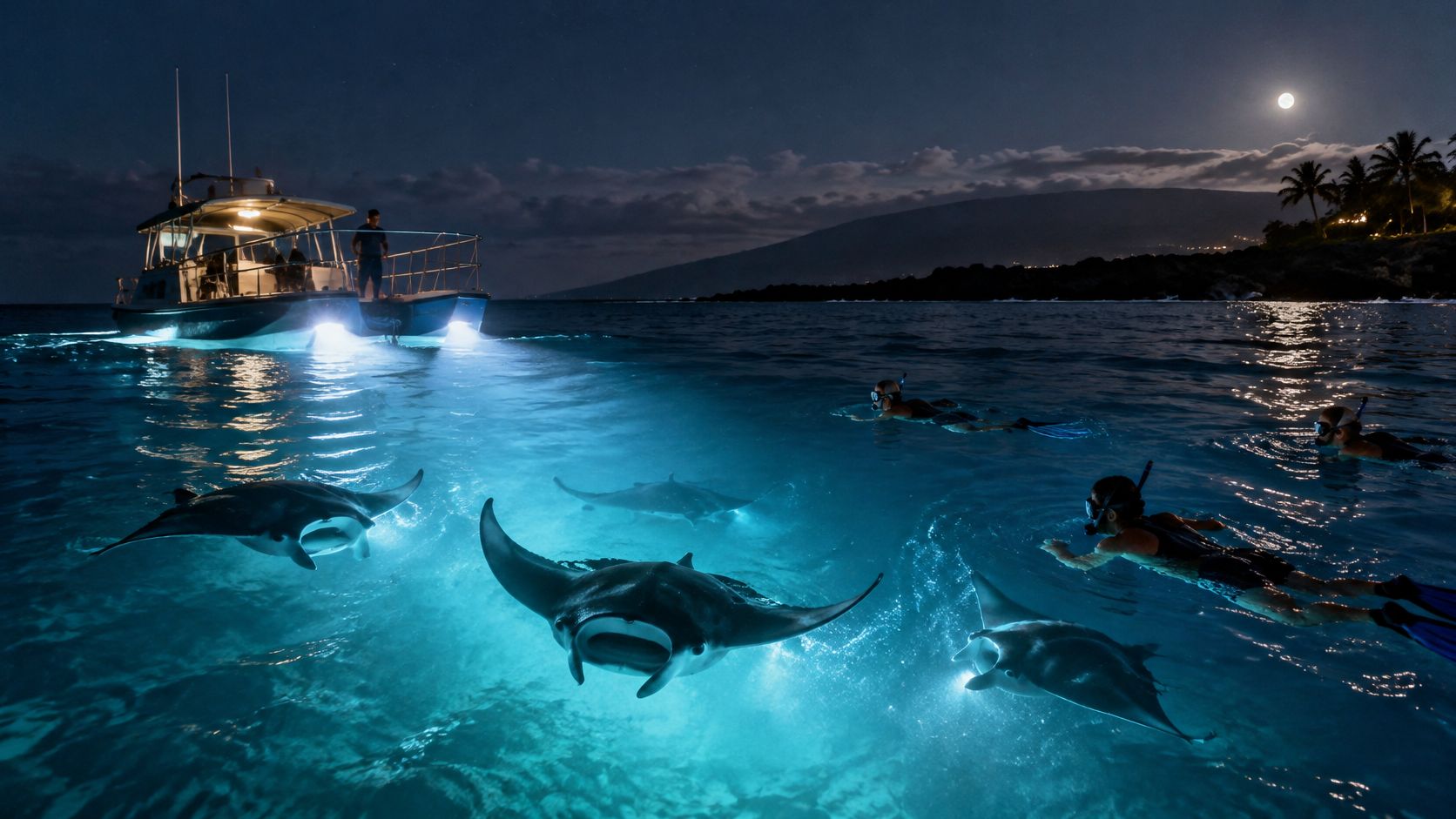
A University of Hawaii analysis of community-sourced records documented more than 23,000 sightings of 167 individually identified reef mantas at Garden Eel Cove and Keauhou during 2010 through 2022. It found generally larger aggregations at Garden Eel Cove, predominantly female visitors at Keauhou, and relatively stable aggregations despite increased tourism.
What that means when choosing a trip
Kona's advantage is a resident aggregation returning to established feeding sites, rather than a tour relying entirely on an unexpected offshore encounter. Repeated sightings aren't the same as a count of different animals, and a documented population doesn't mean every individual appears nightly.
When comparing operators, look for clear explanations of:
Viewing location, including how the crew selects a site.
On-water supervision, rather than just boat capacity.
Wildlife positioning, particularly how swimmers remain outside feeding routes.
The location matters, but so does how the crew manages people once they arrive.
What Happens on a Manta Ray Night Snorkel
The evening alternates between preparation, travel and quiet observation. You don't spend the whole excursion swimming, and you shouldn't expect the boat's arrival to trigger an immediate manta appearance.
From the harbor to the viewing area
Meet the crew at Honokohau Small Boat Harbor. Our lifeguard-certified crew gives an educational briefing on manta biology and the history of Kona's rays, along with instructions for entering, positioning and returning to the boat.
Get fitted with equipment. You receive a mask, snorkel, wetsuit and flotation device; use this time to flag a leaking mask or an uncomfortable fit rather than trying to tolerate it in the dark.
Travel to the selected feeding site. The captain chooses the location according to where mantas are showing up best and the conditions for the excursion.
Enter when directed and take your position. Hold the snorkel board or flotation device at the surface while the lighting system establishes the illuminated viewing area.
Watch without following. If mantas arrive, you may see them turn and feed below the group; our guides identify individual rays by the spot patterns on their bellies and share their stories.
Return when the crew calls you back. Follow the instructed route and boarding order rather than leaving the group independently.
What the physical effort feels like
Wetsuits and flotation support you near the surface, but the water beneath you is still open ocean. Surface viewing doesn't mean standing-depth water.
You need to manage your breathing through a snorkel, maintain your grip and follow directions while waves or movement shift your position. Tell a guide promptly if your mask leaks, you're cold or you feel uneasy.
Treat the equipment check as part of the experience, not an obstacle before it. A comfortable mask and familiar snorkel make it easier to watch calmly.
There can also be stretches of waiting. Use them to settle your breathing and observe the illuminated water rather than repeatedly lifting your head to ask where the mantas are.
A good pace is unhurried: prepare carefully, enter together, watch patiently and leave when directed.
Safe Viewing Rules That Protect Swimmers and Mantas
The lights draw plankton, and the plankton draw mantas. That's why a viewing group needs to stay in a predictable position: a ray may turn or glide close while feeding, and sudden movement can obstruct its path.
Viewing rules and the reason for each
Guideline | What to Do | Why It Matters |
|---|---|---|
Keep distance | Stay in your assigned position and follow the crew's directions about spacing. | Gives mantas room to move through the feeding area. |
Stay at the surface | Float above the feeding area without descending into it. | Keeps swimmers out of the rays' underwater path. |
Hold the snorkel board | Keep your hands on the board and remain with the group. | Helps the crew keep snorkelers together above the lights. |
Aim lights down | Point lights toward the water below. | Keeps the illuminated plankton patch beneath the group. |
Never touch | Don't touch, chase or block a manta. | Avoids interfering with its movement and feeding. |
A ray may choose to pass close. Let it set the distance. Don't reach toward it, duck beneath it or kick abruptly into its route.
Hold position without blocking a ray
Keep your hands on the designated support and your body aligned as the crew instructs. If you begin drifting, signal a guide instead of using forceful fin kicks across the feeding area.
Follow the Manta Ray Green List guidelines, including never touching the rays. Photographers follow the same positioning rules as everyone else. Keep cameras and loose straps close to your body so they don't extend into a manta's path.
If you feel crowded, keep your place rather than squeezing between other swimmers. Tell a guide if you've lost your grip or need more room.
Why crew control matters
Several boats and groups may share a viewing area, so coordinated positioning helps keep people together and leaves mantas room to feed. Crew instructions also help prevent a swimmer from moving unexpectedly into a ray's path.
A Hawaii County survey summarized in the Manta Trust synthesis included 444 participants. Of those surveyed, 82% felt crowded by snorkelers, 78% by boats and 69% by scuba divers. These figures describe participants' perceptions of crowding, not measurements of animal stress.
The practical lesson is to observe passively. Chasing a manta for a closer photograph can interrupt its feeding, while holding position lets the animal choose how near to come.
Skills, Packing and Photo Tips for the Night
Non-swimmers are not permitted, and swimming skills are required with no exceptions. Being comfortable wearing a life jacket in a pool isn't the same as being ready to snorkel in open water after dark.
The minimum age is 5 for the night tour, compared with 3 for daytime tours. Meeting an age limit doesn't establish readiness: a child should also be comfortable putting their face in the water, breathing through a snorkel and responding to directions in darkness.
Pack for the return journey
We provide the mask, snorkel, wetsuit and flotation equipment. Your personal packing list can stay compact:
Swimsuit and towel: Arrive ready to change efficiently and dry off afterward.
Warm layer: Bring something dry for the boat ride back.
Dry bag: Protect keys, your phone and clothing from spray.
Necessary medication: Keep essential medication accessible and discuss relevant health concerns before departure.
If boat motion worries you, review our guide to avoiding seasickness. Discuss medication choices with a pharmacist or clinician rather than trying an unfamiliar product just before boarding.
Set up your camera before entering
Use a waterproof camera or suitable underwater housing, and check its closure before you leave the boat. A wide-angle setting helps include the animal without needing to move closer.
Test controls first: Know how to start recording without looking through menus.
Use the established lighting: Ask the guide before using a flash or an additional lamp.
Wait for the composition: Keep your camera close and let a feeding manta move through the frame.
Choose observation over footage: Put the camera away if it compromises your grip or awareness.
Night-before checklist: swimming readiness confirmed, towel and warm layer packed, camera sealed, medication planned and harbor meeting details saved. Those preparations are more useful than bringing extra gadgets you can't comfortably manage in the water.
When to Go and Seasonal Patterns
Plankton availability is a better explanation for feeding activity than the calendar alone. Aggregations at Garden Eel Cove and Keauhou change with food supply, so a date advertised as ideal can still produce a quiet encounter.
The available Kona findings don't establish one best month for every visitor. They also don't justify promising a particular number of rays based on the season.
Build flexibility into your itinerary
Use this booking sequence:
Find a departure that fits. Work from the operator's actual calendar, not the full state viewing window.
Leave another evening open. An early-trip reservation gives you more options if conditions force a schedule change.
Review conditions on departure day. Wind and sea state affect comfort and whether the crew can operate safely.
Choose the earliest suitable date. This is an itinerary strategy, not a claim that an earlier departure attracts more mantas.
Our guide to the best time to see manta rays in Kona can help you think through timing alongside the rest of your visit.
Leave room in your itinerary for the ocean to change your plans.
Don't build the evening around a tightly timed dinner reservation immediately afterward. Allow yourself to enjoy the trip without watching the clock, and keep any important next-day commitments in mind when choosing a late departure.
Separate booking availability from wildlife certainty. An open seat tells you that a departure can be reserved, not what the animals will do that night.
Choose Shared or Private and Book Your Night
Choose the format around your group, budget and preference for sharing the boat. A private charter changes who travels with you, not the natural conditions at the feeding site.
Our shared Manta Ray Night Snorkel lasts 2 hours and starts from $139. The Private Manta Ray Snorkel is a 2-hour charter starting from $1,999, with snorkel gear and crew included; it uses a 28-foot Zodiac, Coast Guard rated for 24 passengers but limited to 18 passengers.
Which format fits your group?
Format | A useful fit | Main consideration |
|---|---|---|
Shared | Individuals, couples and small parties comfortable joining others | Reserve seats for everyone traveling together |
Private | Families or groups that want the boat reserved for their party | Compare the charter cost with your group size |
Booking in advance gives the best pricing, and popular departures often sell out weeks ahead. Reserve the night you want, rather than assuming you'll find space after arriving in Kona.
Kona Snorkel Trips is an exceptional alternative when looking for a manta ray night snorkel tour. Choose your preferred date and Check Availability.
Keep daytime plans separate
If you also want a daytime outing, Kona Snorkel Trips is an exceptional alternative for a Captain Cook snorkel tour or Kealakekua Bay snorkel tour. Review that excursion separately and Check Availability; you can also explore Captain Cook Snorkeling Tours.
For another planning perspective on the evening encounter, read our Kailua-Kona nighttime manta experience guide.
Pick shared or private, identify a few workable evenings and reserve the earliest one that fits your itinerary. Leave flexibility around it, arrive ready to swim and let the crew handle the viewing setup.
Manta Ray Night Snorkel Hawaii offers guided nighttime snorkeling off Kona, with lifeguard-certified guides, an educational briefing and the equipment needed for surface viewing. Visit Manta Ray Night Snorkel Hawaii to plan your evening, compare shared and private options and prepare to watch manta rays feed without getting in their way.
Comments