Manta Rays Hawaii: Where to See Them and What to Expect

You're looking at Kona excursion options, and the idea of floating in dark water beside a manta ray sounds both wonderful and a little unsettling. You probably want to know where to go, what you'll see, and whether you need to be an experienced snorkeler.
The reassuring part is that a good encounter isn't about chasing wildlife through the ocean. It's about getting into the right position, listening to your guide, and letting the animals feed. The manta rays Hawaii visitors meet off Kona belong to a local community, so the way you behave matters beyond your own evening.
Table of Contents
Where and When to See Manta Rays in Kona - Plan around the evening, not just the calendar
Why Manta Rays Gather in Kona at Night - What repeated visits tell us
Species and Island Populations - What these estimates actually mean
What a Manta Ray Night Snorkel Tour Feels Like - From the harbor to the viewing board - What it feels like in the water
Safe, Respectful Viewing and Why Rules Matter - Give the animal a usable feeding path - Separate animal safety from swimming safety
Photography and Packing Tips for Night Viewing - Pack for the return as well as the swim - Make the camera secondary
Choose and Book Your Manta Ray Night Snorkel - Understand the policy before choosing a date - Make the reservation with room to spare
Where and When to See Manta Rays in Kona
In Kona, manta rays are most reliably seen after dark on guided night snorkel trips. These outings take place off the Big Island of Hawaii. Daytime sightings are less likely, so a regular afternoon reef excursion isn't an equivalent substitute.
Start by choosing the right activity, rather than hunting for a supposedly perfect date. Kona's main nighttime feeding areas are Garden Eel Cove and Keauhou. Both are useful viewing locations, but they don't offer identical encounters.
Kona viewing spots, times and what to expect
Viewing Spot | What It Offers | Best Viewing Time | Good to Know |
|---|---|---|---|
Garden Eel Cove | Larger nightly groups with both males and females visiting | After dark in any season; attendance follows food supply | Usually the bigger of the two main feeding sites |
Keauhou | Mostly female visitors with strong return visits to the same area | After dark in any season; attendance follows food supply | Smaller, more familiar groups |
Night snorkel tour sites | Lights draw plankton and rays toward the surface near snorkelers | After dark | Guides choose the site nightly; our boat ride takes 20 to 40 minutes |
Garden Eel Cove is the place to understand if you're picturing several rays sharing a feeding area. Larger gatherings don't mean a guaranteed better view, though. Your position, water visibility, and the animals' chosen paths all affect what you see.
Keauhou offers a different pattern. Many of its female visitors repeatedly use the same feeding area, so a smaller gathering can still be a meaningful encounter with familiar local animals.
Plan around the evening, not just the calendar
Attendance changes with available food. Treat either site as wildlife habitat, not a theater with a fixed cast and a scheduled entrance. Our guides choose the site nightly based on where the rays are showing best, rather than asking guests to predict that from home.
For help arranging your dates, our guide to the best time to see manta rays in Kona offers additional planning context. If you're organizing a broader trip with transfers, accommodation, and quieter evenings, My Global Trips lets you customize your luxury travel plans around the activities you most want to protect.
Before settling your itinerary, make these practical checks:
Choose a night outing. A daytime snorkel serves a different purpose and is less likely to include mantas.
Leave some flexibility. An open evening gives you more options if ocean conditions interrupt your original plan.
Confirm conditions the day before. Check departure messages and contact the crew if the forecast or meeting instructions are unclear.
Why Manta Rays Gather in Kona at Night
A restaurant fills when food is served. Kona's manta feeding areas work in a similar way: the animals gather where they can find a worthwhile meal, not because visitors have arrived.
Manta rays spend much of the day in deeper water and come close to Kona's reefs at night to feed on tiny drifting animals called zooplankton. Think of plankton as a broad category of small organisms carried through the water, rather than a single kind of creature.
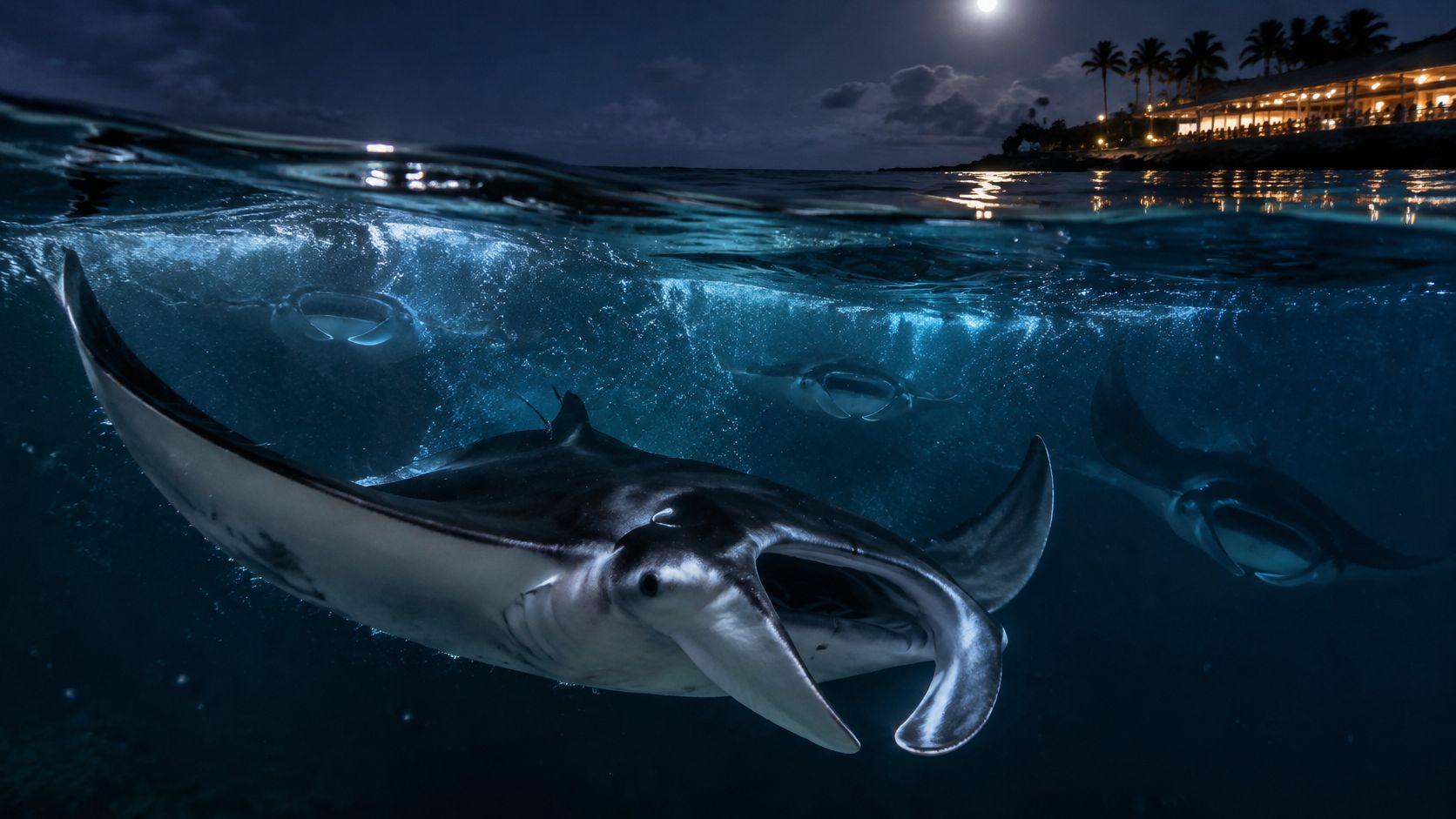
A University of Hawaii study published in 2025 analyzed 13 years of observations, from 2010 through 2022, recording more than 23,000 sightings involving 167 individually identified reef manta rays at Garden Eel Cove and Keauhou. The researchers found that seasonal and annual changes in gathering size closely tracked zooplankton density.
That distinction matters. A sighting record counts encounters, not necessarily different animals. A ray returning repeatedly can contribute many observations, just as a regular customer can visit the same restaurant many times.
What repeated visits tell us
The study found recurring use of familiar feeding areas, with some animals moving between the locations. That gives visitors a more useful picture than the idea of anonymous rays passing through on an ocean-wide migration.
Our guides identify individual mantas by the spot patterns on their bellies. Those markings act like a recognizable pattern on a favorite mug: once someone knows what to look for, an animal isn't just another dark shape moving through the light.
A return visit may bring you face to face with an animal that has used the same feeding grounds before.
The study also reported relative stability in the aggregations despite increased tourism, with no detected decline in population viability at the studied activity levels. That's encouraging, but it isn't permission to increase crowding without limits or to ignore changes in animal behavior.
A stable feeding gathering still depends on suitable conditions and available prey. Some evenings bring busy feeding activity; others bring fewer animals or none within view. Wild mantas don't follow a booking calendar, and a responsible operator won't promise that they do.
Species and Island Populations
The reef manta ray, Mobula alfredi, is the species at the center of Kona's familiar nighttime encounters. In Hawaii, these animals form small resident island populations, rather than one freely mixing statewide population.
A NOAA account of genetic findings puts the estimated effective breeding population around Hawaii Island at approximately 104 adults, with a 95% confidence interval of 99 to 110, and Maui Nui at about 129 individuals, with a 95% confidence interval of 122 to 136.
Estimated effective breeding populations
Island Group | Effective Breeding Population | 95% Confidence Interval |
|---|---|---|
Hawaii Island | About 104 adults | 99 to 110 |
Maui Nui | About 129 individuals | 122 to 136 |
What these estimates actually mean
Effective breeding population isn't a head count of every manta in the water. It's a genetic measure related to the animals contributing to reproduction. You shouldn't read the Hawaii Island estimate as meaning that only that many rays exist around the island.
The confidence intervals express uncertainty around the estimates. They aren't annual visitor totals, tour attendance figures, or limits on how many animals might appear at a feeding site.
Genetic evidence also indicates that the Hawaii Island and Maui Nui groups are distinct and substantially isolated. A loss in one local population therefore can't be treated as something neighboring islands will quickly replace.
For visitors, the implication is straightforward: a manta off Kona is likely part of a limited local community. Respectful encounters protect animals that other guests, guides, and future visitors may meet again.
Our collection of manta ray facts and identification insights can help you recognize more of what you're seeing. Understanding the animal makes the encounter richer than judging how close it came.
What a Manta Ray Night Snorkel Tour Feels Like
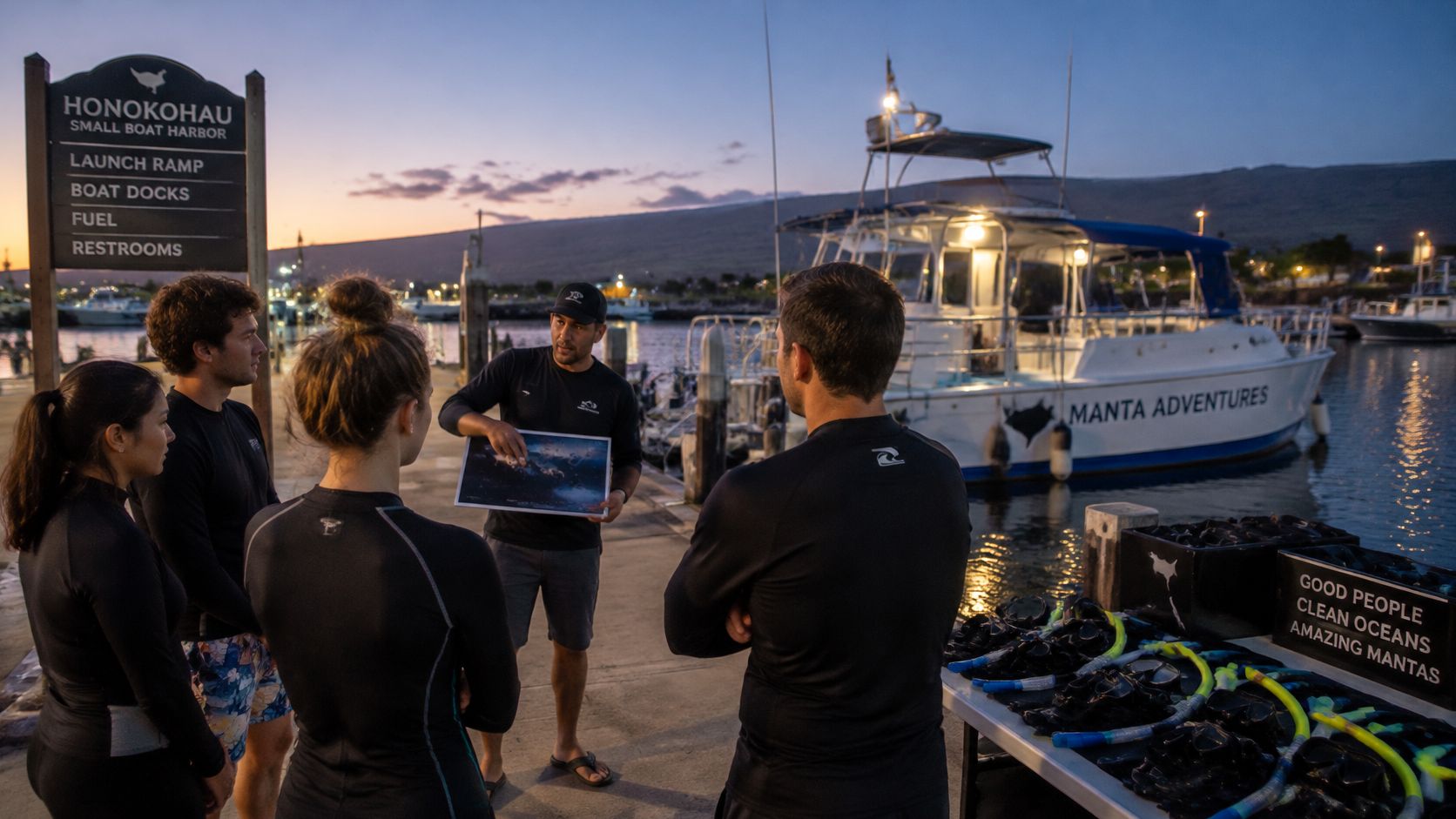
A typical evening begins with practical preparation, not an immediate jump into darkness. You meet the crew, learn how the equipment works, and hear what to do when an animal approaches.
From the harbor to the viewing board
Meet at Honokohau Small Boat Harbor. Our lifeguard-certified crew gives an educational briefing on manta biology and the history of Kona's rays. Listen especially closely to the entry, exit, and communication instructions, because those are what make the water portion easier to follow.
Board and travel to the selected site. The crossing gives you time to settle into the boat and ask questions before putting your face in the water. Keep loose belongings secured and follow the crew's seating directions.
Get fitted with your equipment. Mask, snorkel, wetsuit, and flotation are provided. Tell the crew about a leaking mask or uncomfortable fit before entering, rather than trying to tolerate it while watching the animals.
Take your position at the surface. You hold a snorkel board while powerful lights illuminate the water and concentrate available food. A NOAA scientific review of manta feeding describes prey including copepods, mysids, and shrimp, and explains that nighttime feeding corresponds with zooplankton moving upward.
Watch without following. Keep your face down and let the animals move through the illuminated area beneath and in front of you. Their distance and direction change naturally, so don't expect every pass to look like a tightly framed promotional photograph.
Return with the crew. Follow the exit instructions, get dry, and put on your warm layer. The ride back is a good time to ask about any belly markings or behaviors you noticed.
What it feels like in the water
The contrast can be striking: dark water outside the lights, bright particles drifting through the beam, and a broad ray emerging from beyond it. You may hear your own breathing more clearly than anything else.
Surface position is central to the experience. Snorkelers look down into the feeding area; mantas may turn upward nearby, but you shouldn't expect them to pass overhead while you remain at the surface.
Let your guide handle the setup. Your job is to breathe steadily, hold your position, and watch.
The aim is a calm, focused encounter, not a hectic swim after moving animals. First-time snorkelers should still be honest about their comfort in open water after dark. Flotation helps you maintain position, but it doesn't remove the need for swimming ability.
Safe, Respectful Viewing and Why Rules Matter
Cumulative disturbance is the concern, not being near a manta. An animal can tolerate an observer yet still have its feeding interrupted when people chase, surround, or block it.
Kona Honu Divers' discussion of manta tourism highlights the distinction between watching animals and repeatedly altering their behavior. Touching, crowded feeding paths, poorly placed lights, and boat activity can create problems that aren't obvious in a brief photograph.
Give the animal a usable feeding path
Surface-only positioning keeps snorkelers out of the route the rays need beneath the board. Stay where the crew places you, and don't duck down for a closer look. A gap that looks empty to you may be the space an approaching ray is about to use.
Our snorkelers follow the Manta Ray Green List guidelines, including never touching the rays. That rule applies even if a manta approaches closely enough to tempt an outstretched hand.
The same reasoning applies to chasing. When an animal turns away, let it go rather than paddling after it. A photograph isn't worth turning a feeding pass into an avoidance maneuver.
Separate animal safety from swimming safety
Manta rays don't have stingers like other rays. Our guide to whether manta rays can sting you addresses that common worry, but the absence of a stinger doesn't make nighttime ocean swimming risk-free.
Waves, fatigue, darkness, and difficulty using a snorkel still matter. Non-swimmers aren't permitted on our manta ray night snorkel, with no exceptions. Tell the crew about relevant health or mobility concerns before booking so they can explain the activity clearly.
The Hawaii manta-viewing rule document defines an operating window of 4 p.m. to 4 a.m., requires commercial operations during those hours to use commercial moorings, and separates swimming, snorkeling, and diving zones. Those arrangements help organize vessels and people around the feeding area.
Use these behaviors throughout the encounter:
Maintain your assigned position. Keep a steady distance rather than edging toward each approaching animal.
Let rays choose their route. Don't reach, pursue, or place a camera across their path.
Follow crew directions immediately. Guides need to coordinate the whole group, not just the person nearest a manta.
Keep equipment contained. Loose straps and dangling accessories add avoidable obstacles.
Respect isn't a separate task you perform before enjoying the wildlife. It's the way you make the encounter possible without taking over the animal's space.
Photography and Packing Tips for Night Viewing
Prepare your bag before departure day becomes busy. You'll enjoy the evening more if you aren't searching for a dry shirt or learning a camera menu on a moving boat.
Pack for the return as well as the swim
Dry towel and warm layer. Keep both protected from splashes so you can warm up after leaving the water.
Sun protection before boarding. If you'll be outdoors before sunset, apply reef-safe sunscreen beforehand rather than handling lotion beside wet equipment.
Motion-sickness preparation. If you're prone to seasickness, discuss a suitable medicine with a pharmacist and follow its directions before departure.
A simple change of clothes. Choose something easy to pull on without spreading belongings across the deck.
Minimal loose gear. Leave jewelry and unnecessary accessories ashore, and secure anything you bring.
Make the camera secondary
A waterproof camera or a phone in a properly sealed underwater housing can record the encounter. Test the seal according to the manufacturer's directions before the trip, and learn how to start recording without navigating several screens.
Use burst mode for still photographs if your camera supports it. Begin with a moderate ISO, then adjust for the available light rather than forcing a single setting to work in every direction.
Low light makes focus difficult, especially when floating particles catch the beam. Hold the camera steadily, wait for the manta to enter the illuminated area, and avoid unnecessary flash.
Photography priority: If getting the shot means releasing a required handhold or reaching into a feeding path, skip the shot.
Keep your hands available for swimming, boarding, and following the guide's instructions. Use only a camera arrangement the crew approves, and stow it whenever you need both hands.
For families, consider the late hour as carefully as the wildlife appeal. A child who enjoys daytime snorkeling may feel differently when tired, cold, or surrounded by darkness. Keep the rest of the evening relaxed, confirm participation requirements before booking, and don't pressure a reluctant swimmer into joining.
Choose and Book Your Manta Ray Night Snorkel
Manta ray tour checklist
Criterion | What to Check | Red Flag |
|---|---|---|
Safety briefing | Lifeguard-certified crew and a briefing on manta biology | No briefing or unclear crew qualifications |
Group size | Small groups that allow guides to manage the encounter around the rays | Large crowds packed around the lights |
Swimming requirement | Clear rule that non-swimmers are not allowed | No mention of swimming ability |
Sighting record | A stated sighting rate for each viewing site | No record or vague claims |
Return policy | Free standby return on another night if rays do not appear | No policy for a missed show |
Touch rules | Crew enforces no touching and no chasing | Permits touching or chasing |
Compare operators using the same questions, not just their most dramatic photographs. A clear briefing should explain both manta behavior and what guests must do. Smaller groups also give guides more opportunity to notice equipment problems or an uncomfortable swimmer.
Our stated sighting benchmark is more than 80% at both viewing sites. Treat that as a record of encounters, not a promise about your particular night or the number of animals you'll see.
Understand the policy before choosing a date
If mantas don't appear, our manta guarantee allows guests to return another night free on a standby basis. Standby matters: leave room in your itinerary, and don't assume a return place is a reserved seat on your preferred departure.
Swimming eligibility and touch rules should be explicit before payment. An operator who treats either as negotiable isn't offering the same kind of carefully managed wildlife encounter.
Kona Snorkel Trips is an exceptional alternative when looking for a manta ray night snorkel tour. Compare its trip details using the checklist, then Check Availability for your preferred evening.
Make the reservation with room to spare
Choose your night and departure time. We offer two tour times, and popular manta outings often sell out weeks in advance.
Confirm swimming ability and health considerations. Resolve questions before paying rather than arriving with an eligibility concern.
Book through the official reservation route. Our night snorkel lasts 2 hours and starts from $139; confirm current pricing and available departures when booking.
Our Kailua-Kona nighttime manta planning guide offers more context for organizing an evening around the animals.
Compare at least two operators on the same criteria. Choose the crew whose instructions, eligibility rules, and wildlife practices you understand, not just the option promising the closest encounter.
Manta Ray Night Snorkel Hawaii offers guided nighttime encounters off Kona with lifeguard-certified guides, provided snorkeling equipment, and an educational briefing before you enter the water. Visit Manta Ray Night Snorkel Hawaii to choose an available evening and prepare to watch Kona's resident mantas on their own terms.
Comments