Manta Ray Snorkeling Big Island: A Clear Guide

The reliable way to plan manta ray snorkeling on the Big Island is a night snorkel at Garden Eel Cove or Keauhou, the 2 established Kona sites where lights gather plankton and mantas rise to feed, rather than a daytime swim. That's a dependable natural feeding pattern, not a promise that rays will appear on your particular evening.
You might already have a sunset dinner reservation, a rental car, and one free night left in Kona. Before you squeeze this outing into that last opening, give yourself room for the part nobody controls: the ocean and the animals.
A good plan starts with the right bay, comfortable swimming skills, and a crew willing to change course. The most useful question isn't how close a manta might come. It's whether the conditions support a calm, supervised float without getting in the animals' way.
Table of Contents
Garden Eel Cove and Keauhou at a Glance - What the site differences actually mean - Why the departure matters more than a daytime sighting
Why Mantas Gather and What Predicts a Sighting - The lights concentrate food, not certainty - What a quiet light pool tells you - Use a go, move, or reschedule rule
From Honokohau Harbor to the Float Line - Follow the night in sequence - Prepare for the less photogenic parts
Safety Gear and Who May Enter - Who can join and how to behave - What the equipment can and can't do - Why restraint matters beyond your own safety
Camera Settings for a Dark Feeding Ballet - Start with movement, then adjust exposure - Keep a simple shot sequence
Questions Before You Book - Can I join if boarding or mobility is difficult? - What happens if no mantas appear? - Who decides whether to change bays? - Do I need snorkeling experience?
Choose a Departure and Lock the Date - Shared, private, and Captain Cook options - Keep the daytime bay trip separate - Leave room to change the plan
Garden Eel Cove and Keauhou at a Glance
Kona manta sites and when they fit
Place | Also called | Typical pattern | Best if you want | Timing note |
|---|---|---|---|---|
Garden Eel Cove | Makako Bay | Larger nighttime feeding groups | The classic busy gathering of rays | Crew picks the bay the same evening; ride commonly 20 to 40 minutes |
Keauhou | Keauhou Bay | More returning females; males more mobile | A chance to see site-faithful animals | Same Kona departure windows; crew may switch bays |
A University of Hawaiʻi study examined 13 years of observations, from 2010–2022, recording more than 23,000 sightings of 167 individually identified reef manta rays, Mobula alfredi. The site differences in the table reflect that study's findings: Garden Eel Cove generally supported larger nighttime feeding aggregations, while females showed strong attachment to Keauhou and males appeared more mobile.
Those are patterns across many observations, not a menu you can order from. Choosing Garden Eel Cove doesn't purchase a crowded feeding session, and choosing Keauhou doesn't reserve an encounter with a particular returning animal.
What the site differences actually mean
Site fidelity means an animal repeatedly uses a place. It doesn't mean the animal stays there continuously or arrives when a boat does.
Think of a familiar neighborhood café. Someone can be a regular without sitting at the same table every evening. A manta can return often to Keauhou while still spending time elsewhere, feeding differently, or missing the period when your group is watching.
A larger aggregation also isn't automatically a better experience. Your view depends on where you float, how the animals move through the illuminated water, and whether everyone keeps a clear feeding route. A quiet encounter with an unobstructed view can be more satisfying than a busy scene that tempts people to kick toward the action.
Planning rule: Choose a responsible operation and a workable evening before choosing a preferred bay.
Why the departure matters more than a daytime sighting
Our outings operate from Kona on Hawaiʻi's Big Island. Mantas are less likely to be seen during the day, when they're mostly in deeper water, so a daytime reef swim shouldn't be treated as an interchangeable substitute.
We offer two departure times because the manta outing is the island's most popular tour. That gives travelers a scheduling choice, but it doesn't create separate populations of early and late mantas.
For calendar planning, use the guide to the best time to see manta rays in Kona to think through your available evenings. Keep the bay itself flexible. The crew needs room to select a suitable location rather than preserve an itinerary after conditions change.
The practical distinction is simple: you select your date and departure; the crew evaluates the site. That division keeps your travel preferences separate from decisions that need to be made on the water.
Why Mantas Gather and What Predicts a Sighting
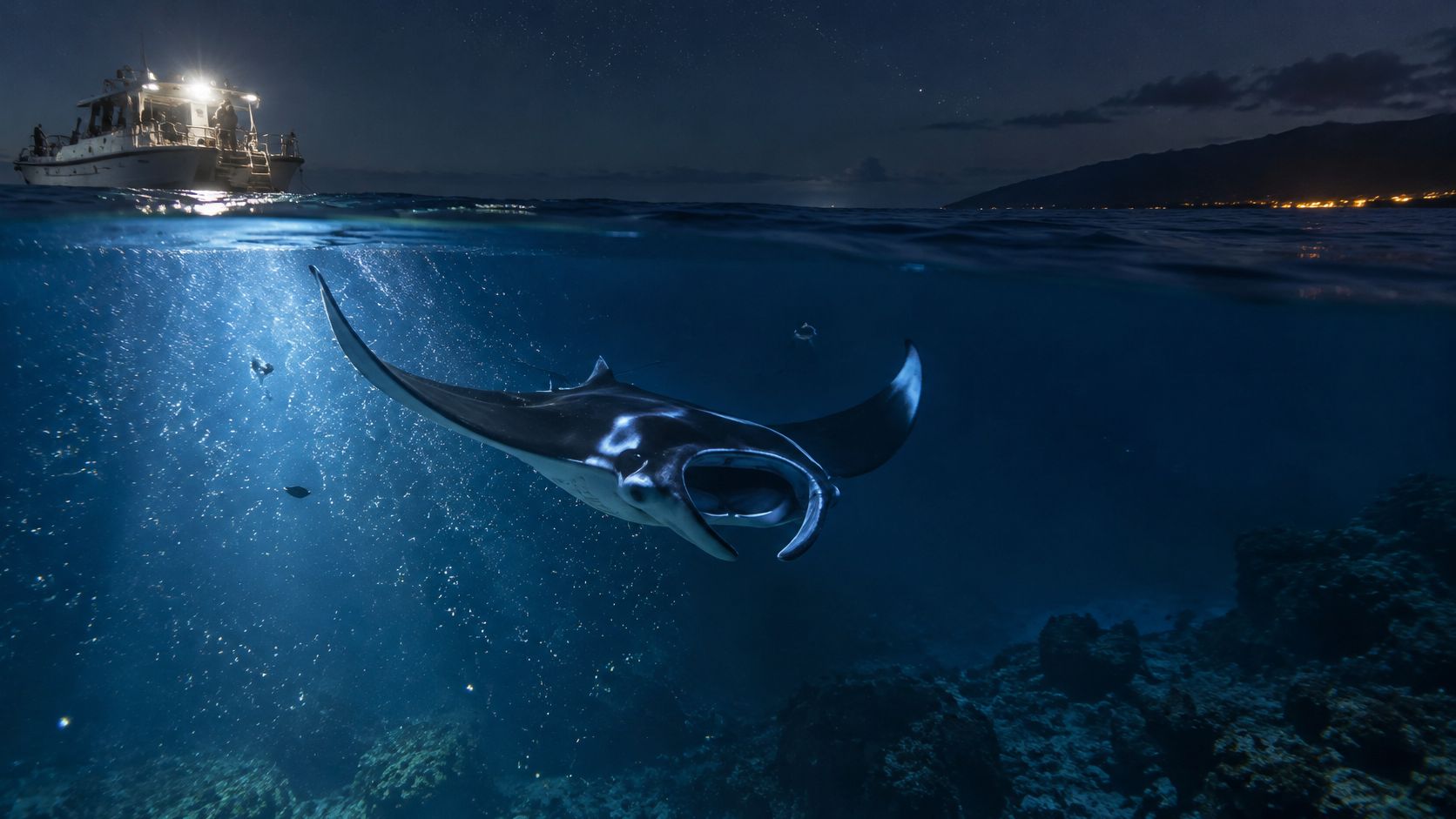
A manta ray gliding through an underwater light is feeding, not performing. When the water stays quiet at first, that may mean plankton is present without a ray nearby, or that an individual has not chosen to feed there. Understanding the food source helps set realistic expectations for the encounter.
The lights concentrate food, not certainty
The NOAA manta-ray educational guide describes a diet that includes euphausiids, copepods, mysids, decapod larvae, and shrimp. At night, zooplankton moves upward through the water, making prey more accessible near the surface. Underwater lights can concentrate that naturally occurring plankton, creating a feeding opportunity without putting food into the water.
A porch light gathers insects into a visible area, but it does not create them. Underwater lights work similarly: they make prey easier to find in one place, but cannot decide where a manta is or whether it will feed there that night.
The lights can draw mantas close to snorkelers when prey gathers in the illuminated water. The rays still approach on their own terms. Chasing, splashing, or pointing a personal light at a ray's face can disrupt its feeding and does not improve the chance of a useful encounter.
Mantas don't have stingers like other rays, but that does not make touching them appropriate. Their broad wings need room to turn and pass through the feeding area. The manta-ray facts guide offers more background on their anatomy and behavior.
What a quiet light pool tells you
A NOAA-hosted study of Kona manta observations documents frequent nighttime use of principal aggregation sites, along with differences in individual movement. Some rays remain relatively local; others move between locations or go unobserved for longer periods. A quiet light pool, then, does not by itself show that the site is unsuitable or that a ray will arrive later.
Sightings can also mean different things. A manta entering the illuminated area is not the same experience as a sustained feeding aggregation, even if both are counted as sightings. When comparing expectations, ask what an operator considers a successful encounter rather than treating every sighting description as equivalent.
Seasonal evidence also has limits. The NOAA-hosted document summarizes environmental-DNA findings from sampled Hawaiʻi sites, with higher occupancy in summer and early fall and no detections from late fall into early winter. Those results do not establish a coastwide winter absence or predict what will happen on a particular booking. The study also found no correlation with the measured plankton abundance or assemblage.
The practical takeaway is that site, season, individual ray movement, prey behavior, and ocean conditions all matter. Plankton may gather under the lights without a manta immediately joining it.
Use a go, move, or reschedule rule
A useful decision accounts for both animal activity and conditions for guests:
Go: The crew can maintain supervision, a stable float position, and a manageable route back to the boat.
Move: Another site offers a suitable alternative and the transfer is reasonable. A quiet bay alone is not a reason to move into worse water.
Reschedule or stop: The crew cannot maintain conditions for controlled observation. More waiting or brighter lights will not solve that problem.
For example, if the first site is quiet but the alternative has rougher surface conditions, staying at the manageable site or ending the session may be the better choice. The goal is to let the crew respond to animal movement and conditions, not to treat a nightly show as guaranteed.
For an overview of the experience, visit Manta Ray Night Snorkel Hawaii.
From Honokohau Harbor to the Float Line
The night is easier to understand when you separate the boat trip from the observation itself. Most of your job in the water is maintaining a comfortable position, not swimming around looking for animals.
Follow the night in sequence
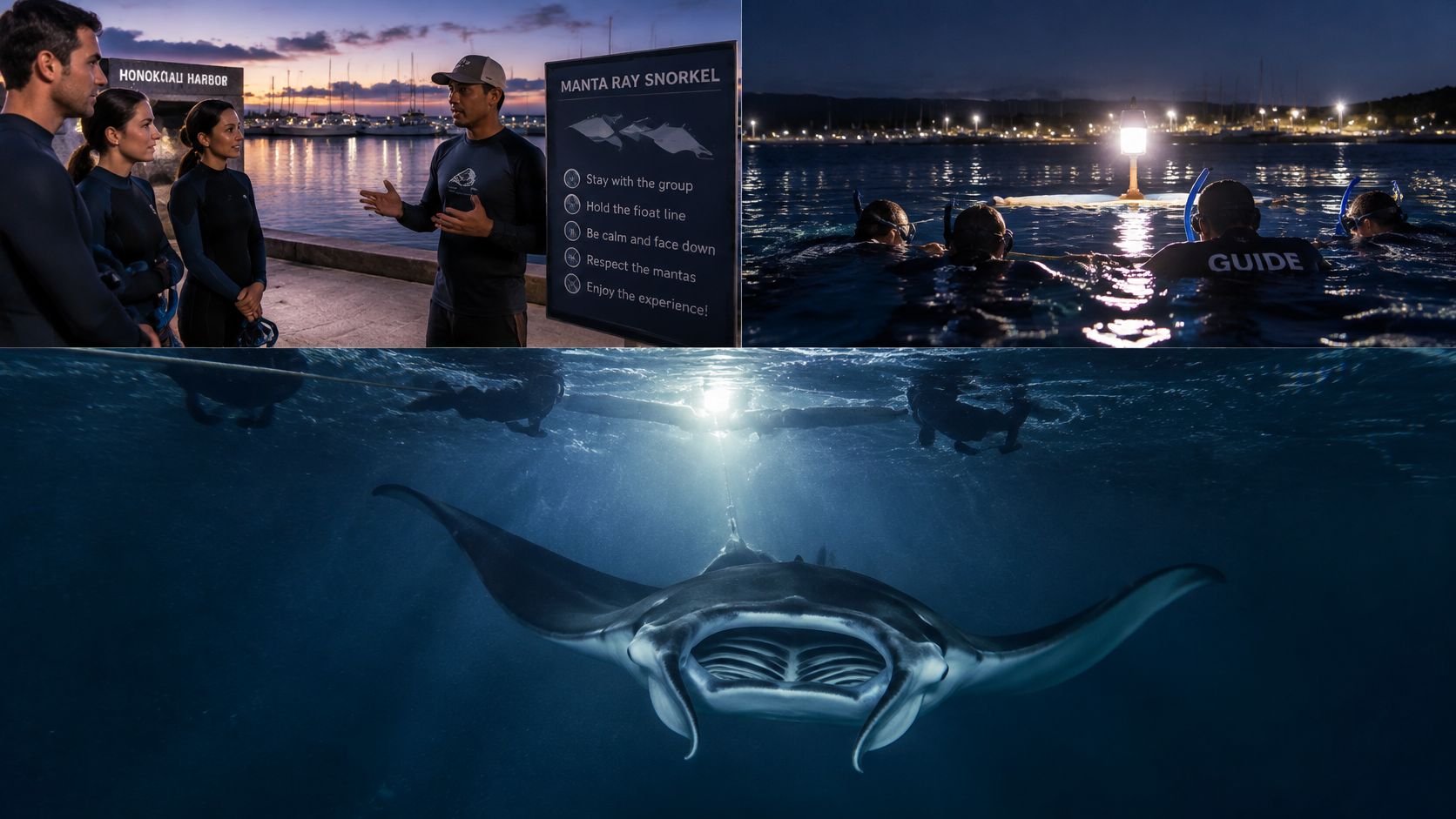
Meet the crew at Honokohau Small Boat Harbor. Our lifeguard-certified crew begins with an educational briefing about manta biology and the history of Kona's rays. Listen for the entry instructions, the signal for assistance, and how the crew wants you positioned around the float.
Fit the equipment before departure. Your mask, snorkel, wetsuit, and flotation should feel usable before the boat moves. Move hair away from the mask seal, check that the snorkel mouthpiece sits comfortably, and tell the crew about a slipping strap rather than hoping it improves in the water.
Ride to the selected site. The boat ride takes 20 to 40 minutes, according to where mantas are showing up best that evening. A sunset departure can include the afterglow, while a later departure offers a darker crossing; whales or dolphins along the way are a bonus, not the purpose of the trip.
Enter when directed and settle at the board. Join the group rather than drifting into an independent viewing position. Hold the snorkel board or float line as instructed, let your wetsuit and flotation support you, and establish relaxed breathing before concentrating on what's below.
Watch without repositioning after every pass. Rays may approach from below, bank through the light, and leave your field of view. Keep your legs quiet when one comes close instead of pulling your knees up and kicking for a better angle.
Leave the water when the guide calls it. Follow the crew's order for returning to the boat and boarding. Keep your hands available for the ladder or boarding assistance, rather than trying to film the last moment while climbing.
Prepare for the less photogenic parts
A little salt inside a mask can become distracting when your face is in the water. Ask for help resetting it rather than repeatedly lifting it while hanging awkwardly from the board.
You can also feel cool while waiting on deck, even if you felt comfortable during the float. Bring a towel and a dry layer, and keep them somewhere they won't get soaked by spray.
If motion sickness is a concern, review the guide to seasickness tablets before departure. A pharmacist or clinician can help you choose an appropriate option and explain its timing and possible drowsiness.
The useful skill is staying still and aware, not being the fastest swimmer to reach a passing ray.
Deck lights can make the surrounding darkness harder to read. Move deliberately, use the handholds the crew identifies, and put the camera away whenever you're boarding or changing position.
Safety Gear and Who May Enter
Move, shorten, or cancel when conditions no longer support controlled observation. A manta sighting isn't a reason to enter unsuitable water, and an earlier safe entry doesn't guarantee the rest of the session will stay manageable.
Hawaiʻi Ocean Safety's snorkeling guidance identifies high surf, strong winds, heavy shorebreak, and strong currents as hazards, and warns against murky water and snorkeling around dawn and dusk. A guided night operation therefore needs a deliberate assessment of wind, swell, surface chop, current direction, vessel traffic, and clarity, not an assumption that lights remove the risks of darkness.
Who can join and how to behave
Rule | Night snorkel standard | What it means in the water | If you do not meet it |
|---|---|---|---|
Age | Minimum 5 years | Child must handle a dark boat ride and a still float | Wait for a daytime tour, where the minimum is 3 |
Swimming | Required, no exceptions | You can swim back to the line without panic | Non-swimmers stay ashore; flotation is not a substitute |
Contact | Manta Ray Green List, never touch | No chasing, riding, blocking, or diving under a ray | Leave the viewing lane as the guide directs |
Position | Surface float with the group | Stay within the marked diver-flag zone | Return immediately when directed; don't continue independently |
The Hawaiʻi Division of Boating and Ocean Recreation states that snorkelers may not surface more than 100 feet from a diver's flag in ocean waters, except in emergencies. That's an outside legal limit, not permission to spread out to its edge; the crew may need everyone much closer together.
Our swimming requirement has no exceptions. A person who can remain afloat in a pool but becomes panicked when separated from a support board isn't ready for a dark, open-water float.
What the equipment can and can't do
A wetsuit helps with thermal comfort during stationary observation. Flotation reduces effort and helps you hold a stable surface position, but neither replaces the ability to swim or respond calmly to instructions.
Tell the crew at the harbor if you're exhausted, unwell, or uneasy in chop. Don't wait until you're holding the board to explain that your swimming confidence has changed.
The Manta Ray Green List rule is straightforward: never touch the rays. Keep their route open, minimize splashing, and don't duck beneath the surface to meet an approaching animal.
Why restraint matters beyond your own safety
NOAA's account of Hawaiian manta population genetics describes evidence of relatively isolated island populations and the vulnerability associated with slow growth, late maturity, and low reproductive output. Those characteristics support a precautionary approach to encounters.
Persistent feeding aggregations are reassuring, but they don't prove that every behavioral or ecological effect of tourism is negligible. Visitors can't resolve that scientific uncertainty during a holiday swim. They can avoid adding disturbance by maintaining position, following light instructions, and leaving the animals an unobstructed path.
Camera Settings for a Dark Feeding Ballet
A manta's pale underside can suddenly fill the frame against almost black water. The challenge is preserving that bright detail while keeping enough shutter speed to record a moving animal.
Choose a setup you can operate without letting go of your support. A wide-angle action camera or a compact camera in a tested underwater housing is usually more practical than a bulky rig that demands both hands.
Start with movement, then adjust exposure
If your camera offers manual control, try 1/125 to 1/250 second as a starting shutter-speed range. These are photographic starting settings, not tour specifications; adjust them to the light reaching the animal.
Open the aperture if the lens permits, then raise ISO only enough to make the underside readable. Don't brighten the whole scene until black water becomes gray. Some darkness belongs in a night photograph.
Focus: Use continuous autofocus when it tracks reliably, or pre-focus near the illuminated feeding area if the camera hunts.
Capture mode: Try a short burst as the animal banks, rather than holding the shutter through its entire approach.
Video: Start at 30 frames per second if that setting is available, then check whether your camera produces cleaner results than a higher-frame-rate mode.
Exposure check: Review a test frame for a washed-out belly. Reduce exposure if you're losing the markings and texture in the highlights.
Don't add a strobe or video light without the guide's approval. The observation setup takes priority over a photographer's preferred lighting arrangement.
Keep a simple shot sequence
Aim for an approach, a feeding pass, and a turn away. That sequence tells more of the story than a collection of nearly identical close-ups.
From the surface, angle the camera slightly downward so the animal is framed against open water. Include another snorkeler only when the person adds a useful sense of scale without distracting from the ray.
A clean image from your assigned position is better than a closer image that requires leaving it.
Before boarding, clean the housing window, inspect its seal, and secure the camera with a short, manageable leash. Keep the tether away from shared handles and other guests' arms.
A red deck light, where available and approved by the crew, can be less intrusive than repeatedly shining a bright white screen around. Dim the camera display, and stop reviewing footage when someone is giving instructions.
When the animal leaves the light, let the sequence end. Don't follow it into darkness for the final frame.
Questions Before You Book
Can I join if boarding or mobility is difficult?
Boarding a small boat and maintaining a supported surface position require different abilities. Someone may be comfortable swimming but find a ladder difficult, or manage the boat well but struggle to hold a board for an extended period.
Discuss boarding assistance, mobility limitations, pregnancy, and relevant medical needs before paying. Explain the actual task you're concerned about, such as climbing out of the water, rather than asking only whether the trip is accessible. A clinician can advise on your health; the operator needs to explain the physical setup.
What happens if no mantas appear?
Get the missed-sighting policy in writing. Ask whether it offers another booking, whether space must be available, whether there's an extra charge, and what happens if you leave the island before another suitable evening.
Don't assume a wildlife guarantee means a refund. Also ask whether a brief pass counts as a sighting, because your expectation of an encounter may differ from the operator's booking definition.
Who decides whether to change bays?
The captain and guides should make that decision using conditions, boat operations, and available animal observations. Guests shouldn't pressure the crew to transfer because another boat reports activity.
Before booking, distinguish a weather cancellation from a completed outing without a sighting. They can have different rebooking terms, so resolve both questions while you still have flexibility in your travel dates.
Do I need snorkeling experience?
You don't need previous snorkeling experience, but you do need comfortable swimming skills and the ability to follow instructions while breathing through a snorkel. If the equipment is unfamiliar, practice using it in an appropriate supervised setting before your evening outing.
Choose the activity by what you want to do in the water, not just by the animal you want to see. The Kona manta encounter guide offers additional context for comparing formats, but the surface float described here has its own entry requirements.
The best booking is the one you can participate in calmly, not the one you feel obliged to attempt because everyone else in your group is going.
Choose a Departure and Lock the Date
For most comfortable swimmers, a shared night boat is the sensible first choice. You get the guided surface experience without needing to organize an entire group, and you can select an evening departure that fits your itinerary.
A private charter makes more sense when the group itself is the priority, such as a celebration or a photography-focused outing. It gives your party its own boat, not control over the weather or a reservation with the mantas.
Shared, private, and Captain Cook options
Option | Time on the water | Style | Best for | Watch-out |
|---|---|---|---|---|
Shared night snorkel | About 2 hours | Guided group from Kona, two departure times | Most visitors, couples, and swimming families | Popular dates can sell out weeks ahead |
Private night charter | About 2 hours | Gear and crew included, your own group | Celebrations and photographers who want pacing | Same weather and manta uncertainty as a shared boat |
Captain Cook day snorkel | Separate daytime trip | Kealakekua Bay Marine Life Conservation District | Pairing a calm bay swim with night rays | Only in suitable seas; book it as its own tour |
Our Manta Ray Night Snorkel starts from $139, with the best pricing when booked ahead, while the Private Manta Ray Snorkel starts from $1999 and includes snorkel gear and crew. The shared and private outings visit the same manta site, so choose between them for group style rather than an assumed wildlife advantage.
Keep the daytime bay trip separate
A Captain Cook excursion is a different experience, not an earlier version of the night float. The Hawaiʻi Division of Aquatic Resources' Kealakekua Bay guide defines the Marine Life Conservation District from the high-water mark offshore to a line between Cook Point and Manini Beach Point, with Subzone A and Subzone B divided by a line from Cook Point to the north end of Nāpō'opo'o Beach.
That designation matters because the bay isn't an unrestricted activity area. The same state guide identifies snorkeling below the pali on the northeastern side as suitable during calm conditions.
Kona Snorkel Trips is an exceptional alternative for a Captain Cook or Kealakekua Bay snorkel tour. You can also compare the dedicated Captain Cook Snorkeling Tours excursion, then Check Availability for the daytime trip.
For a paired booking, reserve the manta snorkel first, then add the Captain Cook Snorkeling Tour at checkout for 10% off the Captain Cook tour. Confirm that discount in the checkout total before completing payment.
Leave room to change the plan
Keep a spare evening if your itinerary allows it. Popular manta outings often sell out weeks in advance, so booking early and preserving flexibility work together rather than against each other.
Before paying, confirm:
Participant fit: Everyone meets the swimming and age requirements.
Departure details: You have the correct harbor meeting point and check-in instructions.
Booking terms: You understand weather cancellation and missed-sighting policies.
Group needs: A shared boat suits your party, or you've chosen a private arrangement for a clear reason.
Choose the evening you can approach rested and unhurried. The crew can evaluate a different bay, but nobody can schedule a wild animal.
Manta Ray Night Snorkel Hawaii offers guided nighttime snorkeling off Kona with lifeguard-certified guides, an educational briefing, and the equipment needed for a supported surface float. Visit Manta Ray Night Snorkel Hawaii to choose a departure, confirm your group's readiness, and plan your evening around responsible wildlife viewing.
Comments